SUBSCRIBE TO OUR FREE NEWSLETTER
Daily news & progressive opinion—funded by the people, not the corporations—delivered straight to your inbox.
5
#000000
#FFFFFF
To donate by check, phone, or other method, see our More Ways to Give page.
Daily news & progressive opinion—funded by the people, not the corporations—delivered straight to your inbox.
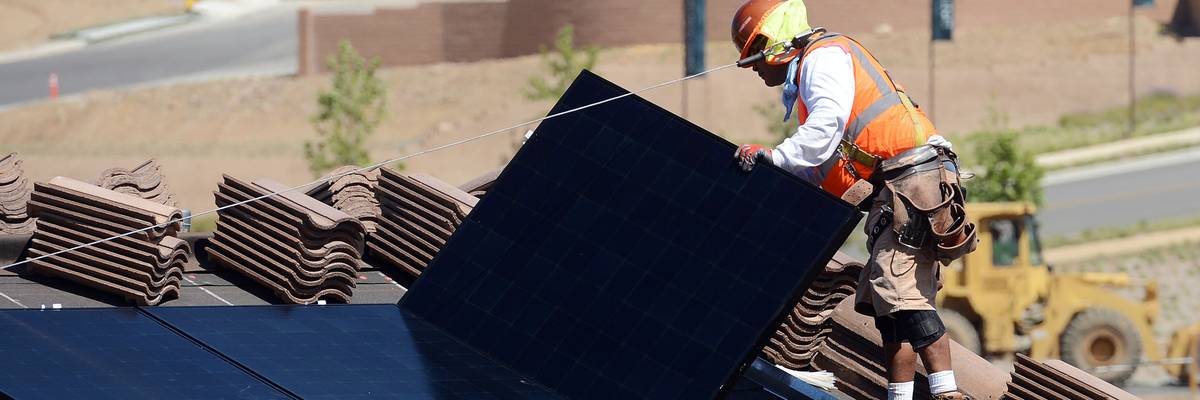
Workers install solar panels on the roofs of homes under construction south of Corona, California Thursday morning on May 3, 2018.
The way to avoid the evacuation of New Orleans—or a thousand follow-on horrors—is to move with desperate urgency to rebuild our energy system.
Our world seems to me to be moving very very fast these days—often that’s because of the feral energy of the Trump White House, feverishly trying to do the wrong thing on as many fronts as possible. In the last few cycles have come the news that that the White House is evicting bison herds from federal lands in Montana (a favor to ranchers, an insult to tribal leaders), approving fruit-flavored vapes (a favor to the big-donor vapor lobby, an insult to public health), and insisting that the Pope wants Iran to have a nuclear weapon (an insult to Catholics, a favor to his easily bruised ego). If the strategy is designed to wear us down, it’s definitely working on me.
But something else is moving fast too, and far more productively—that’s the ascension of new technologies. I don’t mean AI, which so far has had little impact on me and a generally dispiriting one on my fellow Americans, to judge from the polling; I mean the surging changes in clean tech, which are rewriting what’s possible in the course of months, even days.
Consider, for instance, the news from California. As I’ve noted before, the Golden State is suddenly supplying huge amounts of night-time energy from big grid-based batteries; basically, at night its running on stored sunshine. But the reporter Claire Barber, in an interview with grid expert Ed Smeloff, put a number on this Wednesday: California’s new batteries, installed over the last 36 months or so, are the equivalent of a dozen new nuclear power plants. If California had installed a dozen nukes in a couple of years, you’d know about it—indeed, the fate of its single reactor, at Diablo Canyon, has inspired thousands of articles, documentaries, protests, and counterprotests over the same stretch of time. But batteries are… metal boxes that pose no great threat. They just… work. Smeloff:
The most remarkable change in the California energy market has been the very rapid addition of grid-connected batteries and the use of those batteries to provide peak demand capacity. California is transitioning fairly quickly from using primarily natural gas resources to now using batteries. The batteries are [used] during the peak period, which is in the evening, typically around seven o’clock, producing as much as 40% of the peak capacity requirements. That’s a pretty remarkable achievement in a short period of time.
Bottom line, from Stanford’s Mark Jacobson on Tuesday: California using 61% less natural gas this year to generate electricity than it did three years ago.
There’s also the sudden advent of a slightly smaller class of batteries, ones that as Elizabeth Ouzts observes are:
designed to fill specific community needs and—due to their size—relatively quick and low-cost to build.
The Blue Ridge Power Agency, which serves a string of nonprofit utilities in central and western Virginia, is set to go live this summer with a collection of five batteries of about 5 megawatts each. The systems will help two rural electric co-ops and the city of Salem’s utility save money by storing power when it is cheap and abundant. They can then rely on that saved-up power when high demand on the grid spikes prices.
All in all, the projects are predicted to save the member utilities $100 million over the batteries’ 20-year lifespan, addressing long-held local concerns over rising costs.
And now move down one more order of magnitude, and consider the report, out Thursday morning, from the Rewiring America think tank, about how solar, battery, and heat pump technology have advanced so quickly that a few policy shifts could allow the electrification of almost every home in America, turning them into useful and affordable parts of a national energy infrastructure. (Good coverage from Catherine Boudreau here). Consider, say, what we could require of data centers. If some must be built, then force them to supply their own electricity—by buying heat pumps and solar panels for surrounding homes. It’s cheaper than building new supplies, and much much faster:
Hyperscalers are driving more than $100 billion per year into energy generation and infrastructure investment. Directing even a portion of that spending toward distributed energy resources could mobilize tens of billions of dollars for household energy upgrades. Hyperscaler investment in home energy upgrades would make such upgrades affordable for an additional 19 million households (increasing affordability from 30-58% of eligible households)—unlocking average lifetime savings of $9,400 per household.
Again—all this stuff is available right now. There are plenty of heat pumps and batteries; if Google wants a data center, it should be handing them out to the neighbors. And once they have, then all these homes can be easily knit together into virtual power plants (VPPs); as a new report from the good people at Pew points out:
Fully leveraging these existing and future Distributed Energy Resources through VPPs, including providing appropriate compensation for DER owners, could deliver power during peak demand at 40%-60% of the cost of traditional solutions.
And if you’re thinking—"Yeah, but policy changes come too slowly to matter in a polarized America," well, your cynicism is justified. But not entirely. The last few weeks have seen something remarkable, with legislative action happening at a speed I can’t quite recall. Everyone who participated in Sun Day last fall (and that’s many of you) helped launch a nationwide campaign for, among other things, balcony or plug-in solar. And that’s already bearing fruit: Just eight months later it’s passed legislatures in Virginia, Maine, Colorado, and Maryland. It’s through the Senate and the House in New Hampshire, and the Senate in New York, New Jersey, and Vermont, through the House (and late last night the Senate) in Connecticut and through committee in Massachusetts (in the latter two, its part of important larger omnibus solar bills). It’s also before committees in California, Illinois, and DC. This is a reminder that activism can (and must) move as fast as technology—before the spring is out, and despite serious opposition from utilities, we’ll have enough states to establish a firm American market for a technology that has swept through Europe in recent years. (Here’s a great account from my colleagues at Third Act Upstate NY on the kind of organizing that is producing these wins).
Meanwhile, the fossil fuel alternatives are… slow to appear. Dan Gearino has an excellent account of plans for a truly massive gas-fired power plant in Ohio, announced in March by the always classy Howard Lutnick as AC/DC’s Back in Black blared from the speakers. “We’re operating in Trump time,” he told the crowd ahead of the ceremonial groundbreaking. But Trump time sometimes means fantasy time:
“The whole thing doesn’t add up,” said Ric O’Connell, executive director of GridLab, a nonprofit that provides technical expertise on the electricity grid to policymakers and advocates.
O’Connell thinks the power plant’s high costs will make the project difficult to justify outside of a moment in which the Trump administration is seeking attention for big projects. Due to inflation on key components, the project would cost $3,586 per kilowatt, two to three times the cost of a combined-cycle gas plant two years ago.
“They’re just smiling and waving for the cameras, and then, as soon as Trump’s out of power, the [power plant is] going to get scaled way down or killed,” O’Connell said.
The clean energy build-out, of course, can’t come fast enough, because the climate crisis is pushing on inexorably. April saw the atmospheric level of carbon dioxide average 431 parts per million for the first time at the monitoring station in Mauna Loa (but don’t worry—Trump’s new budget zeroes out funding for the facility). A new report put a very human face on those statistics: As Oliver Milman reports, it found that the time may be coming to start thinking of the painful necessity to move people out of New Orleans, because climate change is in danger of putting it past a "point of no return":
Southern Louisiana is facing 3-7 metres of sea-level rise and the loss of three-quarters of its remaining coastal wetlands, which will cause the shoreline “to migrate as much as 100km (62 miles) inland”, thereby stranding New Orleans and Baton Rouge, according to the study, which compared today’s rising global temperatures with a period of similar heat 125,000 years ago that caused a rise in sea level.
This scenario makes the region the “most physically vulnerable coastal zone in the world”, the researchers state, and requires immediate action to prepare a smooth transition for people away from New Orleans, which has a population of about 360,000 people, to safer ground.
The way to avoid this—or a thousand follow-on horrors—is to move with desperate urgency to rebuild our energy system. That won’t end global warming—too late for that. But not too late to shave tenths of a degree off how hot the planet gets, and every tenth of a degree we raise the temperature moves a hundred million souls from a safe climate zone to a perilous one. Maybe New Orleans is in that next increment. Maybe your house. Someone’s house, that’s for sure. So speed, speed, speed.
Dear Common Dreams reader, It’s been nearly 30 years since I co-founded Common Dreams with my late wife, Lina Newhouser. We had the radical notion that journalism should serve the public good, not corporate profits. It was clear to us from the outset what it would take to build such a project. No paid advertisements. No corporate sponsors. No millionaire publisher telling us what to think or do. Many people said we wouldn't last a year, but we proved those doubters wrong. Together with a tremendous team of journalists and dedicated staff, we built an independent media outlet free from the constraints of profits and corporate control. Our mission has always been simple: To inform. To inspire. To ignite change for the common good. Building Common Dreams was not easy. Our survival was never guaranteed. When you take on the most powerful forces—Wall Street greed, fossil fuel industry destruction, Big Tech lobbyists, and uber-rich oligarchs who have spent billions upon billions rigging the economy and democracy in their favor—the only bulwark you have is supporters who believe in your work. But here’s the urgent message from me today. It's never been this bad out there. And it's never been this hard to keep us going. At the very moment Common Dreams is most needed, the threats we face are intensifying. We need your support now more than ever. We don't accept corporate advertising and never will. We don't have a paywall because we don't think people should be blocked from critical news based on their ability to pay. Everything we do is funded by the donations of readers like you. When everyone does the little they can afford, we are strong. But if that support retreats or dries up, so do we. Will you donate now to make sure Common Dreams not only survives but thrives? —Craig Brown, Co-founder |
Our world seems to me to be moving very very fast these days—often that’s because of the feral energy of the Trump White House, feverishly trying to do the wrong thing on as many fronts as possible. In the last few cycles have come the news that that the White House is evicting bison herds from federal lands in Montana (a favor to ranchers, an insult to tribal leaders), approving fruit-flavored vapes (a favor to the big-donor vapor lobby, an insult to public health), and insisting that the Pope wants Iran to have a nuclear weapon (an insult to Catholics, a favor to his easily bruised ego). If the strategy is designed to wear us down, it’s definitely working on me.
But something else is moving fast too, and far more productively—that’s the ascension of new technologies. I don’t mean AI, which so far has had little impact on me and a generally dispiriting one on my fellow Americans, to judge from the polling; I mean the surging changes in clean tech, which are rewriting what’s possible in the course of months, even days.
Consider, for instance, the news from California. As I’ve noted before, the Golden State is suddenly supplying huge amounts of night-time energy from big grid-based batteries; basically, at night its running on stored sunshine. But the reporter Claire Barber, in an interview with grid expert Ed Smeloff, put a number on this Wednesday: California’s new batteries, installed over the last 36 months or so, are the equivalent of a dozen new nuclear power plants. If California had installed a dozen nukes in a couple of years, you’d know about it—indeed, the fate of its single reactor, at Diablo Canyon, has inspired thousands of articles, documentaries, protests, and counterprotests over the same stretch of time. But batteries are… metal boxes that pose no great threat. They just… work. Smeloff:
The most remarkable change in the California energy market has been the very rapid addition of grid-connected batteries and the use of those batteries to provide peak demand capacity. California is transitioning fairly quickly from using primarily natural gas resources to now using batteries. The batteries are [used] during the peak period, which is in the evening, typically around seven o’clock, producing as much as 40% of the peak capacity requirements. That’s a pretty remarkable achievement in a short period of time.
Bottom line, from Stanford’s Mark Jacobson on Tuesday: California using 61% less natural gas this year to generate electricity than it did three years ago.
There’s also the sudden advent of a slightly smaller class of batteries, ones that as Elizabeth Ouzts observes are:
designed to fill specific community needs and—due to their size—relatively quick and low-cost to build.
The Blue Ridge Power Agency, which serves a string of nonprofit utilities in central and western Virginia, is set to go live this summer with a collection of five batteries of about 5 megawatts each. The systems will help two rural electric co-ops and the city of Salem’s utility save money by storing power when it is cheap and abundant. They can then rely on that saved-up power when high demand on the grid spikes prices.
All in all, the projects are predicted to save the member utilities $100 million over the batteries’ 20-year lifespan, addressing long-held local concerns over rising costs.
And now move down one more order of magnitude, and consider the report, out Thursday morning, from the Rewiring America think tank, about how solar, battery, and heat pump technology have advanced so quickly that a few policy shifts could allow the electrification of almost every home in America, turning them into useful and affordable parts of a national energy infrastructure. (Good coverage from Catherine Boudreau here). Consider, say, what we could require of data centers. If some must be built, then force them to supply their own electricity—by buying heat pumps and solar panels for surrounding homes. It’s cheaper than building new supplies, and much much faster:
Hyperscalers are driving more than $100 billion per year into energy generation and infrastructure investment. Directing even a portion of that spending toward distributed energy resources could mobilize tens of billions of dollars for household energy upgrades. Hyperscaler investment in home energy upgrades would make such upgrades affordable for an additional 19 million households (increasing affordability from 30-58% of eligible households)—unlocking average lifetime savings of $9,400 per household.
Again—all this stuff is available right now. There are plenty of heat pumps and batteries; if Google wants a data center, it should be handing them out to the neighbors. And once they have, then all these homes can be easily knit together into virtual power plants (VPPs); as a new report from the good people at Pew points out:
Fully leveraging these existing and future Distributed Energy Resources through VPPs, including providing appropriate compensation for DER owners, could deliver power during peak demand at 40%-60% of the cost of traditional solutions.
And if you’re thinking—"Yeah, but policy changes come too slowly to matter in a polarized America," well, your cynicism is justified. But not entirely. The last few weeks have seen something remarkable, with legislative action happening at a speed I can’t quite recall. Everyone who participated in Sun Day last fall (and that’s many of you) helped launch a nationwide campaign for, among other things, balcony or plug-in solar. And that’s already bearing fruit: Just eight months later it’s passed legislatures in Virginia, Maine, Colorado, and Maryland. It’s through the Senate and the House in New Hampshire, and the Senate in New York, New Jersey, and Vermont, through the House (and late last night the Senate) in Connecticut and through committee in Massachusetts (in the latter two, its part of important larger omnibus solar bills). It’s also before committees in California, Illinois, and DC. This is a reminder that activism can (and must) move as fast as technology—before the spring is out, and despite serious opposition from utilities, we’ll have enough states to establish a firm American market for a technology that has swept through Europe in recent years. (Here’s a great account from my colleagues at Third Act Upstate NY on the kind of organizing that is producing these wins).
Meanwhile, the fossil fuel alternatives are… slow to appear. Dan Gearino has an excellent account of plans for a truly massive gas-fired power plant in Ohio, announced in March by the always classy Howard Lutnick as AC/DC’s Back in Black blared from the speakers. “We’re operating in Trump time,” he told the crowd ahead of the ceremonial groundbreaking. But Trump time sometimes means fantasy time:
“The whole thing doesn’t add up,” said Ric O’Connell, executive director of GridLab, a nonprofit that provides technical expertise on the electricity grid to policymakers and advocates.
O’Connell thinks the power plant’s high costs will make the project difficult to justify outside of a moment in which the Trump administration is seeking attention for big projects. Due to inflation on key components, the project would cost $3,586 per kilowatt, two to three times the cost of a combined-cycle gas plant two years ago.
“They’re just smiling and waving for the cameras, and then, as soon as Trump’s out of power, the [power plant is] going to get scaled way down or killed,” O’Connell said.
The clean energy build-out, of course, can’t come fast enough, because the climate crisis is pushing on inexorably. April saw the atmospheric level of carbon dioxide average 431 parts per million for the first time at the monitoring station in Mauna Loa (but don’t worry—Trump’s new budget zeroes out funding for the facility). A new report put a very human face on those statistics: As Oliver Milman reports, it found that the time may be coming to start thinking of the painful necessity to move people out of New Orleans, because climate change is in danger of putting it past a "point of no return":
Southern Louisiana is facing 3-7 metres of sea-level rise and the loss of three-quarters of its remaining coastal wetlands, which will cause the shoreline “to migrate as much as 100km (62 miles) inland”, thereby stranding New Orleans and Baton Rouge, according to the study, which compared today’s rising global temperatures with a period of similar heat 125,000 years ago that caused a rise in sea level.
This scenario makes the region the “most physically vulnerable coastal zone in the world”, the researchers state, and requires immediate action to prepare a smooth transition for people away from New Orleans, which has a population of about 360,000 people, to safer ground.
The way to avoid this—or a thousand follow-on horrors—is to move with desperate urgency to rebuild our energy system. That won’t end global warming—too late for that. But not too late to shave tenths of a degree off how hot the planet gets, and every tenth of a degree we raise the temperature moves a hundred million souls from a safe climate zone to a perilous one. Maybe New Orleans is in that next increment. Maybe your house. Someone’s house, that’s for sure. So speed, speed, speed.
Our world seems to me to be moving very very fast these days—often that’s because of the feral energy of the Trump White House, feverishly trying to do the wrong thing on as many fronts as possible. In the last few cycles have come the news that that the White House is evicting bison herds from federal lands in Montana (a favor to ranchers, an insult to tribal leaders), approving fruit-flavored vapes (a favor to the big-donor vapor lobby, an insult to public health), and insisting that the Pope wants Iran to have a nuclear weapon (an insult to Catholics, a favor to his easily bruised ego). If the strategy is designed to wear us down, it’s definitely working on me.
But something else is moving fast too, and far more productively—that’s the ascension of new technologies. I don’t mean AI, which so far has had little impact on me and a generally dispiriting one on my fellow Americans, to judge from the polling; I mean the surging changes in clean tech, which are rewriting what’s possible in the course of months, even days.
Consider, for instance, the news from California. As I’ve noted before, the Golden State is suddenly supplying huge amounts of night-time energy from big grid-based batteries; basically, at night its running on stored sunshine. But the reporter Claire Barber, in an interview with grid expert Ed Smeloff, put a number on this Wednesday: California’s new batteries, installed over the last 36 months or so, are the equivalent of a dozen new nuclear power plants. If California had installed a dozen nukes in a couple of years, you’d know about it—indeed, the fate of its single reactor, at Diablo Canyon, has inspired thousands of articles, documentaries, protests, and counterprotests over the same stretch of time. But batteries are… metal boxes that pose no great threat. They just… work. Smeloff:
The most remarkable change in the California energy market has been the very rapid addition of grid-connected batteries and the use of those batteries to provide peak demand capacity. California is transitioning fairly quickly from using primarily natural gas resources to now using batteries. The batteries are [used] during the peak period, which is in the evening, typically around seven o’clock, producing as much as 40% of the peak capacity requirements. That’s a pretty remarkable achievement in a short period of time.
Bottom line, from Stanford’s Mark Jacobson on Tuesday: California using 61% less natural gas this year to generate electricity than it did three years ago.
There’s also the sudden advent of a slightly smaller class of batteries, ones that as Elizabeth Ouzts observes are:
designed to fill specific community needs and—due to their size—relatively quick and low-cost to build.
The Blue Ridge Power Agency, which serves a string of nonprofit utilities in central and western Virginia, is set to go live this summer with a collection of five batteries of about 5 megawatts each. The systems will help two rural electric co-ops and the city of Salem’s utility save money by storing power when it is cheap and abundant. They can then rely on that saved-up power when high demand on the grid spikes prices.
All in all, the projects are predicted to save the member utilities $100 million over the batteries’ 20-year lifespan, addressing long-held local concerns over rising costs.
And now move down one more order of magnitude, and consider the report, out Thursday morning, from the Rewiring America think tank, about how solar, battery, and heat pump technology have advanced so quickly that a few policy shifts could allow the electrification of almost every home in America, turning them into useful and affordable parts of a national energy infrastructure. (Good coverage from Catherine Boudreau here). Consider, say, what we could require of data centers. If some must be built, then force them to supply their own electricity—by buying heat pumps and solar panels for surrounding homes. It’s cheaper than building new supplies, and much much faster:
Hyperscalers are driving more than $100 billion per year into energy generation and infrastructure investment. Directing even a portion of that spending toward distributed energy resources could mobilize tens of billions of dollars for household energy upgrades. Hyperscaler investment in home energy upgrades would make such upgrades affordable for an additional 19 million households (increasing affordability from 30-58% of eligible households)—unlocking average lifetime savings of $9,400 per household.
Again—all this stuff is available right now. There are plenty of heat pumps and batteries; if Google wants a data center, it should be handing them out to the neighbors. And once they have, then all these homes can be easily knit together into virtual power plants (VPPs); as a new report from the good people at Pew points out:
Fully leveraging these existing and future Distributed Energy Resources through VPPs, including providing appropriate compensation for DER owners, could deliver power during peak demand at 40%-60% of the cost of traditional solutions.
And if you’re thinking—"Yeah, but policy changes come too slowly to matter in a polarized America," well, your cynicism is justified. But not entirely. The last few weeks have seen something remarkable, with legislative action happening at a speed I can’t quite recall. Everyone who participated in Sun Day last fall (and that’s many of you) helped launch a nationwide campaign for, among other things, balcony or plug-in solar. And that’s already bearing fruit: Just eight months later it’s passed legislatures in Virginia, Maine, Colorado, and Maryland. It’s through the Senate and the House in New Hampshire, and the Senate in New York, New Jersey, and Vermont, through the House (and late last night the Senate) in Connecticut and through committee in Massachusetts (in the latter two, its part of important larger omnibus solar bills). It’s also before committees in California, Illinois, and DC. This is a reminder that activism can (and must) move as fast as technology—before the spring is out, and despite serious opposition from utilities, we’ll have enough states to establish a firm American market for a technology that has swept through Europe in recent years. (Here’s a great account from my colleagues at Third Act Upstate NY on the kind of organizing that is producing these wins).
Meanwhile, the fossil fuel alternatives are… slow to appear. Dan Gearino has an excellent account of plans for a truly massive gas-fired power plant in Ohio, announced in March by the always classy Howard Lutnick as AC/DC’s Back in Black blared from the speakers. “We’re operating in Trump time,” he told the crowd ahead of the ceremonial groundbreaking. But Trump time sometimes means fantasy time:
“The whole thing doesn’t add up,” said Ric O’Connell, executive director of GridLab, a nonprofit that provides technical expertise on the electricity grid to policymakers and advocates.
O’Connell thinks the power plant’s high costs will make the project difficult to justify outside of a moment in which the Trump administration is seeking attention for big projects. Due to inflation on key components, the project would cost $3,586 per kilowatt, two to three times the cost of a combined-cycle gas plant two years ago.
“They’re just smiling and waving for the cameras, and then, as soon as Trump’s out of power, the [power plant is] going to get scaled way down or killed,” O’Connell said.
The clean energy build-out, of course, can’t come fast enough, because the climate crisis is pushing on inexorably. April saw the atmospheric level of carbon dioxide average 431 parts per million for the first time at the monitoring station in Mauna Loa (but don’t worry—Trump’s new budget zeroes out funding for the facility). A new report put a very human face on those statistics: As Oliver Milman reports, it found that the time may be coming to start thinking of the painful necessity to move people out of New Orleans, because climate change is in danger of putting it past a "point of no return":
Southern Louisiana is facing 3-7 metres of sea-level rise and the loss of three-quarters of its remaining coastal wetlands, which will cause the shoreline “to migrate as much as 100km (62 miles) inland”, thereby stranding New Orleans and Baton Rouge, according to the study, which compared today’s rising global temperatures with a period of similar heat 125,000 years ago that caused a rise in sea level.
This scenario makes the region the “most physically vulnerable coastal zone in the world”, the researchers state, and requires immediate action to prepare a smooth transition for people away from New Orleans, which has a population of about 360,000 people, to safer ground.
The way to avoid this—or a thousand follow-on horrors—is to move with desperate urgency to rebuild our energy system. That won’t end global warming—too late for that. But not too late to shave tenths of a degree off how hot the planet gets, and every tenth of a degree we raise the temperature moves a hundred million souls from a safe climate zone to a perilous one. Maybe New Orleans is in that next increment. Maybe your house. Someone’s house, that’s for sure. So speed, speed, speed.