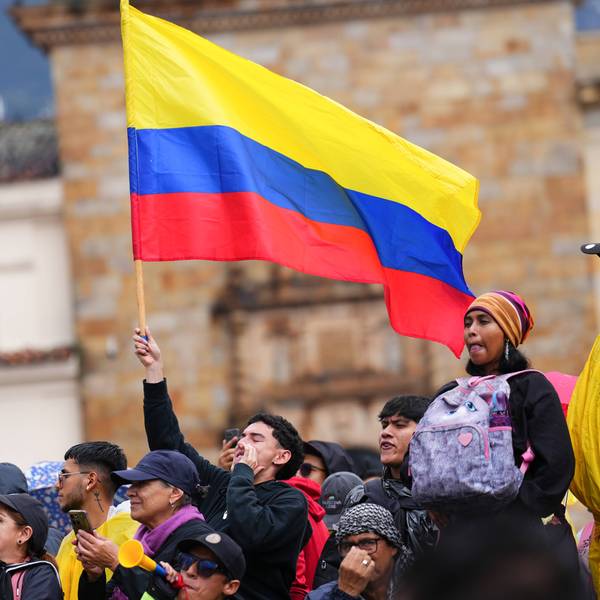
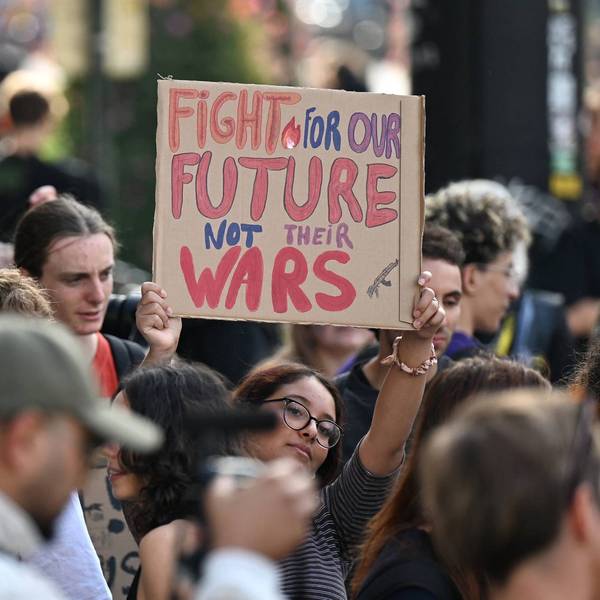
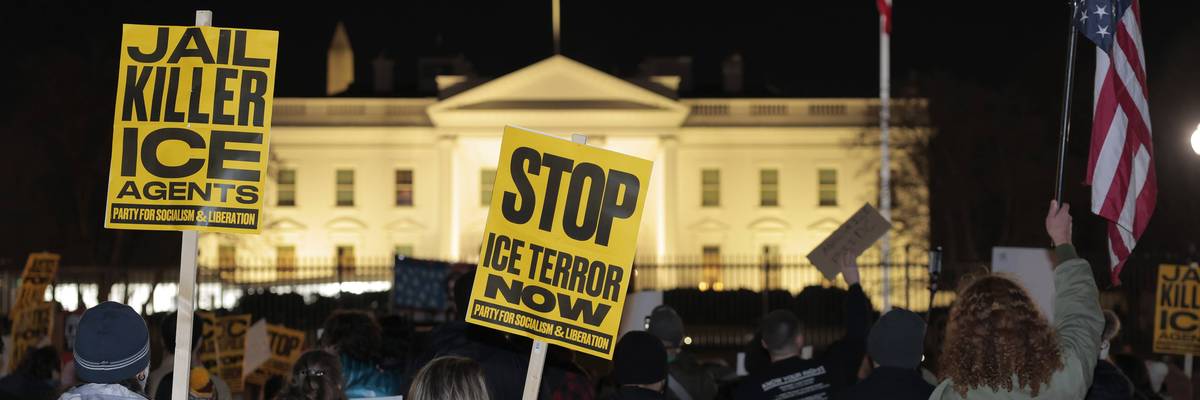
Protesters gather in front of the White House during a protest against the shooting death of Renee Nicole Good on January 8, 2026 in Washington, DC.
From Venezuela to Minneapolis, Protest Matters—Keep It Up!
More public pressure can blunt the Trump administration’s authoritarian ambitions.
Running a news weekly as I do, it’s always interesting to watch the narrative around developing stories that I might comment on as a journalist change quickly over days or even hours. Such is the case with two big national and international stories of great interest to many American citizens and residents this week: the capture of Venezuelan President Nicholas Maduro by the US military under orders from President Donald Trump and the killing of Renee Nicole Good by an Immigration and Customs Enforcement agent (now identified as Jonathan Ross) in Minneapolis.
As more information pours in, both stories are changing by the minute at this point. We’ve seen the White House excitedly claim credit for a successful military action in Venezuela on Saturday that may turn out to have been more of a diplomatic and intelligence “win” than anything else, but the Senate just advanced a bipartisan measure to invoke the War Powers Act to block Trump from “using military force ‘within or against Venezuela’ unless he gets prior approval from Congress.”
Does the Senate vote mean that Trump, his administration, and their oil company cronies aren’t getting what they want from the country with the world’s largest oil reserves? No, they probably are for the time being, but it’s fascinating that five Republican senators crossed the aisle to vote with 47 Democrats, including conservative Dems like Sen. John Fetterman of Pennsylvania, to attempt to restrict presidential power. A clear result of public pressure on the pols to rein in executive authority.
After the tragic Minneapolis shooting, the immediate reaction of tens of thousands of people there and around the country, including here in Boston, was to get out in the street to protest. And Trump has been immediately and roundly condemned for being far too quick to declare the fatal shooting of a person who may have had nothing to do with the small anti-ICE protest on a residential block to be some kind of act of self-defense by an armed government agent against a “professional agitator.” On Thursday, Trump already began backing off his rhetoric under pressure from the public, the press, and the evidence of multiple videos from the scene to lamely say that the shooting victim “behaved horribly.”
I suggest that readers who are unhappy with the Trump administration get out in the streets and protest as often as possible.
Does this mean that anyone has a perfect understanding of either event at this juncture? No. Is every protest acting on the most solid information available. Also no.
But do I think that people protesting presidential overreach in the name of democracy are right to listen to their instincts about the actions taken by the US military in Venezuela and ICE in Minneapolis at the behest of the Trump administration?
Absolutely yes.
Such protest, as usual, is all over the road politically and otherwise. It’s messy. It’s emotional. It gets some things wrong or even misses forests for trees at times. Yet it’s the right thing to do. And it is working. Trump and his allies have not consolidated unlimited power. Far from it. The MAGA movement is fragmenting and the administration is under pressure from many directions.
In such an environment, the president needs as much of the public on his side as possible—with polls showing his popularity has been on the downswing for months.
So I suggest that readers who are unhappy with the Trump administration get out in the streets and protest as often as possible. Your actions won’t solve all of our fragmented nation’s problems and won’t make the Democrats into an actual opposition force. But they may well stop the US from becoming a tinpot dictatorship like the ones previous governments have forced on so many other countries in the Americas and create openings for the construction of a genuinely democratic opposition movement.
Which would be as good an outcome as we might hope for at the moment.
The original version of this article ran on January 8, 2026 at BINJ.News
We are at a crossroads
This country and this world are at a monumental crossroads. In a few short weeks, US voters will have an opportunity to beat back the forces of fascism and confront the billionaires who are rigging the economy, our media system, and our democracy, making it increasingly impossible for ordinary people to get by. We’re not just talking about the election. We’re talking about what must be done once these fascist elements are vanquished from power. We need a bolder set of solutions than what either major party has so far been willing to offer and a working-class movement ready to fight like hell for it. Trump didn't emerge from nowhere. The conditions that fueled MAGA authoritarianism were created by decades of radical neoliberal economic policies and a corrupt political system dominated by corporate interests. They slashed taxes on the super-rich, promising that the benefits would trickle down. They said giveaways to the corporate titans would make life more affordable for the rest of us. It was all bullshit. And when a bitter, betrayed populace searches for someone to blame, right-wing demagogues have little trouble finding scapegoats. People know when they're being lied to, but you won't hear any of this from the corporate media. Only independent journalism—powered and funded by people who believe in building a better world—can deliver truly trustworthy daily news. Our Fall Campaign is underway, and we need your help. To power our newsroom through the rest of the year, we need to raise $125,000 by midnight on October 31. So if you share our vision, please contribute whatever you can to sustain our work. |
Running a news weekly as I do, it’s always interesting to watch the narrative around developing stories that I might comment on as a journalist change quickly over days or even hours. Such is the case with two big national and international stories of great interest to many American citizens and residents this week: the capture of Venezuelan President Nicholas Maduro by the US military under orders from President Donald Trump and the killing of Renee Nicole Good by an Immigration and Customs Enforcement agent (now identified as Jonathan Ross) in Minneapolis.
As more information pours in, both stories are changing by the minute at this point. We’ve seen the White House excitedly claim credit for a successful military action in Venezuela on Saturday that may turn out to have been more of a diplomatic and intelligence “win” than anything else, but the Senate just advanced a bipartisan measure to invoke the War Powers Act to block Trump from “using military force ‘within or against Venezuela’ unless he gets prior approval from Congress.”
Does the Senate vote mean that Trump, his administration, and their oil company cronies aren’t getting what they want from the country with the world’s largest oil reserves? No, they probably are for the time being, but it’s fascinating that five Republican senators crossed the aisle to vote with 47 Democrats, including conservative Dems like Sen. John Fetterman of Pennsylvania, to attempt to restrict presidential power. A clear result of public pressure on the pols to rein in executive authority.
After the tragic Minneapolis shooting, the immediate reaction of tens of thousands of people there and around the country, including here in Boston, was to get out in the street to protest. And Trump has been immediately and roundly condemned for being far too quick to declare the fatal shooting of a person who may have had nothing to do with the small anti-ICE protest on a residential block to be some kind of act of self-defense by an armed government agent against a “professional agitator.” On Thursday, Trump already began backing off his rhetoric under pressure from the public, the press, and the evidence of multiple videos from the scene to lamely say that the shooting victim “behaved horribly.”
I suggest that readers who are unhappy with the Trump administration get out in the streets and protest as often as possible.
Does this mean that anyone has a perfect understanding of either event at this juncture? No. Is every protest acting on the most solid information available. Also no.
But do I think that people protesting presidential overreach in the name of democracy are right to listen to their instincts about the actions taken by the US military in Venezuela and ICE in Minneapolis at the behest of the Trump administration?
Absolutely yes.
Such protest, as usual, is all over the road politically and otherwise. It’s messy. It’s emotional. It gets some things wrong or even misses forests for trees at times. Yet it’s the right thing to do. And it is working. Trump and his allies have not consolidated unlimited power. Far from it. The MAGA movement is fragmenting and the administration is under pressure from many directions.
In such an environment, the president needs as much of the public on his side as possible—with polls showing his popularity has been on the downswing for months.
So I suggest that readers who are unhappy with the Trump administration get out in the streets and protest as often as possible. Your actions won’t solve all of our fragmented nation’s problems and won’t make the Democrats into an actual opposition force. But they may well stop the US from becoming a tinpot dictatorship like the ones previous governments have forced on so many other countries in the Americas and create openings for the construction of a genuinely democratic opposition movement.
Which would be as good an outcome as we might hope for at the moment.
The original version of this article ran on January 8, 2026 at BINJ.News
- Trump Embraces Big Oil and Empire After Kidnapping Venezuela’s President ›
- Trump’s Regime Change War on Venezuela is Patently Illegal ›
- Trump’s Venezuela Regime Change Attempt an Illegal Act of War ›
- 'ICE Has Gone Rogue': Ro Khanna Demands Accountability As New Videos Show Minneapolis Chaos | Common Dreams ›
Running a news weekly as I do, it’s always interesting to watch the narrative around developing stories that I might comment on as a journalist change quickly over days or even hours. Such is the case with two big national and international stories of great interest to many American citizens and residents this week: the capture of Venezuelan President Nicholas Maduro by the US military under orders from President Donald Trump and the killing of Renee Nicole Good by an Immigration and Customs Enforcement agent (now identified as Jonathan Ross) in Minneapolis.
As more information pours in, both stories are changing by the minute at this point. We’ve seen the White House excitedly claim credit for a successful military action in Venezuela on Saturday that may turn out to have been more of a diplomatic and intelligence “win” than anything else, but the Senate just advanced a bipartisan measure to invoke the War Powers Act to block Trump from “using military force ‘within or against Venezuela’ unless he gets prior approval from Congress.”
Does the Senate vote mean that Trump, his administration, and their oil company cronies aren’t getting what they want from the country with the world’s largest oil reserves? No, they probably are for the time being, but it’s fascinating that five Republican senators crossed the aisle to vote with 47 Democrats, including conservative Dems like Sen. John Fetterman of Pennsylvania, to attempt to restrict presidential power. A clear result of public pressure on the pols to rein in executive authority.
After the tragic Minneapolis shooting, the immediate reaction of tens of thousands of people there and around the country, including here in Boston, was to get out in the street to protest. And Trump has been immediately and roundly condemned for being far too quick to declare the fatal shooting of a person who may have had nothing to do with the small anti-ICE protest on a residential block to be some kind of act of self-defense by an armed government agent against a “professional agitator.” On Thursday, Trump already began backing off his rhetoric under pressure from the public, the press, and the evidence of multiple videos from the scene to lamely say that the shooting victim “behaved horribly.”
I suggest that readers who are unhappy with the Trump administration get out in the streets and protest as often as possible.
Does this mean that anyone has a perfect understanding of either event at this juncture? No. Is every protest acting on the most solid information available. Also no.
But do I think that people protesting presidential overreach in the name of democracy are right to listen to their instincts about the actions taken by the US military in Venezuela and ICE in Minneapolis at the behest of the Trump administration?
Absolutely yes.
Such protest, as usual, is all over the road politically and otherwise. It’s messy. It’s emotional. It gets some things wrong or even misses forests for trees at times. Yet it’s the right thing to do. And it is working. Trump and his allies have not consolidated unlimited power. Far from it. The MAGA movement is fragmenting and the administration is under pressure from many directions.
In such an environment, the president needs as much of the public on his side as possible—with polls showing his popularity has been on the downswing for months.
So I suggest that readers who are unhappy with the Trump administration get out in the streets and protest as often as possible. Your actions won’t solve all of our fragmented nation’s problems and won’t make the Democrats into an actual opposition force. But they may well stop the US from becoming a tinpot dictatorship like the ones previous governments have forced on so many other countries in the Americas and create openings for the construction of a genuinely democratic opposition movement.
Which would be as good an outcome as we might hope for at the moment.
The original version of this article ran on January 8, 2026 at BINJ.News
- Trump Embraces Big Oil and Empire After Kidnapping Venezuela’s President ›
- Trump’s Regime Change War on Venezuela is Patently Illegal ›
- Trump’s Venezuela Regime Change Attempt an Illegal Act of War ›
- 'ICE Has Gone Rogue': Ro Khanna Demands Accountability As New Videos Show Minneapolis Chaos | Common Dreams ›