SUBSCRIBE TO OUR FREE NEWSLETTER
Daily news & progressive opinion—funded by the people, not the corporations—delivered straight to your inbox.
5
#000000
#FFFFFF
To donate by check, phone, or other method, see our More Ways to Give page.
Daily news & progressive opinion—funded by the people, not the corporations—delivered straight to your inbox.
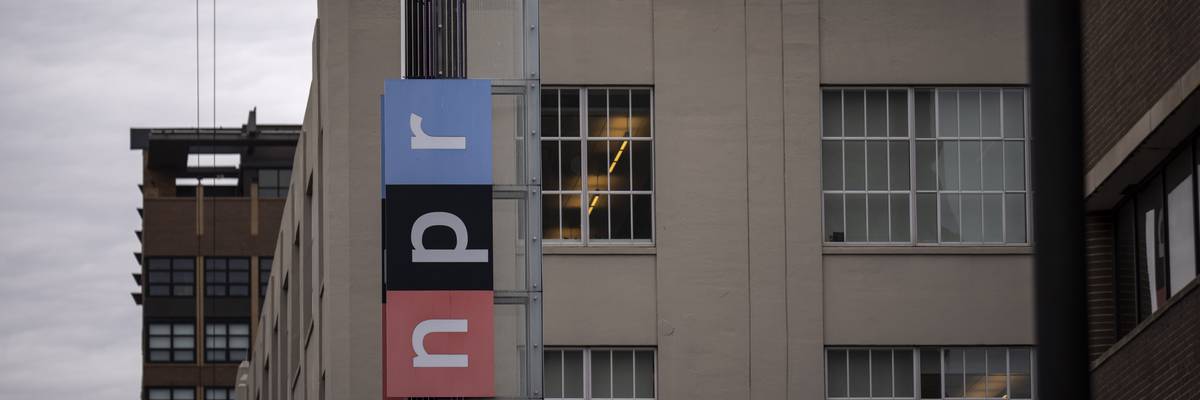
A view of the National Public Radio headquarters on North Capitol Street on February 22, 2023 in Washington, DC.
There is so much that National Public Radio could do to make itself better and raise the expectations of its listening audience.
The reasons Congress created NPR, or National Public Radio, under the Nixon administration were to fill the yawning gaps of commercial radio in local, national, and international news coverage and to give voice to the people without the censorship that comes from advertisers. It was to be publicly funded by taxpayers. Almost 55 years later, NPR is now funded heavily by large corporations. NPR’s local affiliates solicit local business advertisements and grants from local corporations. President Donald Trump has cut out NPR’s small federal subsidy, further increasing its dependence on commercial funding.
Resolution One: Apart from excellent features around the country and the world, NPR should give voice to what civic groups are doing to improve our country locally and nationally. NPR is heavy on entertainment and coverage of entertainers. It needs to fill some of its airtime with news about the bedrock civic community in America. The imbalance is serious from the national to the local. NPR anchors regularly ignore calls by civic leaders requesting discussions about this exclusion.
Resolution Two: NPR has featured many reports and interviews on race but needs far more focus on class. Class exploitation of the poor and working class by the rich and powerful corporate supremacists feeds racial discrimination. The euphemism used is “inequality,” but corporate-bred crime, fraud, and abuse affect all people indiscriminately, which often disproportionately harms minorities. A result of the gross imbalance of time devoted to race and not to class is that indiscriminate injustice is mostly ignored.
Over 60 million poor whites in our country, if they even bothered to listen to NPR, might ask, “What About Us?”
NPR often focuses on racial plights without going to the sources of race- (and class-) based harms from commercial greed. Redlining, exploitation of tenants, lower pay (average hourly wages for Black and Hispanic men are substantially lower than those of white men), substandard healthcare, rampant overcharging of the poor (recall the book The Poor Pay More: Consumer Practices of Low-Income Families by David Caplovitz), greater difficulty getting loans, and discrimination against upward mobility to corporate executive ranks are some examples of systemic commercialism fueling systemic racism.
NPR’s collateral benefit from this inattention is that business advertisers large and small love NPR and its affiliates. This is especially the case for corporations with bad records, which crave NPR’s asserted prestige. NPR should reject ads from disreputable or criminal corporations.
Resolution Three: Stop mimicking commercial radio. NPR’s three-minute news segments on the hour often don’t even match the mediocre quality of CBS Radio’s choice of topics. For example, why, in 2023, were tennis star Novak Djokovic’s visa problems in Australia at the top of NPR news day after day? As for commercials, NPR stretches the envelope, airing, with its affiliates, as many as 30 ads per hour! Imagine the audience irritation. How many times do we have to hear each hour, “NPR is supported by XYZ corporation”? NPR gives abundant repetitive ad time to the same few advertisers that one wonders whether they are assured of exclusivity vis-a-vis competitors. Moreover, NPR starts the evening program "Marketplace" with ads, which even the commercial networks do not do.
Your listeners want you to decongest your programming from ads. And some may want to know why you haven’t, given the decades you have largely given up on reversing the relative decline of congressional appropriations. You give ample time to loud right-wingers and right-wing causes. Why aren’t you gaining bipartisan support for more congressional funding?
Resolution Four: Compress the weather forecasts. Back in 1970-1971, Congress knew that commercial radio stations gave plenty of time to weather, traffic, sports, and music. That is still true. So why does WAMC in Albany, an NPR local affiliate, have such lengthy forecasts, some starting with the West Coast, with ludicrous repetition for adjacent areas? WAMC is above average, with full-time staff covering local and state governments and candidates for public office.
Resolution Five: NPR should re-evaluate its music policy. NPR’s affiliates take their weekends seriously, so much so that they take off right at 6:00 p.m. on Saturday and Sunday evenings. Let the listeners hear music for the rest of the time, as if the world stops then.
Also, musical intervals are often too long, inappropriate for their context, and foolishly interjected. NPR’s evening program Marketplace, anchored by jumping-jack Kai Ryssdal, illustrates these observations. Even while he is rapidly giving the stock market numbers, there is background music loud enough to be considered foreground.
Resolution Six: Reconsider the uniform formulaics shackling your reporters. They respond to the anchor’s inquiry with a zigzag between their sound bites and corroborating sound bites from consulting firms, think tanks, and academic commentators. This model has a tedious staccato ring to it, especially since the reporters often, by way of their introduction, repeat what the interviewees are going to say.
Resolution Seven: Correct or explain your major faux pas. NPR staff need tutorials on the constitutional authority of Congress. NPR needed to explain immediately to its listeners why, with all that staff in Washington, DC, it took about 90 minutes (or until about 3:30 pm) to start telling its affiliates about the January 6, 2021 violent assault on Congress. Commercial CNN and other commercial media started reporting no later than 2:00 pm that fateful day. “And that’s not the only time NPR has messed up,” said one reporter for WAMC (that annually pays NPR $1 million for NPR programming).
Resolution Eight: Give your public editor, Kelly McBride, a regular public time slot to discuss her insights, presently communicated mostly internally, and to address serious feedback from your listeners about NPR’s broadcasting flaws. For example, NPR has broadcast Trump’s soundbite blatant lies without pointing out that they are false. The New York Times and Washington Post frequently advise their readers that such statements by Trump are false. (Local affiliates invite political opinions, personal development, and "how to" questions on related shows).
Ms. McBride could share the program with NPR’s CEO–a position more remote from the NPR public every decade. Hear ye, Katherine Maher! Among other benefits, you’ll get good suggestions for important, little-told news stories (see reportersalert.org).
Congress should have held long-needed public hearings in both the senate and the house of representatives to ascertain whether the original missions accorded to public radio and public broadcasting are being pursued both qualitatively and quantitatively and whether these networks and their affiliates have steadily strayed from those missions, due in part to the absence of congressional oversight and adequate mechanisms for public evaluations.
In that spirit, we issued a report in 2024 titled The Public’s Media by Michael Swerdlow, distributed to many reporters, editors, anchors, and top officials at NPR. The only response was from public editor Kelly McBride, who called it “a fair critique.” Even NPR’s resident intellectual, Scott Simon, has yet to share his thoughts.
There is so much more to learn about NPR and PBS about their relations with American Public Media, the BBC, and other connections to make them better and raise the expectations of their listening audience.
It’s easy to be complacent when you have so little competition from the commercial stations that for decades have debased our publicly owned airwaves, free of charge.
Dear Common Dreams reader, It’s been nearly 30 years since I co-founded Common Dreams with my late wife, Lina Newhouser. We had the radical notion that journalism should serve the public good, not corporate profits. It was clear to us from the outset what it would take to build such a project. No paid advertisements. No corporate sponsors. No millionaire publisher telling us what to think or do. Many people said we wouldn't last a year, but we proved those doubters wrong. Together with a tremendous team of journalists and dedicated staff, we built an independent media outlet free from the constraints of profits and corporate control. Our mission has always been simple: To inform. To inspire. To ignite change for the common good. Building Common Dreams was not easy. Our survival was never guaranteed. When you take on the most powerful forces—Wall Street greed, fossil fuel industry destruction, Big Tech lobbyists, and uber-rich oligarchs who have spent billions upon billions rigging the economy and democracy in their favor—the only bulwark you have is supporters who believe in your work. But here’s the urgent message from me today. It's never been this bad out there. And it's never been this hard to keep us going. At the very moment Common Dreams is most needed, the threats we face are intensifying. We need your support now more than ever. We don't accept corporate advertising and never will. We don't have a paywall because we don't think people should be blocked from critical news based on their ability to pay. Everything we do is funded by the donations of readers like you. When everyone does the little they can afford, we are strong. But if that support retreats or dries up, so do we. Will you donate now to make sure Common Dreams not only survives but thrives? —Craig Brown, Co-founder |
The reasons Congress created NPR, or National Public Radio, under the Nixon administration were to fill the yawning gaps of commercial radio in local, national, and international news coverage and to give voice to the people without the censorship that comes from advertisers. It was to be publicly funded by taxpayers. Almost 55 years later, NPR is now funded heavily by large corporations. NPR’s local affiliates solicit local business advertisements and grants from local corporations. President Donald Trump has cut out NPR’s small federal subsidy, further increasing its dependence on commercial funding.
Resolution One: Apart from excellent features around the country and the world, NPR should give voice to what civic groups are doing to improve our country locally and nationally. NPR is heavy on entertainment and coverage of entertainers. It needs to fill some of its airtime with news about the bedrock civic community in America. The imbalance is serious from the national to the local. NPR anchors regularly ignore calls by civic leaders requesting discussions about this exclusion.
Resolution Two: NPR has featured many reports and interviews on race but needs far more focus on class. Class exploitation of the poor and working class by the rich and powerful corporate supremacists feeds racial discrimination. The euphemism used is “inequality,” but corporate-bred crime, fraud, and abuse affect all people indiscriminately, which often disproportionately harms minorities. A result of the gross imbalance of time devoted to race and not to class is that indiscriminate injustice is mostly ignored.
Over 60 million poor whites in our country, if they even bothered to listen to NPR, might ask, “What About Us?”
NPR often focuses on racial plights without going to the sources of race- (and class-) based harms from commercial greed. Redlining, exploitation of tenants, lower pay (average hourly wages for Black and Hispanic men are substantially lower than those of white men), substandard healthcare, rampant overcharging of the poor (recall the book The Poor Pay More: Consumer Practices of Low-Income Families by David Caplovitz), greater difficulty getting loans, and discrimination against upward mobility to corporate executive ranks are some examples of systemic commercialism fueling systemic racism.
NPR’s collateral benefit from this inattention is that business advertisers large and small love NPR and its affiliates. This is especially the case for corporations with bad records, which crave NPR’s asserted prestige. NPR should reject ads from disreputable or criminal corporations.
Resolution Three: Stop mimicking commercial radio. NPR’s three-minute news segments on the hour often don’t even match the mediocre quality of CBS Radio’s choice of topics. For example, why, in 2023, were tennis star Novak Djokovic’s visa problems in Australia at the top of NPR news day after day? As for commercials, NPR stretches the envelope, airing, with its affiliates, as many as 30 ads per hour! Imagine the audience irritation. How many times do we have to hear each hour, “NPR is supported by XYZ corporation”? NPR gives abundant repetitive ad time to the same few advertisers that one wonders whether they are assured of exclusivity vis-a-vis competitors. Moreover, NPR starts the evening program "Marketplace" with ads, which even the commercial networks do not do.
Your listeners want you to decongest your programming from ads. And some may want to know why you haven’t, given the decades you have largely given up on reversing the relative decline of congressional appropriations. You give ample time to loud right-wingers and right-wing causes. Why aren’t you gaining bipartisan support for more congressional funding?
Resolution Four: Compress the weather forecasts. Back in 1970-1971, Congress knew that commercial radio stations gave plenty of time to weather, traffic, sports, and music. That is still true. So why does WAMC in Albany, an NPR local affiliate, have such lengthy forecasts, some starting with the West Coast, with ludicrous repetition for adjacent areas? WAMC is above average, with full-time staff covering local and state governments and candidates for public office.
Resolution Five: NPR should re-evaluate its music policy. NPR’s affiliates take their weekends seriously, so much so that they take off right at 6:00 p.m. on Saturday and Sunday evenings. Let the listeners hear music for the rest of the time, as if the world stops then.
Also, musical intervals are often too long, inappropriate for their context, and foolishly interjected. NPR’s evening program Marketplace, anchored by jumping-jack Kai Ryssdal, illustrates these observations. Even while he is rapidly giving the stock market numbers, there is background music loud enough to be considered foreground.
Resolution Six: Reconsider the uniform formulaics shackling your reporters. They respond to the anchor’s inquiry with a zigzag between their sound bites and corroborating sound bites from consulting firms, think tanks, and academic commentators. This model has a tedious staccato ring to it, especially since the reporters often, by way of their introduction, repeat what the interviewees are going to say.
Resolution Seven: Correct or explain your major faux pas. NPR staff need tutorials on the constitutional authority of Congress. NPR needed to explain immediately to its listeners why, with all that staff in Washington, DC, it took about 90 minutes (or until about 3:30 pm) to start telling its affiliates about the January 6, 2021 violent assault on Congress. Commercial CNN and other commercial media started reporting no later than 2:00 pm that fateful day. “And that’s not the only time NPR has messed up,” said one reporter for WAMC (that annually pays NPR $1 million for NPR programming).
Resolution Eight: Give your public editor, Kelly McBride, a regular public time slot to discuss her insights, presently communicated mostly internally, and to address serious feedback from your listeners about NPR’s broadcasting flaws. For example, NPR has broadcast Trump’s soundbite blatant lies without pointing out that they are false. The New York Times and Washington Post frequently advise their readers that such statements by Trump are false. (Local affiliates invite political opinions, personal development, and "how to" questions on related shows).
Ms. McBride could share the program with NPR’s CEO–a position more remote from the NPR public every decade. Hear ye, Katherine Maher! Among other benefits, you’ll get good suggestions for important, little-told news stories (see reportersalert.org).
Congress should have held long-needed public hearings in both the senate and the house of representatives to ascertain whether the original missions accorded to public radio and public broadcasting are being pursued both qualitatively and quantitatively and whether these networks and their affiliates have steadily strayed from those missions, due in part to the absence of congressional oversight and adequate mechanisms for public evaluations.
In that spirit, we issued a report in 2024 titled The Public’s Media by Michael Swerdlow, distributed to many reporters, editors, anchors, and top officials at NPR. The only response was from public editor Kelly McBride, who called it “a fair critique.” Even NPR’s resident intellectual, Scott Simon, has yet to share his thoughts.
There is so much more to learn about NPR and PBS about their relations with American Public Media, the BBC, and other connections to make them better and raise the expectations of their listening audience.
It’s easy to be complacent when you have so little competition from the commercial stations that for decades have debased our publicly owned airwaves, free of charge.
The reasons Congress created NPR, or National Public Radio, under the Nixon administration were to fill the yawning gaps of commercial radio in local, national, and international news coverage and to give voice to the people without the censorship that comes from advertisers. It was to be publicly funded by taxpayers. Almost 55 years later, NPR is now funded heavily by large corporations. NPR’s local affiliates solicit local business advertisements and grants from local corporations. President Donald Trump has cut out NPR’s small federal subsidy, further increasing its dependence on commercial funding.
Resolution One: Apart from excellent features around the country and the world, NPR should give voice to what civic groups are doing to improve our country locally and nationally. NPR is heavy on entertainment and coverage of entertainers. It needs to fill some of its airtime with news about the bedrock civic community in America. The imbalance is serious from the national to the local. NPR anchors regularly ignore calls by civic leaders requesting discussions about this exclusion.
Resolution Two: NPR has featured many reports and interviews on race but needs far more focus on class. Class exploitation of the poor and working class by the rich and powerful corporate supremacists feeds racial discrimination. The euphemism used is “inequality,” but corporate-bred crime, fraud, and abuse affect all people indiscriminately, which often disproportionately harms minorities. A result of the gross imbalance of time devoted to race and not to class is that indiscriminate injustice is mostly ignored.
Over 60 million poor whites in our country, if they even bothered to listen to NPR, might ask, “What About Us?”
NPR often focuses on racial plights without going to the sources of race- (and class-) based harms from commercial greed. Redlining, exploitation of tenants, lower pay (average hourly wages for Black and Hispanic men are substantially lower than those of white men), substandard healthcare, rampant overcharging of the poor (recall the book The Poor Pay More: Consumer Practices of Low-Income Families by David Caplovitz), greater difficulty getting loans, and discrimination against upward mobility to corporate executive ranks are some examples of systemic commercialism fueling systemic racism.
NPR’s collateral benefit from this inattention is that business advertisers large and small love NPR and its affiliates. This is especially the case for corporations with bad records, which crave NPR’s asserted prestige. NPR should reject ads from disreputable or criminal corporations.
Resolution Three: Stop mimicking commercial radio. NPR’s three-minute news segments on the hour often don’t even match the mediocre quality of CBS Radio’s choice of topics. For example, why, in 2023, were tennis star Novak Djokovic’s visa problems in Australia at the top of NPR news day after day? As for commercials, NPR stretches the envelope, airing, with its affiliates, as many as 30 ads per hour! Imagine the audience irritation. How many times do we have to hear each hour, “NPR is supported by XYZ corporation”? NPR gives abundant repetitive ad time to the same few advertisers that one wonders whether they are assured of exclusivity vis-a-vis competitors. Moreover, NPR starts the evening program "Marketplace" with ads, which even the commercial networks do not do.
Your listeners want you to decongest your programming from ads. And some may want to know why you haven’t, given the decades you have largely given up on reversing the relative decline of congressional appropriations. You give ample time to loud right-wingers and right-wing causes. Why aren’t you gaining bipartisan support for more congressional funding?
Resolution Four: Compress the weather forecasts. Back in 1970-1971, Congress knew that commercial radio stations gave plenty of time to weather, traffic, sports, and music. That is still true. So why does WAMC in Albany, an NPR local affiliate, have such lengthy forecasts, some starting with the West Coast, with ludicrous repetition for adjacent areas? WAMC is above average, with full-time staff covering local and state governments and candidates for public office.
Resolution Five: NPR should re-evaluate its music policy. NPR’s affiliates take their weekends seriously, so much so that they take off right at 6:00 p.m. on Saturday and Sunday evenings. Let the listeners hear music for the rest of the time, as if the world stops then.
Also, musical intervals are often too long, inappropriate for their context, and foolishly interjected. NPR’s evening program Marketplace, anchored by jumping-jack Kai Ryssdal, illustrates these observations. Even while he is rapidly giving the stock market numbers, there is background music loud enough to be considered foreground.
Resolution Six: Reconsider the uniform formulaics shackling your reporters. They respond to the anchor’s inquiry with a zigzag between their sound bites and corroborating sound bites from consulting firms, think tanks, and academic commentators. This model has a tedious staccato ring to it, especially since the reporters often, by way of their introduction, repeat what the interviewees are going to say.
Resolution Seven: Correct or explain your major faux pas. NPR staff need tutorials on the constitutional authority of Congress. NPR needed to explain immediately to its listeners why, with all that staff in Washington, DC, it took about 90 minutes (or until about 3:30 pm) to start telling its affiliates about the January 6, 2021 violent assault on Congress. Commercial CNN and other commercial media started reporting no later than 2:00 pm that fateful day. “And that’s not the only time NPR has messed up,” said one reporter for WAMC (that annually pays NPR $1 million for NPR programming).
Resolution Eight: Give your public editor, Kelly McBride, a regular public time slot to discuss her insights, presently communicated mostly internally, and to address serious feedback from your listeners about NPR’s broadcasting flaws. For example, NPR has broadcast Trump’s soundbite blatant lies without pointing out that they are false. The New York Times and Washington Post frequently advise their readers that such statements by Trump are false. (Local affiliates invite political opinions, personal development, and "how to" questions on related shows).
Ms. McBride could share the program with NPR’s CEO–a position more remote from the NPR public every decade. Hear ye, Katherine Maher! Among other benefits, you’ll get good suggestions for important, little-told news stories (see reportersalert.org).
Congress should have held long-needed public hearings in both the senate and the house of representatives to ascertain whether the original missions accorded to public radio and public broadcasting are being pursued both qualitatively and quantitatively and whether these networks and their affiliates have steadily strayed from those missions, due in part to the absence of congressional oversight and adequate mechanisms for public evaluations.
In that spirit, we issued a report in 2024 titled The Public’s Media by Michael Swerdlow, distributed to many reporters, editors, anchors, and top officials at NPR. The only response was from public editor Kelly McBride, who called it “a fair critique.” Even NPR’s resident intellectual, Scott Simon, has yet to share his thoughts.
There is so much more to learn about NPR and PBS about their relations with American Public Media, the BBC, and other connections to make them better and raise the expectations of their listening audience.
It’s easy to be complacent when you have so little competition from the commercial stations that for decades have debased our publicly owned airwaves, free of charge.