SUBSCRIBE TO OUR FREE NEWSLETTER
Daily news & progressive opinion—funded by the people, not the corporations—delivered straight to your inbox.
5
#000000
#FFFFFF
To donate by check, phone, or other method, see our More Ways to Give page.
Daily news & progressive opinion—funded by the people, not the corporations—delivered straight to your inbox.
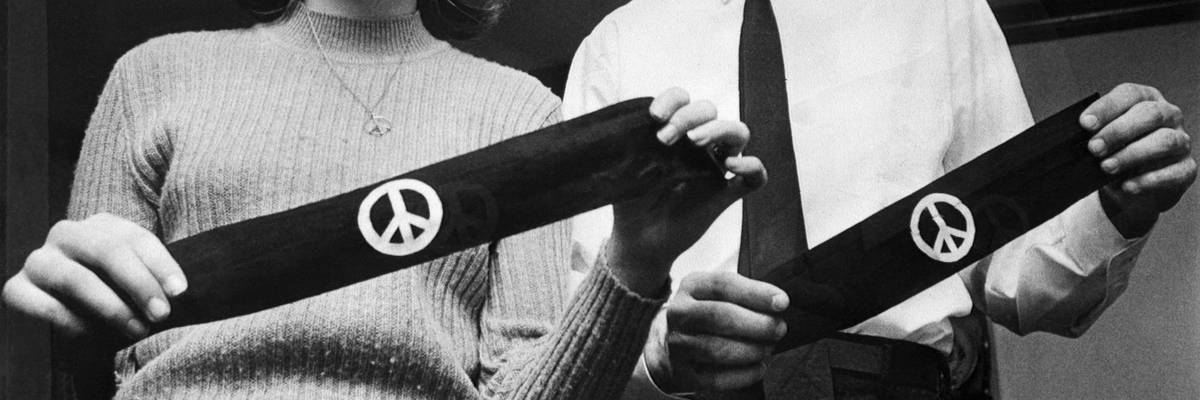
(Original Caption) 3/04/1968-Des Moines, Iowa: Mary Beth Tinker and her brother, John, display two black armbands, the objects of the US Supreme Court's agreement March 4th to hear arguments on how far public schools may go in limiting the wearing of political symbols.
If the goal of the movement is to engage people as broadly as possible, as well as to demonstrate power, then the armbands can offer additional options and bring the day of protests into more places.
Major unions like the National Education Association and American Federation of Teachers, and citizen groups like Indivisible and Public Citizen, are calling for a national May Day strike. It’s a powerful idea, building off of a Minnesota day this past January where people didn’t go to work or school, didn’t shop, and didn’t otherwise participate in ordinary activities. The Minnesota day was spearheaded by major unions, 700 local businesses closed in solidarity, and 75,000-100,000 people marched in the streets.
For the national day, I’d suggest adding one more element: incorporating armbands, like black armbands, so people who are participating can make clear their sympathies. And those who can’t take off from work or school, or who are retired, so have no jobs to leave, can show support as well.
The armband idea comes from the October 15, 1969 Vietnam Moratorium. They didn’t call it a strike, but it was a similar day of marches, walkouts, teach-ins, and other activities that gave as many ways as possible to participate. Two million participated in the day’s marches, but far more in other activities. New York City’s Council endorsed it. Milwaukee held a funeral procession. Small towns rang church bells to commemorate the dead. The Moratorium took place while President Richard Nixon was threatening North Vietnam with nuclear weapons, and although Nixon said at the time the protests made no difference to him, he later revealed that the breadth of support led him to back off from the threat.
I was in high school in Los Angeles. I wore my black armband to school and my after-school job at a drugstore. My manager told me to take it off. I resisted as politely as I could. As I recall, he finally backed down. Another friend wore his armband at his high school in a mill town north of Seattle. In both cases, the armbands got people talking and thinking. They gave an additional way to participate for those who couldn’t join the walkouts. They reinforced anti-war solidarity. US soldiers in Vietnam even wore armbands as a way of joining the protests, following a full-page New York Times ad signed by 1,366 active service members.
So why not include a call for armbands as part of the May Day strike? It’s true that some people might use them as a substitute for visibly leaving jobs or schools. But if the goal of the movement is to engage people as broadly as possible, as well as to demonstrate power, then the armbands can offer additional options and bring the day of protests into more places. They’re an alternative for retired people who don’t have jobs to walk out of. They’re one more antidote to powerlessness, allowing people to participate step by step. It seems important to add them as part of the day’s organizing.
Dear Common Dreams reader, It’s been nearly 30 years since I co-founded Common Dreams with my late wife, Lina Newhouser. We had the radical notion that journalism should serve the public good, not corporate profits. It was clear to us from the outset what it would take to build such a project. No paid advertisements. No corporate sponsors. No millionaire publisher telling us what to think or do. Many people said we wouldn't last a year, but we proved those doubters wrong. Together with a tremendous team of journalists and dedicated staff, we built an independent media outlet free from the constraints of profits and corporate control. Our mission has always been simple: To inform. To inspire. To ignite change for the common good. Building Common Dreams was not easy. Our survival was never guaranteed. When you take on the most powerful forces—Wall Street greed, fossil fuel industry destruction, Big Tech lobbyists, and uber-rich oligarchs who have spent billions upon billions rigging the economy and democracy in their favor—the only bulwark you have is supporters who believe in your work. But here’s the urgent message from me today. It's never been this bad out there. And it's never been this hard to keep us going. At the very moment Common Dreams is most needed, the threats we face are intensifying. We need your support now more than ever. We don't accept corporate advertising and never will. We don't have a paywall because we don't think people should be blocked from critical news based on their ability to pay. Everything we do is funded by the donations of readers like you. When everyone does the little they can afford, we are strong. But if that support retreats or dries up, so do we. Will you donate now to make sure Common Dreams not only survives but thrives? —Craig Brown, Co-founder |
Major unions like the National Education Association and American Federation of Teachers, and citizen groups like Indivisible and Public Citizen, are calling for a national May Day strike. It’s a powerful idea, building off of a Minnesota day this past January where people didn’t go to work or school, didn’t shop, and didn’t otherwise participate in ordinary activities. The Minnesota day was spearheaded by major unions, 700 local businesses closed in solidarity, and 75,000-100,000 people marched in the streets.
For the national day, I’d suggest adding one more element: incorporating armbands, like black armbands, so people who are participating can make clear their sympathies. And those who can’t take off from work or school, or who are retired, so have no jobs to leave, can show support as well.
The armband idea comes from the October 15, 1969 Vietnam Moratorium. They didn’t call it a strike, but it was a similar day of marches, walkouts, teach-ins, and other activities that gave as many ways as possible to participate. Two million participated in the day’s marches, but far more in other activities. New York City’s Council endorsed it. Milwaukee held a funeral procession. Small towns rang church bells to commemorate the dead. The Moratorium took place while President Richard Nixon was threatening North Vietnam with nuclear weapons, and although Nixon said at the time the protests made no difference to him, he later revealed that the breadth of support led him to back off from the threat.
I was in high school in Los Angeles. I wore my black armband to school and my after-school job at a drugstore. My manager told me to take it off. I resisted as politely as I could. As I recall, he finally backed down. Another friend wore his armband at his high school in a mill town north of Seattle. In both cases, the armbands got people talking and thinking. They gave an additional way to participate for those who couldn’t join the walkouts. They reinforced anti-war solidarity. US soldiers in Vietnam even wore armbands as a way of joining the protests, following a full-page New York Times ad signed by 1,366 active service members.
So why not include a call for armbands as part of the May Day strike? It’s true that some people might use them as a substitute for visibly leaving jobs or schools. But if the goal of the movement is to engage people as broadly as possible, as well as to demonstrate power, then the armbands can offer additional options and bring the day of protests into more places. They’re an alternative for retired people who don’t have jobs to walk out of. They’re one more antidote to powerlessness, allowing people to participate step by step. It seems important to add them as part of the day’s organizing.
Major unions like the National Education Association and American Federation of Teachers, and citizen groups like Indivisible and Public Citizen, are calling for a national May Day strike. It’s a powerful idea, building off of a Minnesota day this past January where people didn’t go to work or school, didn’t shop, and didn’t otherwise participate in ordinary activities. The Minnesota day was spearheaded by major unions, 700 local businesses closed in solidarity, and 75,000-100,000 people marched in the streets.
For the national day, I’d suggest adding one more element: incorporating armbands, like black armbands, so people who are participating can make clear their sympathies. And those who can’t take off from work or school, or who are retired, so have no jobs to leave, can show support as well.
The armband idea comes from the October 15, 1969 Vietnam Moratorium. They didn’t call it a strike, but it was a similar day of marches, walkouts, teach-ins, and other activities that gave as many ways as possible to participate. Two million participated in the day’s marches, but far more in other activities. New York City’s Council endorsed it. Milwaukee held a funeral procession. Small towns rang church bells to commemorate the dead. The Moratorium took place while President Richard Nixon was threatening North Vietnam with nuclear weapons, and although Nixon said at the time the protests made no difference to him, he later revealed that the breadth of support led him to back off from the threat.
I was in high school in Los Angeles. I wore my black armband to school and my after-school job at a drugstore. My manager told me to take it off. I resisted as politely as I could. As I recall, he finally backed down. Another friend wore his armband at his high school in a mill town north of Seattle. In both cases, the armbands got people talking and thinking. They gave an additional way to participate for those who couldn’t join the walkouts. They reinforced anti-war solidarity. US soldiers in Vietnam even wore armbands as a way of joining the protests, following a full-page New York Times ad signed by 1,366 active service members.
So why not include a call for armbands as part of the May Day strike? It’s true that some people might use them as a substitute for visibly leaving jobs or schools. But if the goal of the movement is to engage people as broadly as possible, as well as to demonstrate power, then the armbands can offer additional options and bring the day of protests into more places. They’re an alternative for retired people who don’t have jobs to walk out of. They’re one more antidote to powerlessness, allowing people to participate step by step. It seems important to add them as part of the day’s organizing.