

SUBSCRIBE TO OUR FREE NEWSLETTER
Daily news & progressive opinion—funded by the people, not the corporations—delivered straight to your inbox.
5
#000000
#FFFFFF
To donate by check, phone, or other method, see our More Ways to Give page.
Daily news & progressive opinion—funded by the people, not the corporations—delivered straight to your inbox.
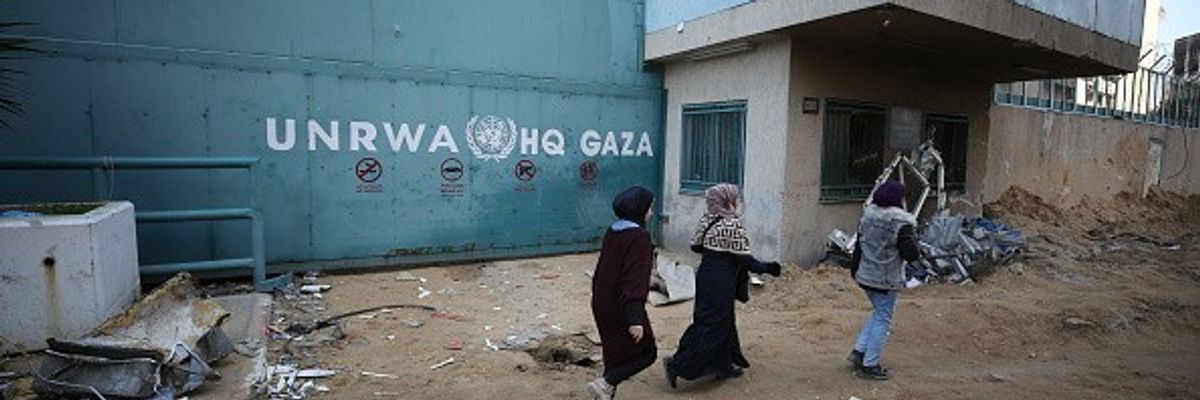
People walk past the headquarters of the United Nations Relief and Works Agency for Palestine Refugees in the Near East.
Israel's banning of UNRWA should represent an opportunity for those concerned about the standing of the U.N. to remind Israel that U.N. members who have no respect for international law deserve to be delegitimized themselves.
On October 28, the Israeli Knesset passed a second reading of two bills that effectively ban the United Nations Agency for Palestinian Refugees (UNRWA) from carrying out "any activity" in Israel and occupied Palestine.
Simply put, the decision is catastrophic, because UNRWA is the main international body responsible for the welfare of millions of Palestinians throughout the occupied territories, and throughout much of the region.
Israel followed its decision by attacking and damaging an UNRWA office in the Nur Shams refugee camp in the occupied West Bank. It was the Israeli government's way of demonstrating its seriousness regarding the matter.
A key player in the war on UNRWA was Jared Kushner, son-in-law of former U.S. President, and now President-elect, Donald Trump.
This is not the first time that Israel has pursued an anti-UNRWA agenda and, contrary to claims by Israeli Prime Minister Benjamin Netanyahu and other Israel officials, the decision is not linked to the current genocidal war on Gaza, or the unfounded claims that UNRWA supports "terrorism."
An independent review commissioned by the U.N. revealed that Israel "made public claims that a significant number of UNRWA employees are members of terrorist organizations," but that it "has yet to provide supporting evidence of this."
Israeli claims, however, did a great deal of damage to the organization, as 13 countries, including the United States, Canada, Australia, Britain, Germany, and Italy, withheld badly needed funds which were helping Gaza stave off a horrific famine.
Eventually, most of these countries reinstated their financial support, though without apologizing to the Palestinians who were adversely impacted by these countries' initial, unfair decision.
Unrepenting, Israel continued to unleash its relentless war on the organization. "UNRWA workers involved in terrorist activities against Israel must be held accountable," Netanyahu said in a statement on October 28.
The anti-UNRWA rhetoric remains functional for Israel. Amplified by the ever-willing U.S. mainstream media, Israel has managed to keep UNRWA's name in the news, always associating it with "supporting terrorism." So, when the Israeli Knesset voted for the anti-UNRWA bills, mainstream media conveyed the news as if they were the only rational conclusion to an essentially fabricated story.
Israel's problem with UNRWA has little to do with the organization itself, but with its underlying political representation as a U.N. entity whose mission is predicated on providing "assistance and protection to Palestine refugees."
UNRWA was established in 1949 by the U.N. General Assembly Resolution 302 (IV). It began its operations on May 1, 1950, and with time, it became central to the survival of a large number of Palestinian refugee communities in Gaza, the West Bank, Lebanon, Syria, and Jordan.
Many have rightly criticized the U.N. for failing to supplement UNRWA's humanitarian mandate with a political equivalent that would ultimately help Palestinians achieve their Right of Return in accordance with U.N. Resolution 194. For Israel, however, UNRWA remained problematic.
According to Tel Aviv's thinking, UNRWA's existence is a constant reminder that there is a distinct group of people called Palestinian refugees. And though UNRWA is not a political organization, the Palestinian refugee crisis and all related U.N. resolutions that emphasize the "inalienable" rights of these refugees are very political.
Taking advantage of the initial, albeit brief, sympathy with Israel worldwide, and the massive campaign of misinformation emanating from Israel and its allies, Netanyahu used October 7 as an opportunity to further demonize UNRWA. However, his campaign had started much earlier.
A key player in the war on UNRWA was Jared Kushner, son-in-law of former U.S. President, and now President-elect, Donald Trump. Kushner, who invested much time in helping Israel defeat the Palestinians once and for all, made UNRWA a key point in his plan. He vowed to carry out "sincere effort to disrupt" the work of the organization, a leaked email revealed.
Due to international rejection and solidarity, Kushner ultimately failed. Even the withholding of funds by the U.S. administration did not force the organization to shut down, although it did negatively impact the lives of millions of Palestinians.
The ongoing war on Gaza and the push to annex large parts of the West Bank represented a golden opportunity for Netanyahu and his extremist government to increase the pressure on UNRWA. They have been enabled by unconditional U.S. support, and the willingness of various Western governments to recklessly act upon Israel's false claims regarding the U.N. organization.
By allowing Israel to delegitimize the very organization responsible for enforcing international law, the U.N.'s crisis becomes much deeper.
The impassioned plea on October 30 by U.N. Special Rapporteur Francesca Albanese reflects the frustration felt by many U.N.-affiliated officials regarding the growing irrelevance of the U.N.
In her speech, Albanese pointed out that, if the U.N.'s failures continue, its impact will become even "more and more irrelevant to the rest of the world," especially during these times of turmoil.
This irrelevance is already being felt by millions of Palestinians, mainly in Gaza, but also in the West Bank. Though Palestinians continue to withstand and reject and resist Israeli aggression, they are fed up with an international system that seems to offer them only words, but little action.
Israel's banning of UNRWA should represent an opportunity for those concerned about the standing of the United Nations, to remind Israel that U.N. members who have no respect for international law deserve to be delegitimized. This time, words must be accompanied by action. Nothing else will suffice.
Dear Common Dreams reader, It’s been nearly 30 years since I co-founded Common Dreams with my late wife, Lina Newhouser. We had the radical notion that journalism should serve the public good, not corporate profits. It was clear to us from the outset what it would take to build such a project. No paid advertisements. No corporate sponsors. No millionaire publisher telling us what to think or do. Many people said we wouldn't last a year, but we proved those doubters wrong. Together with a tremendous team of journalists and dedicated staff, we built an independent media outlet free from the constraints of profits and corporate control. Our mission has always been simple: To inform. To inspire. To ignite change for the common good. Building Common Dreams was not easy. Our survival was never guaranteed. When you take on the most powerful forces—Wall Street greed, fossil fuel industry destruction, Big Tech lobbyists, and uber-rich oligarchs who have spent billions upon billions rigging the economy and democracy in their favor—the only bulwark you have is supporters who believe in your work. But here’s the urgent message from me today. It's never been this bad out there. And it's never been this hard to keep us going. At the very moment Common Dreams is most needed, the threats we face are intensifying. We need your support now more than ever. We don't accept corporate advertising and never will. We don't have a paywall because we don't think people should be blocked from critical news based on their ability to pay. Everything we do is funded by the donations of readers like you. When everyone does the little they can afford, we are strong. But if that support retreats or dries up, so do we. Will you donate now to make sure Common Dreams not only survives but thrives? —Craig Brown, Co-founder |
On October 28, the Israeli Knesset passed a second reading of two bills that effectively ban the United Nations Agency for Palestinian Refugees (UNRWA) from carrying out "any activity" in Israel and occupied Palestine.
Simply put, the decision is catastrophic, because UNRWA is the main international body responsible for the welfare of millions of Palestinians throughout the occupied territories, and throughout much of the region.
Israel followed its decision by attacking and damaging an UNRWA office in the Nur Shams refugee camp in the occupied West Bank. It was the Israeli government's way of demonstrating its seriousness regarding the matter.
A key player in the war on UNRWA was Jared Kushner, son-in-law of former U.S. President, and now President-elect, Donald Trump.
This is not the first time that Israel has pursued an anti-UNRWA agenda and, contrary to claims by Israeli Prime Minister Benjamin Netanyahu and other Israel officials, the decision is not linked to the current genocidal war on Gaza, or the unfounded claims that UNRWA supports "terrorism."
An independent review commissioned by the U.N. revealed that Israel "made public claims that a significant number of UNRWA employees are members of terrorist organizations," but that it "has yet to provide supporting evidence of this."
Israeli claims, however, did a great deal of damage to the organization, as 13 countries, including the United States, Canada, Australia, Britain, Germany, and Italy, withheld badly needed funds which were helping Gaza stave off a horrific famine.
Eventually, most of these countries reinstated their financial support, though without apologizing to the Palestinians who were adversely impacted by these countries' initial, unfair decision.
Unrepenting, Israel continued to unleash its relentless war on the organization. "UNRWA workers involved in terrorist activities against Israel must be held accountable," Netanyahu said in a statement on October 28.
The anti-UNRWA rhetoric remains functional for Israel. Amplified by the ever-willing U.S. mainstream media, Israel has managed to keep UNRWA's name in the news, always associating it with "supporting terrorism." So, when the Israeli Knesset voted for the anti-UNRWA bills, mainstream media conveyed the news as if they were the only rational conclusion to an essentially fabricated story.
Israel's problem with UNRWA has little to do with the organization itself, but with its underlying political representation as a U.N. entity whose mission is predicated on providing "assistance and protection to Palestine refugees."
UNRWA was established in 1949 by the U.N. General Assembly Resolution 302 (IV). It began its operations on May 1, 1950, and with time, it became central to the survival of a large number of Palestinian refugee communities in Gaza, the West Bank, Lebanon, Syria, and Jordan.
Many have rightly criticized the U.N. for failing to supplement UNRWA's humanitarian mandate with a political equivalent that would ultimately help Palestinians achieve their Right of Return in accordance with U.N. Resolution 194. For Israel, however, UNRWA remained problematic.
According to Tel Aviv's thinking, UNRWA's existence is a constant reminder that there is a distinct group of people called Palestinian refugees. And though UNRWA is not a political organization, the Palestinian refugee crisis and all related U.N. resolutions that emphasize the "inalienable" rights of these refugees are very political.
Taking advantage of the initial, albeit brief, sympathy with Israel worldwide, and the massive campaign of misinformation emanating from Israel and its allies, Netanyahu used October 7 as an opportunity to further demonize UNRWA. However, his campaign had started much earlier.
A key player in the war on UNRWA was Jared Kushner, son-in-law of former U.S. President, and now President-elect, Donald Trump. Kushner, who invested much time in helping Israel defeat the Palestinians once and for all, made UNRWA a key point in his plan. He vowed to carry out "sincere effort to disrupt" the work of the organization, a leaked email revealed.
Due to international rejection and solidarity, Kushner ultimately failed. Even the withholding of funds by the U.S. administration did not force the organization to shut down, although it did negatively impact the lives of millions of Palestinians.
The ongoing war on Gaza and the push to annex large parts of the West Bank represented a golden opportunity for Netanyahu and his extremist government to increase the pressure on UNRWA. They have been enabled by unconditional U.S. support, and the willingness of various Western governments to recklessly act upon Israel's false claims regarding the U.N. organization.
By allowing Israel to delegitimize the very organization responsible for enforcing international law, the U.N.'s crisis becomes much deeper.
The impassioned plea on October 30 by U.N. Special Rapporteur Francesca Albanese reflects the frustration felt by many U.N.-affiliated officials regarding the growing irrelevance of the U.N.
In her speech, Albanese pointed out that, if the U.N.'s failures continue, its impact will become even "more and more irrelevant to the rest of the world," especially during these times of turmoil.
This irrelevance is already being felt by millions of Palestinians, mainly in Gaza, but also in the West Bank. Though Palestinians continue to withstand and reject and resist Israeli aggression, they are fed up with an international system that seems to offer them only words, but little action.
Israel's banning of UNRWA should represent an opportunity for those concerned about the standing of the United Nations, to remind Israel that U.N. members who have no respect for international law deserve to be delegitimized. This time, words must be accompanied by action. Nothing else will suffice.
On October 28, the Israeli Knesset passed a second reading of two bills that effectively ban the United Nations Agency for Palestinian Refugees (UNRWA) from carrying out "any activity" in Israel and occupied Palestine.
Simply put, the decision is catastrophic, because UNRWA is the main international body responsible for the welfare of millions of Palestinians throughout the occupied territories, and throughout much of the region.
Israel followed its decision by attacking and damaging an UNRWA office in the Nur Shams refugee camp in the occupied West Bank. It was the Israeli government's way of demonstrating its seriousness regarding the matter.
A key player in the war on UNRWA was Jared Kushner, son-in-law of former U.S. President, and now President-elect, Donald Trump.
This is not the first time that Israel has pursued an anti-UNRWA agenda and, contrary to claims by Israeli Prime Minister Benjamin Netanyahu and other Israel officials, the decision is not linked to the current genocidal war on Gaza, or the unfounded claims that UNRWA supports "terrorism."
An independent review commissioned by the U.N. revealed that Israel "made public claims that a significant number of UNRWA employees are members of terrorist organizations," but that it "has yet to provide supporting evidence of this."
Israeli claims, however, did a great deal of damage to the organization, as 13 countries, including the United States, Canada, Australia, Britain, Germany, and Italy, withheld badly needed funds which were helping Gaza stave off a horrific famine.
Eventually, most of these countries reinstated their financial support, though without apologizing to the Palestinians who were adversely impacted by these countries' initial, unfair decision.
Unrepenting, Israel continued to unleash its relentless war on the organization. "UNRWA workers involved in terrorist activities against Israel must be held accountable," Netanyahu said in a statement on October 28.
The anti-UNRWA rhetoric remains functional for Israel. Amplified by the ever-willing U.S. mainstream media, Israel has managed to keep UNRWA's name in the news, always associating it with "supporting terrorism." So, when the Israeli Knesset voted for the anti-UNRWA bills, mainstream media conveyed the news as if they were the only rational conclusion to an essentially fabricated story.
Israel's problem with UNRWA has little to do with the organization itself, but with its underlying political representation as a U.N. entity whose mission is predicated on providing "assistance and protection to Palestine refugees."
UNRWA was established in 1949 by the U.N. General Assembly Resolution 302 (IV). It began its operations on May 1, 1950, and with time, it became central to the survival of a large number of Palestinian refugee communities in Gaza, the West Bank, Lebanon, Syria, and Jordan.
Many have rightly criticized the U.N. for failing to supplement UNRWA's humanitarian mandate with a political equivalent that would ultimately help Palestinians achieve their Right of Return in accordance with U.N. Resolution 194. For Israel, however, UNRWA remained problematic.
According to Tel Aviv's thinking, UNRWA's existence is a constant reminder that there is a distinct group of people called Palestinian refugees. And though UNRWA is not a political organization, the Palestinian refugee crisis and all related U.N. resolutions that emphasize the "inalienable" rights of these refugees are very political.
Taking advantage of the initial, albeit brief, sympathy with Israel worldwide, and the massive campaign of misinformation emanating from Israel and its allies, Netanyahu used October 7 as an opportunity to further demonize UNRWA. However, his campaign had started much earlier.
A key player in the war on UNRWA was Jared Kushner, son-in-law of former U.S. President, and now President-elect, Donald Trump. Kushner, who invested much time in helping Israel defeat the Palestinians once and for all, made UNRWA a key point in his plan. He vowed to carry out "sincere effort to disrupt" the work of the organization, a leaked email revealed.
Due to international rejection and solidarity, Kushner ultimately failed. Even the withholding of funds by the U.S. administration did not force the organization to shut down, although it did negatively impact the lives of millions of Palestinians.
The ongoing war on Gaza and the push to annex large parts of the West Bank represented a golden opportunity for Netanyahu and his extremist government to increase the pressure on UNRWA. They have been enabled by unconditional U.S. support, and the willingness of various Western governments to recklessly act upon Israel's false claims regarding the U.N. organization.
By allowing Israel to delegitimize the very organization responsible for enforcing international law, the U.N.'s crisis becomes much deeper.
The impassioned plea on October 30 by U.N. Special Rapporteur Francesca Albanese reflects the frustration felt by many U.N.-affiliated officials regarding the growing irrelevance of the U.N.
In her speech, Albanese pointed out that, if the U.N.'s failures continue, its impact will become even "more and more irrelevant to the rest of the world," especially during these times of turmoil.
This irrelevance is already being felt by millions of Palestinians, mainly in Gaza, but also in the West Bank. Though Palestinians continue to withstand and reject and resist Israeli aggression, they are fed up with an international system that seems to offer them only words, but little action.
Israel's banning of UNRWA should represent an opportunity for those concerned about the standing of the United Nations, to remind Israel that U.N. members who have no respect for international law deserve to be delegitimized. This time, words must be accompanied by action. Nothing else will suffice.

