SUBSCRIBE TO OUR FREE NEWSLETTER
Daily news & progressive opinion—funded by the people, not the corporations—delivered straight to your inbox.
5
#000000
#FFFFFF
To donate by check, phone, or other method, see our More Ways to Give page.
Daily news & progressive opinion—funded by the people, not the corporations—delivered straight to your inbox.
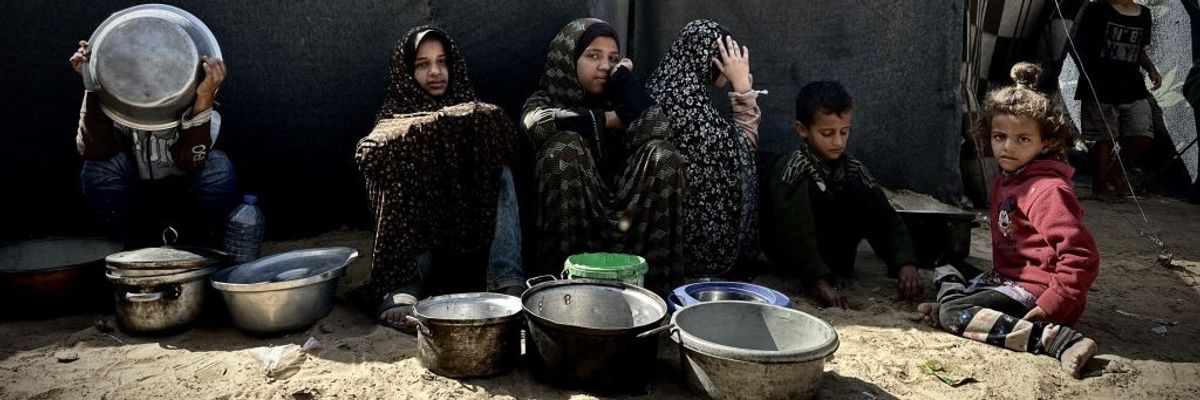
Palestinian children sit with pots near makeshift tents as they wait to receive food aid in Khan Younis, Gaza on October 28, 2024.
"It'll likely see the collapse of the humanitarian system in Gaza," warned a spokesperson for the U.N. Children's Fund.
Humanitarian groups and United Nations officials issued dire warnings Tuesday about the potentially catastrophic consequences of Israeli lawmakers' vote to ban the U.N. agency for Palestinian refugees, the body primarily responsible for delivering lifesaving aid to the people of Gaza and the West Bank, including East Jerusalem.
James Elder, a spokesperson for the United Nations Children's Fund (UNICEF), said Tuesday that if the U.N. Relief and Works Agency for Palestine Refugees in the Near East (UNRWA) is unable to operate due to the measures passed overwhelmingly by the Israeli Knesset on Monday, "it'll likely see the collapse of the humanitarian system in Gaza."
"So a decision such as this suddenly means that a new way has been found to kill children," said Elder.
The legislation that Israeli lawmakers passed in a 92-10 vote bars UNRWA—a frequent target of Israeli smear campaigns and military attacks—from operating or providing "any service" within "in the sovereign territory of the state of Israel."
Israeli lawmakers also passed a measure declaring UNRWA a "terror" group, barring Israeli officials from engaging in any contact with the agency.
The Guardian noted that the newly passed measures—which are set to be implemented within 90 days—are "expected to lead to the closure of UNRWA's East Jerusalem headquarters and would effectively block the delivery of humanitarian aid into Gaza via Rafah."
"The severing of diplomatic relations would preclude Israel from issuing entry and work permits to foreign UNRWA staff and prevent coordination with the Israeli military to permit aid shipments," the newspaper added.
"Humanitarian actors rely on coordination with UNWRA to deliver aid and alleviate suffering. UNWRA cannot be replaced by NGOs."
Agnès Callamard, the secretary-general of Amnesty International, warned in a statement Tuesday that the measures represent "an outright attack on the rights of Palestinian refugees."
"It is clearly designed to make it impossible for the agency to operate in the occupied Palestinian territory by forcing the closure of the UNRWA headquarters in East Jerusalem and ending visas for its staff," said Callamard. "It amounts to the criminalization of humanitarian aid and will worsen an already catastrophic humanitarian crisis."
"This appalling, inhumane law will only exacerbate the suffering of Palestinians, who have endured unimaginable hardship since the horrific attacks by Hamas and other armed groups in southern Israel one year ago, and whose need for global support is greater than ever. The international community must be quick to condemn it in the strongest possible terms and exert any influence they have on the Israeli government to repeal it.”
The U.N. General Assembly established UNRWA in the aftermath of the 1948 Nakba, and the agency is central to humanitarian operations in the famine-stricken Gaza Strip—a role that aid groups described as necessary and irreplaceable. According to a World Health Organization official, roughly a third of the healthcare workers assisting the polio vaccination campaign in Gaza work with UNRWA.
"UNRWA plays a critical role in serving civilians in desperate need in Gaza," the International Rescue Committee (IRC) said Tuesday. "Humanitarian actors rely on coordination with UNRWA to deliver aid and alleviate suffering. UNRWA cannot be replaced by NGOs like IRC."
"The bill passed in the Israeli parliament is an unprecedented attack on a U.N. agency and, if implemented, would only worsen the humanitarian catastrophe," IRC added. "We strongly urge that this legislation is not applied. We continue to advocate for an immediate ceasefire to get aid in, to release the hostages, and to meet the growing and dire needs of the civilian population."
Sam Rose, deputy director of UNRWA affairs in Gaza, said in a CNN interview that "the entire humanitarian system" in the Palestinian enclave "relies every minute of every day on UNRWA to deliver services to 2 million people living in the worst possible conditions."
Implementation of the ban, Rose warned, "would be devastating for us, devastating for other aid agencies—but more importantly, for the population here that's suffering so much."
Dear Common Dreams reader, It’s been nearly 30 years since I co-founded Common Dreams with my late wife, Lina Newhouser. We had the radical notion that journalism should serve the public good, not corporate profits. It was clear to us from the outset what it would take to build such a project. No paid advertisements. No corporate sponsors. No millionaire publisher telling us what to think or do. Many people said we wouldn't last a year, but we proved those doubters wrong. Together with a tremendous team of journalists and dedicated staff, we built an independent media outlet free from the constraints of profits and corporate control. Our mission has always been simple: To inform. To inspire. To ignite change for the common good. Building Common Dreams was not easy. Our survival was never guaranteed. When you take on the most powerful forces—Wall Street greed, fossil fuel industry destruction, Big Tech lobbyists, and uber-rich oligarchs who have spent billions upon billions rigging the economy and democracy in their favor—the only bulwark you have is supporters who believe in your work. But here’s the urgent message from me today. It's never been this bad out there. And it's never been this hard to keep us going. At the very moment Common Dreams is most needed, the threats we face are intensifying. We need your support now more than ever. We don't accept corporate advertising and never will. We don't have a paywall because we don't think people should be blocked from critical news based on their ability to pay. Everything we do is funded by the donations of readers like you. When everyone does the little they can afford, we are strong. But if that support retreats or dries up, so do we. Will you donate now to make sure Common Dreams not only survives but thrives? —Craig Brown, Co-founder |
Humanitarian groups and United Nations officials issued dire warnings Tuesday about the potentially catastrophic consequences of Israeli lawmakers' vote to ban the U.N. agency for Palestinian refugees, the body primarily responsible for delivering lifesaving aid to the people of Gaza and the West Bank, including East Jerusalem.
James Elder, a spokesperson for the United Nations Children's Fund (UNICEF), said Tuesday that if the U.N. Relief and Works Agency for Palestine Refugees in the Near East (UNRWA) is unable to operate due to the measures passed overwhelmingly by the Israeli Knesset on Monday, "it'll likely see the collapse of the humanitarian system in Gaza."
"So a decision such as this suddenly means that a new way has been found to kill children," said Elder.
The legislation that Israeli lawmakers passed in a 92-10 vote bars UNRWA—a frequent target of Israeli smear campaigns and military attacks—from operating or providing "any service" within "in the sovereign territory of the state of Israel."
Israeli lawmakers also passed a measure declaring UNRWA a "terror" group, barring Israeli officials from engaging in any contact with the agency.
The Guardian noted that the newly passed measures—which are set to be implemented within 90 days—are "expected to lead to the closure of UNRWA's East Jerusalem headquarters and would effectively block the delivery of humanitarian aid into Gaza via Rafah."
"The severing of diplomatic relations would preclude Israel from issuing entry and work permits to foreign UNRWA staff and prevent coordination with the Israeli military to permit aid shipments," the newspaper added.
"Humanitarian actors rely on coordination with UNWRA to deliver aid and alleviate suffering. UNWRA cannot be replaced by NGOs."
Agnès Callamard, the secretary-general of Amnesty International, warned in a statement Tuesday that the measures represent "an outright attack on the rights of Palestinian refugees."
"It is clearly designed to make it impossible for the agency to operate in the occupied Palestinian territory by forcing the closure of the UNRWA headquarters in East Jerusalem and ending visas for its staff," said Callamard. "It amounts to the criminalization of humanitarian aid and will worsen an already catastrophic humanitarian crisis."
"This appalling, inhumane law will only exacerbate the suffering of Palestinians, who have endured unimaginable hardship since the horrific attacks by Hamas and other armed groups in southern Israel one year ago, and whose need for global support is greater than ever. The international community must be quick to condemn it in the strongest possible terms and exert any influence they have on the Israeli government to repeal it.”
The U.N. General Assembly established UNRWA in the aftermath of the 1948 Nakba, and the agency is central to humanitarian operations in the famine-stricken Gaza Strip—a role that aid groups described as necessary and irreplaceable. According to a World Health Organization official, roughly a third of the healthcare workers assisting the polio vaccination campaign in Gaza work with UNRWA.
"UNRWA plays a critical role in serving civilians in desperate need in Gaza," the International Rescue Committee (IRC) said Tuesday. "Humanitarian actors rely on coordination with UNRWA to deliver aid and alleviate suffering. UNRWA cannot be replaced by NGOs like IRC."
"The bill passed in the Israeli parliament is an unprecedented attack on a U.N. agency and, if implemented, would only worsen the humanitarian catastrophe," IRC added. "We strongly urge that this legislation is not applied. We continue to advocate for an immediate ceasefire to get aid in, to release the hostages, and to meet the growing and dire needs of the civilian population."
Sam Rose, deputy director of UNRWA affairs in Gaza, said in a CNN interview that "the entire humanitarian system" in the Palestinian enclave "relies every minute of every day on UNRWA to deliver services to 2 million people living in the worst possible conditions."
Implementation of the ban, Rose warned, "would be devastating for us, devastating for other aid agencies—but more importantly, for the population here that's suffering so much."
Humanitarian groups and United Nations officials issued dire warnings Tuesday about the potentially catastrophic consequences of Israeli lawmakers' vote to ban the U.N. agency for Palestinian refugees, the body primarily responsible for delivering lifesaving aid to the people of Gaza and the West Bank, including East Jerusalem.
James Elder, a spokesperson for the United Nations Children's Fund (UNICEF), said Tuesday that if the U.N. Relief and Works Agency for Palestine Refugees in the Near East (UNRWA) is unable to operate due to the measures passed overwhelmingly by the Israeli Knesset on Monday, "it'll likely see the collapse of the humanitarian system in Gaza."
"So a decision such as this suddenly means that a new way has been found to kill children," said Elder.
The legislation that Israeli lawmakers passed in a 92-10 vote bars UNRWA—a frequent target of Israeli smear campaigns and military attacks—from operating or providing "any service" within "in the sovereign territory of the state of Israel."
Israeli lawmakers also passed a measure declaring UNRWA a "terror" group, barring Israeli officials from engaging in any contact with the agency.
The Guardian noted that the newly passed measures—which are set to be implemented within 90 days—are "expected to lead to the closure of UNRWA's East Jerusalem headquarters and would effectively block the delivery of humanitarian aid into Gaza via Rafah."
"The severing of diplomatic relations would preclude Israel from issuing entry and work permits to foreign UNRWA staff and prevent coordination with the Israeli military to permit aid shipments," the newspaper added.
"Humanitarian actors rely on coordination with UNWRA to deliver aid and alleviate suffering. UNWRA cannot be replaced by NGOs."
Agnès Callamard, the secretary-general of Amnesty International, warned in a statement Tuesday that the measures represent "an outright attack on the rights of Palestinian refugees."
"It is clearly designed to make it impossible for the agency to operate in the occupied Palestinian territory by forcing the closure of the UNRWA headquarters in East Jerusalem and ending visas for its staff," said Callamard. "It amounts to the criminalization of humanitarian aid and will worsen an already catastrophic humanitarian crisis."
"This appalling, inhumane law will only exacerbate the suffering of Palestinians, who have endured unimaginable hardship since the horrific attacks by Hamas and other armed groups in southern Israel one year ago, and whose need for global support is greater than ever. The international community must be quick to condemn it in the strongest possible terms and exert any influence they have on the Israeli government to repeal it.”
The U.N. General Assembly established UNRWA in the aftermath of the 1948 Nakba, and the agency is central to humanitarian operations in the famine-stricken Gaza Strip—a role that aid groups described as necessary and irreplaceable. According to a World Health Organization official, roughly a third of the healthcare workers assisting the polio vaccination campaign in Gaza work with UNRWA.
"UNRWA plays a critical role in serving civilians in desperate need in Gaza," the International Rescue Committee (IRC) said Tuesday. "Humanitarian actors rely on coordination with UNRWA to deliver aid and alleviate suffering. UNRWA cannot be replaced by NGOs like IRC."
"The bill passed in the Israeli parliament is an unprecedented attack on a U.N. agency and, if implemented, would only worsen the humanitarian catastrophe," IRC added. "We strongly urge that this legislation is not applied. We continue to advocate for an immediate ceasefire to get aid in, to release the hostages, and to meet the growing and dire needs of the civilian population."
Sam Rose, deputy director of UNRWA affairs in Gaza, said in a CNN interview that "the entire humanitarian system" in the Palestinian enclave "relies every minute of every day on UNRWA to deliver services to 2 million people living in the worst possible conditions."
Implementation of the ban, Rose warned, "would be devastating for us, devastating for other aid agencies—but more importantly, for the population here that's suffering so much."