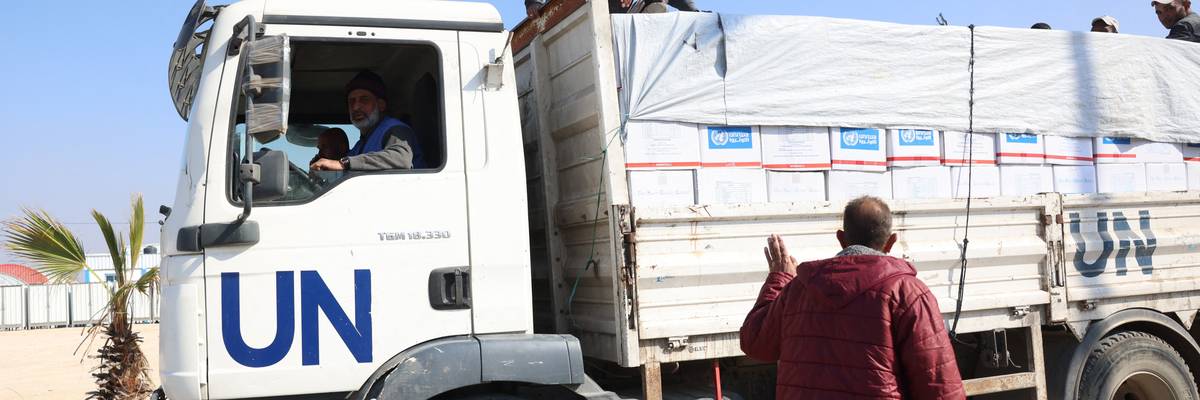
An UNRWA truck transports aid for Palestinians during a tour by the organisation's senior emergency officer in Khan Yunis on December 3, 2024, amid the continuing war between Israel and Hamas.
UNRWA Preparing to Shutter Gaza, West Bank Operations Over Israeli Laws
"The laws would cripple the humanitarian response in Gaza and deprive millions of Palestine refugees of essential services in the West Bank, including East Jerusalem," said the agency's leader.
The United Nations Relief and Works Agency for Palestine Refugees in the Near East, a crucial source of food, water, medicine, and more for Palestinians, is preparing to shut down its offices in the West Bank and Gaza in response to two laws passed by the Israeli parliament that, if enforced, will effectively prevent the UNRWA from operating in those locations.
The laws were passed in October and are set to go into effect at the end of January.
The New York Times reported Thursday that U.N. officials say they are preparing to wind down UNRWA operations in both locations, a move that Jamie McGoldrick, who oversaw the U.N. humanitarian operation across Gaza and the West Bank until April, told the Times "would be a massive impact on an already catastrophic situation."
"If that is what the Israeli intention is—to remove any ability for us to save lives—you have to question what is the thinking and what is the end goal?" McGoldrick added.
UNRWA and Israel have long had a contentious relationship, but tensions escalated after Israel accused some of the agency's employees of taking part in Hamas' attack on Israel on October 7, 2023. This prompted the U.S.—the largest international funder of the agency, which relies almost entirely on voluntary contributions from donor states—to suspend funding for UNRWA last January. Congress later passed a bill prohibiting UNRWA funding through at least March 2025.
In October, the Israeli parliament passed two bills targeting UNRWA— one that mandates UNRWA "will not operate any missions, won't provide any service, and won't hold any activity—directly or indirectly—in the sovereign territory of the state of Israel," and a second under which the Israeli agency that handles humanitarian issues, the Coordinator of Government Activities in the Territories, will have to cut off contact with UNRWA.
"The laws would cripple the humanitarian response in Gaza and deprive millions of Palestine refugees of essential services in the West Bank, including East Jerusalem," wrote Philippe Lazzarini, the Commissioner-General of UNRWA, in an opinion piece for The Guardian published in mid-December.
UNRWA has provided support to Palestinians for decades and been the backbone of aid response in Gaza since Israel's cataclysmic military campaign on the enclave began in October 2023. It is the largest aid organization operating in the Palestinian territories, according to the Wall Street Journal.
One Palestinian woman in the West Bank told the paper that halting UNRWA's operations is "life or death."
Kenneth Roth, the former the executive director of Human Rights Watch, reacted to this quote on social media Friday, writing that Israeli Prime Minister Benjamin Netanyahu "picks death (for Palestinians)."
We are at a crossroads
This country and this world are at a monumental crossroads. In a few short weeks, US voters will have an opportunity to beat back the forces of fascism and confront the billionaires who are rigging the economy, our media system, and our democracy, making it increasingly impossible for ordinary people to get by. We’re not just talking about the election. We’re talking about what must be done once these fascist elements are vanquished from power. We need a bolder set of solutions than what either major party has so far been willing to offer and a working-class movement ready to fight like hell for it. Trump didn't emerge from nowhere. The conditions that fueled MAGA authoritarianism were created by decades of radical neoliberal economic policies and a corrupt political system dominated by corporate interests. They slashed taxes on the super-rich, promising that the benefits would trickle down. They said giveaways to the corporate titans would make life more affordable for the rest of us. It was all bullshit. And when a bitter, betrayed populace searches for someone to blame, right-wing demagogues have little trouble finding scapegoats. People know when they're being lied to, but you won't hear any of this from the corporate media. Only independent journalism—powered and funded by people who believe in building a better world—can deliver truly trustworthy daily news. Our Fall Campaign is underway, and we need your help. To power our newsroom through the rest of the year, we need to raise $125,000 by midnight on October 31. So if you share our vision, please contribute whatever you can to sustain our work. |
The United Nations Relief and Works Agency for Palestine Refugees in the Near East, a crucial source of food, water, medicine, and more for Palestinians, is preparing to shut down its offices in the West Bank and Gaza in response to two laws passed by the Israeli parliament that, if enforced, will effectively prevent the UNRWA from operating in those locations.
The laws were passed in October and are set to go into effect at the end of January.
The New York Times reported Thursday that U.N. officials say they are preparing to wind down UNRWA operations in both locations, a move that Jamie McGoldrick, who oversaw the U.N. humanitarian operation across Gaza and the West Bank until April, told the Times "would be a massive impact on an already catastrophic situation."
"If that is what the Israeli intention is—to remove any ability for us to save lives—you have to question what is the thinking and what is the end goal?" McGoldrick added.
UNRWA and Israel have long had a contentious relationship, but tensions escalated after Israel accused some of the agency's employees of taking part in Hamas' attack on Israel on October 7, 2023. This prompted the U.S.—the largest international funder of the agency, which relies almost entirely on voluntary contributions from donor states—to suspend funding for UNRWA last January. Congress later passed a bill prohibiting UNRWA funding through at least March 2025.
In October, the Israeli parliament passed two bills targeting UNRWA— one that mandates UNRWA "will not operate any missions, won't provide any service, and won't hold any activity—directly or indirectly—in the sovereign territory of the state of Israel," and a second under which the Israeli agency that handles humanitarian issues, the Coordinator of Government Activities in the Territories, will have to cut off contact with UNRWA.
"The laws would cripple the humanitarian response in Gaza and deprive millions of Palestine refugees of essential services in the West Bank, including East Jerusalem," wrote Philippe Lazzarini, the Commissioner-General of UNRWA, in an opinion piece for The Guardian published in mid-December.
UNRWA has provided support to Palestinians for decades and been the backbone of aid response in Gaza since Israel's cataclysmic military campaign on the enclave began in October 2023. It is the largest aid organization operating in the Palestinian territories, according to the Wall Street Journal.
One Palestinian woman in the West Bank told the paper that halting UNRWA's operations is "life or death."
Kenneth Roth, the former the executive director of Human Rights Watch, reacted to this quote on social media Friday, writing that Israeli Prime Minister Benjamin Netanyahu "picks death (for Palestinians)."
The United Nations Relief and Works Agency for Palestine Refugees in the Near East, a crucial source of food, water, medicine, and more for Palestinians, is preparing to shut down its offices in the West Bank and Gaza in response to two laws passed by the Israeli parliament that, if enforced, will effectively prevent the UNRWA from operating in those locations.
The laws were passed in October and are set to go into effect at the end of January.
The New York Times reported Thursday that U.N. officials say they are preparing to wind down UNRWA operations in both locations, a move that Jamie McGoldrick, who oversaw the U.N. humanitarian operation across Gaza and the West Bank until April, told the Times "would be a massive impact on an already catastrophic situation."
"If that is what the Israeli intention is—to remove any ability for us to save lives—you have to question what is the thinking and what is the end goal?" McGoldrick added.
UNRWA and Israel have long had a contentious relationship, but tensions escalated after Israel accused some of the agency's employees of taking part in Hamas' attack on Israel on October 7, 2023. This prompted the U.S.—the largest international funder of the agency, which relies almost entirely on voluntary contributions from donor states—to suspend funding for UNRWA last January. Congress later passed a bill prohibiting UNRWA funding through at least March 2025.
In October, the Israeli parliament passed two bills targeting UNRWA— one that mandates UNRWA "will not operate any missions, won't provide any service, and won't hold any activity—directly or indirectly—in the sovereign territory of the state of Israel," and a second under which the Israeli agency that handles humanitarian issues, the Coordinator of Government Activities in the Territories, will have to cut off contact with UNRWA.
"The laws would cripple the humanitarian response in Gaza and deprive millions of Palestine refugees of essential services in the West Bank, including East Jerusalem," wrote Philippe Lazzarini, the Commissioner-General of UNRWA, in an opinion piece for The Guardian published in mid-December.
UNRWA has provided support to Palestinians for decades and been the backbone of aid response in Gaza since Israel's cataclysmic military campaign on the enclave began in October 2023. It is the largest aid organization operating in the Palestinian territories, according to the Wall Street Journal.
One Palestinian woman in the West Bank told the paper that halting UNRWA's operations is "life or death."
Kenneth Roth, the former the executive director of Human Rights Watch, reacted to this quote on social media Friday, writing that Israeli Prime Minister Benjamin Netanyahu "picks death (for Palestinians)."