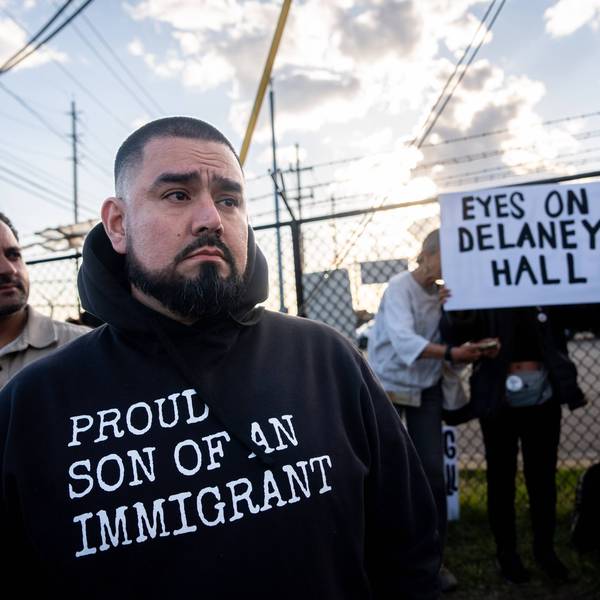
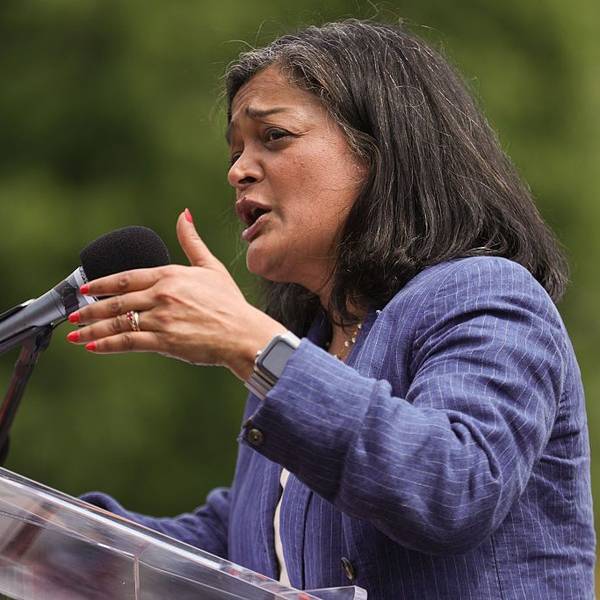
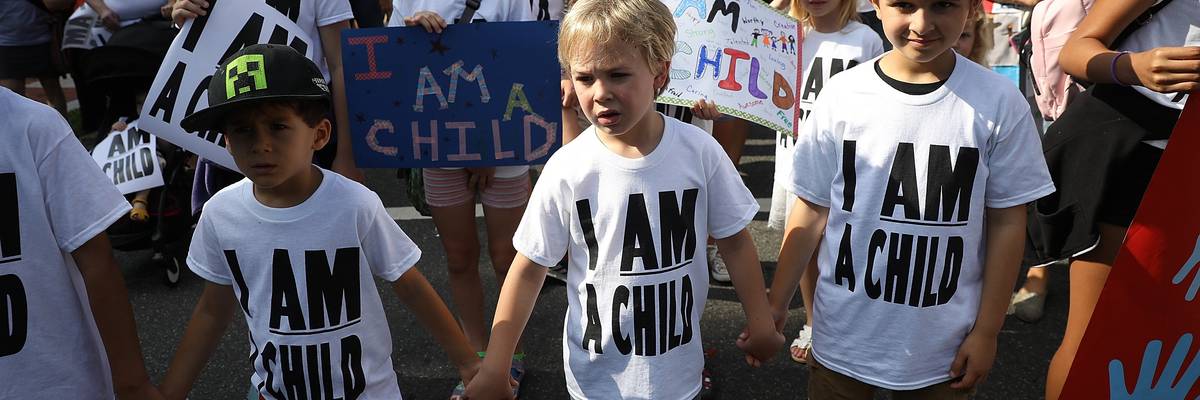
Protesters and their children participate in a march prior to a sit-in in the Hart Senate Office Building to mark the court-ordered deadline for the Trump administration to reunify thousands of families separated at the border July 26, 2018 in Washington, DC.
(Photo by Win McNamee/Getty Images)
When ICE Detains a Father, a Child Pays the Price
As Father's Day approaches, many children are already missing fathers they were unfairly separated from, not because those fathers failed their children, but because of a failed immigration system that is increasingly willing to separate families.
Jun 19, 2026
When I was little, I’d wake up when I heard my dad getting ready for work. I’d run downstairs hoping to catch him before he left so I could hug him goodbye. My father, an immigrant from India, came to the United States as a child with my grandparents in search of stability and opportunity. They worked hard to build a life here, and I grew up watching my dad do the same—out the door early, home late.
Sometimes I cried if I missed him before he left. Sometimes I cried even after a hug, because the day felt so long without him. But there was one thing I never questioned: He would come home.
Too many children in immigrant families don’t have that certainty today. In recent months, high-profile cases have shown how quickly stability can disappear, as families are swept into immigration enforcement and children are separated from their parents, often with little warning. New research from the Brookings Institution estimates that more than 100,000 children have been separated from a parent during the Trump administration’s immigration crackdown, and that most of those children are likely US citizens. Researchers also warn the true scale may be even higher because the government does not consistently track whether detained immigrants are parents.
A father can leave for a shift and not come back, not because he chose to abandon his family, but because immigration agents arrested him on his way to work, during a scheduled court check-in, or even in everyday places like airports. In recent weeks, Immigration and Customs Enforcement (ICE) agents have been deployed in airports across the country, where travelers have witnessed arrests unfold in real time. We are already seeing the consequences in deeply troubling ways, including the case of 5-year-old Liam Conejo Ramos in Minnesota, whose detention alongside his father drew national attention.
For years, politicians have lamented a “fatherlessness crisis.” We should name what we are doing when we detain and deport fathers without regard for their children. We are actively manufacturing it.
When parents are detained, children are often pulled into the system with them, or families are left scrambling to stay together. Recent court filings describe hundreds of children held in family detention facilities beyond court-ordered limits, often without adequate food, medical care, or mental health support. Many other children are left with relatives, neighbors, older siblings, or informal caregivers while parents remain in detention or face deportation proceedings, forcing children to navigate sudden loss and uncertainty.
According to federal data compiled by TRAC, more than 60,000 people are currently held in ICE detention, and nearly three-quarters have no criminal conviction. The Trump administration claims that ICE targets “the worst of the worst,” but the data tell a different story. Because immigration arrests disproportionately target working-age men, many detained are likely fathers. That gap matters deeply in a country where more than 4 million US citizen children live with an undocumented parent. That omission makes it easier to debate immigration enforcement policy while overlooking the children who are directly impacted. Even if only a fraction of those detained are parents, that still means thousands of children losing a caregiver, a provider, or both, frequently overnight. They are neighbors and community members, often fathers who were actively raising their children until the day the government took them away. I know this not only from policy data, but from listening to fathers talk about their children.
As a senior policy researcher at Children’s Rights, I study how family stability shapes a child’s well-being and how quickly it can be shattered by the government. We have found that current immigration policies are not only separating families but causing measurable harm to children, including mental health challenges, developmental delays, and disruptions to their education. Federal data show children being held in immigration custody for months at a time, often averaging more than 150 days, exposing them to prolonged instability and stress.
In a qualitative study published in the Journal of Child and Family Studies, my co-authors and I interviewed 85 Latino fathers raising young children in the United States. Many were immigrants, primarily from Mexico, El Salvador, and Guatemala. They spoke about love and connection, wanting to be present, witness milestones, and serve as role models. They reflected on their own parents and their hopes for their children. They described the burdens of responsibility, but also of joy. They sounded like parents everywhere, underscoring how universal these parenting motivations are.
That is why detaining fathers is not just harsh, it is shortsighted. Decades of research show fathers play a unique role in children’s emotional well-being, behavior, and learning. When the government removes a father without warning, holds him for weeks or months, and ultimately deports him, children do not experience it as “policy.” They experience it as a profound loss.
As Father’s Day approaches, I am thinking about the fathers who show up for their children every day, who work long hours, provide stability, and try to build better futures for their families. Across the country, many children are already missing fathers they were unfairly separated from. Not because those fathers failed their children, but because of a failed immigration system that is increasingly willing to separate families.
For years, politicians have lamented a “fatherlessness crisis.” We should name what we are doing when we detain and deport fathers without regard for their children. We are actively manufacturing it. If we truly care about children’s health and well-being, we must treat family integrity and stability as essential.
Congress and the administration should require ICE to collect and publicly report whether those it detains are parents of minor children, and ensure children are not left without safe caregiving arrangements. This is especially urgent given recent reporting that ICE is failing to follow its own policies designed to protect family unity, including requirements that agents ask whether someone has children and allow parents to make decisions about their care. ICE should use detention more sparingly for parents and expand community-based alternatives that allow people to keep working and caring for their children while their cases proceed.
I still picture my younger self at the top of the stairs, running toward my father’s morning hug. Every child deserves to believe, with confidence, that a parent who leaves in the morning will come home at night.
An Urgent Message From Our Co-Founder
Dear Common Dreams reader, It’s been nearly 30 years since I co-founded Common Dreams with my late wife, Lina Newhouser. We had the radical notion that journalism should serve the public good, not corporate profits. It was clear to us from the outset what it would take to build such a project. No paid advertisements. No corporate sponsors. No millionaire publisher telling us what to think or do. Many people said we wouldn't last a year, but we proved those doubters wrong. Together with a tremendous team of journalists and dedicated staff, we built an independent media outlet free from the constraints of profits and corporate control. Our mission has always been simple: To inform. To inspire. To ignite change for the common good. Building Common Dreams was not easy. Our survival was never guaranteed. When you take on the most powerful forces—Wall Street greed, fossil fuel industry destruction, Big Tech lobbyists, and uber-rich oligarchs who have spent billions upon billions rigging the economy and democracy in their favor—the only bulwark you have is supporters who believe in your work. But here’s the urgent message from me today. It's never been this bad out there. And it's never been this hard to keep us going. At the very moment Common Dreams is most needed, the threats we face are intensifying. We need your support now more than ever. We don't accept corporate advertising and never will. We don't have a paywall because we don't think people should be blocked from critical news based on their ability to pay. Everything we do is funded by the donations of readers like you. When everyone does the little they can afford, we are strong. But if that support retreats or dries up, so do we. Will you donate now to make sure Common Dreams not only survives but thrives? —Craig Brown, Co-founder |
Our work is licensed under Creative Commons (CC BY-NC-ND 3.0). Feel free to republish and share widely.
Rachel Ghosh is a senior policy researcher at Children’s Rights, a national advocacy organization working to protect and advance the rights of children impacted by government systems, including foster care, immigration enforcement, and family separation.
immigration and customs enforcement
trump administration
children's rights
immigration detention
family separation
When I was little, I’d wake up when I heard my dad getting ready for work. I’d run downstairs hoping to catch him before he left so I could hug him goodbye. My father, an immigrant from India, came to the United States as a child with my grandparents in search of stability and opportunity. They worked hard to build a life here, and I grew up watching my dad do the same—out the door early, home late.
Sometimes I cried if I missed him before he left. Sometimes I cried even after a hug, because the day felt so long without him. But there was one thing I never questioned: He would come home.
Too many children in immigrant families don’t have that certainty today. In recent months, high-profile cases have shown how quickly stability can disappear, as families are swept into immigration enforcement and children are separated from their parents, often with little warning. New research from the Brookings Institution estimates that more than 100,000 children have been separated from a parent during the Trump administration’s immigration crackdown, and that most of those children are likely US citizens. Researchers also warn the true scale may be even higher because the government does not consistently track whether detained immigrants are parents.
A father can leave for a shift and not come back, not because he chose to abandon his family, but because immigration agents arrested him on his way to work, during a scheduled court check-in, or even in everyday places like airports. In recent weeks, Immigration and Customs Enforcement (ICE) agents have been deployed in airports across the country, where travelers have witnessed arrests unfold in real time. We are already seeing the consequences in deeply troubling ways, including the case of 5-year-old Liam Conejo Ramos in Minnesota, whose detention alongside his father drew national attention.
For years, politicians have lamented a “fatherlessness crisis.” We should name what we are doing when we detain and deport fathers without regard for their children. We are actively manufacturing it.
When parents are detained, children are often pulled into the system with them, or families are left scrambling to stay together. Recent court filings describe hundreds of children held in family detention facilities beyond court-ordered limits, often without adequate food, medical care, or mental health support. Many other children are left with relatives, neighbors, older siblings, or informal caregivers while parents remain in detention or face deportation proceedings, forcing children to navigate sudden loss and uncertainty.
According to federal data compiled by TRAC, more than 60,000 people are currently held in ICE detention, and nearly three-quarters have no criminal conviction. The Trump administration claims that ICE targets “the worst of the worst,” but the data tell a different story. Because immigration arrests disproportionately target working-age men, many detained are likely fathers. That gap matters deeply in a country where more than 4 million US citizen children live with an undocumented parent. That omission makes it easier to debate immigration enforcement policy while overlooking the children who are directly impacted. Even if only a fraction of those detained are parents, that still means thousands of children losing a caregiver, a provider, or both, frequently overnight. They are neighbors and community members, often fathers who were actively raising their children until the day the government took them away. I know this not only from policy data, but from listening to fathers talk about their children.
As a senior policy researcher at Children’s Rights, I study how family stability shapes a child’s well-being and how quickly it can be shattered by the government. We have found that current immigration policies are not only separating families but causing measurable harm to children, including mental health challenges, developmental delays, and disruptions to their education. Federal data show children being held in immigration custody for months at a time, often averaging more than 150 days, exposing them to prolonged instability and stress.
In a qualitative study published in the Journal of Child and Family Studies, my co-authors and I interviewed 85 Latino fathers raising young children in the United States. Many were immigrants, primarily from Mexico, El Salvador, and Guatemala. They spoke about love and connection, wanting to be present, witness milestones, and serve as role models. They reflected on their own parents and their hopes for their children. They described the burdens of responsibility, but also of joy. They sounded like parents everywhere, underscoring how universal these parenting motivations are.
That is why detaining fathers is not just harsh, it is shortsighted. Decades of research show fathers play a unique role in children’s emotional well-being, behavior, and learning. When the government removes a father without warning, holds him for weeks or months, and ultimately deports him, children do not experience it as “policy.” They experience it as a profound loss.
As Father’s Day approaches, I am thinking about the fathers who show up for their children every day, who work long hours, provide stability, and try to build better futures for their families. Across the country, many children are already missing fathers they were unfairly separated from. Not because those fathers failed their children, but because of a failed immigration system that is increasingly willing to separate families.
For years, politicians have lamented a “fatherlessness crisis.” We should name what we are doing when we detain and deport fathers without regard for their children. We are actively manufacturing it. If we truly care about children’s health and well-being, we must treat family integrity and stability as essential.
Congress and the administration should require ICE to collect and publicly report whether those it detains are parents of minor children, and ensure children are not left without safe caregiving arrangements. This is especially urgent given recent reporting that ICE is failing to follow its own policies designed to protect family unity, including requirements that agents ask whether someone has children and allow parents to make decisions about their care. ICE should use detention more sparingly for parents and expand community-based alternatives that allow people to keep working and caring for their children while their cases proceed.
I still picture my younger self at the top of the stairs, running toward my father’s morning hug. Every child deserves to believe, with confidence, that a parent who leaves in the morning will come home at night.
From Your Site Articles
- After 'Heartless' ICE Refusal, Judge Orders Officials to Allow Mahmoud Khalil to See His Family ›
- Ahead of Father’s Day, Celebrity Dads Share Mahmoud Khalil’s Letter to His Newborn Son ›
- 'Unimaginable Cruelty': ICE Denies Father's Request to Attend Son's Funeral ›
- 'Absolutely Vile': ICE Snatches Young Kids From Minnesota Schools, Sends Them to Texas ›
- ICE Deporting Parents Without Allowing Them to Bring or Find Care for Children: Report ›
Rachel Ghosh is a senior policy researcher at Children’s Rights, a national advocacy organization working to protect and advance the rights of children impacted by government systems, including foster care, immigration enforcement, and family separation.
When I was little, I’d wake up when I heard my dad getting ready for work. I’d run downstairs hoping to catch him before he left so I could hug him goodbye. My father, an immigrant from India, came to the United States as a child with my grandparents in search of stability and opportunity. They worked hard to build a life here, and I grew up watching my dad do the same—out the door early, home late.
Sometimes I cried if I missed him before he left. Sometimes I cried even after a hug, because the day felt so long without him. But there was one thing I never questioned: He would come home.
Too many children in immigrant families don’t have that certainty today. In recent months, high-profile cases have shown how quickly stability can disappear, as families are swept into immigration enforcement and children are separated from their parents, often with little warning. New research from the Brookings Institution estimates that more than 100,000 children have been separated from a parent during the Trump administration’s immigration crackdown, and that most of those children are likely US citizens. Researchers also warn the true scale may be even higher because the government does not consistently track whether detained immigrants are parents.
A father can leave for a shift and not come back, not because he chose to abandon his family, but because immigration agents arrested him on his way to work, during a scheduled court check-in, or even in everyday places like airports. In recent weeks, Immigration and Customs Enforcement (ICE) agents have been deployed in airports across the country, where travelers have witnessed arrests unfold in real time. We are already seeing the consequences in deeply troubling ways, including the case of 5-year-old Liam Conejo Ramos in Minnesota, whose detention alongside his father drew national attention.
For years, politicians have lamented a “fatherlessness crisis.” We should name what we are doing when we detain and deport fathers without regard for their children. We are actively manufacturing it.
When parents are detained, children are often pulled into the system with them, or families are left scrambling to stay together. Recent court filings describe hundreds of children held in family detention facilities beyond court-ordered limits, often without adequate food, medical care, or mental health support. Many other children are left with relatives, neighbors, older siblings, or informal caregivers while parents remain in detention or face deportation proceedings, forcing children to navigate sudden loss and uncertainty.
According to federal data compiled by TRAC, more than 60,000 people are currently held in ICE detention, and nearly three-quarters have no criminal conviction. The Trump administration claims that ICE targets “the worst of the worst,” but the data tell a different story. Because immigration arrests disproportionately target working-age men, many detained are likely fathers. That gap matters deeply in a country where more than 4 million US citizen children live with an undocumented parent. That omission makes it easier to debate immigration enforcement policy while overlooking the children who are directly impacted. Even if only a fraction of those detained are parents, that still means thousands of children losing a caregiver, a provider, or both, frequently overnight. They are neighbors and community members, often fathers who were actively raising their children until the day the government took them away. I know this not only from policy data, but from listening to fathers talk about their children.
As a senior policy researcher at Children’s Rights, I study how family stability shapes a child’s well-being and how quickly it can be shattered by the government. We have found that current immigration policies are not only separating families but causing measurable harm to children, including mental health challenges, developmental delays, and disruptions to their education. Federal data show children being held in immigration custody for months at a time, often averaging more than 150 days, exposing them to prolonged instability and stress.
In a qualitative study published in the Journal of Child and Family Studies, my co-authors and I interviewed 85 Latino fathers raising young children in the United States. Many were immigrants, primarily from Mexico, El Salvador, and Guatemala. They spoke about love and connection, wanting to be present, witness milestones, and serve as role models. They reflected on their own parents and their hopes for their children. They described the burdens of responsibility, but also of joy. They sounded like parents everywhere, underscoring how universal these parenting motivations are.
That is why detaining fathers is not just harsh, it is shortsighted. Decades of research show fathers play a unique role in children’s emotional well-being, behavior, and learning. When the government removes a father without warning, holds him for weeks or months, and ultimately deports him, children do not experience it as “policy.” They experience it as a profound loss.
As Father’s Day approaches, I am thinking about the fathers who show up for their children every day, who work long hours, provide stability, and try to build better futures for their families. Across the country, many children are already missing fathers they were unfairly separated from. Not because those fathers failed their children, but because of a failed immigration system that is increasingly willing to separate families.
For years, politicians have lamented a “fatherlessness crisis.” We should name what we are doing when we detain and deport fathers without regard for their children. We are actively manufacturing it. If we truly care about children’s health and well-being, we must treat family integrity and stability as essential.
Congress and the administration should require ICE to collect and publicly report whether those it detains are parents of minor children, and ensure children are not left without safe caregiving arrangements. This is especially urgent given recent reporting that ICE is failing to follow its own policies designed to protect family unity, including requirements that agents ask whether someone has children and allow parents to make decisions about their care. ICE should use detention more sparingly for parents and expand community-based alternatives that allow people to keep working and caring for their children while their cases proceed.
I still picture my younger self at the top of the stairs, running toward my father’s morning hug. Every child deserves to believe, with confidence, that a parent who leaves in the morning will come home at night.
From Your Site Articles
- After 'Heartless' ICE Refusal, Judge Orders Officials to Allow Mahmoud Khalil to See His Family ›
- Ahead of Father’s Day, Celebrity Dads Share Mahmoud Khalil’s Letter to His Newborn Son ›
- 'Unimaginable Cruelty': ICE Denies Father's Request to Attend Son's Funeral ›
- 'Absolutely Vile': ICE Snatches Young Kids From Minnesota Schools, Sends Them to Texas ›
- ICE Deporting Parents Without Allowing Them to Bring or Find Care for Children: Report ›
immigration and customs enforcement
trump administration
children's rights
immigration detention
family separation
We've had enough. The 1% own and operate the corporate media. They are doing everything they can to defend the status quo, squash dissent and protect the wealthy and the powerful. The Common Dreams media model is different. We cover the news that matters to the 99%. Our mission? To inform. To inspire. To ignite change for the common good. How? Nonprofit. Independent. Reader-supported. Free to read. Free to republish. Free to share. With no advertising. No paywalls. No selling of your data. Thousands of small donations fund our newsroom and allow us to continue publishing. Can you chip in? We can't do it without you. Thank you.