SUBSCRIBE TO OUR FREE NEWSLETTER
Daily news & progressive opinion—funded by the people, not the corporations—delivered straight to your inbox.
5
#000000
#FFFFFF
To donate by check, phone, or other method, see our More Ways to Give page.
Daily news & progressive opinion—funded by the people, not the corporations—delivered straight to your inbox.
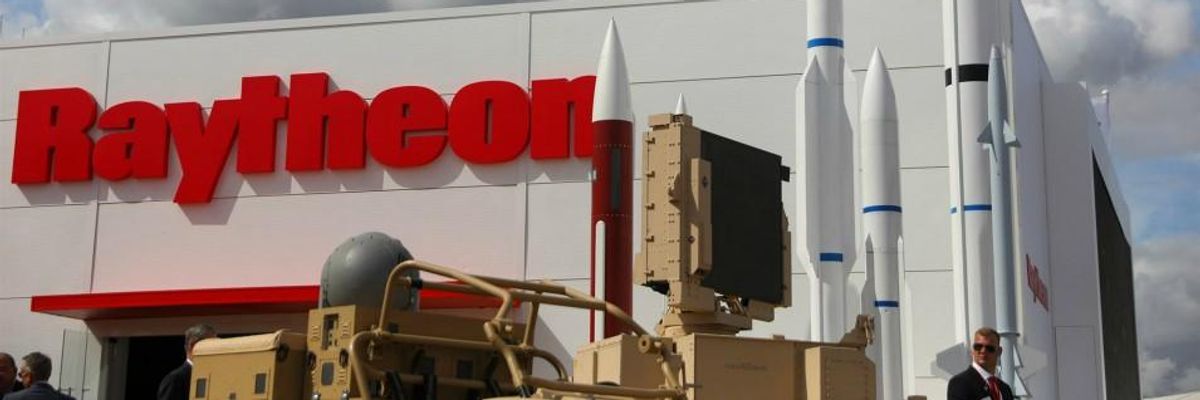
Raytheon Technologies is the world's fourth-largest seller of weapons. (Photo: Simon Dawson/Bloomberg via Getty Images)
Sixty years to the month after President Dwight D. Eisenhower prophetically warned against the "unwarranted influence" of the "military-industrial complex" in his farewell address, the chief executive of one of the world's biggest weapons makers affirmed that ongoing war in the Middle East is good for business.
"Look, peace is not going to break out in the Middle East anytime soon. I think it remains an area where we'll continue to see solid growth."
--Greg Hayes, Raytheon CEO
During a Tuesday earnings call, Raytheon Technologies CEO Greg Hayes told investors he anticipated the Biden administration would temporarily block the sale of 7,500 of his company's Paveway bombs to Saudi Arabia, a nearly $500 million deal sealed during the final months of former President Donald Trump's tenure. Hayes quasi-cryptically said that a certain "offensive weapons system" to a certain "customer in the Middle East [who] we can't talk about" was coming off the company's books.
No single sale, not even one for half a billion dollars worth of so-called precision bombs, is going to seriously dent Raytheon's profits. On Tuesday's earnings call, Hayes sounded upbeat: "Look," he told investors, "peace is not going to break out in the Middle East anytime soon. I think it remains an area where we'll continue to see solid growth."
The women-led peace group CodePink tweeted that Hayes, "who makes a killing on killing... gets our taxpayer money to profit off war":
Unlike Trump, the new administration appears far more concerned about the Saudi-led war in Yemen, which has killed well over 100,000 people, many of them with weapons made in and sold by the United States. Fulfilling a campaign promise, President Joe Biden is freezing arms sales to the Saudis, and to the United Arab Emirates, pending further review.
Such sales are nothing new. In January 1957, Eisenhower proclaimed the eponymous doctrine extending U.S. military aid to any Middle Eastern nation beset by the bugaboo of Soviet-led international communism. The Cold War meant hot sales for the likes of Raytheon, which in addition to pioneering microwave ovens was at the time turning out cutting-edge missiles that would change the ways wars were fought.
Wars haven't stopped being fought in the Middle East--in no small part due to incessant U.S. intervention in the region--and today Raytheon is a $100 billion behemoth that, with over $25 billion in annual sales, is the world's fourth-largest weapons seller.
Raytheon enjoyed solid growth in 2018, beating Wall Street analysts' estimates while on the way to $27 billion in annual sales. In April of that year, a Raytheon Paveway II laser-guided bomb dropped by a Saudi-led coalition warplane struck a wedding party in Hajjah governate, northern Yemen, killing the bride and dozens of other people and wounding scores more, including the groom and nearly 60 children.
Amina Al-Shahb, mother of the groom, described the scene:
The blood was everywhere. Fingers and intestines were in all directions. Body parts were on trees and rocks and people tried to collect as many of them as possible and the remaining body parts were eaten by dogs.
That year, Hayes' total compensation was over $17.5 million. Last year, as Raytheon slashed salaries for thousands of its employees during the worsening coronavirus pandemic, it tweaked its stock payout calculations, leading to an additional $12.5 million windfall for the CEO.
The pandemic has witnessed historic levels of economic distress in the United States, and along with all the bombs and bullets has exacerbated the most acute hardship and hunger Yemenis have experienced in modern times.
Shortly after taking office in 1953, as U.S. bombs and bullets were still killing off an estimated 20% of North Korea's population, Eisenhower said that "every gun that is made, every warship launched, every rocket fired signifies, in the final sense, a theft from those who hunger and are not fed, those who are cold and are not clothed."
"This is not a way of life at all, in any true sense," Eisenhower added. "Under the cloud of threatening war, it is humanity hanging from a cross of iron."
Dear Common Dreams reader, It’s been nearly 30 years since I co-founded Common Dreams with my late wife, Lina Newhouser. We had the radical notion that journalism should serve the public good, not corporate profits. It was clear to us from the outset what it would take to build such a project. No paid advertisements. No corporate sponsors. No millionaire publisher telling us what to think or do. Many people said we wouldn't last a year, but we proved those doubters wrong. Together with a tremendous team of journalists and dedicated staff, we built an independent media outlet free from the constraints of profits and corporate control. Our mission has always been simple: To inform. To inspire. To ignite change for the common good. Building Common Dreams was not easy. Our survival was never guaranteed. When you take on the most powerful forces—Wall Street greed, fossil fuel industry destruction, Big Tech lobbyists, and uber-rich oligarchs who have spent billions upon billions rigging the economy and democracy in their favor—the only bulwark you have is supporters who believe in your work. But here’s the urgent message from me today. It's never been this bad out there. And it's never been this hard to keep us going. At the very moment Common Dreams is most needed, the threats we face are intensifying. We need your support now more than ever. We don't accept corporate advertising and never will. We don't have a paywall because we don't think people should be blocked from critical news based on their ability to pay. Everything we do is funded by the donations of readers like you. When everyone does the little they can afford, we are strong. But if that support retreats or dries up, so do we. Will you donate now to make sure Common Dreams not only survives but thrives? —Craig Brown, Co-founder |
Sixty years to the month after President Dwight D. Eisenhower prophetically warned against the "unwarranted influence" of the "military-industrial complex" in his farewell address, the chief executive of one of the world's biggest weapons makers affirmed that ongoing war in the Middle East is good for business.
"Look, peace is not going to break out in the Middle East anytime soon. I think it remains an area where we'll continue to see solid growth."
--Greg Hayes, Raytheon CEO
During a Tuesday earnings call, Raytheon Technologies CEO Greg Hayes told investors he anticipated the Biden administration would temporarily block the sale of 7,500 of his company's Paveway bombs to Saudi Arabia, a nearly $500 million deal sealed during the final months of former President Donald Trump's tenure. Hayes quasi-cryptically said that a certain "offensive weapons system" to a certain "customer in the Middle East [who] we can't talk about" was coming off the company's books.
No single sale, not even one for half a billion dollars worth of so-called precision bombs, is going to seriously dent Raytheon's profits. On Tuesday's earnings call, Hayes sounded upbeat: "Look," he told investors, "peace is not going to break out in the Middle East anytime soon. I think it remains an area where we'll continue to see solid growth."
The women-led peace group CodePink tweeted that Hayes, "who makes a killing on killing... gets our taxpayer money to profit off war":
Unlike Trump, the new administration appears far more concerned about the Saudi-led war in Yemen, which has killed well over 100,000 people, many of them with weapons made in and sold by the United States. Fulfilling a campaign promise, President Joe Biden is freezing arms sales to the Saudis, and to the United Arab Emirates, pending further review.
Such sales are nothing new. In January 1957, Eisenhower proclaimed the eponymous doctrine extending U.S. military aid to any Middle Eastern nation beset by the bugaboo of Soviet-led international communism. The Cold War meant hot sales for the likes of Raytheon, which in addition to pioneering microwave ovens was at the time turning out cutting-edge missiles that would change the ways wars were fought.
Wars haven't stopped being fought in the Middle East--in no small part due to incessant U.S. intervention in the region--and today Raytheon is a $100 billion behemoth that, with over $25 billion in annual sales, is the world's fourth-largest weapons seller.
Raytheon enjoyed solid growth in 2018, beating Wall Street analysts' estimates while on the way to $27 billion in annual sales. In April of that year, a Raytheon Paveway II laser-guided bomb dropped by a Saudi-led coalition warplane struck a wedding party in Hajjah governate, northern Yemen, killing the bride and dozens of other people and wounding scores more, including the groom and nearly 60 children.
Amina Al-Shahb, mother of the groom, described the scene:
The blood was everywhere. Fingers and intestines were in all directions. Body parts were on trees and rocks and people tried to collect as many of them as possible and the remaining body parts were eaten by dogs.
That year, Hayes' total compensation was over $17.5 million. Last year, as Raytheon slashed salaries for thousands of its employees during the worsening coronavirus pandemic, it tweaked its stock payout calculations, leading to an additional $12.5 million windfall for the CEO.
The pandemic has witnessed historic levels of economic distress in the United States, and along with all the bombs and bullets has exacerbated the most acute hardship and hunger Yemenis have experienced in modern times.
Shortly after taking office in 1953, as U.S. bombs and bullets were still killing off an estimated 20% of North Korea's population, Eisenhower said that "every gun that is made, every warship launched, every rocket fired signifies, in the final sense, a theft from those who hunger and are not fed, those who are cold and are not clothed."
"This is not a way of life at all, in any true sense," Eisenhower added. "Under the cloud of threatening war, it is humanity hanging from a cross of iron."
Sixty years to the month after President Dwight D. Eisenhower prophetically warned against the "unwarranted influence" of the "military-industrial complex" in his farewell address, the chief executive of one of the world's biggest weapons makers affirmed that ongoing war in the Middle East is good for business.
"Look, peace is not going to break out in the Middle East anytime soon. I think it remains an area where we'll continue to see solid growth."
--Greg Hayes, Raytheon CEO
During a Tuesday earnings call, Raytheon Technologies CEO Greg Hayes told investors he anticipated the Biden administration would temporarily block the sale of 7,500 of his company's Paveway bombs to Saudi Arabia, a nearly $500 million deal sealed during the final months of former President Donald Trump's tenure. Hayes quasi-cryptically said that a certain "offensive weapons system" to a certain "customer in the Middle East [who] we can't talk about" was coming off the company's books.
No single sale, not even one for half a billion dollars worth of so-called precision bombs, is going to seriously dent Raytheon's profits. On Tuesday's earnings call, Hayes sounded upbeat: "Look," he told investors, "peace is not going to break out in the Middle East anytime soon. I think it remains an area where we'll continue to see solid growth."
The women-led peace group CodePink tweeted that Hayes, "who makes a killing on killing... gets our taxpayer money to profit off war":
Unlike Trump, the new administration appears far more concerned about the Saudi-led war in Yemen, which has killed well over 100,000 people, many of them with weapons made in and sold by the United States. Fulfilling a campaign promise, President Joe Biden is freezing arms sales to the Saudis, and to the United Arab Emirates, pending further review.
Such sales are nothing new. In January 1957, Eisenhower proclaimed the eponymous doctrine extending U.S. military aid to any Middle Eastern nation beset by the bugaboo of Soviet-led international communism. The Cold War meant hot sales for the likes of Raytheon, which in addition to pioneering microwave ovens was at the time turning out cutting-edge missiles that would change the ways wars were fought.
Wars haven't stopped being fought in the Middle East--in no small part due to incessant U.S. intervention in the region--and today Raytheon is a $100 billion behemoth that, with over $25 billion in annual sales, is the world's fourth-largest weapons seller.
Raytheon enjoyed solid growth in 2018, beating Wall Street analysts' estimates while on the way to $27 billion in annual sales. In April of that year, a Raytheon Paveway II laser-guided bomb dropped by a Saudi-led coalition warplane struck a wedding party in Hajjah governate, northern Yemen, killing the bride and dozens of other people and wounding scores more, including the groom and nearly 60 children.
Amina Al-Shahb, mother of the groom, described the scene:
The blood was everywhere. Fingers and intestines were in all directions. Body parts were on trees and rocks and people tried to collect as many of them as possible and the remaining body parts were eaten by dogs.
That year, Hayes' total compensation was over $17.5 million. Last year, as Raytheon slashed salaries for thousands of its employees during the worsening coronavirus pandemic, it tweaked its stock payout calculations, leading to an additional $12.5 million windfall for the CEO.
The pandemic has witnessed historic levels of economic distress in the United States, and along with all the bombs and bullets has exacerbated the most acute hardship and hunger Yemenis have experienced in modern times.
Shortly after taking office in 1953, as U.S. bombs and bullets were still killing off an estimated 20% of North Korea's population, Eisenhower said that "every gun that is made, every warship launched, every rocket fired signifies, in the final sense, a theft from those who hunger and are not fed, those who are cold and are not clothed."
"This is not a way of life at all, in any true sense," Eisenhower added. "Under the cloud of threatening war, it is humanity hanging from a cross of iron."