
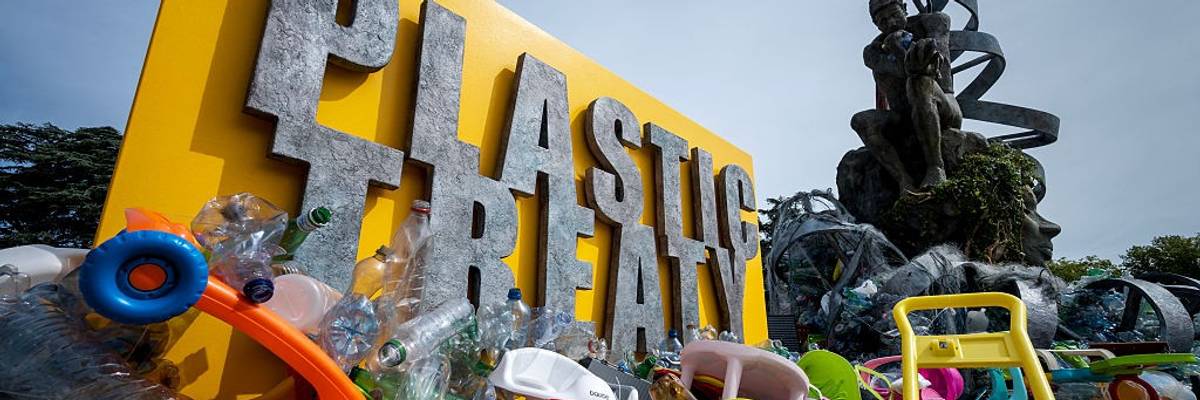
An artwork by Canadian artist, activist, and photographer Benjamin Von Wong entitled "The Thinker's Burden," a 6-meter-tall sculptural remix of Rodin's iconic Thinker, which was created for the Plastics Treaty negotiations, is seen in front of the United Nations Offices in Geneva on August 4, 2025.
There Is Still Hope for an Ambitious Plastics Treaty
The plastics crisis must remain a priority in international negotiations.
Contrary to some reporting, the United Nations Global Plastics Treaty hasn’t failed—but recent talks in Geneva are a blaring wake-up call. If we don’t get this right, human health will suffer for generations, and our climate goals will slip further behind. It is vital that plastics, and the treaty, continue to be a priority in international fora.
Despite 99% of plastics being made from fossil fuel and plastic production projected to triple by 2060, plastics were low on the global agenda at the recently concluded COP30 climate summit. Countries will soon be reconvening at the UN Environmental Assembly (UNEA-7) to confront the world’s biggest environmental problems, presenting another opportunity to restore momentum and align global action on the detrimental environmental, health, and economic impacts of the plastics crisis.
Microplastics are now in even the most remote places on the planet and found throughout human bodies. Thousands of chemicals in plastics have been linked to immune system disorders, hormone imbalances, diabetes, obesity, cancer, and infertility, costing an estimated $1.5 trillion in health-related economic losses every year worldwide.
Despite efforts by countries to delay progress at INC 5.2 in August, high-ambition countries succeeded in rejecting a weak deal that failed to protect people and the planet, recognizing it would do more harm than good and take decades to fix. The talks aren’t over: The chance to deliver a treaty that helps to end the plastic pollution crisis is still on the table. Ambitious countries have yet to use all the tools at their disposal, including voting, to secure real progress.
Stalled by Design
The treaty talks haven’t failed, but deep flaws in the process remain. Countries with heavy fossil fuel interests, or “petrostates”—and the lobbyists backing them—are deliberately delaying progress to protect profits. An estimated 234 fossil fuel, petrochemical, and plastics industry lobbyists flooded the Geneva talks, with some even embedded in country delegations. Their goal is for a toothless treaty—one primarily focused on waste management, with voluntary commitments—or for the process to collapse entirely to safeguard business as usual.
Ambitious countries pushed back, rejecting two watered-down proposals in Geneva that would have created exactly that kind of weak agreement, instead of scaling down plastic production. Most plastic can’t and won’t ever be recycled, but ends up landfilled, incinerated, and polluting our communities and environment.
If we want meaningful climate action, we can’t ignore plastic production.
Despite most countries supporting an agreement that curbs plastic production, bans toxic chemicals, and protects human health, a handful of petrostates have blocked such commonsense provisions under the guise of reaching consensus. While consensus may seem ideal, it gives single countries the power to veto widely supported texts and stand in the way of progress. Meanwhile, participation for Indigenous Peoples, scientists, and public interest nonprofits has not lived up to the promise of an open and transparent process.
These dynamics mirror the long delays that have plagued climate action under the UN Framework Convention on Climate Change for decades. The plastics industry now heats the world four times more than air travel, and serves as a “Plan B” for fossil fuel companies, letting them protect profits, expand markets, and drive more fossil fuel use. If we want meaningful climate action, we can’t ignore plastic production. That makes a strong, legally binding plastics treaty more urgent than ever.
Path Forward
UN member states must act rather than continue negotiating in circles. With the recent resignation of the chair of the Intergovernmental Negotiating Committee (INC), 166 members of Civil Society have sent a letter to member states calling for the new chair, when elected, to fix the process. The next chair must ensure the voices of those harmed first and the worst by plastics—from fossil fuel extraction and plastic production to incineration, landfills, and pollution—are heard.
Countries still have a chance to get the treaty process back on track. The plastics crisis is an all-hands-on-deck moment, requiring governments all around the world to respond at the local, national, regional, and international levels. We are already making progress at the international level, as demonstrated with a groundbreaking resolution at the recent International Union for Conservation of Nature. We need to see more of these kinds of actions, not less.
After all, it was at UNEA-5.2 in 2022 that countries first agreed to negotiate a global plastics treaty.
We cannot afford a weak deal. Ambitious countries must exercise their power to call for a vote when low-ambition petrostates weaponize consensus.
If world leaders fix the process and keep ambition high, a treaty that puts people and the planet before plastics and profits is within reach.
We are at a crossroads
This country and this world are at a monumental crossroads. In a few short weeks, US voters will have an opportunity to beat back the forces of fascism and confront the billionaires who are rigging the economy, our media system, and our democracy, making it increasingly impossible for ordinary people to get by. We’re not just talking about the election. We’re talking about what must be done once these fascist elements are vanquished from power. We need a bolder set of solutions than what either major party has so far been willing to offer and a working-class movement ready to fight like hell for it. Trump didn't emerge from nowhere. The conditions that fueled MAGA authoritarianism were created by decades of radical neoliberal economic policies and a corrupt political system dominated by corporate interests. They slashed taxes on the super-rich, promising that the benefits would trickle down. They said giveaways to the corporate titans would make life more affordable for the rest of us. It was all bullshit. And when a bitter, betrayed populace searches for someone to blame, right-wing demagogues have little trouble finding scapegoats. People know when they're being lied to, but you won't hear any of this from the corporate media. Only independent journalism—powered and funded by people who believe in building a better world—can deliver truly trustworthy daily news. Our Fall Campaign is underway, and we need your help. To power our newsroom through the rest of the year, we need to raise $125,000 by midnight on October 31. So if you share our vision, please contribute whatever you can to sustain our work. |
Contrary to some reporting, the United Nations Global Plastics Treaty hasn’t failed—but recent talks in Geneva are a blaring wake-up call. If we don’t get this right, human health will suffer for generations, and our climate goals will slip further behind. It is vital that plastics, and the treaty, continue to be a priority in international fora.
Despite 99% of plastics being made from fossil fuel and plastic production projected to triple by 2060, plastics were low on the global agenda at the recently concluded COP30 climate summit. Countries will soon be reconvening at the UN Environmental Assembly (UNEA-7) to confront the world’s biggest environmental problems, presenting another opportunity to restore momentum and align global action on the detrimental environmental, health, and economic impacts of the plastics crisis.
Microplastics are now in even the most remote places on the planet and found throughout human bodies. Thousands of chemicals in plastics have been linked to immune system disorders, hormone imbalances, diabetes, obesity, cancer, and infertility, costing an estimated $1.5 trillion in health-related economic losses every year worldwide.
Despite efforts by countries to delay progress at INC 5.2 in August, high-ambition countries succeeded in rejecting a weak deal that failed to protect people and the planet, recognizing it would do more harm than good and take decades to fix. The talks aren’t over: The chance to deliver a treaty that helps to end the plastic pollution crisis is still on the table. Ambitious countries have yet to use all the tools at their disposal, including voting, to secure real progress.
Stalled by Design
The treaty talks haven’t failed, but deep flaws in the process remain. Countries with heavy fossil fuel interests, or “petrostates”—and the lobbyists backing them—are deliberately delaying progress to protect profits. An estimated 234 fossil fuel, petrochemical, and plastics industry lobbyists flooded the Geneva talks, with some even embedded in country delegations. Their goal is for a toothless treaty—one primarily focused on waste management, with voluntary commitments—or for the process to collapse entirely to safeguard business as usual.
Ambitious countries pushed back, rejecting two watered-down proposals in Geneva that would have created exactly that kind of weak agreement, instead of scaling down plastic production. Most plastic can’t and won’t ever be recycled, but ends up landfilled, incinerated, and polluting our communities and environment.
If we want meaningful climate action, we can’t ignore plastic production.
Despite most countries supporting an agreement that curbs plastic production, bans toxic chemicals, and protects human health, a handful of petrostates have blocked such commonsense provisions under the guise of reaching consensus. While consensus may seem ideal, it gives single countries the power to veto widely supported texts and stand in the way of progress. Meanwhile, participation for Indigenous Peoples, scientists, and public interest nonprofits has not lived up to the promise of an open and transparent process.
These dynamics mirror the long delays that have plagued climate action under the UN Framework Convention on Climate Change for decades. The plastics industry now heats the world four times more than air travel, and serves as a “Plan B” for fossil fuel companies, letting them protect profits, expand markets, and drive more fossil fuel use. If we want meaningful climate action, we can’t ignore plastic production. That makes a strong, legally binding plastics treaty more urgent than ever.
Path Forward
UN member states must act rather than continue negotiating in circles. With the recent resignation of the chair of the Intergovernmental Negotiating Committee (INC), 166 members of Civil Society have sent a letter to member states calling for the new chair, when elected, to fix the process. The next chair must ensure the voices of those harmed first and the worst by plastics—from fossil fuel extraction and plastic production to incineration, landfills, and pollution—are heard.
Countries still have a chance to get the treaty process back on track. The plastics crisis is an all-hands-on-deck moment, requiring governments all around the world to respond at the local, national, regional, and international levels. We are already making progress at the international level, as demonstrated with a groundbreaking resolution at the recent International Union for Conservation of Nature. We need to see more of these kinds of actions, not less.
After all, it was at UNEA-5.2 in 2022 that countries first agreed to negotiate a global plastics treaty.
We cannot afford a weak deal. Ambitious countries must exercise their power to call for a vote when low-ambition petrostates weaponize consensus.
If world leaders fix the process and keep ambition high, a treaty that puts people and the planet before plastics and profits is within reach.
- Ahead of Treaty Negotiations, Hundreds March to 'End the Plastic Era' ›
- We Must Not Allow Industry Lobbyists to Destroy Global Plastics Treaty ›
- 187 Countries Just Took 'Crucial' Step to Stop Rich Nations From Treating Global South as Dumping Ground for Plastic Waste ›
- New Study Details How Mass-Scale Reuse Could Help End 'Scourge' of Plastic Pollution ›
- We Need a Global Treaty More Powerful Than the Plastics Industry ›
- Opinion | Why the UN Environment Assembly Is Essential to a Safer, More Resilient Planet | Common Dreams ›
Contrary to some reporting, the United Nations Global Plastics Treaty hasn’t failed—but recent talks in Geneva are a blaring wake-up call. If we don’t get this right, human health will suffer for generations, and our climate goals will slip further behind. It is vital that plastics, and the treaty, continue to be a priority in international fora.
Despite 99% of plastics being made from fossil fuel and plastic production projected to triple by 2060, plastics were low on the global agenda at the recently concluded COP30 climate summit. Countries will soon be reconvening at the UN Environmental Assembly (UNEA-7) to confront the world’s biggest environmental problems, presenting another opportunity to restore momentum and align global action on the detrimental environmental, health, and economic impacts of the plastics crisis.
Microplastics are now in even the most remote places on the planet and found throughout human bodies. Thousands of chemicals in plastics have been linked to immune system disorders, hormone imbalances, diabetes, obesity, cancer, and infertility, costing an estimated $1.5 trillion in health-related economic losses every year worldwide.
Despite efforts by countries to delay progress at INC 5.2 in August, high-ambition countries succeeded in rejecting a weak deal that failed to protect people and the planet, recognizing it would do more harm than good and take decades to fix. The talks aren’t over: The chance to deliver a treaty that helps to end the plastic pollution crisis is still on the table. Ambitious countries have yet to use all the tools at their disposal, including voting, to secure real progress.
Stalled by Design
The treaty talks haven’t failed, but deep flaws in the process remain. Countries with heavy fossil fuel interests, or “petrostates”—and the lobbyists backing them—are deliberately delaying progress to protect profits. An estimated 234 fossil fuel, petrochemical, and plastics industry lobbyists flooded the Geneva talks, with some even embedded in country delegations. Their goal is for a toothless treaty—one primarily focused on waste management, with voluntary commitments—or for the process to collapse entirely to safeguard business as usual.
Ambitious countries pushed back, rejecting two watered-down proposals in Geneva that would have created exactly that kind of weak agreement, instead of scaling down plastic production. Most plastic can’t and won’t ever be recycled, but ends up landfilled, incinerated, and polluting our communities and environment.
If we want meaningful climate action, we can’t ignore plastic production.
Despite most countries supporting an agreement that curbs plastic production, bans toxic chemicals, and protects human health, a handful of petrostates have blocked such commonsense provisions under the guise of reaching consensus. While consensus may seem ideal, it gives single countries the power to veto widely supported texts and stand in the way of progress. Meanwhile, participation for Indigenous Peoples, scientists, and public interest nonprofits has not lived up to the promise of an open and transparent process.
These dynamics mirror the long delays that have plagued climate action under the UN Framework Convention on Climate Change for decades. The plastics industry now heats the world four times more than air travel, and serves as a “Plan B” for fossil fuel companies, letting them protect profits, expand markets, and drive more fossil fuel use. If we want meaningful climate action, we can’t ignore plastic production. That makes a strong, legally binding plastics treaty more urgent than ever.
Path Forward
UN member states must act rather than continue negotiating in circles. With the recent resignation of the chair of the Intergovernmental Negotiating Committee (INC), 166 members of Civil Society have sent a letter to member states calling for the new chair, when elected, to fix the process. The next chair must ensure the voices of those harmed first and the worst by plastics—from fossil fuel extraction and plastic production to incineration, landfills, and pollution—are heard.
Countries still have a chance to get the treaty process back on track. The plastics crisis is an all-hands-on-deck moment, requiring governments all around the world to respond at the local, national, regional, and international levels. We are already making progress at the international level, as demonstrated with a groundbreaking resolution at the recent International Union for Conservation of Nature. We need to see more of these kinds of actions, not less.
After all, it was at UNEA-5.2 in 2022 that countries first agreed to negotiate a global plastics treaty.
We cannot afford a weak deal. Ambitious countries must exercise their power to call for a vote when low-ambition petrostates weaponize consensus.
If world leaders fix the process and keep ambition high, a treaty that puts people and the planet before plastics and profits is within reach.
- Ahead of Treaty Negotiations, Hundreds March to 'End the Plastic Era' ›
- We Must Not Allow Industry Lobbyists to Destroy Global Plastics Treaty ›
- 187 Countries Just Took 'Crucial' Step to Stop Rich Nations From Treating Global South as Dumping Ground for Plastic Waste ›
- New Study Details How Mass-Scale Reuse Could Help End 'Scourge' of Plastic Pollution ›
- We Need a Global Treaty More Powerful Than the Plastics Industry ›
- Opinion | Why the UN Environment Assembly Is Essential to a Safer, More Resilient Planet | Common Dreams ›