
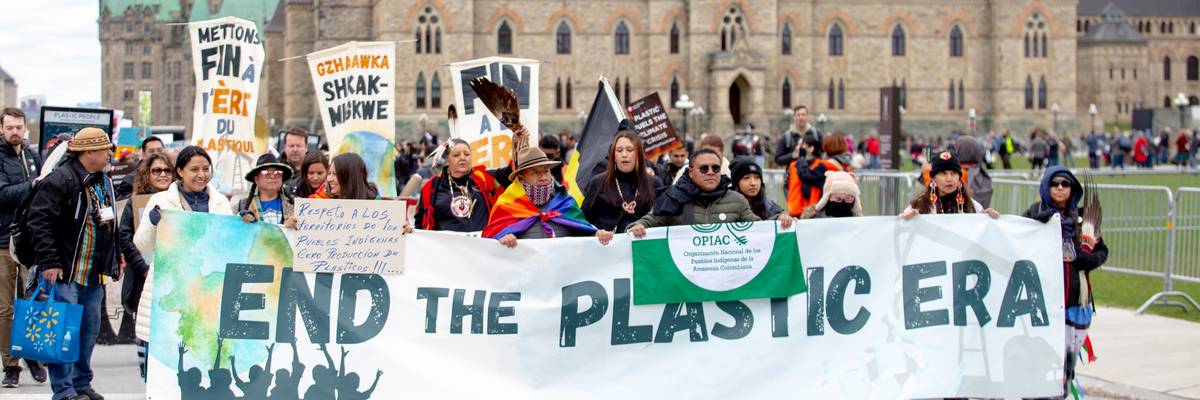
Days before national delegates gather for the fourth and penultimate negotiations to develop a Global Plastics Treaty in Ottawa, Canada, around 500 Indigenous and community representatives, members of civil society and environmental groups, and experts and scientists gathered for a "March to End the Plastic Era" on Sunday.
The protesters, organized under the banner of Break Free From Plastic, called for a treaty that significantly reduces plastic production and centers the frontline communities most impacted by the plastics crisis.
"Delegates must act like our lives depend on it—because they do," Daniela Duran Gonzales, senior legal campaigner with the Center for International Environmental Law, said in a statement. "Our climate goals, the protection of human health, the enjoyment of human rights, and the rights of future generations all rest on whether the future plastics treaty will control and reduce polymers to successfully end the plastic pollution crisis."
"Short-sighted business interests must be out of the room because the only way to achieve equitable livelihoods is when we have a healthy planet."
The official meeting of the Intergovernmental Negotiating Committee (INC) to craft a "international legally binding instrument on plastic pollution, including in the marine environment," will run from April 23 to 29 in the Canadian capital.
Break Free From Plastic called the negotiations a "make or break" moment for the treaty, which is supposed to be completed in late 2024 in Busan, South Korean. However, civil society groups have expressed concern that oil-producing countries and the plastics industry will water down the agreement and steer it toward waste management and recycling, which has been revealed to be a false solution to plastic pollution knowingly promoted by the industry for decades.
The last round of negotiations concluded in late 2023 in Nairobi, Kenya, with little progress made after 143 fossil fuel and chemical lobbyists attended.
Salisa Traipipitsiriwat of Thailand, who is the senior campaigner and Southeast Asia plastics project manager for the Environmental Justice Foundation, said ahead of Sunday's march that it was "crucial for world leaders to step up and put the people and planet at the forefront."
"Short-sighted business interests must be out of the room because the only way to achieve equitable livelihoods is when we have a healthy planet," Traipipitsiriwat added.
On Sunday, marchers gathered for a press conference at 10:30 am ET before marching at around 11:30 am from Parliament Hill to the Shaw Center, were negotiations will begin on Tuesday. Crowds began to disperse around 1:30 pm. Participants carried large banners with messages including, "End the plastic era," "End multigenerational toxic exposure," and pointing out that 99% of plastics came from fossil fuels. The gathering featured live music and art, including a giant tap pouring out plastics and a "Plastisaurus rex" with the message "Make single-use plastic extinct."
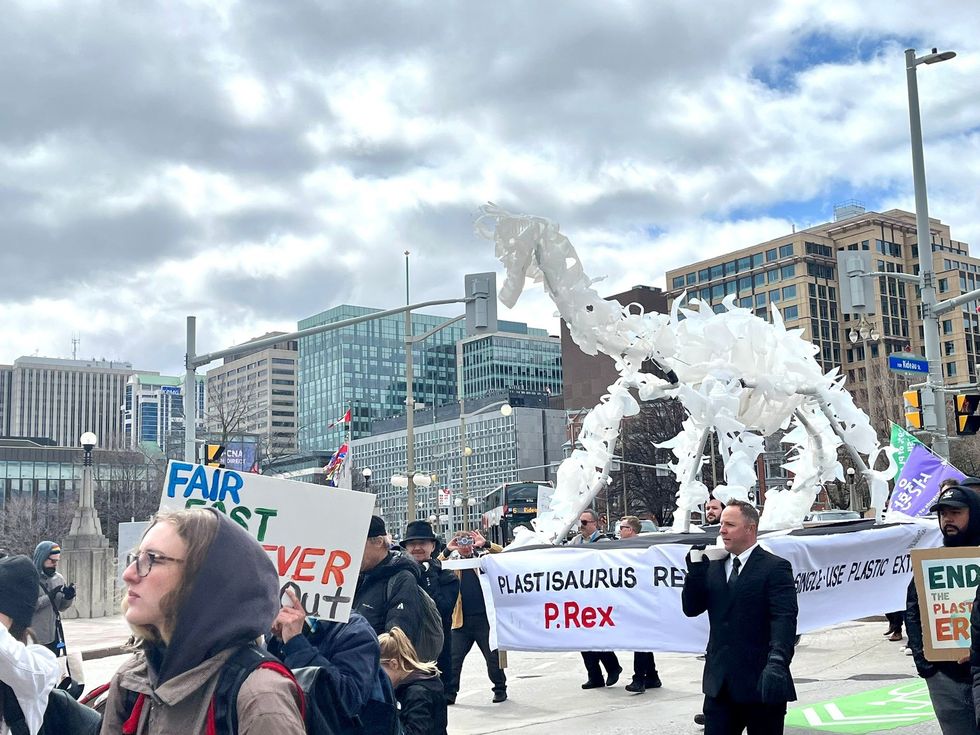 (Photo: Break Free From Plastics)
"Now's the time to be bold and push for a treaty that cuts plastic production and holds polluters accountable," Julie Teel Simmonds, a senior attorney at the Center for Biological Diversity, said in a pre-march statement. "I'm inspired to be joining so many advocates in Ottawa, standing up against the enormous harm the fossil fuel and petrochemical industries are causing to people's health and the planet. I hope to see countries showing ambition this week, and I urge them to remember what's at stake for future generations."
Civil society groups have compiled several demands for an ambitious and effective treaty. These are:
- Centering human rights, especially those of Indigenous communities, young people, and workers most impacted by plastic pollution;
- Protecting the rights of Indigenous peoples throughout the treaty process;
- Dealing with plastics across their entire lifecyle;
- Reducing production as a "nonnegotiable" part of the treaty;
- Eliminating toxic chemicals and additives from plastics;
- Bolstering reuse systems for plastics that are non-toxic;
- Prioritizing first prevention, then reuse, recycling, recovery, and disposal when managing plastic waste;
- Ending "waste colonialism" by strengthening regulations for trading plastics;
- Guaranteeing a "just transition" for people employed across the plastics lifecycle;
- Including "non-party" provisions in the treaty;
- Establishing a mechanism to fund countries so they can fully implement the treaty; and
- Enshrining conflict-of-interest policies as a protection against plastics industry lobbying.
The coalition emphasized the need to tackle the problem of plastic from cradle to grave.
"Plastic doesn't just become pollution when it's thrown away," said Jessica Roff, the U.S. and Canada plastics and petrochemicals program manager for the Global Alliance for Incinerator Alternatives. "Plastic is pollution, from the moment the fossil fuels are extracted from the ground to the eternity of waste it spawns."
Chrie Wilke, global advocacy manager for the Waterkeeper Alliance, said "Clearly the crux of the plastic pollution crisis is too much plastic being produced. There is no way to recycle our way out of this. We must face the fact that plastic and petrochemicals, at current production levels, endanger waterways, communities, and fisheries across the globe. Cutting production and implementing non-plastic alternatives and reuse systems is essential."
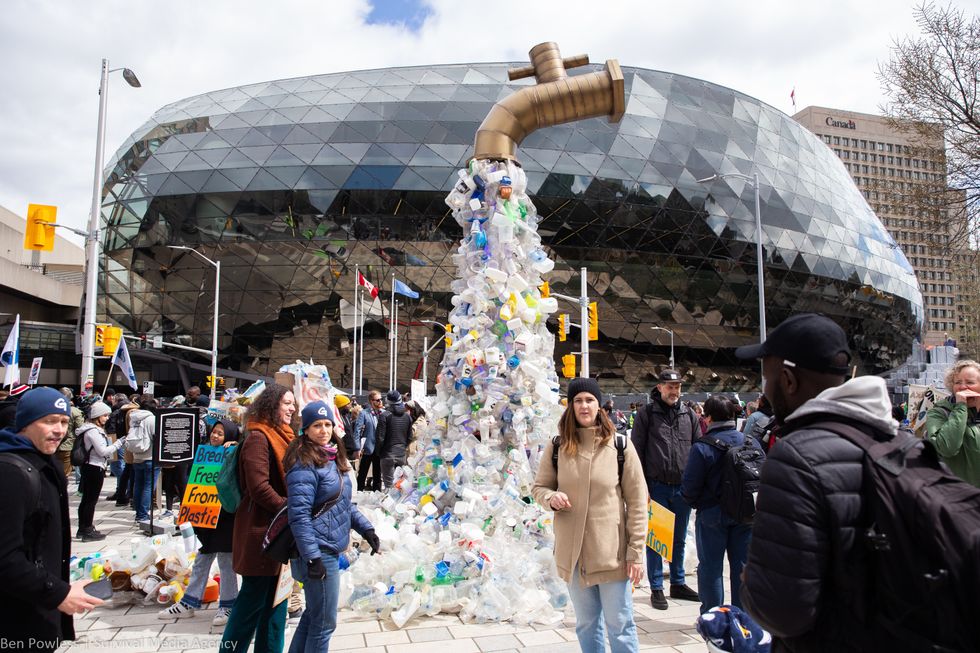 (Photo: Ben Powless/Survival Media Agency)
Activists also emphasized the environmental justice implications of plastic pollution, and how some communities and groups are more burdened than others, both from the dangers of the production process and from waste disposal.
"Children and youth like me suffer the most and are recognized as a vulnerable group," said Aeshnina 'Nina' Azzahra, the founder of River Warrior Indonesia. "My playground and my future are at risk. We all want our environment to be plastic-free, but please don't put your burden on the other side of the world—this is NOT fair. As adults who come to Ottawa to negotiate the plastic treaty, you must protect our rights to live in a healthy and safe environment."
Jo Banner, co-founder and co-directer of The Descendants Project, said:"Frontline community members, such as myself, are participating in these treaty negotiations with heavy hearts as our communities back home are struggling with sickness and disease caused by the upstream production of plastic."
"Although our hearts are heavy, they are full with passion urging negotiators to aim for an ambitious treaty that caps plastic production," Banner added. "Areas such as my hometown, located in the heart of Louisiana's Cancer Alley, need a strong treaty now. There is no more time to waste."
Days before national delegates gather for the fourth and penultimate negotiations to develop a Global Plastics Treaty in Ottawa, Canada, around 500 Indigenous and community representatives, members of civil society and environmental groups, and experts and scientists gathered for a "March to End the Plastic Era" on Sunday.
The protesters, organized under the banner of Break Free From Plastic, called for a treaty that significantly reduces plastic production and centers the frontline communities most impacted by the plastics crisis.
"Delegates must act like our lives depend on it—because they do," Daniela Duran Gonzales, senior legal campaigner with the Center for International Environmental Law, said in a statement. "Our climate goals, the protection of human health, the enjoyment of human rights, and the rights of future generations all rest on whether the future plastics treaty will control and reduce polymers to successfully end the plastic pollution crisis."
"Short-sighted business interests must be out of the room because the only way to achieve equitable livelihoods is when we have a healthy planet."
The official meeting of the Intergovernmental Negotiating Committee (INC) to craft a "international legally binding instrument on plastic pollution, including in the marine environment," will run from April 23 to 29 in the Canadian capital.
Break Free From Plastic called the negotiations a "make or break" moment for the treaty, which is supposed to be completed in late 2024 in Busan, South Korean. However, civil society groups have expressed concern that oil-producing countries and the plastics industry will water down the agreement and steer it toward waste management and recycling, which has been revealed to be a false solution to plastic pollution knowingly promoted by the industry for decades.
The last round of negotiations concluded in late 2023 in Nairobi, Kenya, with little progress made after 143 fossil fuel and chemical lobbyists attended.
Salisa Traipipitsiriwat of Thailand, who is the senior campaigner and Southeast Asia plastics project manager for the Environmental Justice Foundation, said ahead of Sunday's march that it was "crucial for world leaders to step up and put the people and planet at the forefront."
"Short-sighted business interests must be out of the room because the only way to achieve equitable livelihoods is when we have a healthy planet," Traipipitsiriwat added.
On Sunday, marchers gathered for a press conference at 10:30 am ET before marching at around 11:30 am from Parliament Hill to the Shaw Center, were negotiations will begin on Tuesday. Crowds began to disperse around 1:30 pm. Participants carried large banners with messages including, "End the plastic era," "End multigenerational toxic exposure," and pointing out that 99% of plastics came from fossil fuels. The gathering featured live music and art, including a giant tap pouring out plastics and a "Plastisaurus rex" with the message "Make single-use plastic extinct."
(Photo: Break Free From Plastics)
"Now's the time to be bold and push for a treaty that cuts plastic production and holds polluters accountable," Julie Teel Simmonds, a senior attorney at the Center for Biological Diversity, said in a pre-march statement. "I'm inspired to be joining so many advocates in Ottawa, standing up against the enormous harm the fossil fuel and petrochemical industries are causing to people's health and the planet. I hope to see countries showing ambition this week, and I urge them to remember what's at stake for future generations."
Civil society groups have compiled several demands for an ambitious and effective treaty. These are:
- Centering human rights, especially those of Indigenous communities, young people, and workers most impacted by plastic pollution;
- Protecting the rights of Indigenous peoples throughout the treaty process;
- Dealing with plastics across their entire lifecyle;
- Reducing production as a "nonnegotiable" part of the treaty;
- Eliminating toxic chemicals and additives from plastics;
- Bolstering reuse systems for plastics that are non-toxic;
- Prioritizing first prevention, then reuse, recycling, recovery, and disposal when managing plastic waste;
- Ending "waste colonialism" by strengthening regulations for trading plastics;
- Guaranteeing a "just transition" for people employed across the plastics lifecycle;
- Including "non-party" provisions in the treaty;
- Establishing a mechanism to fund countries so they can fully implement the treaty; and
- Enshrining conflict-of-interest policies as a protection against plastics industry lobbying.
The coalition emphasized the need to tackle the problem of plastic from cradle to grave.
"Plastic doesn't just become pollution when it's thrown away," said Jessica Roff, the U.S. and Canada plastics and petrochemicals program manager for the Global Alliance for Incinerator Alternatives. "Plastic is pollution, from the moment the fossil fuels are extracted from the ground to the eternity of waste it spawns."
Chrie Wilke, global advocacy manager for the Waterkeeper Alliance, said "Clearly the crux of the plastic pollution crisis is too much plastic being produced. There is no way to recycle our way out of this. We must face the fact that plastic and petrochemicals, at current production levels, endanger waterways, communities, and fisheries across the globe. Cutting production and implementing non-plastic alternatives and reuse systems is essential."
(Photo: Ben Powless/Survival Media Agency)
Activists also emphasized the environmental justice implications of plastic pollution, and how some communities and groups are more burdened than others, both from the dangers of the production process and from waste disposal.
"Children and youth like me suffer the most and are recognized as a vulnerable group," said Aeshnina 'Nina' Azzahra, the founder of River Warrior Indonesia. "My playground and my future are at risk. We all want our environment to be plastic-free, but please don't put your burden on the other side of the world—this is NOT fair. As adults who come to Ottawa to negotiate the plastic treaty, you must protect our rights to live in a healthy and safe environment."
Jo Banner, co-founder and co-directer of The Descendants Project, said:"Frontline community members, such as myself, are participating in these treaty negotiations with heavy hearts as our communities back home are struggling with sickness and disease caused by the upstream production of plastic."
"Although our hearts are heavy, they are full with passion urging negotiators to aim for an ambitious treaty that caps plastic production," Banner added. "Areas such as my hometown, located in the heart of Louisiana's Cancer Alley, need a strong treaty now. There is no more time to waste."
- 'Progress Almost Invisible': World Set to Produce 220 Million Tonnes of Plastic Waste ›
- Ahead of Plastics Treaty Summit, Studies Make Case for Stopping Pollution at the Source ›
- Study Reveals Up to 11 Million Tons of Plastic Polluting Ocean Floors ›
- To Push for Bold Treaty, Greenpeace Unveils Biden's Plastic Legacy Monument ›
- Starbucks to Eliminate Plastic Straws Following Strong Investor Support for As You Sow Proposal ›
- Opinion | Plastic Poisons People. Will the Biden Administration Protect Us? | Common Dreams ›
- Opinion | From Mardi Gras to Plastic-Free Fridays: The RISE of Sustainable Celebrations | Common Dreams ›
- Opinion | The UN Plastics Treaty Must Confront Fossil Fuel Power | Common Dreams ›
- Opinion | There Is Still Hope for an Ambitious Plastics Treaty | Common Dreams ›
- Opinion | Plastic-Free Friday: Renewal After Mardi Gras in a Transcultural Diasporic Tradition | Common Dreams ›
Days before national delegates gather for the fourth and penultimate negotiations to develop a Global Plastics Treaty in Ottawa, Canada, around 500 Indigenous and community representatives, members of civil society and environmental groups, and experts and scientists gathered for a "March to End the Plastic Era" on Sunday.
The protesters, organized under the banner of Break Free From Plastic, called for a treaty that significantly reduces plastic production and centers the frontline communities most impacted by the plastics crisis.
"Delegates must act like our lives depend on it—because they do," Daniela Duran Gonzales, senior legal campaigner with the Center for International Environmental Law, said in a statement. "Our climate goals, the protection of human health, the enjoyment of human rights, and the rights of future generations all rest on whether the future plastics treaty will control and reduce polymers to successfully end the plastic pollution crisis."
"Short-sighted business interests must be out of the room because the only way to achieve equitable livelihoods is when we have a healthy planet."
The official meeting of the Intergovernmental Negotiating Committee (INC) to craft a "international legally binding instrument on plastic pollution, including in the marine environment," will run from April 23 to 29 in the Canadian capital.
Break Free From Plastic called the negotiations a "make or break" moment for the treaty, which is supposed to be completed in late 2024 in Busan, South Korean. However, civil society groups have expressed concern that oil-producing countries and the plastics industry will water down the agreement and steer it toward waste management and recycling, which has been revealed to be a false solution to plastic pollution knowingly promoted by the industry for decades.
The last round of negotiations concluded in late 2023 in Nairobi, Kenya, with little progress made after 143 fossil fuel and chemical lobbyists attended.
Salisa Traipipitsiriwat of Thailand, who is the senior campaigner and Southeast Asia plastics project manager for the Environmental Justice Foundation, said ahead of Sunday's march that it was "crucial for world leaders to step up and put the people and planet at the forefront."
"Short-sighted business interests must be out of the room because the only way to achieve equitable livelihoods is when we have a healthy planet," Traipipitsiriwat added.
On Sunday, marchers gathered for a press conference at 10:30 am ET before marching at around 11:30 am from Parliament Hill to the Shaw Center, were negotiations will begin on Tuesday. Crowds began to disperse around 1:30 pm. Participants carried large banners with messages including, "End the plastic era," "End multigenerational toxic exposure," and pointing out that 99% of plastics came from fossil fuels. The gathering featured live music and art, including a giant tap pouring out plastics and a "Plastisaurus rex" with the message "Make single-use plastic extinct."
(Photo: Break Free From Plastics)
"Now's the time to be bold and push for a treaty that cuts plastic production and holds polluters accountable," Julie Teel Simmonds, a senior attorney at the Center for Biological Diversity, said in a pre-march statement. "I'm inspired to be joining so many advocates in Ottawa, standing up against the enormous harm the fossil fuel and petrochemical industries are causing to people's health and the planet. I hope to see countries showing ambition this week, and I urge them to remember what's at stake for future generations."
Civil society groups have compiled several demands for an ambitious and effective treaty. These are:
- Centering human rights, especially those of Indigenous communities, young people, and workers most impacted by plastic pollution;
- Protecting the rights of Indigenous peoples throughout the treaty process;
- Dealing with plastics across their entire lifecyle;
- Reducing production as a "nonnegotiable" part of the treaty;
- Eliminating toxic chemicals and additives from plastics;
- Bolstering reuse systems for plastics that are non-toxic;
- Prioritizing first prevention, then reuse, recycling, recovery, and disposal when managing plastic waste;
- Ending "waste colonialism" by strengthening regulations for trading plastics;
- Guaranteeing a "just transition" for people employed across the plastics lifecycle;
- Including "non-party" provisions in the treaty;
- Establishing a mechanism to fund countries so they can fully implement the treaty; and
- Enshrining conflict-of-interest policies as a protection against plastics industry lobbying.
The coalition emphasized the need to tackle the problem of plastic from cradle to grave.
"Plastic doesn't just become pollution when it's thrown away," said Jessica Roff, the U.S. and Canada plastics and petrochemicals program manager for the Global Alliance for Incinerator Alternatives. "Plastic is pollution, from the moment the fossil fuels are extracted from the ground to the eternity of waste it spawns."
Chrie Wilke, global advocacy manager for the Waterkeeper Alliance, said "Clearly the crux of the plastic pollution crisis is too much plastic being produced. There is no way to recycle our way out of this. We must face the fact that plastic and petrochemicals, at current production levels, endanger waterways, communities, and fisheries across the globe. Cutting production and implementing non-plastic alternatives and reuse systems is essential."
(Photo: Ben Powless/Survival Media Agency)
Activists also emphasized the environmental justice implications of plastic pollution, and how some communities and groups are more burdened than others, both from the dangers of the production process and from waste disposal.
"Children and youth like me suffer the most and are recognized as a vulnerable group," said Aeshnina 'Nina' Azzahra, the founder of River Warrior Indonesia. "My playground and my future are at risk. We all want our environment to be plastic-free, but please don't put your burden on the other side of the world—this is NOT fair. As adults who come to Ottawa to negotiate the plastic treaty, you must protect our rights to live in a healthy and safe environment."
Jo Banner, co-founder and co-directer of The Descendants Project, said:"Frontline community members, such as myself, are participating in these treaty negotiations with heavy hearts as our communities back home are struggling with sickness and disease caused by the upstream production of plastic."
"Although our hearts are heavy, they are full with passion urging negotiators to aim for an ambitious treaty that caps plastic production," Banner added. "Areas such as my hometown, located in the heart of Louisiana's Cancer Alley, need a strong treaty now. There is no more time to waste."
- 'Progress Almost Invisible': World Set to Produce 220 Million Tonnes of Plastic Waste ›
- Ahead of Plastics Treaty Summit, Studies Make Case for Stopping Pollution at the Source ›
- Study Reveals Up to 11 Million Tons of Plastic Polluting Ocean Floors ›
- To Push for Bold Treaty, Greenpeace Unveils Biden's Plastic Legacy Monument ›
- Starbucks to Eliminate Plastic Straws Following Strong Investor Support for As You Sow Proposal ›
- Opinion | Plastic Poisons People. Will the Biden Administration Protect Us? | Common Dreams ›
- Opinion | From Mardi Gras to Plastic-Free Fridays: The RISE of Sustainable Celebrations | Common Dreams ›
- Opinion | The UN Plastics Treaty Must Confront Fossil Fuel Power | Common Dreams ›
- Opinion | There Is Still Hope for an Ambitious Plastics Treaty | Common Dreams ›
- Opinion | Plastic-Free Friday: Renewal After Mardi Gras in a Transcultural Diasporic Tradition | Common Dreams ›