SUBSCRIBE TO OUR FREE NEWSLETTER
Daily news & progressive opinion—funded by the people, not the corporations—delivered straight to your inbox.
5
#000000
#FFFFFF
To donate by check, phone, or other method, see our More Ways to Give page.
Daily news & progressive opinion—funded by the people, not the corporations—delivered straight to your inbox.
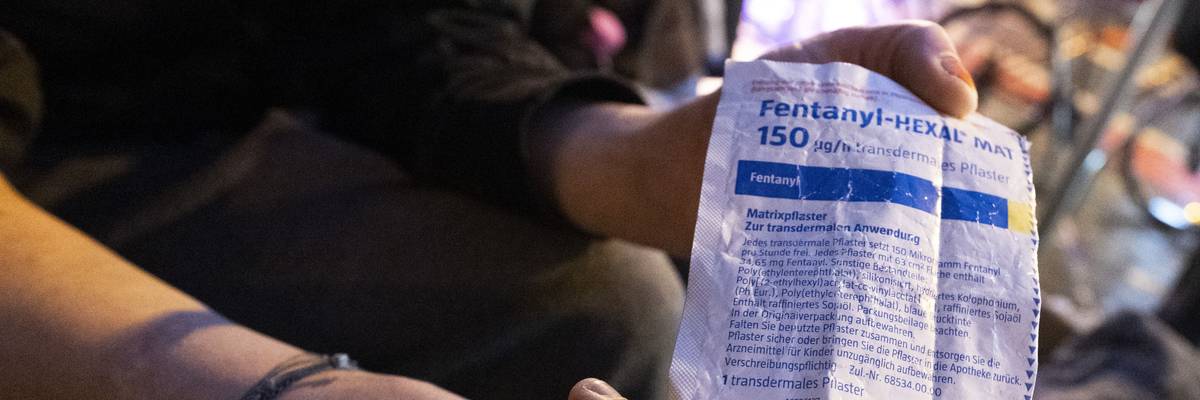
A package of fentanyl. Originally designed as a powerful painkiller in the form of patches, the powerful drug is now at the center of Trump's policy of murdering people on the high seas without due process.
The ramifications of misinformation concerning fentanyl are clear in the recent US military bombings of boats in the Caribbean and the US government’s threats against the sovereign nation of Venezuela.
On December 15, US President Donald Trump signed an executive order titled “Designating Fentanyl as a Weapon of Mass Destruction.” The order declares that “Illicit fentanyl is closer to a chemical weapon than a narcotic. Two milligrams, an almost undetectable trace amount equivalent to 10 to 15 grains of table salt, constitutes a lethal dose.” If it was not already clear and despite many think pieces and obituaries to it, the US government continues its failed War on Drugs.
This designation of fentanyl as a weapon of mass destruction has been nearly a decade in the making across multiple presidential administrations and with bipartisan support and media complicity. The people of the US have been groomed for this moment since 2015. On March 18, 2015, the Obama administration’s Drug Enforcement Administration (DEA) issued a nationwide alert that “fentanyl can be absorbed through the skin and accidental inhalation of airborne powder can also occur.” The DEA doubled down on this threat over a year later, when, on June 10, 2016, they released a roll call video and press release reiterating that “Fentanyl Exposure Kills.” The press release notes that “A very small amount ingested, or absorbed through your skin, can kill you.”
The last statement is only partially true. It is important to understand that, if used without a doctor’s supervision, fentanyl is a dangerous drug that has led to hundreds of thousands of overdose deaths over the last decade. However, doctors, pharmacologists and their associations, with Dr. Ryan Marino at the forefront, have long noted that fentanyl cannot kill you through passive exposure or absorption through the skin except under rare circumstances. For example, Dr. Marino noted that “you would probably have to be in a wind tunnel with dunes of fentanyl around you” in order to overdose from exposure to fentanyl in the air. Chad Sabora, a harm reduction expert, put fentanyl in his hand to show that skin exposure is not killer. A case study where a researcher spilled a “large dose” of fentanyl “at a site with some skin barrier compromise, a factor that can increase fentanyl absorption,” experienced “no clinical effects of opioid exposure.” There have been zero reported cases of someone touching fentanyl and dying.
Despite the scientific debunkings of police claims that fentanyl exposure kills, as Alec Karakatsanis so aptly shows in his work, the media report what the cops tell them without hesitation and context. Police would send out a press release reporting that one of their officers overdosed from fentanyl exposure and the media shared it unchecked. In 2020, research showed that the fentanyl exposure panic had “appeared in 551 news articles spanning 48 states” and that these reports were shared over 450,000 times on Facebook “potentially reaching nearly 70,000,000 users" from 2015 to 2019.
The most egregious example for this narrative comes from Bloomberg in 2018. The headline reads “This Killer Opioid Could Become a Weapon of Mass Destruction,” accompanied by a picture showing a grim reaper figure spreading powder, implied to be fentanyl, over a large city.
The media and the police had zero excuses here. In 2017, the American College and Medical Toxicology and the American Academy of Clinical Toxicology released a joint statement that said, “the risk of clinically significant exposure to emergency responders is extremely low.” Yet, in tandem, the police and media circulated the false narrative of fentanyl exposure. This continues into the present. In 2022, Zachary Siegel wrote in the New York Times of the continued trend of viral fentanyl exposure police videos. Just this past summer in my home state of South Carolina, the media reported on a sheriff’s deputy who was administered Narcan after collapsing from “fentanyl exposure.” Though the media now will sometimes report, after the initial story, that experts dispute the claims of overdose through fentanyl exposure, the damage is done. In fact, the story linked above quotes an experienced fentanyl user who debunks the claim. However, in a country where research has shown that most consumers of news only read the headline, who is reading this debunking on the third paragraph?
Today, we are seeing the impact of the distribution of the “fentanyl exposure” myth by police and media. In addition to this recent executive order, states have been proposing and passing laws that criminalize people who “expose” first responders to fentanyl. Other states, like North Carolina, have a “Death by Distribution” law where a person can be charged with second-degree murder if they sell drugs that lead to an overdose. South Carolina created a new “fentanyl-induced homicide” crime that penalizes someone for “lacing” drugs with fentanyl with 30 years in prison. After its passage, the current South Carolina Attorney General and gubernatorial candidate praised this as a response to the “chemical warfare on our streets.” In West Virginia, the state passed Lauren’s Law, which requires a 10- to 40-year sentence for the delivery of drugs that results in death.
Potentially even more consequential, however, is the impact this narrative is having on the US government’s imperialist objectives. The US government constantly associates fentanyl as a problem facilitated by China and/or a problem at the US/Mexico border. Former Republican Mike Garcia of California, when in office, authored a resolution titled “Condemning the Chinese Community Party for its role in the fentanyl crisis.” This past September, the House passed the “Stop Chinese Fentanyl Act,” which, according to its author, Rep. Andy Barr (R-Ky.), will “hold the Chinese Communist Party (CCP) and its affiliates accountable for fueling America’s fentanyl crisis.” The bill “would impose sanctions,” a popular tool of aggression by the US government, “on Chinese officials who intentionally avoid taking action to prevent the trafficking of fentanyl.” Finally, the US House released a report accusing the CCP of intentionally fueling the crisis. While absolving the US pharmaceutical companies responsible for actually fueling the US opioid crisis, the US government is using fentanyl to prime its people for war with China.
Moreover, the ramifications of this propaganda are clear in the recent US military bombings of boats in the Caribbean and the US government’s threats against the sovereign nation of Venezuela. In his UN General Assembly speech on September 23, 2025, President Trump said, “we've recently begun using the supreme power of the United States military to destroy Venezuelan terrorists and trafficking networks led by Nicolas Maduro.” Despite the DEA never including Venezuela in its annual National Drug Threat Assessment reports, the Trump Administration continues its attempts to overthrow the Maduro government, efforts that date back to 2019, this time with fentanyl and drugs more broadly as its justification. To date, the US government has killed more than 95 people in more than 24 boat strikes.
The US government’s use of illicit drugs to legitimize its actions is far from new. The Trump administration’s Executive Order declaring fentanyl as a weapon of mass destruction is a continuation of the destructive and misguided War on Drugs as continued justification for US imperialist objectives and the expansion of domestic surveillance and criminalization. The government, police, and media are complicit in US war crimes abroad, the potentially impending invasion of Venezuela, and the overdose crisis that is killing many people in the US through its peddling of fentanyl disinformation.
Recently, drug overdose deaths sharply declined 25% over one year. Early evidence suggests this is, in part, due to the harm reduction approaches to drug use. However, reduction in drug overdose deaths is not the US government’s goal. The goal appears far more sinister.
Dear Common Dreams reader, It’s been nearly 30 years since I co-founded Common Dreams with my late wife, Lina Newhouser. We had the radical notion that journalism should serve the public good, not corporate profits. It was clear to us from the outset what it would take to build such a project. No paid advertisements. No corporate sponsors. No millionaire publisher telling us what to think or do. Many people said we wouldn't last a year, but we proved those doubters wrong. Together with a tremendous team of journalists and dedicated staff, we built an independent media outlet free from the constraints of profits and corporate control. Our mission has always been simple: To inform. To inspire. To ignite change for the common good. Building Common Dreams was not easy. Our survival was never guaranteed. When you take on the most powerful forces—Wall Street greed, fossil fuel industry destruction, Big Tech lobbyists, and uber-rich oligarchs who have spent billions upon billions rigging the economy and democracy in their favor—the only bulwark you have is supporters who believe in your work. But here’s the urgent message from me today. It's never been this bad out there. And it's never been this hard to keep us going. At the very moment Common Dreams is most needed, the threats we face are intensifying. We need your support now more than ever. We don't accept corporate advertising and never will. We don't have a paywall because we don't think people should be blocked from critical news based on their ability to pay. Everything we do is funded by the donations of readers like you. When everyone does the little they can afford, we are strong. But if that support retreats or dries up, so do we. Will you donate now to make sure Common Dreams not only survives but thrives? —Craig Brown, Co-founder |
On December 15, US President Donald Trump signed an executive order titled “Designating Fentanyl as a Weapon of Mass Destruction.” The order declares that “Illicit fentanyl is closer to a chemical weapon than a narcotic. Two milligrams, an almost undetectable trace amount equivalent to 10 to 15 grains of table salt, constitutes a lethal dose.” If it was not already clear and despite many think pieces and obituaries to it, the US government continues its failed War on Drugs.
This designation of fentanyl as a weapon of mass destruction has been nearly a decade in the making across multiple presidential administrations and with bipartisan support and media complicity. The people of the US have been groomed for this moment since 2015. On March 18, 2015, the Obama administration’s Drug Enforcement Administration (DEA) issued a nationwide alert that “fentanyl can be absorbed through the skin and accidental inhalation of airborne powder can also occur.” The DEA doubled down on this threat over a year later, when, on June 10, 2016, they released a roll call video and press release reiterating that “Fentanyl Exposure Kills.” The press release notes that “A very small amount ingested, or absorbed through your skin, can kill you.”
The last statement is only partially true. It is important to understand that, if used without a doctor’s supervision, fentanyl is a dangerous drug that has led to hundreds of thousands of overdose deaths over the last decade. However, doctors, pharmacologists and their associations, with Dr. Ryan Marino at the forefront, have long noted that fentanyl cannot kill you through passive exposure or absorption through the skin except under rare circumstances. For example, Dr. Marino noted that “you would probably have to be in a wind tunnel with dunes of fentanyl around you” in order to overdose from exposure to fentanyl in the air. Chad Sabora, a harm reduction expert, put fentanyl in his hand to show that skin exposure is not killer. A case study where a researcher spilled a “large dose” of fentanyl “at a site with some skin barrier compromise, a factor that can increase fentanyl absorption,” experienced “no clinical effects of opioid exposure.” There have been zero reported cases of someone touching fentanyl and dying.
Despite the scientific debunkings of police claims that fentanyl exposure kills, as Alec Karakatsanis so aptly shows in his work, the media report what the cops tell them without hesitation and context. Police would send out a press release reporting that one of their officers overdosed from fentanyl exposure and the media shared it unchecked. In 2020, research showed that the fentanyl exposure panic had “appeared in 551 news articles spanning 48 states” and that these reports were shared over 450,000 times on Facebook “potentially reaching nearly 70,000,000 users" from 2015 to 2019.
The most egregious example for this narrative comes from Bloomberg in 2018. The headline reads “This Killer Opioid Could Become a Weapon of Mass Destruction,” accompanied by a picture showing a grim reaper figure spreading powder, implied to be fentanyl, over a large city.
The media and the police had zero excuses here. In 2017, the American College and Medical Toxicology and the American Academy of Clinical Toxicology released a joint statement that said, “the risk of clinically significant exposure to emergency responders is extremely low.” Yet, in tandem, the police and media circulated the false narrative of fentanyl exposure. This continues into the present. In 2022, Zachary Siegel wrote in the New York Times of the continued trend of viral fentanyl exposure police videos. Just this past summer in my home state of South Carolina, the media reported on a sheriff’s deputy who was administered Narcan after collapsing from “fentanyl exposure.” Though the media now will sometimes report, after the initial story, that experts dispute the claims of overdose through fentanyl exposure, the damage is done. In fact, the story linked above quotes an experienced fentanyl user who debunks the claim. However, in a country where research has shown that most consumers of news only read the headline, who is reading this debunking on the third paragraph?
Today, we are seeing the impact of the distribution of the “fentanyl exposure” myth by police and media. In addition to this recent executive order, states have been proposing and passing laws that criminalize people who “expose” first responders to fentanyl. Other states, like North Carolina, have a “Death by Distribution” law where a person can be charged with second-degree murder if they sell drugs that lead to an overdose. South Carolina created a new “fentanyl-induced homicide” crime that penalizes someone for “lacing” drugs with fentanyl with 30 years in prison. After its passage, the current South Carolina Attorney General and gubernatorial candidate praised this as a response to the “chemical warfare on our streets.” In West Virginia, the state passed Lauren’s Law, which requires a 10- to 40-year sentence for the delivery of drugs that results in death.
Potentially even more consequential, however, is the impact this narrative is having on the US government’s imperialist objectives. The US government constantly associates fentanyl as a problem facilitated by China and/or a problem at the US/Mexico border. Former Republican Mike Garcia of California, when in office, authored a resolution titled “Condemning the Chinese Community Party for its role in the fentanyl crisis.” This past September, the House passed the “Stop Chinese Fentanyl Act,” which, according to its author, Rep. Andy Barr (R-Ky.), will “hold the Chinese Communist Party (CCP) and its affiliates accountable for fueling America’s fentanyl crisis.” The bill “would impose sanctions,” a popular tool of aggression by the US government, “on Chinese officials who intentionally avoid taking action to prevent the trafficking of fentanyl.” Finally, the US House released a report accusing the CCP of intentionally fueling the crisis. While absolving the US pharmaceutical companies responsible for actually fueling the US opioid crisis, the US government is using fentanyl to prime its people for war with China.
Moreover, the ramifications of this propaganda are clear in the recent US military bombings of boats in the Caribbean and the US government’s threats against the sovereign nation of Venezuela. In his UN General Assembly speech on September 23, 2025, President Trump said, “we've recently begun using the supreme power of the United States military to destroy Venezuelan terrorists and trafficking networks led by Nicolas Maduro.” Despite the DEA never including Venezuela in its annual National Drug Threat Assessment reports, the Trump Administration continues its attempts to overthrow the Maduro government, efforts that date back to 2019, this time with fentanyl and drugs more broadly as its justification. To date, the US government has killed more than 95 people in more than 24 boat strikes.
The US government’s use of illicit drugs to legitimize its actions is far from new. The Trump administration’s Executive Order declaring fentanyl as a weapon of mass destruction is a continuation of the destructive and misguided War on Drugs as continued justification for US imperialist objectives and the expansion of domestic surveillance and criminalization. The government, police, and media are complicit in US war crimes abroad, the potentially impending invasion of Venezuela, and the overdose crisis that is killing many people in the US through its peddling of fentanyl disinformation.
Recently, drug overdose deaths sharply declined 25% over one year. Early evidence suggests this is, in part, due to the harm reduction approaches to drug use. However, reduction in drug overdose deaths is not the US government’s goal. The goal appears far more sinister.
On December 15, US President Donald Trump signed an executive order titled “Designating Fentanyl as a Weapon of Mass Destruction.” The order declares that “Illicit fentanyl is closer to a chemical weapon than a narcotic. Two milligrams, an almost undetectable trace amount equivalent to 10 to 15 grains of table salt, constitutes a lethal dose.” If it was not already clear and despite many think pieces and obituaries to it, the US government continues its failed War on Drugs.
This designation of fentanyl as a weapon of mass destruction has been nearly a decade in the making across multiple presidential administrations and with bipartisan support and media complicity. The people of the US have been groomed for this moment since 2015. On March 18, 2015, the Obama administration’s Drug Enforcement Administration (DEA) issued a nationwide alert that “fentanyl can be absorbed through the skin and accidental inhalation of airborne powder can also occur.” The DEA doubled down on this threat over a year later, when, on June 10, 2016, they released a roll call video and press release reiterating that “Fentanyl Exposure Kills.” The press release notes that “A very small amount ingested, or absorbed through your skin, can kill you.”
The last statement is only partially true. It is important to understand that, if used without a doctor’s supervision, fentanyl is a dangerous drug that has led to hundreds of thousands of overdose deaths over the last decade. However, doctors, pharmacologists and their associations, with Dr. Ryan Marino at the forefront, have long noted that fentanyl cannot kill you through passive exposure or absorption through the skin except under rare circumstances. For example, Dr. Marino noted that “you would probably have to be in a wind tunnel with dunes of fentanyl around you” in order to overdose from exposure to fentanyl in the air. Chad Sabora, a harm reduction expert, put fentanyl in his hand to show that skin exposure is not killer. A case study where a researcher spilled a “large dose” of fentanyl “at a site with some skin barrier compromise, a factor that can increase fentanyl absorption,” experienced “no clinical effects of opioid exposure.” There have been zero reported cases of someone touching fentanyl and dying.
Despite the scientific debunkings of police claims that fentanyl exposure kills, as Alec Karakatsanis so aptly shows in his work, the media report what the cops tell them without hesitation and context. Police would send out a press release reporting that one of their officers overdosed from fentanyl exposure and the media shared it unchecked. In 2020, research showed that the fentanyl exposure panic had “appeared in 551 news articles spanning 48 states” and that these reports were shared over 450,000 times on Facebook “potentially reaching nearly 70,000,000 users" from 2015 to 2019.
The most egregious example for this narrative comes from Bloomberg in 2018. The headline reads “This Killer Opioid Could Become a Weapon of Mass Destruction,” accompanied by a picture showing a grim reaper figure spreading powder, implied to be fentanyl, over a large city.
The media and the police had zero excuses here. In 2017, the American College and Medical Toxicology and the American Academy of Clinical Toxicology released a joint statement that said, “the risk of clinically significant exposure to emergency responders is extremely low.” Yet, in tandem, the police and media circulated the false narrative of fentanyl exposure. This continues into the present. In 2022, Zachary Siegel wrote in the New York Times of the continued trend of viral fentanyl exposure police videos. Just this past summer in my home state of South Carolina, the media reported on a sheriff’s deputy who was administered Narcan after collapsing from “fentanyl exposure.” Though the media now will sometimes report, after the initial story, that experts dispute the claims of overdose through fentanyl exposure, the damage is done. In fact, the story linked above quotes an experienced fentanyl user who debunks the claim. However, in a country where research has shown that most consumers of news only read the headline, who is reading this debunking on the third paragraph?
Today, we are seeing the impact of the distribution of the “fentanyl exposure” myth by police and media. In addition to this recent executive order, states have been proposing and passing laws that criminalize people who “expose” first responders to fentanyl. Other states, like North Carolina, have a “Death by Distribution” law where a person can be charged with second-degree murder if they sell drugs that lead to an overdose. South Carolina created a new “fentanyl-induced homicide” crime that penalizes someone for “lacing” drugs with fentanyl with 30 years in prison. After its passage, the current South Carolina Attorney General and gubernatorial candidate praised this as a response to the “chemical warfare on our streets.” In West Virginia, the state passed Lauren’s Law, which requires a 10- to 40-year sentence for the delivery of drugs that results in death.
Potentially even more consequential, however, is the impact this narrative is having on the US government’s imperialist objectives. The US government constantly associates fentanyl as a problem facilitated by China and/or a problem at the US/Mexico border. Former Republican Mike Garcia of California, when in office, authored a resolution titled “Condemning the Chinese Community Party for its role in the fentanyl crisis.” This past September, the House passed the “Stop Chinese Fentanyl Act,” which, according to its author, Rep. Andy Barr (R-Ky.), will “hold the Chinese Communist Party (CCP) and its affiliates accountable for fueling America’s fentanyl crisis.” The bill “would impose sanctions,” a popular tool of aggression by the US government, “on Chinese officials who intentionally avoid taking action to prevent the trafficking of fentanyl.” Finally, the US House released a report accusing the CCP of intentionally fueling the crisis. While absolving the US pharmaceutical companies responsible for actually fueling the US opioid crisis, the US government is using fentanyl to prime its people for war with China.
Moreover, the ramifications of this propaganda are clear in the recent US military bombings of boats in the Caribbean and the US government’s threats against the sovereign nation of Venezuela. In his UN General Assembly speech on September 23, 2025, President Trump said, “we've recently begun using the supreme power of the United States military to destroy Venezuelan terrorists and trafficking networks led by Nicolas Maduro.” Despite the DEA never including Venezuela in its annual National Drug Threat Assessment reports, the Trump Administration continues its attempts to overthrow the Maduro government, efforts that date back to 2019, this time with fentanyl and drugs more broadly as its justification. To date, the US government has killed more than 95 people in more than 24 boat strikes.
The US government’s use of illicit drugs to legitimize its actions is far from new. The Trump administration’s Executive Order declaring fentanyl as a weapon of mass destruction is a continuation of the destructive and misguided War on Drugs as continued justification for US imperialist objectives and the expansion of domestic surveillance and criminalization. The government, police, and media are complicit in US war crimes abroad, the potentially impending invasion of Venezuela, and the overdose crisis that is killing many people in the US through its peddling of fentanyl disinformation.
Recently, drug overdose deaths sharply declined 25% over one year. Early evidence suggests this is, in part, due to the harm reduction approaches to drug use. However, reduction in drug overdose deaths is not the US government’s goal. The goal appears far more sinister.