SUBSCRIBE TO OUR FREE NEWSLETTER
Daily news & progressive opinion—funded by the people, not the corporations—delivered straight to your inbox.
5
#000000
#FFFFFF
To donate by check, phone, or other method, see our More Ways to Give page.
Daily news & progressive opinion—funded by the people, not the corporations—delivered straight to your inbox.

A screenshot of a video from the US Southern Command shows the targeting of a boat in the eastern Pacific on December 15, 2025.
One expert said the Trump White House is "replaying the Bush administration's greatest hits as farce."
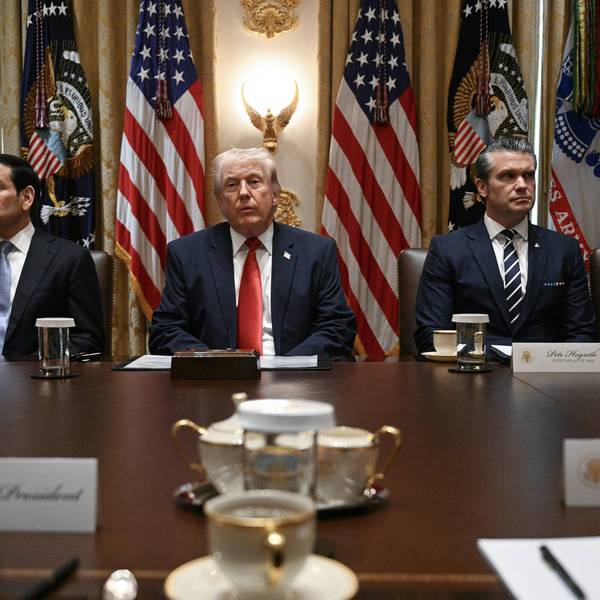
US President Donald Trump on Monday signed an executive order designating fentanyl a "weapon of mass destruction," a move that came hours before his administration carried out another flurry of deadly strikes on vessels in the eastern Pacific accused—without evidence—of drug trafficking.
Trump's order instructs the Pentagon and other US agencies to "take appropriate action" to "eliminate the threat of illicit fentanyl and its core precursor chemicals to the United States." The order also warns of "the potential for fentanyl to be weaponized for concentrated, large-scale terror attacks by organized adversaries."
Brian Finucane, a senior adviser with the US Program at the International Crisis Group, said in response to the executive action that Trump is "replaying the Bush administration's greatest hits as farce," referencing the lead-up to the Iraq War. Trump has repeatedly threatened military attacks on Venezuela, Colombia, and Mexico, citing fentanyl trafficking as the pretext.
Ahead of the official signing of the fentanyl order, an anonymous State Department official suggested to the independent outlet The Handbasket that the directive's "purpose is a combination of designating fentanyl cartels as terrorist organizations and creating justification for conducting military operations in Mexico and Canada."
The official also suspected "that it will be used domestically as justification for rounding up homeless encampments and deporting drug users who are not citizens," reported The Handbasket's Marisa Kabas.
Hours after Trump formally announced the order, the US Southern Command said it carried out strikes on three boats in the eastern Pacific, killing at least eight people.
"The lawless killing spree continues," Finucane wrote late Monday. "The administration justifies this slaughter by claiming there’s an armed conflict. But it won’t even tell the US public who the supposed enemies are. Of course, there’s no armed conflict. And outside armed conflict, we call premeditated killing murder."
Kenneth Roth, former executive director of Human Rights Watch, argued that "Trump's classification of fentanyl as a 'weapon of mass destruction' will do nothing to salvage the blatant illegality of his summary executions off the coasts of Venezuela and Colombia because fentanyl largely enters the United States from Mexico."
On Dec. 15, at the direction of @SecWar Pete Hegseth, Joint Task Force Southern Spear conducted lethal kinetic strikes on three vessels operated by Designated Terrorist Organizations in international waters. Intelligence confirmed that the vessels were transiting along known… pic.twitter.com/IQfCVvUpau
— U.S. Southern Command (@Southcom) December 16, 2025
Monday's boat bombings brought the death toll from the Trump administration's illegal strikes in the Caribbean and eastern Pacific, which began in early September, to at least 95.
Writing for Salon last week, Drug Policy Alliance executive director Kassandra Frederique and former counternarcotics official James Saenz observed that "the US is bombing boats that have nothing to do with fentanyl or the overdose crisis devastating American communities."
"These recent military actions have negligible impact on the transshipment of illicit drugs and absolutely no impact on the production or movement of synthetic opioids. And fentanyl, the synthetic opioid responsible for most US overdoses, is not produced in Venezuela," they wrote. "These developments raise serious questions about the direction of US drug policy. We must ask ourselves: If these extrajudicial strikes are not stopping fentanyl, then what are the motives?"
"History should be a warning to us. In the Philippines under Rodrigo Duterte, the drug war became a tool of fear," Frederique and Saenz added. "Thousands were killed without trial, democratic institutions were hollowed out, and civil liberties stripped away—all while drugs continued to flow into the country."
Dear Common Dreams reader, It’s been nearly 30 years since I co-founded Common Dreams with my late wife, Lina Newhouser. We had the radical notion that journalism should serve the public good, not corporate profits. It was clear to us from the outset what it would take to build such a project. No paid advertisements. No corporate sponsors. No millionaire publisher telling us what to think or do. Many people said we wouldn't last a year, but we proved those doubters wrong. Together with a tremendous team of journalists and dedicated staff, we built an independent media outlet free from the constraints of profits and corporate control. Our mission has always been simple: To inform. To inspire. To ignite change for the common good. Building Common Dreams was not easy. Our survival was never guaranteed. When you take on the most powerful forces—Wall Street greed, fossil fuel industry destruction, Big Tech lobbyists, and uber-rich oligarchs who have spent billions upon billions rigging the economy and democracy in their favor—the only bulwark you have is supporters who believe in your work. But here’s the urgent message from me today. It's never been this bad out there. And it's never been this hard to keep us going. At the very moment Common Dreams is most needed, the threats we face are intensifying. We need your support now more than ever. We don't accept corporate advertising and never will. We don't have a paywall because we don't think people should be blocked from critical news based on their ability to pay. Everything we do is funded by the donations of readers like you. When everyone does the little they can afford, we are strong. But if that support retreats or dries up, so do we. Will you donate now to make sure Common Dreams not only survives but thrives? —Craig Brown, Co-founder |
US President Donald Trump on Monday signed an executive order designating fentanyl a "weapon of mass destruction," a move that came hours before his administration carried out another flurry of deadly strikes on vessels in the eastern Pacific accused—without evidence—of drug trafficking.
Trump's order instructs the Pentagon and other US agencies to "take appropriate action" to "eliminate the threat of illicit fentanyl and its core precursor chemicals to the United States." The order also warns of "the potential for fentanyl to be weaponized for concentrated, large-scale terror attacks by organized adversaries."
Brian Finucane, a senior adviser with the US Program at the International Crisis Group, said in response to the executive action that Trump is "replaying the Bush administration's greatest hits as farce," referencing the lead-up to the Iraq War. Trump has repeatedly threatened military attacks on Venezuela, Colombia, and Mexico, citing fentanyl trafficking as the pretext.
Ahead of the official signing of the fentanyl order, an anonymous State Department official suggested to the independent outlet The Handbasket that the directive's "purpose is a combination of designating fentanyl cartels as terrorist organizations and creating justification for conducting military operations in Mexico and Canada."
The official also suspected "that it will be used domestically as justification for rounding up homeless encampments and deporting drug users who are not citizens," reported The Handbasket's Marisa Kabas.
Hours after Trump formally announced the order, the US Southern Command said it carried out strikes on three boats in the eastern Pacific, killing at least eight people.
"The lawless killing spree continues," Finucane wrote late Monday. "The administration justifies this slaughter by claiming there’s an armed conflict. But it won’t even tell the US public who the supposed enemies are. Of course, there’s no armed conflict. And outside armed conflict, we call premeditated killing murder."
Kenneth Roth, former executive director of Human Rights Watch, argued that "Trump's classification of fentanyl as a 'weapon of mass destruction' will do nothing to salvage the blatant illegality of his summary executions off the coasts of Venezuela and Colombia because fentanyl largely enters the United States from Mexico."
On Dec. 15, at the direction of @SecWar Pete Hegseth, Joint Task Force Southern Spear conducted lethal kinetic strikes on three vessels operated by Designated Terrorist Organizations in international waters. Intelligence confirmed that the vessels were transiting along known… pic.twitter.com/IQfCVvUpau
— U.S. Southern Command (@Southcom) December 16, 2025
Monday's boat bombings brought the death toll from the Trump administration's illegal strikes in the Caribbean and eastern Pacific, which began in early September, to at least 95.
Writing for Salon last week, Drug Policy Alliance executive director Kassandra Frederique and former counternarcotics official James Saenz observed that "the US is bombing boats that have nothing to do with fentanyl or the overdose crisis devastating American communities."
"These recent military actions have negligible impact on the transshipment of illicit drugs and absolutely no impact on the production or movement of synthetic opioids. And fentanyl, the synthetic opioid responsible for most US overdoses, is not produced in Venezuela," they wrote. "These developments raise serious questions about the direction of US drug policy. We must ask ourselves: If these extrajudicial strikes are not stopping fentanyl, then what are the motives?"
"History should be a warning to us. In the Philippines under Rodrigo Duterte, the drug war became a tool of fear," Frederique and Saenz added. "Thousands were killed without trial, democratic institutions were hollowed out, and civil liberties stripped away—all while drugs continued to flow into the country."
US President Donald Trump on Monday signed an executive order designating fentanyl a "weapon of mass destruction," a move that came hours before his administration carried out another flurry of deadly strikes on vessels in the eastern Pacific accused—without evidence—of drug trafficking.
Trump's order instructs the Pentagon and other US agencies to "take appropriate action" to "eliminate the threat of illicit fentanyl and its core precursor chemicals to the United States." The order also warns of "the potential for fentanyl to be weaponized for concentrated, large-scale terror attacks by organized adversaries."
Brian Finucane, a senior adviser with the US Program at the International Crisis Group, said in response to the executive action that Trump is "replaying the Bush administration's greatest hits as farce," referencing the lead-up to the Iraq War. Trump has repeatedly threatened military attacks on Venezuela, Colombia, and Mexico, citing fentanyl trafficking as the pretext.
Ahead of the official signing of the fentanyl order, an anonymous State Department official suggested to the independent outlet The Handbasket that the directive's "purpose is a combination of designating fentanyl cartels as terrorist organizations and creating justification for conducting military operations in Mexico and Canada."
The official also suspected "that it will be used domestically as justification for rounding up homeless encampments and deporting drug users who are not citizens," reported The Handbasket's Marisa Kabas.
Hours after Trump formally announced the order, the US Southern Command said it carried out strikes on three boats in the eastern Pacific, killing at least eight people.
"The lawless killing spree continues," Finucane wrote late Monday. "The administration justifies this slaughter by claiming there’s an armed conflict. But it won’t even tell the US public who the supposed enemies are. Of course, there’s no armed conflict. And outside armed conflict, we call premeditated killing murder."
Kenneth Roth, former executive director of Human Rights Watch, argued that "Trump's classification of fentanyl as a 'weapon of mass destruction' will do nothing to salvage the blatant illegality of his summary executions off the coasts of Venezuela and Colombia because fentanyl largely enters the United States from Mexico."
On Dec. 15, at the direction of @SecWar Pete Hegseth, Joint Task Force Southern Spear conducted lethal kinetic strikes on three vessels operated by Designated Terrorist Organizations in international waters. Intelligence confirmed that the vessels were transiting along known… pic.twitter.com/IQfCVvUpau
— U.S. Southern Command (@Southcom) December 16, 2025
Monday's boat bombings brought the death toll from the Trump administration's illegal strikes in the Caribbean and eastern Pacific, which began in early September, to at least 95.
Writing for Salon last week, Drug Policy Alliance executive director Kassandra Frederique and former counternarcotics official James Saenz observed that "the US is bombing boats that have nothing to do with fentanyl or the overdose crisis devastating American communities."
"These recent military actions have negligible impact on the transshipment of illicit drugs and absolutely no impact on the production or movement of synthetic opioids. And fentanyl, the synthetic opioid responsible for most US overdoses, is not produced in Venezuela," they wrote. "These developments raise serious questions about the direction of US drug policy. We must ask ourselves: If these extrajudicial strikes are not stopping fentanyl, then what are the motives?"
"History should be a warning to us. In the Philippines under Rodrigo Duterte, the drug war became a tool of fear," Frederique and Saenz added. "Thousands were killed without trial, democratic institutions were hollowed out, and civil liberties stripped away—all while drugs continued to flow into the country."