US Immigration and Customs Enforcement (ICE) agents guard outside Delaney Hall, a migrant detention facility, while anti-ICE activists demonstrate on June 12, 2025 in Newark, New Jersey. Anti-ICE protests have been spreading to cities across America since ICE deportation quotas have increased.
DHS Is Turning Warehouses Into Mass Detention Camps–It Must be Stopped
With unprecedented funding and minimal oversight, DHS is rapidly building a national detention infrastructure that will treat human beings as freight and confine civilians at an industrial scale.
The Department of Homeland Security’s (DHS) warehouse detention system is rapidly unfolding across the United States, advancing in open contempt of oversight, outpacing public scrutiny, and operating with the same disregard for the Constitution, the rule of law, and human life that defines the Trump administration’s exercise of power.
In November 2025, NBC News reported that DHS was actively scouting enormous industrial warehouses across the country, particularly in rural areas near major airports and transportation hubs, in an effort to expand the administration’s capacity to execute its mass deportation agenda—a system Secretary Noem recently aptly described as “one of the most consequential periods of action and reform in American history.”
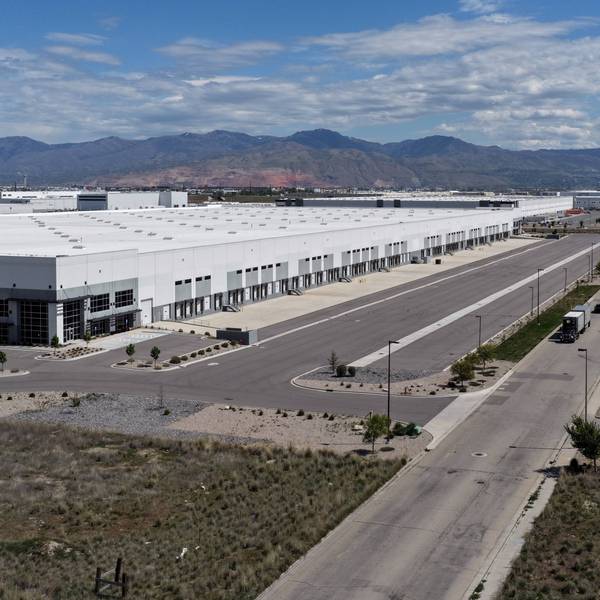
After the “Big Beautiful Bill” allocated an additional $45 billion specifically to ICE for building new immigration detention centers through 2029—a budget 62 percent larger than the entire federal prison system—DHS gained unprecedented financial capacity to expand its system of terror on a massive scale. Some of the warehouses under imminent consideration exceed 800,000 square feet and could hold far more people than existing detention centers, compressing thousands of human beings into spaces designed for inventory, not habitation.
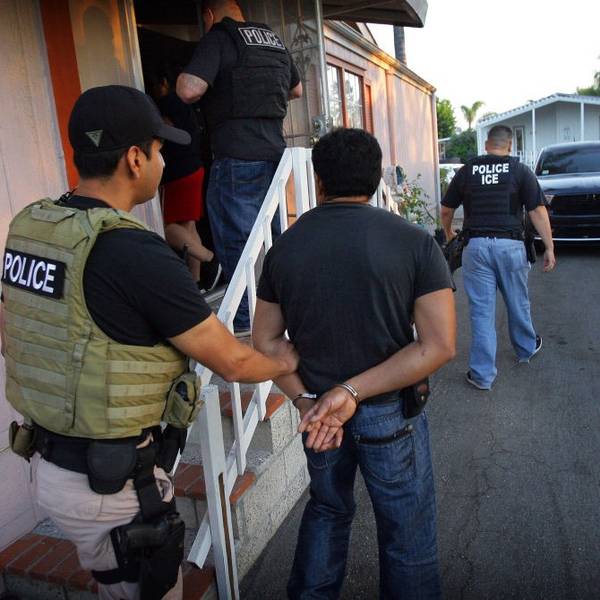
Further reporting in December showed that with this massive budget increase, DHS is not merely expanding capacity at the margins, but is redesigning the model itself. All those detained by DHS and ICE agents, including predominantly people without criminal records, both documented and undocumented im/migrants, and US citizens, will presumably be swiftly processed at local sites before being funneled into a small number of mega-facilities, each holding between 5,000 and 10,000 people. The plans outlining the duration of confinement and the conditions under which people will be held in these warehouses while awaiting deportation remain unknown.
Regardless of motive, Americans must confront that this hub-and-spoke detention network is a moral calamity, echoing some of the most inhumane periods in American and world history.
One can only assume the system will operate as Trump’s ICE Director Todd Lyons described at the 2025 Border Security Expo in Phoenix: “like Amazon Prime, but with human beings.” Concern for fundamental standards of care and due process, or pathways to legal immigration is replaced with the directive to “get better at treating this like a business.” The confinement, neglect, abuse, and exploitation that this process will inevitably worsen will be excused by the administration as “efficient.”
Since the news first broke, local reporting has confirmed the rapid construction and conversion of mass confinement centers across the country. Warehouse sites in Maryland, Texas, Florida, and New York’s Hudson Valley were reported to be under active consideration just in the past two weeks. Many communities slated to host these facilities have only learned of the plans through national reporting. In early January, The Washington Post found that when it contacted local governments in all 23 cities on ICE’s internal list, many officials had not been informed by federal authorities and could not comment. Multiple members of Congress have also stated publicly that they were not formally notified about the plans to establish these facilities in their districts.
State and local officials near proposed sites are now scrambling to hold emergency meetings, trying desperately to prevent being cut out of decisions with profound moral and ethical consequences that will reshape their communities. Still, there is widespread fear that the federal government will simply ignore local zoning and land-use laws.
Under the Supremacy Clause, federal agencies are largely immune from local zoning rules unless Congress explicitly requires compliance. Private contractors or lessees are not automatically covered, but in practice, immigration detention facilities and their operators face almost no local oversight. States like California have passed laws to empower health inspections and enforce standards against operators such as GEO Group, yet counties rarely act, and courts often side with federal preemption. If this continues, DHS could override community land-use standards entirely, imposing massive detention infrastructure on rural, resource-strained neighborhoods without consent, accountability, or regard for local residents.
Notably, the Trump administration has already made clear its intention to restrict congressional oversight of existing detention facilities, leaving little reason to believe the mega-warehouse model will be any more transparent or accountable. On January 8, DHS issued a directive requiring members of Congress to provide prior notice before inspecting immigration facilities, attempting to circumvent a court order that blocked such restrictions. Although federal law allows for unannounced visits, the Noem memo instructs staff that visits are not considered actionable until acknowledged by the Office of Congressional Relations, which coordinates with ICE and confirms details “as soon as practicable.”
The only supposed oversight of this expansion is being handled by figures deeply embedded in the detention industry, such as David Venturella, who has been seen in recent weeks touring ICE facilities slated for the “unloading and loading of goods.” Venturella quietly entered the Trump administration in early 2025 to avoid Senate confirmation, when DHS hired him as a full-time adviser and granted him an ethics waiver. Prior to this role, he spent more than a decade at GEO Group, one of the nation’s largest private prison corporations, where public filings show he was paid over $6 million to oversee immigrant detention operations. His career has moved seamlessly between ICE leadership and private security firms, including GEO Group, L-3 Communications, and USIS—companies whose profits depend on surveillance, enforcement, and confinement. He now oversees the ICE division responsible for detention contracts and infrastructure, the same system he previously expanded for private prison shareholders.
Private contractors such as GEO Group continue to operate facilities housing the vast majority of ICE detainees, positioning themselves to make substantial profit as the administration moves to double detention capacity to 100,000 beds with tens of billions in federal spending. GEO Group and CoreCivic have already reported soaring revenues under Trump’s second term, with executives describing the expansion as “pivotal” and “an unprecedented growth opportunity.” In this system, human confinement has been transformed into an investment strategy.
Regardless of motive, Americans must confront that this hub-and-spoke detention network is a moral calamity, echoing some of the most inhumane periods in American and world history. These warehouses lack climate control, ventilation, running water, sanitation, and medical facilities. The public cannot assume they will be retrofitted to meet even basic standards. Under the pressures imposed by political will and the promise of enormous financial gain for both contractors and the administration, restrained only by Trump’s own notion of “morality,” overcrowding, medical neglect, sanitation failures, family separation, and death are not incidental or isolated. They are the predictable, systemic outcomes of this design. Frequent transfers between facilities further destabilize those detained, shattering whatever order remains in local custody, tearing families apart, severing access to legal support, and concentrating the suffering of detention out of public view.
2025 was already ICE’s deadliest year in more than two decades, with at least thirty-two people dying in custody. In December 2025, Amnesty International described ICE facilities as “a deliberate system built to punish, dehumanize, and hide the suffering of people in detention.” Recent site visits documented by Congressman Ro Khanna further revealed the inhumane and degrading conditions detainees face today, including denial of medical care and meals containing rocks and debris.
In this moment of utter chaos—multiple wars looming or underway, international law ignored and explicitly disregarded, pedophiles protected, cities under conditions of terror, with agents told they have “federal immunity” to occupy streets—the infrastructure for this mass detainment system is expanding largely out of public view. Facilities may be secured before communities can mobilize, contracts locked in before lawmakers intervene, and once operational, and our communities will be left to reckon with the human suffering they guarantee.
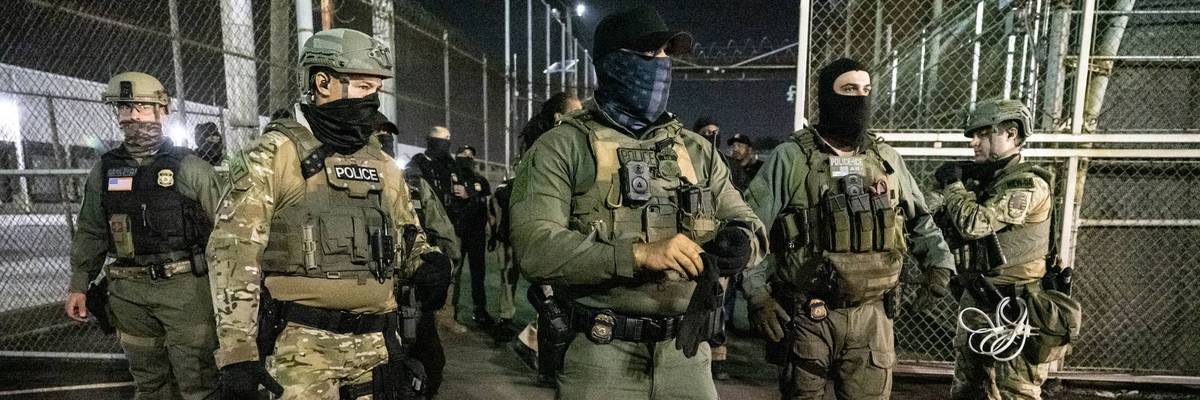
These facilities are instruments of state-sanctioned inhumanity, engineered to evade legal standards and public accountability. The depravity lies not only in the degrading conditions they produce but in the calculus that animates them: speed is treated as a virtue, suffering is deemed acceptable—perhaps even a goal—and profit is treated as proof of success. The administration is not asking the public to accept this system; it is demanding acquiescence and enforcing it through threat and force. ICE’s expansion has already reshaped the country’s physical and moral landscape, without consent, transparency, or regard for human life. The choice is no longer abstract; communities must decide whether to act against this system of cruelty, or let silence stand as consent.
We are at a crossroads
This country and this world are at a monumental crossroads. In a few short weeks, US voters will have an opportunity to beat back the forces of fascism and confront the billionaires who are rigging the economy, our media system, and our democracy, making it increasingly impossible for ordinary people to get by. We’re not just talking about the election. We’re talking about what must be done once these fascist elements are vanquished from power. We need a bolder set of solutions than what either major party has so far been willing to offer and a working-class movement ready to fight like hell for it. Trump didn't emerge from nowhere. The conditions that fueled MAGA authoritarianism were created by decades of radical neoliberal economic policies and a corrupt political system dominated by corporate interests. They slashed taxes on the super-rich, promising that the benefits would trickle down. They said giveaways to the corporate titans would make life more affordable for the rest of us. It was all bullshit. And when a bitter, betrayed populace searches for someone to blame, right-wing demagogues have little trouble finding scapegoats. People know when they're being lied to, but you won't hear any of this from the corporate media. Only independent journalism—powered and funded by people who believe in building a better world—can deliver truly trustworthy daily news. Our Fall Campaign is underway, and we need your help. To power our newsroom through the rest of the year, we need to raise $125,000 by midnight on October 31. So if you share our vision, please contribute whatever you can to sustain our work. |
The Department of Homeland Security’s (DHS) warehouse detention system is rapidly unfolding across the United States, advancing in open contempt of oversight, outpacing public scrutiny, and operating with the same disregard for the Constitution, the rule of law, and human life that defines the Trump administration’s exercise of power.
In November 2025, NBC News reported that DHS was actively scouting enormous industrial warehouses across the country, particularly in rural areas near major airports and transportation hubs, in an effort to expand the administration’s capacity to execute its mass deportation agenda—a system Secretary Noem recently aptly described as “one of the most consequential periods of action and reform in American history.”
After the “Big Beautiful Bill” allocated an additional $45 billion specifically to ICE for building new immigration detention centers through 2029—a budget 62 percent larger than the entire federal prison system—DHS gained unprecedented financial capacity to expand its system of terror on a massive scale. Some of the warehouses under imminent consideration exceed 800,000 square feet and could hold far more people than existing detention centers, compressing thousands of human beings into spaces designed for inventory, not habitation.
Further reporting in December showed that with this massive budget increase, DHS is not merely expanding capacity at the margins, but is redesigning the model itself. All those detained by DHS and ICE agents, including predominantly people without criminal records, both documented and undocumented im/migrants, and US citizens, will presumably be swiftly processed at local sites before being funneled into a small number of mega-facilities, each holding between 5,000 and 10,000 people. The plans outlining the duration of confinement and the conditions under which people will be held in these warehouses while awaiting deportation remain unknown.
Regardless of motive, Americans must confront that this hub-and-spoke detention network is a moral calamity, echoing some of the most inhumane periods in American and world history.
One can only assume the system will operate as Trump’s ICE Director Todd Lyons described at the 2025 Border Security Expo in Phoenix: “like Amazon Prime, but with human beings.” Concern for fundamental standards of care and due process, or pathways to legal immigration is replaced with the directive to “get better at treating this like a business.” The confinement, neglect, abuse, and exploitation that this process will inevitably worsen will be excused by the administration as “efficient.”
Since the news first broke, local reporting has confirmed the rapid construction and conversion of mass confinement centers across the country. Warehouse sites in Maryland, Texas, Florida, and New York’s Hudson Valley were reported to be under active consideration just in the past two weeks. Many communities slated to host these facilities have only learned of the plans through national reporting. In early January, The Washington Post found that when it contacted local governments in all 23 cities on ICE’s internal list, many officials had not been informed by federal authorities and could not comment. Multiple members of Congress have also stated publicly that they were not formally notified about the plans to establish these facilities in their districts.
State and local officials near proposed sites are now scrambling to hold emergency meetings, trying desperately to prevent being cut out of decisions with profound moral and ethical consequences that will reshape their communities. Still, there is widespread fear that the federal government will simply ignore local zoning and land-use laws.
Under the Supremacy Clause, federal agencies are largely immune from local zoning rules unless Congress explicitly requires compliance. Private contractors or lessees are not automatically covered, but in practice, immigration detention facilities and their operators face almost no local oversight. States like California have passed laws to empower health inspections and enforce standards against operators such as GEO Group, yet counties rarely act, and courts often side with federal preemption. If this continues, DHS could override community land-use standards entirely, imposing massive detention infrastructure on rural, resource-strained neighborhoods without consent, accountability, or regard for local residents.
Notably, the Trump administration has already made clear its intention to restrict congressional oversight of existing detention facilities, leaving little reason to believe the mega-warehouse model will be any more transparent or accountable. On January 8, DHS issued a directive requiring members of Congress to provide prior notice before inspecting immigration facilities, attempting to circumvent a court order that blocked such restrictions. Although federal law allows for unannounced visits, the Noem memo instructs staff that visits are not considered actionable until acknowledged by the Office of Congressional Relations, which coordinates with ICE and confirms details “as soon as practicable.”
The only supposed oversight of this expansion is being handled by figures deeply embedded in the detention industry, such as David Venturella, who has been seen in recent weeks touring ICE facilities slated for the “unloading and loading of goods.” Venturella quietly entered the Trump administration in early 2025 to avoid Senate confirmation, when DHS hired him as a full-time adviser and granted him an ethics waiver. Prior to this role, he spent more than a decade at GEO Group, one of the nation’s largest private prison corporations, where public filings show he was paid over $6 million to oversee immigrant detention operations. His career has moved seamlessly between ICE leadership and private security firms, including GEO Group, L-3 Communications, and USIS—companies whose profits depend on surveillance, enforcement, and confinement. He now oversees the ICE division responsible for detention contracts and infrastructure, the same system he previously expanded for private prison shareholders.
Private contractors such as GEO Group continue to operate facilities housing the vast majority of ICE detainees, positioning themselves to make substantial profit as the administration moves to double detention capacity to 100,000 beds with tens of billions in federal spending. GEO Group and CoreCivic have already reported soaring revenues under Trump’s second term, with executives describing the expansion as “pivotal” and “an unprecedented growth opportunity.” In this system, human confinement has been transformed into an investment strategy.
Regardless of motive, Americans must confront that this hub-and-spoke detention network is a moral calamity, echoing some of the most inhumane periods in American and world history. These warehouses lack climate control, ventilation, running water, sanitation, and medical facilities. The public cannot assume they will be retrofitted to meet even basic standards. Under the pressures imposed by political will and the promise of enormous financial gain for both contractors and the administration, restrained only by Trump’s own notion of “morality,” overcrowding, medical neglect, sanitation failures, family separation, and death are not incidental or isolated. They are the predictable, systemic outcomes of this design. Frequent transfers between facilities further destabilize those detained, shattering whatever order remains in local custody, tearing families apart, severing access to legal support, and concentrating the suffering of detention out of public view.
2025 was already ICE’s deadliest year in more than two decades, with at least thirty-two people dying in custody. In December 2025, Amnesty International described ICE facilities as “a deliberate system built to punish, dehumanize, and hide the suffering of people in detention.” Recent site visits documented by Congressman Ro Khanna further revealed the inhumane and degrading conditions detainees face today, including denial of medical care and meals containing rocks and debris.
In this moment of utter chaos—multiple wars looming or underway, international law ignored and explicitly disregarded, pedophiles protected, cities under conditions of terror, with agents told they have “federal immunity” to occupy streets—the infrastructure for this mass detainment system is expanding largely out of public view. Facilities may be secured before communities can mobilize, contracts locked in before lawmakers intervene, and once operational, and our communities will be left to reckon with the human suffering they guarantee.
These facilities are instruments of state-sanctioned inhumanity, engineered to evade legal standards and public accountability. The depravity lies not only in the degrading conditions they produce but in the calculus that animates them: speed is treated as a virtue, suffering is deemed acceptable—perhaps even a goal—and profit is treated as proof of success. The administration is not asking the public to accept this system; it is demanding acquiescence and enforcing it through threat and force. ICE’s expansion has already reshaped the country’s physical and moral landscape, without consent, transparency, or regard for human life. The choice is no longer abstract; communities must decide whether to act against this system of cruelty, or let silence stand as consent.
The Department of Homeland Security’s (DHS) warehouse detention system is rapidly unfolding across the United States, advancing in open contempt of oversight, outpacing public scrutiny, and operating with the same disregard for the Constitution, the rule of law, and human life that defines the Trump administration’s exercise of power.
In November 2025, NBC News reported that DHS was actively scouting enormous industrial warehouses across the country, particularly in rural areas near major airports and transportation hubs, in an effort to expand the administration’s capacity to execute its mass deportation agenda—a system Secretary Noem recently aptly described as “one of the most consequential periods of action and reform in American history.”
After the “Big Beautiful Bill” allocated an additional $45 billion specifically to ICE for building new immigration detention centers through 2029—a budget 62 percent larger than the entire federal prison system—DHS gained unprecedented financial capacity to expand its system of terror on a massive scale. Some of the warehouses under imminent consideration exceed 800,000 square feet and could hold far more people than existing detention centers, compressing thousands of human beings into spaces designed for inventory, not habitation.
Further reporting in December showed that with this massive budget increase, DHS is not merely expanding capacity at the margins, but is redesigning the model itself. All those detained by DHS and ICE agents, including predominantly people without criminal records, both documented and undocumented im/migrants, and US citizens, will presumably be swiftly processed at local sites before being funneled into a small number of mega-facilities, each holding between 5,000 and 10,000 people. The plans outlining the duration of confinement and the conditions under which people will be held in these warehouses while awaiting deportation remain unknown.
Regardless of motive, Americans must confront that this hub-and-spoke detention network is a moral calamity, echoing some of the most inhumane periods in American and world history.
One can only assume the system will operate as Trump’s ICE Director Todd Lyons described at the 2025 Border Security Expo in Phoenix: “like Amazon Prime, but with human beings.” Concern for fundamental standards of care and due process, or pathways to legal immigration is replaced with the directive to “get better at treating this like a business.” The confinement, neglect, abuse, and exploitation that this process will inevitably worsen will be excused by the administration as “efficient.”
Since the news first broke, local reporting has confirmed the rapid construction and conversion of mass confinement centers across the country. Warehouse sites in Maryland, Texas, Florida, and New York’s Hudson Valley were reported to be under active consideration just in the past two weeks. Many communities slated to host these facilities have only learned of the plans through national reporting. In early January, The Washington Post found that when it contacted local governments in all 23 cities on ICE’s internal list, many officials had not been informed by federal authorities and could not comment. Multiple members of Congress have also stated publicly that they were not formally notified about the plans to establish these facilities in their districts.
State and local officials near proposed sites are now scrambling to hold emergency meetings, trying desperately to prevent being cut out of decisions with profound moral and ethical consequences that will reshape their communities. Still, there is widespread fear that the federal government will simply ignore local zoning and land-use laws.
Under the Supremacy Clause, federal agencies are largely immune from local zoning rules unless Congress explicitly requires compliance. Private contractors or lessees are not automatically covered, but in practice, immigration detention facilities and their operators face almost no local oversight. States like California have passed laws to empower health inspections and enforce standards against operators such as GEO Group, yet counties rarely act, and courts often side with federal preemption. If this continues, DHS could override community land-use standards entirely, imposing massive detention infrastructure on rural, resource-strained neighborhoods without consent, accountability, or regard for local residents.
Notably, the Trump administration has already made clear its intention to restrict congressional oversight of existing detention facilities, leaving little reason to believe the mega-warehouse model will be any more transparent or accountable. On January 8, DHS issued a directive requiring members of Congress to provide prior notice before inspecting immigration facilities, attempting to circumvent a court order that blocked such restrictions. Although federal law allows for unannounced visits, the Noem memo instructs staff that visits are not considered actionable until acknowledged by the Office of Congressional Relations, which coordinates with ICE and confirms details “as soon as practicable.”
The only supposed oversight of this expansion is being handled by figures deeply embedded in the detention industry, such as David Venturella, who has been seen in recent weeks touring ICE facilities slated for the “unloading and loading of goods.” Venturella quietly entered the Trump administration in early 2025 to avoid Senate confirmation, when DHS hired him as a full-time adviser and granted him an ethics waiver. Prior to this role, he spent more than a decade at GEO Group, one of the nation’s largest private prison corporations, where public filings show he was paid over $6 million to oversee immigrant detention operations. His career has moved seamlessly between ICE leadership and private security firms, including GEO Group, L-3 Communications, and USIS—companies whose profits depend on surveillance, enforcement, and confinement. He now oversees the ICE division responsible for detention contracts and infrastructure, the same system he previously expanded for private prison shareholders.
Private contractors such as GEO Group continue to operate facilities housing the vast majority of ICE detainees, positioning themselves to make substantial profit as the administration moves to double detention capacity to 100,000 beds with tens of billions in federal spending. GEO Group and CoreCivic have already reported soaring revenues under Trump’s second term, with executives describing the expansion as “pivotal” and “an unprecedented growth opportunity.” In this system, human confinement has been transformed into an investment strategy.
Regardless of motive, Americans must confront that this hub-and-spoke detention network is a moral calamity, echoing some of the most inhumane periods in American and world history. These warehouses lack climate control, ventilation, running water, sanitation, and medical facilities. The public cannot assume they will be retrofitted to meet even basic standards. Under the pressures imposed by political will and the promise of enormous financial gain for both contractors and the administration, restrained only by Trump’s own notion of “morality,” overcrowding, medical neglect, sanitation failures, family separation, and death are not incidental or isolated. They are the predictable, systemic outcomes of this design. Frequent transfers between facilities further destabilize those detained, shattering whatever order remains in local custody, tearing families apart, severing access to legal support, and concentrating the suffering of detention out of public view.
2025 was already ICE’s deadliest year in more than two decades, with at least thirty-two people dying in custody. In December 2025, Amnesty International described ICE facilities as “a deliberate system built to punish, dehumanize, and hide the suffering of people in detention.” Recent site visits documented by Congressman Ro Khanna further revealed the inhumane and degrading conditions detainees face today, including denial of medical care and meals containing rocks and debris.
In this moment of utter chaos—multiple wars looming or underway, international law ignored and explicitly disregarded, pedophiles protected, cities under conditions of terror, with agents told they have “federal immunity” to occupy streets—the infrastructure for this mass detainment system is expanding largely out of public view. Facilities may be secured before communities can mobilize, contracts locked in before lawmakers intervene, and once operational, and our communities will be left to reckon with the human suffering they guarantee.
These facilities are instruments of state-sanctioned inhumanity, engineered to evade legal standards and public accountability. The depravity lies not only in the degrading conditions they produce but in the calculus that animates them: speed is treated as a virtue, suffering is deemed acceptable—perhaps even a goal—and profit is treated as proof of success. The administration is not asking the public to accept this system; it is demanding acquiescence and enforcing it through threat and force. ICE’s expansion has already reshaped the country’s physical and moral landscape, without consent, transparency, or regard for human life. The choice is no longer abstract; communities must decide whether to act against this system of cruelty, or let silence stand as consent.