
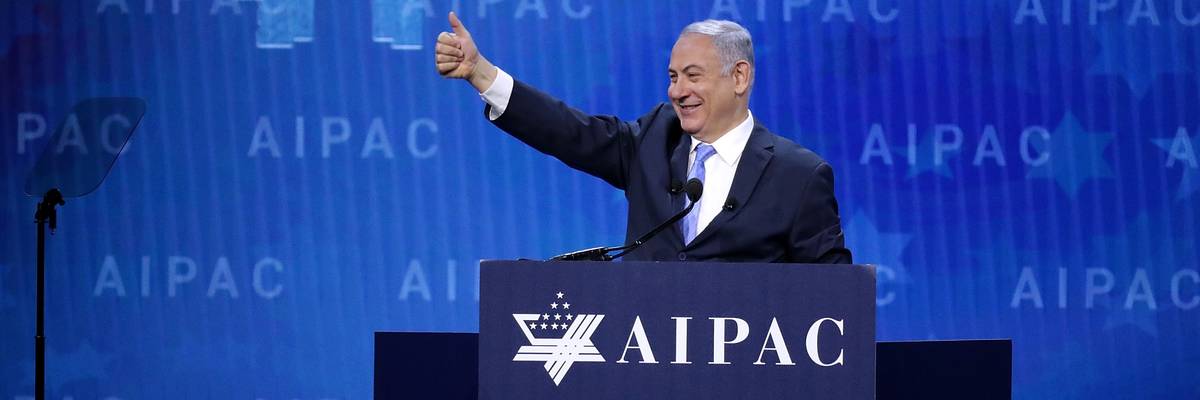
Israeli Prime Minister Benjamin Netanyahu addresses the American Israel Public Affairs Committee's annual policy conference at the Washington Convention Center March 6, 2018 in Washington, DC.
AIPAC: Defending the Indefensible
A lobby that asks for its community to have a voice is making a claim every American can make. A lobby that vows to end any candidacy which crosses its red line on Israel is not asking for a voice—it is enforcing obedience and silence.
As the American Israel Public Affairs Committee confronts a changing political landscape, one in which support for Israel has become a liability, powerful voices are coming to the defense of AIPAC and its hold on American democracy.
Pennsylvania Gov. Josh Shapiro is one such voice. He addressed the issue in an interview with Politico. Questioned whether the pro-Israel lobby had become a dividing line in the Democratic Party, Shapiro lamented what he described as the "weaponization" of criticism directed at AIPAC, saying it was being "used cynically by some to try and silence certain voices." Pressed on whether he meant critics were erasing the distinction between opposition to AIPAC and opposition to Jewish donors, he said yes. Shapiro is recasting the lobby's scorched-earth tactics against politicians who do not toe the line on Israel as an attack on Jews and their right to political participation. That framing makes criticism of AIPAC appear suspect before the substance of the criticism is addressed.
He is not alone. Sen. Elissa Slotkin (D-Mich.), confronted at a town hall over $4.5 million she had taken from "pro-Israel lobbies," objected that the figure lumped ordinary Jewish donors in with the lobby. This was problematic, she said, "Not just as an elected official," but "as a Jew." In The Washington Post, the columnist Matthew Schmitz gathered statements like these into a thesis: that criticism of Israel has curdled into hostility toward Jews themselves, and that the Democratic Party is turning on a community that has been part of its coalition for a century.
Although a problematic charge, it is deserving of a serious answer. The charge conflates criticizing a political lobby with attacking the Jewish people. This conflation is convenient for the defenders of AIPAC. To see why, start with what AIPAC does.
The existence of antisemitism does not make AIPAC immune from criticism, any more than the existence of anti-Muslim bigotry would make Saudi lobbying immune from scrutiny.
AIPAC does not have to single-handedly decide an election to shape its outcome. Its power lies in changing the conditions under which the election is fought. The organization describes itself as working to "help elect Democrats and Republicans" who support the US-Israel relationship and to "defeat detractors" of that relationship. Its formal PAC gives directly to candidates, while its affiliated super PAC, United Democracy Project, can raise and spend unlimited sums through independent expenditures. In the 2024 cycle, AIPAC and United Democracy Project spent $95.1 million, more than double their 2022 spending. United Democracy Project spent almost $9.9 million to defeat Jamaal Bowman and nearly $4.8 million to install George Latimer in his place, a level of outside money The New York Times called unprecedented for a single House race. It spent more than $5.2 million against Cori Bush and another $3.3 million for Wesley Bell, who beat her.
By 2026 the same machinery had crossed party lines, and this time it left no doubt about what it was for. In May, Kentucky Republican Thomas Massie, a seven-term incumbent, lost his primary after pro-Israel groups spent roughly $9 million to defeat him, part of more than $32 million that made it the most expensive House primary in American history, surpassing the record set against Bowman two years before. AIPAC did not hide its hand. It congratulated the winner for "defeating anti-Israel incumbent Thomas Massie" and declared that "being pro-Israel is good policy and good politics." An organization whose stated mission is to silence dissent over Israel policy took a victory lap after defeating a dissenter. This is not representation but political enforcement.
That is the record the conflation obscures, because it points to a distinction Shapiro and Slotkin would rather we not draw. There is a difference between a lobby that advances an industry or community's interests and a lobby whose signature work is to destroy the people who dissent from it. The first is ordinary democracy; every group does it, and every group should be free to. The second is something else. A lobby that asks for its community to have a voice is making a claim every American can make. A lobby that vows to end any candidacy which crosses its red line on Israel is not asking for a voice—it is enforcing obedience and silence. AIPAC is the second kind, and no amount of talk about Jewish participation changes what its money does.
Here Slotkin's objection deserves a fair hearing, and then a harder look. She is right about one thing, and it matters: The $4.5 million figure she was confronted with came from a group that counts individual Jewish donors as lobby money. That is a crude metric, and her instinct to reject it is correct. Treating every Jewish donor as AIPAC is exactly the conflation worth refusing. However, she used the softness of that one number to wave away the entire subject, and the subject does not depend on that number. United Democracy Project's independent expenditures are not estimates pulled from a donor tally. They are filed with the Federal Election Commission. Nearly $10 million to defeat a single congressman is not a Jewish donor being smeared. It is a documented political operation, and in a democracy, it is fair game.
Slotkin then offered her own analogy, and it is more revealing than she intended. Plenty of groups do the same thing, she said—"a Pakistani-American group, or whatever group." Exactly so. And if a Pakistani-American group spent $95 million in a single cycle to end the careers of politicians who crossed it, that spending would be criticized too, loudly and by name—and no one would call the criticism anti-Pakistani bigotry. That is the tell. The objection to AIPAC was never that Jews organize, donate, or advocate; Americans of every background do, and should. The objection is to what this particular organization spends its money to accomplish. AIPAC is not being challenged because it is Jewish. It is being challenged because it uses organized money to enforce a narrow pro-Israel line in American politics. Strip away the identity framing and you are left with a plain question about political power—which is the question its defenders are working so hard to avoid.
The conflation cuts both ways, and the second cut is the dangerous one. Slotkin is right that lumping every Jewish donor into "the pro-Israel lobby" is crude and potentially ugly; Jewish donors are not AIPAC by definition. But the reverse move is just as serious, and it is the one AIPAC defenders rely on: treating any criticism of AIPAC's political spending as though it were an attack on Jewish identity itself. The first error mistakes ordinary Jews for the lobby. The second dresses the lobby up as ordinary Jews. That second move gives AIPAC an exemption no other lobby receives—it lets a bare-knuckle political operation spend like a political operation and then, the moment it is criticized, takes cover as a vulnerable civic organization.
The pro-AIPAC defense generally leans on ugly examples—candidates who have made reckless comments, activists who slide from criticism of Israel into something darker, a political culture where antisemitism plainly exists. None of that should be denied, and a thesis about an entire party should not be built on a handful of fringe figures either. But none of it answers the central question. The existence of antisemitism does not make AIPAC immune from criticism, any more than the existence of anti-Muslim bigotry would make Saudi lobbying immune from scrutiny.
Bigotry is real. So is political power. A serious argument must be able to recognize both at once. AIPAC is not merely participating in democracy; it is using concentrated money to discipline the boundaries of acceptable speech on Israel, while its defenders try to collapse that political critique into ethnic or religious hostility.
We are at a crossroads
This country and this world are at a monumental crossroads. In a few short weeks, US voters will have an opportunity to beat back the forces of fascism and confront the billionaires who are rigging the economy, our media system, and our democracy, making it increasingly impossible for ordinary people to get by. We’re not just talking about the election. We’re talking about what must be done once these fascist elements are vanquished from power. We need a bolder set of solutions than what either major party has so far been willing to offer and a working-class movement ready to fight like hell for it. Trump didn't emerge from nowhere. The conditions that fueled MAGA authoritarianism were created by decades of radical neoliberal economic policies and a corrupt political system dominated by corporate interests. They slashed taxes on the super-rich, promising that the benefits would trickle down. They said giveaways to the corporate titans would make life more affordable for the rest of us. It was all bullshit. And when a bitter, betrayed populace searches for someone to blame, right-wing demagogues have little trouble finding scapegoats. People know when they're being lied to, but you won't hear any of this from the corporate media. Only independent journalism—powered and funded by people who believe in building a better world—can deliver truly trustworthy daily news. Our Fall Campaign is underway, and we need your help. To power our newsroom through the rest of the year, we need to raise $125,000 by midnight on October 31. So if you share our vision, please contribute whatever you can to sustain our work. |
As the American Israel Public Affairs Committee confronts a changing political landscape, one in which support for Israel has become a liability, powerful voices are coming to the defense of AIPAC and its hold on American democracy.
Pennsylvania Gov. Josh Shapiro is one such voice. He addressed the issue in an interview with Politico. Questioned whether the pro-Israel lobby had become a dividing line in the Democratic Party, Shapiro lamented what he described as the "weaponization" of criticism directed at AIPAC, saying it was being "used cynically by some to try and silence certain voices." Pressed on whether he meant critics were erasing the distinction between opposition to AIPAC and opposition to Jewish donors, he said yes. Shapiro is recasting the lobby's scorched-earth tactics against politicians who do not toe the line on Israel as an attack on Jews and their right to political participation. That framing makes criticism of AIPAC appear suspect before the substance of the criticism is addressed.
He is not alone. Sen. Elissa Slotkin (D-Mich.), confronted at a town hall over $4.5 million she had taken from "pro-Israel lobbies," objected that the figure lumped ordinary Jewish donors in with the lobby. This was problematic, she said, "Not just as an elected official," but "as a Jew." In The Washington Post, the columnist Matthew Schmitz gathered statements like these into a thesis: that criticism of Israel has curdled into hostility toward Jews themselves, and that the Democratic Party is turning on a community that has been part of its coalition for a century.
Although a problematic charge, it is deserving of a serious answer. The charge conflates criticizing a political lobby with attacking the Jewish people. This conflation is convenient for the defenders of AIPAC. To see why, start with what AIPAC does.
The existence of antisemitism does not make AIPAC immune from criticism, any more than the existence of anti-Muslim bigotry would make Saudi lobbying immune from scrutiny.
AIPAC does not have to single-handedly decide an election to shape its outcome. Its power lies in changing the conditions under which the election is fought. The organization describes itself as working to "help elect Democrats and Republicans" who support the US-Israel relationship and to "defeat detractors" of that relationship. Its formal PAC gives directly to candidates, while its affiliated super PAC, United Democracy Project, can raise and spend unlimited sums through independent expenditures. In the 2024 cycle, AIPAC and United Democracy Project spent $95.1 million, more than double their 2022 spending. United Democracy Project spent almost $9.9 million to defeat Jamaal Bowman and nearly $4.8 million to install George Latimer in his place, a level of outside money The New York Times called unprecedented for a single House race. It spent more than $5.2 million against Cori Bush and another $3.3 million for Wesley Bell, who beat her.
By 2026 the same machinery had crossed party lines, and this time it left no doubt about what it was for. In May, Kentucky Republican Thomas Massie, a seven-term incumbent, lost his primary after pro-Israel groups spent roughly $9 million to defeat him, part of more than $32 million that made it the most expensive House primary in American history, surpassing the record set against Bowman two years before. AIPAC did not hide its hand. It congratulated the winner for "defeating anti-Israel incumbent Thomas Massie" and declared that "being pro-Israel is good policy and good politics." An organization whose stated mission is to silence dissent over Israel policy took a victory lap after defeating a dissenter. This is not representation but political enforcement.
That is the record the conflation obscures, because it points to a distinction Shapiro and Slotkin would rather we not draw. There is a difference between a lobby that advances an industry or community's interests and a lobby whose signature work is to destroy the people who dissent from it. The first is ordinary democracy; every group does it, and every group should be free to. The second is something else. A lobby that asks for its community to have a voice is making a claim every American can make. A lobby that vows to end any candidacy which crosses its red line on Israel is not asking for a voice—it is enforcing obedience and silence. AIPAC is the second kind, and no amount of talk about Jewish participation changes what its money does.
Here Slotkin's objection deserves a fair hearing, and then a harder look. She is right about one thing, and it matters: The $4.5 million figure she was confronted with came from a group that counts individual Jewish donors as lobby money. That is a crude metric, and her instinct to reject it is correct. Treating every Jewish donor as AIPAC is exactly the conflation worth refusing. However, she used the softness of that one number to wave away the entire subject, and the subject does not depend on that number. United Democracy Project's independent expenditures are not estimates pulled from a donor tally. They are filed with the Federal Election Commission. Nearly $10 million to defeat a single congressman is not a Jewish donor being smeared. It is a documented political operation, and in a democracy, it is fair game.
Slotkin then offered her own analogy, and it is more revealing than she intended. Plenty of groups do the same thing, she said—"a Pakistani-American group, or whatever group." Exactly so. And if a Pakistani-American group spent $95 million in a single cycle to end the careers of politicians who crossed it, that spending would be criticized too, loudly and by name—and no one would call the criticism anti-Pakistani bigotry. That is the tell. The objection to AIPAC was never that Jews organize, donate, or advocate; Americans of every background do, and should. The objection is to what this particular organization spends its money to accomplish. AIPAC is not being challenged because it is Jewish. It is being challenged because it uses organized money to enforce a narrow pro-Israel line in American politics. Strip away the identity framing and you are left with a plain question about political power—which is the question its defenders are working so hard to avoid.
The conflation cuts both ways, and the second cut is the dangerous one. Slotkin is right that lumping every Jewish donor into "the pro-Israel lobby" is crude and potentially ugly; Jewish donors are not AIPAC by definition. But the reverse move is just as serious, and it is the one AIPAC defenders rely on: treating any criticism of AIPAC's political spending as though it were an attack on Jewish identity itself. The first error mistakes ordinary Jews for the lobby. The second dresses the lobby up as ordinary Jews. That second move gives AIPAC an exemption no other lobby receives—it lets a bare-knuckle political operation spend like a political operation and then, the moment it is criticized, takes cover as a vulnerable civic organization.
The pro-AIPAC defense generally leans on ugly examples—candidates who have made reckless comments, activists who slide from criticism of Israel into something darker, a political culture where antisemitism plainly exists. None of that should be denied, and a thesis about an entire party should not be built on a handful of fringe figures either. But none of it answers the central question. The existence of antisemitism does not make AIPAC immune from criticism, any more than the existence of anti-Muslim bigotry would make Saudi lobbying immune from scrutiny.
Bigotry is real. So is political power. A serious argument must be able to recognize both at once. AIPAC is not merely participating in democracy; it is using concentrated money to discipline the boundaries of acceptable speech on Israel, while its defenders try to collapse that political critique into ethnic or religious hostility.
- As AIPAC Spends Millions to Oust Him, Massie Unveils Bill Requiring Pro-Israel Lobby to Register as Foreign Agent ›
- AOC Blasts AIPAC as 'The NRA of Foreign Policy' ›
- AIPAC Flops in Illinois, But Record Election Spending Called a 'Full-Spectrum Disaster for Democracy' ›
- 'Very Bad Sign for Democracy': AIPAC Has Spent Over $100 Million on 2024 Elections ›
- While Distancing from AIPAC, Most 2028 Democratic Hopefuls Are Still Embracing Israel ›
- 'Price of Defending Apartheid': AIPAC Set to Spend $100 Million Against Squad ›
As the American Israel Public Affairs Committee confronts a changing political landscape, one in which support for Israel has become a liability, powerful voices are coming to the defense of AIPAC and its hold on American democracy.
Pennsylvania Gov. Josh Shapiro is one such voice. He addressed the issue in an interview with Politico. Questioned whether the pro-Israel lobby had become a dividing line in the Democratic Party, Shapiro lamented what he described as the "weaponization" of criticism directed at AIPAC, saying it was being "used cynically by some to try and silence certain voices." Pressed on whether he meant critics were erasing the distinction between opposition to AIPAC and opposition to Jewish donors, he said yes. Shapiro is recasting the lobby's scorched-earth tactics against politicians who do not toe the line on Israel as an attack on Jews and their right to political participation. That framing makes criticism of AIPAC appear suspect before the substance of the criticism is addressed.
He is not alone. Sen. Elissa Slotkin (D-Mich.), confronted at a town hall over $4.5 million she had taken from "pro-Israel lobbies," objected that the figure lumped ordinary Jewish donors in with the lobby. This was problematic, she said, "Not just as an elected official," but "as a Jew." In The Washington Post, the columnist Matthew Schmitz gathered statements like these into a thesis: that criticism of Israel has curdled into hostility toward Jews themselves, and that the Democratic Party is turning on a community that has been part of its coalition for a century.
Although a problematic charge, it is deserving of a serious answer. The charge conflates criticizing a political lobby with attacking the Jewish people. This conflation is convenient for the defenders of AIPAC. To see why, start with what AIPAC does.
The existence of antisemitism does not make AIPAC immune from criticism, any more than the existence of anti-Muslim bigotry would make Saudi lobbying immune from scrutiny.
AIPAC does not have to single-handedly decide an election to shape its outcome. Its power lies in changing the conditions under which the election is fought. The organization describes itself as working to "help elect Democrats and Republicans" who support the US-Israel relationship and to "defeat detractors" of that relationship. Its formal PAC gives directly to candidates, while its affiliated super PAC, United Democracy Project, can raise and spend unlimited sums through independent expenditures. In the 2024 cycle, AIPAC and United Democracy Project spent $95.1 million, more than double their 2022 spending. United Democracy Project spent almost $9.9 million to defeat Jamaal Bowman and nearly $4.8 million to install George Latimer in his place, a level of outside money The New York Times called unprecedented for a single House race. It spent more than $5.2 million against Cori Bush and another $3.3 million for Wesley Bell, who beat her.
By 2026 the same machinery had crossed party lines, and this time it left no doubt about what it was for. In May, Kentucky Republican Thomas Massie, a seven-term incumbent, lost his primary after pro-Israel groups spent roughly $9 million to defeat him, part of more than $32 million that made it the most expensive House primary in American history, surpassing the record set against Bowman two years before. AIPAC did not hide its hand. It congratulated the winner for "defeating anti-Israel incumbent Thomas Massie" and declared that "being pro-Israel is good policy and good politics." An organization whose stated mission is to silence dissent over Israel policy took a victory lap after defeating a dissenter. This is not representation but political enforcement.
That is the record the conflation obscures, because it points to a distinction Shapiro and Slotkin would rather we not draw. There is a difference between a lobby that advances an industry or community's interests and a lobby whose signature work is to destroy the people who dissent from it. The first is ordinary democracy; every group does it, and every group should be free to. The second is something else. A lobby that asks for its community to have a voice is making a claim every American can make. A lobby that vows to end any candidacy which crosses its red line on Israel is not asking for a voice—it is enforcing obedience and silence. AIPAC is the second kind, and no amount of talk about Jewish participation changes what its money does.
Here Slotkin's objection deserves a fair hearing, and then a harder look. She is right about one thing, and it matters: The $4.5 million figure she was confronted with came from a group that counts individual Jewish donors as lobby money. That is a crude metric, and her instinct to reject it is correct. Treating every Jewish donor as AIPAC is exactly the conflation worth refusing. However, she used the softness of that one number to wave away the entire subject, and the subject does not depend on that number. United Democracy Project's independent expenditures are not estimates pulled from a donor tally. They are filed with the Federal Election Commission. Nearly $10 million to defeat a single congressman is not a Jewish donor being smeared. It is a documented political operation, and in a democracy, it is fair game.
Slotkin then offered her own analogy, and it is more revealing than she intended. Plenty of groups do the same thing, she said—"a Pakistani-American group, or whatever group." Exactly so. And if a Pakistani-American group spent $95 million in a single cycle to end the careers of politicians who crossed it, that spending would be criticized too, loudly and by name—and no one would call the criticism anti-Pakistani bigotry. That is the tell. The objection to AIPAC was never that Jews organize, donate, or advocate; Americans of every background do, and should. The objection is to what this particular organization spends its money to accomplish. AIPAC is not being challenged because it is Jewish. It is being challenged because it uses organized money to enforce a narrow pro-Israel line in American politics. Strip away the identity framing and you are left with a plain question about political power—which is the question its defenders are working so hard to avoid.
The conflation cuts both ways, and the second cut is the dangerous one. Slotkin is right that lumping every Jewish donor into "the pro-Israel lobby" is crude and potentially ugly; Jewish donors are not AIPAC by definition. But the reverse move is just as serious, and it is the one AIPAC defenders rely on: treating any criticism of AIPAC's political spending as though it were an attack on Jewish identity itself. The first error mistakes ordinary Jews for the lobby. The second dresses the lobby up as ordinary Jews. That second move gives AIPAC an exemption no other lobby receives—it lets a bare-knuckle political operation spend like a political operation and then, the moment it is criticized, takes cover as a vulnerable civic organization.
The pro-AIPAC defense generally leans on ugly examples—candidates who have made reckless comments, activists who slide from criticism of Israel into something darker, a political culture where antisemitism plainly exists. None of that should be denied, and a thesis about an entire party should not be built on a handful of fringe figures either. But none of it answers the central question. The existence of antisemitism does not make AIPAC immune from criticism, any more than the existence of anti-Muslim bigotry would make Saudi lobbying immune from scrutiny.
Bigotry is real. So is political power. A serious argument must be able to recognize both at once. AIPAC is not merely participating in democracy; it is using concentrated money to discipline the boundaries of acceptable speech on Israel, while its defenders try to collapse that political critique into ethnic or religious hostility.
- As AIPAC Spends Millions to Oust Him, Massie Unveils Bill Requiring Pro-Israel Lobby to Register as Foreign Agent ›
- AOC Blasts AIPAC as 'The NRA of Foreign Policy' ›
- AIPAC Flops in Illinois, But Record Election Spending Called a 'Full-Spectrum Disaster for Democracy' ›
- 'Very Bad Sign for Democracy': AIPAC Has Spent Over $100 Million on 2024 Elections ›
- While Distancing from AIPAC, Most 2028 Democratic Hopefuls Are Still Embracing Israel ›
- 'Price of Defending Apartheid': AIPAC Set to Spend $100 Million Against Squad ›