SUBSCRIBE TO OUR FREE NEWSLETTER
Daily news & progressive opinion—funded by the people, not the corporations—delivered straight to your inbox.
5
#000000
#FFFFFF
To donate by check, phone, or other method, see our More Ways to Give page.
Daily news & progressive opinion—funded by the people, not the corporations—delivered straight to your inbox.
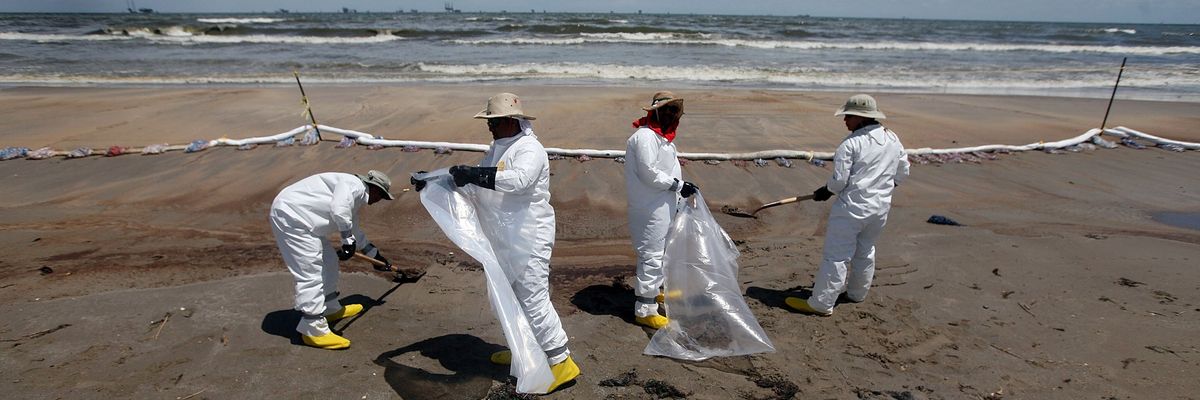
Workers are seen as they clear off some of the oil washing on to Fourchon Beach from the Deepwater Horizon oil spill in the Gulf of Mexico on June 28, 2010 in Port Fourchon, Louisiana.
Fifteen years after the oil spill, the legacy of Corexit dispersants continues to manifest in the broken bodies and shattered lives of those who were exposed, including those who spoke out to save future generations.
As the mother of a childhood cancer survivor from a coastal Alabama cluster, I reflect on the 15th anniversary of the Deepwater Horizon disaster with anger and frustration at the countless lives needlessly destroyed by the spill and its “cleanup.” But more than anything, I am afraid… I am afraid because the same chemicals that wrought havoc on Gulf communities aren’t being disposed of—they are being rebranded to be reused.
During my seven years of assisting cleanup workers at a Miami-based law firm and Government Accountability Project, I saw the stuff of medical nightmares manifest in real life as I came face-to-face with an innocuously named monster: Corexit. Corexit is a chemical oil dispersant that was used liberally in the wake of the Deepwater Horizon disaster to break up oil slicks into smaller droplets that can be submerged underwater. While Corexit was once described as being “as safe as dish soap” by a BP executive, the final chapter of its use in the Deepwater Horizon disaster was not to be told via feel-good commercials of freshly cleaned ducklings. It is still being written by outsiders documenting the broken lives of the men and women who can no longer speak for themselves after volunteering to clean the Gulf.
Many of the men and women who volunteered to clean the Gulf, a body of water that bound together their communities, jobs, and very way of life, died in the months and years after exposure to Corexit, often from serious diseases including blood and pancreatic cancers—silencing their voices long before justice could be served. I personally knew dozens who were exposed and subsequently left the Earth far too soon.
The corporate shell game of rebranding these toxic chemicals under new names must not distract us from the fundamental truth that these dispersants should never be used again in our waters.
I still think about Captain Bill, who came to us when Stage 4 colon cancer appeared after running a supply boat to the sinking Deepwater Horizon rig. He did not believe all the hype from environmentalists about the dangers of dispersants until he got crop-dusted with them. He developed softball sized cysts all over his body filled with bacteria and was left with just months to live. He left behind a wife and three children, including a young son with autism.
I remember Sandra, a woman who always exuded joy during the 20 years I’d known her. Her job for BP required her to hop on and off oil-contaminated boats; she tragically developed a rare myeloproliferative disorder that ended her life at age 60. She left behind a husband who missed her so profoundly that he lasted only a few months without her.
Corexit has been proven to have deadly side effects within humans, but that won’t stop corporate greed from slapping a new label on it and sending it to a different country. The U.S. Environmental Protection Agency (EPA) was in the process of finalizing new rules and regulations governing the usage of oil dispersants. Right before the rules were set to be finalized, the manufacturer of Corexit abruptly discontinued its product line which constituted over 45% of globally stockpiled dispersants. This was likely not coincidental; the new EPA rules require manufacturers to truthfully report known or anticipated harm to human health and wildlife from their products. Corexit’s parent company chose to withdraw from the U.S. market while re-registering the same toxic products in the United Kingdom and Brazil in 2024, with France also considering approval.
People and communities were falsely reassured about the safety of the working conditions, as BP told workers personal protective gear was unnecessary when dealing with the chemicals. Now, with the risks and threats of exposure known, the protective gear could have saved hundreds of lives and communities from devastation.
Fifteen years after the Deepwater Horizon oil spill, the legacy of Corexit dispersants continues to manifest in the broken bodies and shattered lives of those who were exposed, including those who spoke out to save future generations. The corporate shell game of rebranding these toxic chemicals under new names must not distract us from the fundamental truth that these dispersants should never be used again in our waters. The time has come to close this dark chapter in our history and commit to solutions that truly protect both our coasts and the people who call them home.
Dear Common Dreams reader, It’s been nearly 30 years since I co-founded Common Dreams with my late wife, Lina Newhouser. We had the radical notion that journalism should serve the public good, not corporate profits. It was clear to us from the outset what it would take to build such a project. No paid advertisements. No corporate sponsors. No millionaire publisher telling us what to think or do. Many people said we wouldn't last a year, but we proved those doubters wrong. Together with a tremendous team of journalists and dedicated staff, we built an independent media outlet free from the constraints of profits and corporate control. Our mission has always been simple: To inform. To inspire. To ignite change for the common good. Building Common Dreams was not easy. Our survival was never guaranteed. When you take on the most powerful forces—Wall Street greed, fossil fuel industry destruction, Big Tech lobbyists, and uber-rich oligarchs who have spent billions upon billions rigging the economy and democracy in their favor—the only bulwark you have is supporters who believe in your work. But here’s the urgent message from me today. It's never been this bad out there. And it's never been this hard to keep us going. At the very moment Common Dreams is most needed, the threats we face are intensifying. We need your support now more than ever. We don't accept corporate advertising and never will. We don't have a paywall because we don't think people should be blocked from critical news based on their ability to pay. Everything we do is funded by the donations of readers like you. When everyone does the little they can afford, we are strong. But if that support retreats or dries up, so do we. Will you donate now to make sure Common Dreams not only survives but thrives? —Craig Brown, Co-founder |
As the mother of a childhood cancer survivor from a coastal Alabama cluster, I reflect on the 15th anniversary of the Deepwater Horizon disaster with anger and frustration at the countless lives needlessly destroyed by the spill and its “cleanup.” But more than anything, I am afraid… I am afraid because the same chemicals that wrought havoc on Gulf communities aren’t being disposed of—they are being rebranded to be reused.
During my seven years of assisting cleanup workers at a Miami-based law firm and Government Accountability Project, I saw the stuff of medical nightmares manifest in real life as I came face-to-face with an innocuously named monster: Corexit. Corexit is a chemical oil dispersant that was used liberally in the wake of the Deepwater Horizon disaster to break up oil slicks into smaller droplets that can be submerged underwater. While Corexit was once described as being “as safe as dish soap” by a BP executive, the final chapter of its use in the Deepwater Horizon disaster was not to be told via feel-good commercials of freshly cleaned ducklings. It is still being written by outsiders documenting the broken lives of the men and women who can no longer speak for themselves after volunteering to clean the Gulf.
Many of the men and women who volunteered to clean the Gulf, a body of water that bound together their communities, jobs, and very way of life, died in the months and years after exposure to Corexit, often from serious diseases including blood and pancreatic cancers—silencing their voices long before justice could be served. I personally knew dozens who were exposed and subsequently left the Earth far too soon.
The corporate shell game of rebranding these toxic chemicals under new names must not distract us from the fundamental truth that these dispersants should never be used again in our waters.
I still think about Captain Bill, who came to us when Stage 4 colon cancer appeared after running a supply boat to the sinking Deepwater Horizon rig. He did not believe all the hype from environmentalists about the dangers of dispersants until he got crop-dusted with them. He developed softball sized cysts all over his body filled with bacteria and was left with just months to live. He left behind a wife and three children, including a young son with autism.
I remember Sandra, a woman who always exuded joy during the 20 years I’d known her. Her job for BP required her to hop on and off oil-contaminated boats; she tragically developed a rare myeloproliferative disorder that ended her life at age 60. She left behind a husband who missed her so profoundly that he lasted only a few months without her.
Corexit has been proven to have deadly side effects within humans, but that won’t stop corporate greed from slapping a new label on it and sending it to a different country. The U.S. Environmental Protection Agency (EPA) was in the process of finalizing new rules and regulations governing the usage of oil dispersants. Right before the rules were set to be finalized, the manufacturer of Corexit abruptly discontinued its product line which constituted over 45% of globally stockpiled dispersants. This was likely not coincidental; the new EPA rules require manufacturers to truthfully report known or anticipated harm to human health and wildlife from their products. Corexit’s parent company chose to withdraw from the U.S. market while re-registering the same toxic products in the United Kingdom and Brazil in 2024, with France also considering approval.
People and communities were falsely reassured about the safety of the working conditions, as BP told workers personal protective gear was unnecessary when dealing with the chemicals. Now, with the risks and threats of exposure known, the protective gear could have saved hundreds of lives and communities from devastation.
Fifteen years after the Deepwater Horizon oil spill, the legacy of Corexit dispersants continues to manifest in the broken bodies and shattered lives of those who were exposed, including those who spoke out to save future generations. The corporate shell game of rebranding these toxic chemicals under new names must not distract us from the fundamental truth that these dispersants should never be used again in our waters. The time has come to close this dark chapter in our history and commit to solutions that truly protect both our coasts and the people who call them home.
As the mother of a childhood cancer survivor from a coastal Alabama cluster, I reflect on the 15th anniversary of the Deepwater Horizon disaster with anger and frustration at the countless lives needlessly destroyed by the spill and its “cleanup.” But more than anything, I am afraid… I am afraid because the same chemicals that wrought havoc on Gulf communities aren’t being disposed of—they are being rebranded to be reused.
During my seven years of assisting cleanup workers at a Miami-based law firm and Government Accountability Project, I saw the stuff of medical nightmares manifest in real life as I came face-to-face with an innocuously named monster: Corexit. Corexit is a chemical oil dispersant that was used liberally in the wake of the Deepwater Horizon disaster to break up oil slicks into smaller droplets that can be submerged underwater. While Corexit was once described as being “as safe as dish soap” by a BP executive, the final chapter of its use in the Deepwater Horizon disaster was not to be told via feel-good commercials of freshly cleaned ducklings. It is still being written by outsiders documenting the broken lives of the men and women who can no longer speak for themselves after volunteering to clean the Gulf.
Many of the men and women who volunteered to clean the Gulf, a body of water that bound together their communities, jobs, and very way of life, died in the months and years after exposure to Corexit, often from serious diseases including blood and pancreatic cancers—silencing their voices long before justice could be served. I personally knew dozens who were exposed and subsequently left the Earth far too soon.
The corporate shell game of rebranding these toxic chemicals under new names must not distract us from the fundamental truth that these dispersants should never be used again in our waters.
I still think about Captain Bill, who came to us when Stage 4 colon cancer appeared after running a supply boat to the sinking Deepwater Horizon rig. He did not believe all the hype from environmentalists about the dangers of dispersants until he got crop-dusted with them. He developed softball sized cysts all over his body filled with bacteria and was left with just months to live. He left behind a wife and three children, including a young son with autism.
I remember Sandra, a woman who always exuded joy during the 20 years I’d known her. Her job for BP required her to hop on and off oil-contaminated boats; she tragically developed a rare myeloproliferative disorder that ended her life at age 60. She left behind a husband who missed her so profoundly that he lasted only a few months without her.
Corexit has been proven to have deadly side effects within humans, but that won’t stop corporate greed from slapping a new label on it and sending it to a different country. The U.S. Environmental Protection Agency (EPA) was in the process of finalizing new rules and regulations governing the usage of oil dispersants. Right before the rules were set to be finalized, the manufacturer of Corexit abruptly discontinued its product line which constituted over 45% of globally stockpiled dispersants. This was likely not coincidental; the new EPA rules require manufacturers to truthfully report known or anticipated harm to human health and wildlife from their products. Corexit’s parent company chose to withdraw from the U.S. market while re-registering the same toxic products in the United Kingdom and Brazil in 2024, with France also considering approval.
People and communities were falsely reassured about the safety of the working conditions, as BP told workers personal protective gear was unnecessary when dealing with the chemicals. Now, with the risks and threats of exposure known, the protective gear could have saved hundreds of lives and communities from devastation.
Fifteen years after the Deepwater Horizon oil spill, the legacy of Corexit dispersants continues to manifest in the broken bodies and shattered lives of those who were exposed, including those who spoke out to save future generations. The corporate shell game of rebranding these toxic chemicals under new names must not distract us from the fundamental truth that these dispersants should never be used again in our waters. The time has come to close this dark chapter in our history and commit to solutions that truly protect both our coasts and the people who call them home.