5
#000000
#FFFFFF
To donate by check, phone, or other method, see our More Ways to Give page.
Daily news & progressive opinion—funded by the people, not the corporations—delivered straight to your inbox.
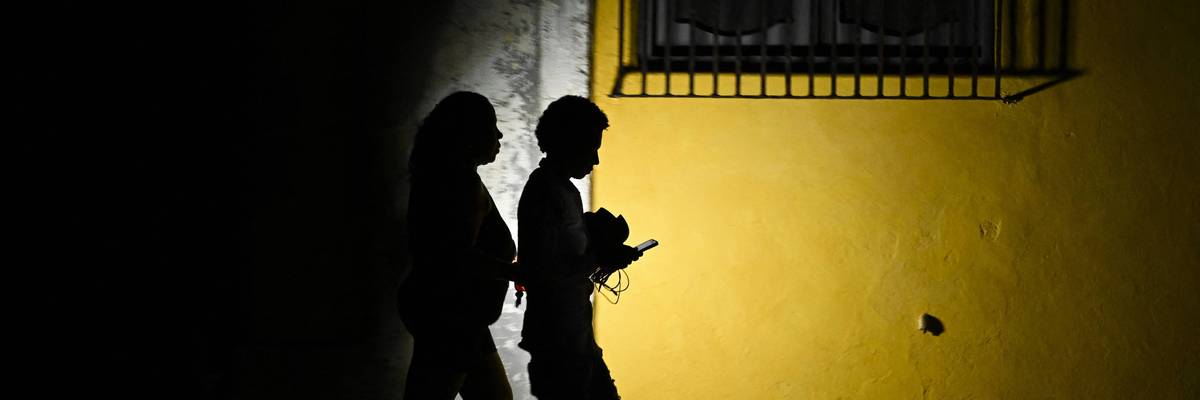
A woman holds a flashlight while walking with a man on a street during a blackout in Havana on March 16, 2026.
The real story is not the candle in the window. It is the hand that cut the fuel.
When the lights go out in Havana, the foreign cameras arrive to film the darkness.
They come for the blackout glow: candles in apartment windows, families sleeping on balconies, mothers fanning infants through another airless night. They come for the line outside the pharmacy, the bus that never comes, the refrigerator gone warm.
They come for the darkness.
A recent CBS segment on Cuba offered viewers a familiar script: a “failed” island, an aging revolution, refugees in Florida, and Washington once again contemplating what to do with the place 90 miles away. But the segment was also built on an omission so large it swallowed the truth: that while these cameras speak of shortages and collapse, babies are dying under a policy designed to create both.
If the Cuban system is truly destined to fail on its own, why has so much power been invested in making sure it does?
A new report from the Center for Economic and Policy Research has found that the expansion of US sanctions beginning in 2017 was likely the primary cause of a dramatic rise in infant mortality in Cuba. According to the report, Cuba’s infant mortality rate surged by 148% from 2018 to 2025. Had the rate remained stable, approximately 1,800 babies who died during those years would likely still be alive.
Read that again. Babies.
The report links the rise to the tightening of unilateral US coercive measures under the first Donald Trump administration, the continuation of most of those measures under Joe Biden, and further escalation under the second Trump administration. Instead of telling that story, prime-time segments like CBS recycle Cold War clichés.
In this segment, people are invited to remember prerevolutionary Cuba as a lost paradise. But beyond the casino lights were cane cutters; domestic workers; rural families without doctors; children without schools; Black Cubans denied the full rights, dignity, and opportunities the government claimed to promise; workers, surviving in an economy where much of the wealth flowed upward. For many Cubans, the revolution was a rupture with dependency.
It is common in US media to shrink the Cuban Revolution into one beard, one speech, one man. As if millions of lives, shaped by inequality, dictatorship, and foreign domination, could be reduced to nothing more than a personality cult. Fidel Castro was central to Cuba’s history, but so were peasants who wanted land, teachers who crossed mountains to teach literacy, doctors who stayed in poor neighborhoods, workers who believed sovereignty meant something more than a flag.
Like any other country, Cuba has real internal problems. Bureaucracy exists. Economic errors exist. Frustration is real. Emigration is real. And yet, these realities are routinely seized upon by Washington as the ready-made justification for intervention, pressure, and policies that deepen the very conditions they claim to condemn.
For decades, the United States has built an external wall around the island brick by brick. Sanctions. Financial penalties. Shipping restrictions. Fuel pressure. Banking obstacles. Threats against companies that trade. Punishments for third countries. Obstacles to medicine, parts, credit, investment, and entrepreneurs. Policy papers described the logic openly generations ago: Create hardship, provoke desperation, generate political unrest.
This is where media like CBS plays a critical role by showing the suffering while obscuring the system that produces it. By rendering US policy as background noise rather than as an active force shaping the very reality being filmed. And this is not an isolated editorial choice. It is a pattern.
But when infant deaths rise sharply during a period of intensified external strangulation, honesty demands more than repeating those talking points. It requires naming cause and responsibility. And it requires asking a more uncomfortable question: If the Cuban system is truly destined to fail on its own, why has so much power been invested in making sure it does?
You don’t spend decades trying to suffocate something that poses no alternative. Why isolate, sanction, and punish a model you believe is irrelevant? Unless the fear is not that it will fail. Unless the fear is that it might, even with all its contradictions, suggest a different way of organizing society. One where people are not reduced to clients, markets, or consumers to be captured, but honored as human beings to be nourished, protected, and allowed to flourish.
When I walked through Havana during a blackout, I saw neighbors calling across courtyards, playing dominoes by candlelight. Someone on the corner had a speaker with half a battery and enough music for three buildings. Two young people kissed along the Malecón. Someone cursed the government. Someone cursed the blockade. Someone cursed both. Someone laughed. I saw human beings remain stubbornly human.
Why does CBS not cover that? Because they film the darkness. But the real story is not the candle in the window. It is the hand that cut the fuel, the policy that constricted the hospital, the silence that normalized preventable deaths, and the infants whose names will never appear in the broadcast.
Dear Common Dreams reader, It’s been nearly 30 years since I co-founded Common Dreams with my late wife, Lina Newhouser. We had the radical notion that journalism should serve the public good, not corporate profits. It was clear to us from the outset what it would take to build such a project. No paid advertisements. No corporate sponsors. No millionaire publisher telling us what to think or do. Many people said we wouldn't last a year, but we proved those doubters wrong. Together with a tremendous team of journalists and dedicated staff, we built an independent media outlet free from the constraints of profits and corporate control. Our mission has always been simple: To inform. To inspire. To ignite change for the common good. Building Common Dreams was not easy. Our survival was never guaranteed. When you take on the most powerful forces—Wall Street greed, fossil fuel industry destruction, Big Tech lobbyists, and uber-rich oligarchs who have spent billions upon billions rigging the economy and democracy in their favor—the only bulwark you have is supporters who believe in your work. But here’s the urgent message from me today. It's never been this bad out there. And it's never been this hard to keep us going. At the very moment Common Dreams is most needed, the threats we face are intensifying. We need your support now more than ever. We don't accept corporate advertising and never will. We don't have a paywall because we don't think people should be blocked from critical news based on their ability to pay. Everything we do is funded by the donations of readers like you. When everyone does the little they can afford, we are strong. But if that support retreats or dries up, so do we. Will you donate now to make sure Common Dreams not only survives but thrives? —Craig Brown, Co-founder |
When the lights go out in Havana, the foreign cameras arrive to film the darkness.
They come for the blackout glow: candles in apartment windows, families sleeping on balconies, mothers fanning infants through another airless night. They come for the line outside the pharmacy, the bus that never comes, the refrigerator gone warm.
They come for the darkness.
A recent CBS segment on Cuba offered viewers a familiar script: a “failed” island, an aging revolution, refugees in Florida, and Washington once again contemplating what to do with the place 90 miles away. But the segment was also built on an omission so large it swallowed the truth: that while these cameras speak of shortages and collapse, babies are dying under a policy designed to create both.
If the Cuban system is truly destined to fail on its own, why has so much power been invested in making sure it does?
A new report from the Center for Economic and Policy Research has found that the expansion of US sanctions beginning in 2017 was likely the primary cause of a dramatic rise in infant mortality in Cuba. According to the report, Cuba’s infant mortality rate surged by 148% from 2018 to 2025. Had the rate remained stable, approximately 1,800 babies who died during those years would likely still be alive.
Read that again. Babies.
The report links the rise to the tightening of unilateral US coercive measures under the first Donald Trump administration, the continuation of most of those measures under Joe Biden, and further escalation under the second Trump administration. Instead of telling that story, prime-time segments like CBS recycle Cold War clichés.
In this segment, people are invited to remember prerevolutionary Cuba as a lost paradise. But beyond the casino lights were cane cutters; domestic workers; rural families without doctors; children without schools; Black Cubans denied the full rights, dignity, and opportunities the government claimed to promise; workers, surviving in an economy where much of the wealth flowed upward. For many Cubans, the revolution was a rupture with dependency.
It is common in US media to shrink the Cuban Revolution into one beard, one speech, one man. As if millions of lives, shaped by inequality, dictatorship, and foreign domination, could be reduced to nothing more than a personality cult. Fidel Castro was central to Cuba’s history, but so were peasants who wanted land, teachers who crossed mountains to teach literacy, doctors who stayed in poor neighborhoods, workers who believed sovereignty meant something more than a flag.
Like any other country, Cuba has real internal problems. Bureaucracy exists. Economic errors exist. Frustration is real. Emigration is real. And yet, these realities are routinely seized upon by Washington as the ready-made justification for intervention, pressure, and policies that deepen the very conditions they claim to condemn.
For decades, the United States has built an external wall around the island brick by brick. Sanctions. Financial penalties. Shipping restrictions. Fuel pressure. Banking obstacles. Threats against companies that trade. Punishments for third countries. Obstacles to medicine, parts, credit, investment, and entrepreneurs. Policy papers described the logic openly generations ago: Create hardship, provoke desperation, generate political unrest.
This is where media like CBS plays a critical role by showing the suffering while obscuring the system that produces it. By rendering US policy as background noise rather than as an active force shaping the very reality being filmed. And this is not an isolated editorial choice. It is a pattern.
But when infant deaths rise sharply during a period of intensified external strangulation, honesty demands more than repeating those talking points. It requires naming cause and responsibility. And it requires asking a more uncomfortable question: If the Cuban system is truly destined to fail on its own, why has so much power been invested in making sure it does?
You don’t spend decades trying to suffocate something that poses no alternative. Why isolate, sanction, and punish a model you believe is irrelevant? Unless the fear is not that it will fail. Unless the fear is that it might, even with all its contradictions, suggest a different way of organizing society. One where people are not reduced to clients, markets, or consumers to be captured, but honored as human beings to be nourished, protected, and allowed to flourish.
When I walked through Havana during a blackout, I saw neighbors calling across courtyards, playing dominoes by candlelight. Someone on the corner had a speaker with half a battery and enough music for three buildings. Two young people kissed along the Malecón. Someone cursed the government. Someone cursed the blockade. Someone cursed both. Someone laughed. I saw human beings remain stubbornly human.
Why does CBS not cover that? Because they film the darkness. But the real story is not the candle in the window. It is the hand that cut the fuel, the policy that constricted the hospital, the silence that normalized preventable deaths, and the infants whose names will never appear in the broadcast.
When the lights go out in Havana, the foreign cameras arrive to film the darkness.
They come for the blackout glow: candles in apartment windows, families sleeping on balconies, mothers fanning infants through another airless night. They come for the line outside the pharmacy, the bus that never comes, the refrigerator gone warm.
They come for the darkness.
A recent CBS segment on Cuba offered viewers a familiar script: a “failed” island, an aging revolution, refugees in Florida, and Washington once again contemplating what to do with the place 90 miles away. But the segment was also built on an omission so large it swallowed the truth: that while these cameras speak of shortages and collapse, babies are dying under a policy designed to create both.
If the Cuban system is truly destined to fail on its own, why has so much power been invested in making sure it does?
A new report from the Center for Economic and Policy Research has found that the expansion of US sanctions beginning in 2017 was likely the primary cause of a dramatic rise in infant mortality in Cuba. According to the report, Cuba’s infant mortality rate surged by 148% from 2018 to 2025. Had the rate remained stable, approximately 1,800 babies who died during those years would likely still be alive.
Read that again. Babies.
The report links the rise to the tightening of unilateral US coercive measures under the first Donald Trump administration, the continuation of most of those measures under Joe Biden, and further escalation under the second Trump administration. Instead of telling that story, prime-time segments like CBS recycle Cold War clichés.
In this segment, people are invited to remember prerevolutionary Cuba as a lost paradise. But beyond the casino lights were cane cutters; domestic workers; rural families without doctors; children without schools; Black Cubans denied the full rights, dignity, and opportunities the government claimed to promise; workers, surviving in an economy where much of the wealth flowed upward. For many Cubans, the revolution was a rupture with dependency.
It is common in US media to shrink the Cuban Revolution into one beard, one speech, one man. As if millions of lives, shaped by inequality, dictatorship, and foreign domination, could be reduced to nothing more than a personality cult. Fidel Castro was central to Cuba’s history, but so were peasants who wanted land, teachers who crossed mountains to teach literacy, doctors who stayed in poor neighborhoods, workers who believed sovereignty meant something more than a flag.
Like any other country, Cuba has real internal problems. Bureaucracy exists. Economic errors exist. Frustration is real. Emigration is real. And yet, these realities are routinely seized upon by Washington as the ready-made justification for intervention, pressure, and policies that deepen the very conditions they claim to condemn.
For decades, the United States has built an external wall around the island brick by brick. Sanctions. Financial penalties. Shipping restrictions. Fuel pressure. Banking obstacles. Threats against companies that trade. Punishments for third countries. Obstacles to medicine, parts, credit, investment, and entrepreneurs. Policy papers described the logic openly generations ago: Create hardship, provoke desperation, generate political unrest.
This is where media like CBS plays a critical role by showing the suffering while obscuring the system that produces it. By rendering US policy as background noise rather than as an active force shaping the very reality being filmed. And this is not an isolated editorial choice. It is a pattern.
But when infant deaths rise sharply during a period of intensified external strangulation, honesty demands more than repeating those talking points. It requires naming cause and responsibility. And it requires asking a more uncomfortable question: If the Cuban system is truly destined to fail on its own, why has so much power been invested in making sure it does?
You don’t spend decades trying to suffocate something that poses no alternative. Why isolate, sanction, and punish a model you believe is irrelevant? Unless the fear is not that it will fail. Unless the fear is that it might, even with all its contradictions, suggest a different way of organizing society. One where people are not reduced to clients, markets, or consumers to be captured, but honored as human beings to be nourished, protected, and allowed to flourish.
When I walked through Havana during a blackout, I saw neighbors calling across courtyards, playing dominoes by candlelight. Someone on the corner had a speaker with half a battery and enough music for three buildings. Two young people kissed along the Malecón. Someone cursed the government. Someone cursed the blockade. Someone cursed both. Someone laughed. I saw human beings remain stubbornly human.
Why does CBS not cover that? Because they film the darkness. But the real story is not the candle in the window. It is the hand that cut the fuel, the policy that constricted the hospital, the silence that normalized preventable deaths, and the infants whose names will never appear in the broadcast.