5
#000000
#FFFFFF
To donate by check, phone, or other method, see our More Ways to Give page.
Daily news & progressive opinion—funded by the people, not the corporations—delivered straight to your inbox.
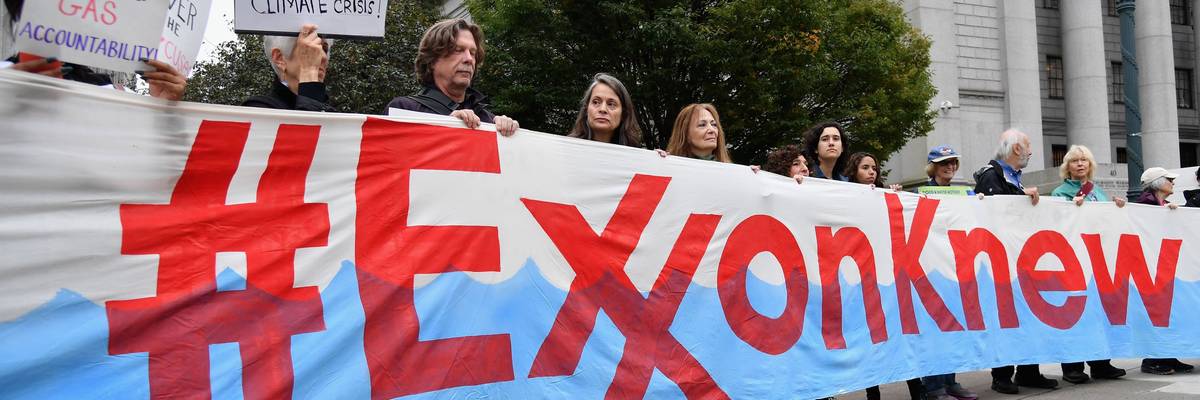
Climate activists protest on the first day of the Exxon Mobil trial outside the New York State Supreme Court building on October 22, 2019 in New York City.
Massachusetts must pass a Climate Superfund Act to hold big polluters accountable and keep our communities safe from climate harm.
Early in my career as a primary care physician, I found myself steering my car through driving rain around downed power lines and fallen tree branches for a shift in urgent care. I was already nervous about my new role. Having a hurricane didn’t help. I remember feeling overwhelmed and inadequate when I had to refer a patient to the already overburdened ER. The deep wound a roof shingle had carved in their scalp was too much for me. Hurricane Bob was a Category 3 hurricane and it took 18 people’s lives and caused today’s equivalent of ~$3.5 billion in damages. The fear, the injuries, and the losses all fell on the local community.
That was decades ago. Nowadays—from Texas floods, to Western wildfires, to deadly heatwaves across the Midwest and Northeast—communities across the country are paying the price. Severe storms are more frequent because of climate change caused by burning fossil fuels. Extreme weather events are causing traumatic injuries, post-traumatic stress disorders, medication shortages, and death. Heatwaves are more frequent and more dangerous, causing heart attacks, asthma attacks, kidney failure, and death. Floods are ravaging our towns, roads, bridges, and farms, overwhelming local businesses and thinly stretched municipal budgets. Public health and infrastructure costs from these crises are mounting. And fossil fuel air pollution—accounting for ~95% of total air pollution in the state—currently kills over 2,700 residents each year in Massachusetts through heart disease, lung cancer, stroke, and chronic lung illness.
Meanwhile, the petrochemical corporations—who’ve knowingly fueled the climate crisis and spent tens of millions of dollars to sow disinformation—got off scot-free.
As a doctor, I can treat people for asthma from air pollution and dehydration from heatwaves, but if the root cause is not addressed, countless more will suffer. The enormity of this threat to public health led me to retire from primary care and join with those fighting for clean energy. We urgently need to stop burning fossil fuels, but we must also invest in resilience and adaptation projects, to safeguard Massachusetts communities against the climate harms they are already experiencing—from the flooding and erosion threatening residents and businesses in Boston and along the coast, to the droughts facing farmers in Western Mass, to the record-shattering heatwaves hitting the entire state this month.
In my medical practice, if I discovered a treatment I prescribed was harming my patients, I’d be ethically bound to speak out. It’s abundantly clear that the fossil fuel industry follows a different ethic.
Passing the state Climate Superfund Act is one step we must take, following in the footsteps of our Vermont and New York neighbors and coalition partners in the nationwide movement to hold big polluters accountable and keep our communities safe from climate harm. Passing a superfund in Massachusetts would allow us to build resiliency in our communities using funds from Big Oil’s checkbook. This act would require the biggest polluters to pay, based on their historical emissions, for projects across the Commonwealth—upgrading stormwater drains, protecting our coasts, installing energy-efficient cooling for seniors who swelter without AC, and offering preventive healthcare programs to treat those sickened by climate change. We desperately need these measures, and this gives us a fair way to pay for them. If you made a mess, you need to clean it up.
In my medical practice, if I discovered a treatment I prescribed was harming my patients, I’d be ethically bound to speak out. It’s abundantly clear that the fossil fuel industry follows a different ethic. Big Oil has known for more than 60 years about the harms their products were causing, but instead of putting people over profits, they have spent tens of millions to cover it up and lie to the public about the damage they were creating.
We can no longer afford to be complacent. It’s time for the Massachusetts legislature to stop “studying” this problem and start protecting its people with this legislation that the majority of its residents support. It’s financially and morally imperative that we pass the Climate Superfund Act. It’s time to make polluters pay for the health of our Commonwealth.
Dear Common Dreams reader, It’s been nearly 30 years since I co-founded Common Dreams with my late wife, Lina Newhouser. We had the radical notion that journalism should serve the public good, not corporate profits. It was clear to us from the outset what it would take to build such a project. No paid advertisements. No corporate sponsors. No millionaire publisher telling us what to think or do. Many people said we wouldn't last a year, but we proved those doubters wrong. Together with a tremendous team of journalists and dedicated staff, we built an independent media outlet free from the constraints of profits and corporate control. Our mission has always been simple: To inform. To inspire. To ignite change for the common good. Building Common Dreams was not easy. Our survival was never guaranteed. When you take on the most powerful forces—Wall Street greed, fossil fuel industry destruction, Big Tech lobbyists, and uber-rich oligarchs who have spent billions upon billions rigging the economy and democracy in their favor—the only bulwark you have is supporters who believe in your work. But here’s the urgent message from me today. It's never been this bad out there. And it's never been this hard to keep us going. At the very moment Common Dreams is most needed, the threats we face are intensifying. We need your support now more than ever. We don't accept corporate advertising and never will. We don't have a paywall because we don't think people should be blocked from critical news based on their ability to pay. Everything we do is funded by the donations of readers like you. When everyone does the little they can afford, we are strong. But if that support retreats or dries up, so do we. Will you donate now to make sure Common Dreams not only survives but thrives? —Craig Brown, Co-founder |
Early in my career as a primary care physician, I found myself steering my car through driving rain around downed power lines and fallen tree branches for a shift in urgent care. I was already nervous about my new role. Having a hurricane didn’t help. I remember feeling overwhelmed and inadequate when I had to refer a patient to the already overburdened ER. The deep wound a roof shingle had carved in their scalp was too much for me. Hurricane Bob was a Category 3 hurricane and it took 18 people’s lives and caused today’s equivalent of ~$3.5 billion in damages. The fear, the injuries, and the losses all fell on the local community.
That was decades ago. Nowadays—from Texas floods, to Western wildfires, to deadly heatwaves across the Midwest and Northeast—communities across the country are paying the price. Severe storms are more frequent because of climate change caused by burning fossil fuels. Extreme weather events are causing traumatic injuries, post-traumatic stress disorders, medication shortages, and death. Heatwaves are more frequent and more dangerous, causing heart attacks, asthma attacks, kidney failure, and death. Floods are ravaging our towns, roads, bridges, and farms, overwhelming local businesses and thinly stretched municipal budgets. Public health and infrastructure costs from these crises are mounting. And fossil fuel air pollution—accounting for ~95% of total air pollution in the state—currently kills over 2,700 residents each year in Massachusetts through heart disease, lung cancer, stroke, and chronic lung illness.
Meanwhile, the petrochemical corporations—who’ve knowingly fueled the climate crisis and spent tens of millions of dollars to sow disinformation—got off scot-free.
As a doctor, I can treat people for asthma from air pollution and dehydration from heatwaves, but if the root cause is not addressed, countless more will suffer. The enormity of this threat to public health led me to retire from primary care and join with those fighting for clean energy. We urgently need to stop burning fossil fuels, but we must also invest in resilience and adaptation projects, to safeguard Massachusetts communities against the climate harms they are already experiencing—from the flooding and erosion threatening residents and businesses in Boston and along the coast, to the droughts facing farmers in Western Mass, to the record-shattering heatwaves hitting the entire state this month.
In my medical practice, if I discovered a treatment I prescribed was harming my patients, I’d be ethically bound to speak out. It’s abundantly clear that the fossil fuel industry follows a different ethic.
Passing the state Climate Superfund Act is one step we must take, following in the footsteps of our Vermont and New York neighbors and coalition partners in the nationwide movement to hold big polluters accountable and keep our communities safe from climate harm. Passing a superfund in Massachusetts would allow us to build resiliency in our communities using funds from Big Oil’s checkbook. This act would require the biggest polluters to pay, based on their historical emissions, for projects across the Commonwealth—upgrading stormwater drains, protecting our coasts, installing energy-efficient cooling for seniors who swelter without AC, and offering preventive healthcare programs to treat those sickened by climate change. We desperately need these measures, and this gives us a fair way to pay for them. If you made a mess, you need to clean it up.
In my medical practice, if I discovered a treatment I prescribed was harming my patients, I’d be ethically bound to speak out. It’s abundantly clear that the fossil fuel industry follows a different ethic. Big Oil has known for more than 60 years about the harms their products were causing, but instead of putting people over profits, they have spent tens of millions to cover it up and lie to the public about the damage they were creating.
We can no longer afford to be complacent. It’s time for the Massachusetts legislature to stop “studying” this problem and start protecting its people with this legislation that the majority of its residents support. It’s financially and morally imperative that we pass the Climate Superfund Act. It’s time to make polluters pay for the health of our Commonwealth.
Early in my career as a primary care physician, I found myself steering my car through driving rain around downed power lines and fallen tree branches for a shift in urgent care. I was already nervous about my new role. Having a hurricane didn’t help. I remember feeling overwhelmed and inadequate when I had to refer a patient to the already overburdened ER. The deep wound a roof shingle had carved in their scalp was too much for me. Hurricane Bob was a Category 3 hurricane and it took 18 people’s lives and caused today’s equivalent of ~$3.5 billion in damages. The fear, the injuries, and the losses all fell on the local community.
That was decades ago. Nowadays—from Texas floods, to Western wildfires, to deadly heatwaves across the Midwest and Northeast—communities across the country are paying the price. Severe storms are more frequent because of climate change caused by burning fossil fuels. Extreme weather events are causing traumatic injuries, post-traumatic stress disorders, medication shortages, and death. Heatwaves are more frequent and more dangerous, causing heart attacks, asthma attacks, kidney failure, and death. Floods are ravaging our towns, roads, bridges, and farms, overwhelming local businesses and thinly stretched municipal budgets. Public health and infrastructure costs from these crises are mounting. And fossil fuel air pollution—accounting for ~95% of total air pollution in the state—currently kills over 2,700 residents each year in Massachusetts through heart disease, lung cancer, stroke, and chronic lung illness.
Meanwhile, the petrochemical corporations—who’ve knowingly fueled the climate crisis and spent tens of millions of dollars to sow disinformation—got off scot-free.
As a doctor, I can treat people for asthma from air pollution and dehydration from heatwaves, but if the root cause is not addressed, countless more will suffer. The enormity of this threat to public health led me to retire from primary care and join with those fighting for clean energy. We urgently need to stop burning fossil fuels, but we must also invest in resilience and adaptation projects, to safeguard Massachusetts communities against the climate harms they are already experiencing—from the flooding and erosion threatening residents and businesses in Boston and along the coast, to the droughts facing farmers in Western Mass, to the record-shattering heatwaves hitting the entire state this month.
In my medical practice, if I discovered a treatment I prescribed was harming my patients, I’d be ethically bound to speak out. It’s abundantly clear that the fossil fuel industry follows a different ethic.
Passing the state Climate Superfund Act is one step we must take, following in the footsteps of our Vermont and New York neighbors and coalition partners in the nationwide movement to hold big polluters accountable and keep our communities safe from climate harm. Passing a superfund in Massachusetts would allow us to build resiliency in our communities using funds from Big Oil’s checkbook. This act would require the biggest polluters to pay, based on their historical emissions, for projects across the Commonwealth—upgrading stormwater drains, protecting our coasts, installing energy-efficient cooling for seniors who swelter without AC, and offering preventive healthcare programs to treat those sickened by climate change. We desperately need these measures, and this gives us a fair way to pay for them. If you made a mess, you need to clean it up.
In my medical practice, if I discovered a treatment I prescribed was harming my patients, I’d be ethically bound to speak out. It’s abundantly clear that the fossil fuel industry follows a different ethic. Big Oil has known for more than 60 years about the harms their products were causing, but instead of putting people over profits, they have spent tens of millions to cover it up and lie to the public about the damage they were creating.
We can no longer afford to be complacent. It’s time for the Massachusetts legislature to stop “studying” this problem and start protecting its people with this legislation that the majority of its residents support. It’s financially and morally imperative that we pass the Climate Superfund Act. It’s time to make polluters pay for the health of our Commonwealth.