SUBSCRIBE TO OUR FREE NEWSLETTER
Daily news & progressive opinion—funded by the people, not the corporations—delivered straight to your inbox.
5
#000000
#FFFFFF
To donate by check, phone, or other method, see our More Ways to Give page.
Daily news & progressive opinion—funded by the people, not the corporations—delivered straight to your inbox.
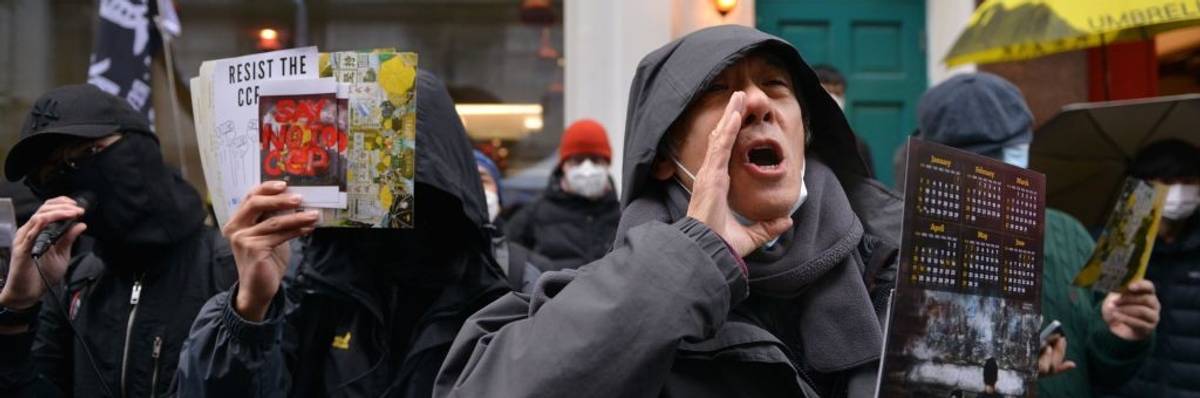
If the United States can’t learn to cooperate with China, our future will be one of constant escalation of wars and threats of wars and all that comes with them—including massive refugee flows, environmental destruction, and rising poverty.
Whenever the threat of war against a new enemy abroad rises, attacks at home erupt first against those who are perceived to have ties to that so-called enemy—and then against those who stand against war and call instead for diplomacy and engagement.
The new Cold War comes home with a rise in anti-Asian racism, including everything from violent attacks on innocent people to clouds of suspicion hovering over Asian and Asian-American scientists and researchers, with threats of lost jobs, deportation, even arrest. Advocates for diplomacy instead of war with China, peace activists, environmentalists who recognize we cannot deal with the global climate crisis without cooperation and collaboration with China—all are accused of being soft on communism, or spreading “Chinese government talking points.”
We live in the wealthiest, most powerful country in the history of the world. But our world is burning, inequality is rising, and war threatens global destruction. Our country can’t solve those problems alone. We need global cooperation—on a scale never seen in our world—to protect our earth, to protect our people, to prevent our wars.
And that cooperation has to start with China.
If the United States can’t learn to cooperate with China, our future will be one of constant escalation of wars and threats of wars and all that comes with them—including massive refugee flows, environmental destruction, and rising poverty.
"Instead of cooperation, we are entering a new Cold War—where competition with China determines everything from our federal budget to where we get our most advanced computer chips to who can study or teach in our universities."
Without diplomacy, we’ll face a future of escalating military spending—already at 53 cents of every dollar in the Congressional budget. That means hundreds of billions of dollars lost for jobs, health care, housing, education, child and elder care—all the things that actually keep us safe.
But instead of cooperation, we are entering a new Cold War—where competition with China determines everything from our federal budget to where we get our most advanced computer chips to who can study or teach in our universities. And just like the first Cold War—with its half a century of tense nuclear stand-offs between the U.S. and the Soviet Union and the accompanying hot wars that devastated poor countries across the Global South—this new iteration has a domestic component too.
While Washington mobilized against the Soviet Union abroad, the U.S. government, corporations, media, universities, and Hollywood began a political campaign at home to turn the Soviets and the Russian people into an enemy in the mind and heart of everyone living in this country. In an age of nuclear standoffs, that was dangerous enough. And to make that possible, a national campaign painted critics—from progressives who fought against racism and for a fairer economy to opponents of war and advocates of diplomacy—as agents or “fellow travelers” of the Soviet Union.
That campaign became known for its most virulent perpetrator, Senator Joseph McCarthy. And we are seeing a new McCarthyism rising today, as anti-China campaigns erupt across our country.
"We see not only both parties in Congress, but mainstream media outlets from Fox News to the New York Times frequently putting forward a vision of China as nothing but an ideological and implacable enemy."
There is a dangerous consensus in Congress between leading Democrats and Republicans who support spending hundreds of billions of dollars—and billions more each year—to counter China. Even the $100+ billion already sent for military and economic support of Ukraine is described as necessary to prevent a Chinese version of Russia’s invasion, with Taiwan as the next Ukraine. NATO is now including Asia-Pacific leaders as partners in their summits, clearly aimed at expanding the military alliance’s influence beyond its North Atlantic origins.
It’s all about China–not as a major competitor (it has the world’s second-largest economy, after ours) with which U.S. corporations contend for commercial advantage, but as an economic and financial enemy we must destroy. Not as a strategic challenger (it has the second largest military budget, though less than one-third of what Washington spends) that we have to approach with creative diplomacy and regional as well as global cooperation, but as an enemy we must crush.
We see not only both parties in Congress, but mainstream media outlets from Fox News to the New York Times frequently putting forward a vision of China as nothing but an ideological and implacable enemy.
When Energy Secretary Jennifer Granholm said the U.S. could learn something from China’s insufficient but important climate advances, Fox News and congressional Republicans called it “CCP propaganda.” More recently, the New York Times linked some straight reporting to old-fashioned anti-communist guilt by association, insinuating evil-doing from a decorative plate on a shelf, slogans on tote bags, and the cover of a notebook, all foregrounding anti-China fear-mongering.
The danger of this kind of propaganda at home is that it can set the stage for this new Cold War turning very hot very fast. And most at risk are the impacted communities deemed sympathetic to the “enemy.”
World War II saw the mass round-up and incarceration of people of Japanese origin. The period after 9/11 saw not only a series of U.S. wars and military operations abroad, including Guantanamo and a global network of torture sites, but a tidal wave of anti-Muslim racism at home — detentions, surveillance, deportations, no-fly lists, and more. From the very beginning of the so-called Global War on Terror, many of us fought against the attacks on Muslim communities and individuals that aimed to build support at home for that war abroad.
"The danger of this kind of propaganda at home is that it can set the stage for this new Cold War turning very hot very fast."
We in civil society and social movements—who hold a legitimacy for such criticism that our government does not—will continue to call on the Chinese government to stop denying and weakening the labor rights of Chinese workers and the critical environmental protections needed around the world. And in keeping with our legacy of mobilizing against U.S. and allied governments’ attacks on Muslim communities, we will continue to demand an end to Beijing’s brutal repression against Uyghurs.
As we do, we will continue to fight against wars and militarism and call on our own government to slash the almost trillion-dollar military budget to pay for green jobs, health care, education, and to end poverty in this country and around the world. And we’ll continue to call for diplomacy instead of war–everywhere.
The price for the Cold War was paid with millions of lives lost in related wars around the world. Ending it took decades. We can’t afford to wait that long again. We need to work now to prevent a 21st century version.Dear Common Dreams reader, It’s been nearly 30 years since I co-founded Common Dreams with my late wife, Lina Newhouser. We had the radical notion that journalism should serve the public good, not corporate profits. It was clear to us from the outset what it would take to build such a project. No paid advertisements. No corporate sponsors. No millionaire publisher telling us what to think or do. Many people said we wouldn't last a year, but we proved those doubters wrong. Together with a tremendous team of journalists and dedicated staff, we built an independent media outlet free from the constraints of profits and corporate control. Our mission has always been simple: To inform. To inspire. To ignite change for the common good. Building Common Dreams was not easy. Our survival was never guaranteed. When you take on the most powerful forces—Wall Street greed, fossil fuel industry destruction, Big Tech lobbyists, and uber-rich oligarchs who have spent billions upon billions rigging the economy and democracy in their favor—the only bulwark you have is supporters who believe in your work. But here’s the urgent message from me today. It's never been this bad out there. And it's never been this hard to keep us going. At the very moment Common Dreams is most needed, the threats we face are intensifying. We need your support now more than ever. We don't accept corporate advertising and never will. We don't have a paywall because we don't think people should be blocked from critical news based on their ability to pay. Everything we do is funded by the donations of readers like you. When everyone does the little they can afford, we are strong. But if that support retreats or dries up, so do we. Will you donate now to make sure Common Dreams not only survives but thrives? —Craig Brown, Co-founder |
Whenever the threat of war against a new enemy abroad rises, attacks at home erupt first against those who are perceived to have ties to that so-called enemy—and then against those who stand against war and call instead for diplomacy and engagement.
The new Cold War comes home with a rise in anti-Asian racism, including everything from violent attacks on innocent people to clouds of suspicion hovering over Asian and Asian-American scientists and researchers, with threats of lost jobs, deportation, even arrest. Advocates for diplomacy instead of war with China, peace activists, environmentalists who recognize we cannot deal with the global climate crisis without cooperation and collaboration with China—all are accused of being soft on communism, or spreading “Chinese government talking points.”
We live in the wealthiest, most powerful country in the history of the world. But our world is burning, inequality is rising, and war threatens global destruction. Our country can’t solve those problems alone. We need global cooperation—on a scale never seen in our world—to protect our earth, to protect our people, to prevent our wars.
And that cooperation has to start with China.
If the United States can’t learn to cooperate with China, our future will be one of constant escalation of wars and threats of wars and all that comes with them—including massive refugee flows, environmental destruction, and rising poverty.
"Instead of cooperation, we are entering a new Cold War—where competition with China determines everything from our federal budget to where we get our most advanced computer chips to who can study or teach in our universities."
Without diplomacy, we’ll face a future of escalating military spending—already at 53 cents of every dollar in the Congressional budget. That means hundreds of billions of dollars lost for jobs, health care, housing, education, child and elder care—all the things that actually keep us safe.
But instead of cooperation, we are entering a new Cold War—where competition with China determines everything from our federal budget to where we get our most advanced computer chips to who can study or teach in our universities. And just like the first Cold War—with its half a century of tense nuclear stand-offs between the U.S. and the Soviet Union and the accompanying hot wars that devastated poor countries across the Global South—this new iteration has a domestic component too.
While Washington mobilized against the Soviet Union abroad, the U.S. government, corporations, media, universities, and Hollywood began a political campaign at home to turn the Soviets and the Russian people into an enemy in the mind and heart of everyone living in this country. In an age of nuclear standoffs, that was dangerous enough. And to make that possible, a national campaign painted critics—from progressives who fought against racism and for a fairer economy to opponents of war and advocates of diplomacy—as agents or “fellow travelers” of the Soviet Union.
That campaign became known for its most virulent perpetrator, Senator Joseph McCarthy. And we are seeing a new McCarthyism rising today, as anti-China campaigns erupt across our country.
"We see not only both parties in Congress, but mainstream media outlets from Fox News to the New York Times frequently putting forward a vision of China as nothing but an ideological and implacable enemy."
There is a dangerous consensus in Congress between leading Democrats and Republicans who support spending hundreds of billions of dollars—and billions more each year—to counter China. Even the $100+ billion already sent for military and economic support of Ukraine is described as necessary to prevent a Chinese version of Russia’s invasion, with Taiwan as the next Ukraine. NATO is now including Asia-Pacific leaders as partners in their summits, clearly aimed at expanding the military alliance’s influence beyond its North Atlantic origins.
It’s all about China–not as a major competitor (it has the world’s second-largest economy, after ours) with which U.S. corporations contend for commercial advantage, but as an economic and financial enemy we must destroy. Not as a strategic challenger (it has the second largest military budget, though less than one-third of what Washington spends) that we have to approach with creative diplomacy and regional as well as global cooperation, but as an enemy we must crush.
We see not only both parties in Congress, but mainstream media outlets from Fox News to the New York Times frequently putting forward a vision of China as nothing but an ideological and implacable enemy.
When Energy Secretary Jennifer Granholm said the U.S. could learn something from China’s insufficient but important climate advances, Fox News and congressional Republicans called it “CCP propaganda.” More recently, the New York Times linked some straight reporting to old-fashioned anti-communist guilt by association, insinuating evil-doing from a decorative plate on a shelf, slogans on tote bags, and the cover of a notebook, all foregrounding anti-China fear-mongering.
The danger of this kind of propaganda at home is that it can set the stage for this new Cold War turning very hot very fast. And most at risk are the impacted communities deemed sympathetic to the “enemy.”
World War II saw the mass round-up and incarceration of people of Japanese origin. The period after 9/11 saw not only a series of U.S. wars and military operations abroad, including Guantanamo and a global network of torture sites, but a tidal wave of anti-Muslim racism at home — detentions, surveillance, deportations, no-fly lists, and more. From the very beginning of the so-called Global War on Terror, many of us fought against the attacks on Muslim communities and individuals that aimed to build support at home for that war abroad.
"The danger of this kind of propaganda at home is that it can set the stage for this new Cold War turning very hot very fast."
We in civil society and social movements—who hold a legitimacy for such criticism that our government does not—will continue to call on the Chinese government to stop denying and weakening the labor rights of Chinese workers and the critical environmental protections needed around the world. And in keeping with our legacy of mobilizing against U.S. and allied governments’ attacks on Muslim communities, we will continue to demand an end to Beijing’s brutal repression against Uyghurs.
As we do, we will continue to fight against wars and militarism and call on our own government to slash the almost trillion-dollar military budget to pay for green jobs, health care, education, and to end poverty in this country and around the world. And we’ll continue to call for diplomacy instead of war–everywhere.
The price for the Cold War was paid with millions of lives lost in related wars around the world. Ending it took decades. We can’t afford to wait that long again. We need to work now to prevent a 21st century version.Whenever the threat of war against a new enemy abroad rises, attacks at home erupt first against those who are perceived to have ties to that so-called enemy—and then against those who stand against war and call instead for diplomacy and engagement.
The new Cold War comes home with a rise in anti-Asian racism, including everything from violent attacks on innocent people to clouds of suspicion hovering over Asian and Asian-American scientists and researchers, with threats of lost jobs, deportation, even arrest. Advocates for diplomacy instead of war with China, peace activists, environmentalists who recognize we cannot deal with the global climate crisis without cooperation and collaboration with China—all are accused of being soft on communism, or spreading “Chinese government talking points.”
We live in the wealthiest, most powerful country in the history of the world. But our world is burning, inequality is rising, and war threatens global destruction. Our country can’t solve those problems alone. We need global cooperation—on a scale never seen in our world—to protect our earth, to protect our people, to prevent our wars.
And that cooperation has to start with China.
If the United States can’t learn to cooperate with China, our future will be one of constant escalation of wars and threats of wars and all that comes with them—including massive refugee flows, environmental destruction, and rising poverty.
"Instead of cooperation, we are entering a new Cold War—where competition with China determines everything from our federal budget to where we get our most advanced computer chips to who can study or teach in our universities."
Without diplomacy, we’ll face a future of escalating military spending—already at 53 cents of every dollar in the Congressional budget. That means hundreds of billions of dollars lost for jobs, health care, housing, education, child and elder care—all the things that actually keep us safe.
But instead of cooperation, we are entering a new Cold War—where competition with China determines everything from our federal budget to where we get our most advanced computer chips to who can study or teach in our universities. And just like the first Cold War—with its half a century of tense nuclear stand-offs between the U.S. and the Soviet Union and the accompanying hot wars that devastated poor countries across the Global South—this new iteration has a domestic component too.
While Washington mobilized against the Soviet Union abroad, the U.S. government, corporations, media, universities, and Hollywood began a political campaign at home to turn the Soviets and the Russian people into an enemy in the mind and heart of everyone living in this country. In an age of nuclear standoffs, that was dangerous enough. And to make that possible, a national campaign painted critics—from progressives who fought against racism and for a fairer economy to opponents of war and advocates of diplomacy—as agents or “fellow travelers” of the Soviet Union.
That campaign became known for its most virulent perpetrator, Senator Joseph McCarthy. And we are seeing a new McCarthyism rising today, as anti-China campaigns erupt across our country.
"We see not only both parties in Congress, but mainstream media outlets from Fox News to the New York Times frequently putting forward a vision of China as nothing but an ideological and implacable enemy."
There is a dangerous consensus in Congress between leading Democrats and Republicans who support spending hundreds of billions of dollars—and billions more each year—to counter China. Even the $100+ billion already sent for military and economic support of Ukraine is described as necessary to prevent a Chinese version of Russia’s invasion, with Taiwan as the next Ukraine. NATO is now including Asia-Pacific leaders as partners in their summits, clearly aimed at expanding the military alliance’s influence beyond its North Atlantic origins.
It’s all about China–not as a major competitor (it has the world’s second-largest economy, after ours) with which U.S. corporations contend for commercial advantage, but as an economic and financial enemy we must destroy. Not as a strategic challenger (it has the second largest military budget, though less than one-third of what Washington spends) that we have to approach with creative diplomacy and regional as well as global cooperation, but as an enemy we must crush.
We see not only both parties in Congress, but mainstream media outlets from Fox News to the New York Times frequently putting forward a vision of China as nothing but an ideological and implacable enemy.
When Energy Secretary Jennifer Granholm said the U.S. could learn something from China’s insufficient but important climate advances, Fox News and congressional Republicans called it “CCP propaganda.” More recently, the New York Times linked some straight reporting to old-fashioned anti-communist guilt by association, insinuating evil-doing from a decorative plate on a shelf, slogans on tote bags, and the cover of a notebook, all foregrounding anti-China fear-mongering.
The danger of this kind of propaganda at home is that it can set the stage for this new Cold War turning very hot very fast. And most at risk are the impacted communities deemed sympathetic to the “enemy.”
World War II saw the mass round-up and incarceration of people of Japanese origin. The period after 9/11 saw not only a series of U.S. wars and military operations abroad, including Guantanamo and a global network of torture sites, but a tidal wave of anti-Muslim racism at home — detentions, surveillance, deportations, no-fly lists, and more. From the very beginning of the so-called Global War on Terror, many of us fought against the attacks on Muslim communities and individuals that aimed to build support at home for that war abroad.
"The danger of this kind of propaganda at home is that it can set the stage for this new Cold War turning very hot very fast."
We in civil society and social movements—who hold a legitimacy for such criticism that our government does not—will continue to call on the Chinese government to stop denying and weakening the labor rights of Chinese workers and the critical environmental protections needed around the world. And in keeping with our legacy of mobilizing against U.S. and allied governments’ attacks on Muslim communities, we will continue to demand an end to Beijing’s brutal repression against Uyghurs.
As we do, we will continue to fight against wars and militarism and call on our own government to slash the almost trillion-dollar military budget to pay for green jobs, health care, education, and to end poverty in this country and around the world. And we’ll continue to call for diplomacy instead of war–everywhere.
The price for the Cold War was paid with millions of lives lost in related wars around the world. Ending it took decades. We can’t afford to wait that long again. We need to work now to prevent a 21st century version.