SUBSCRIBE TO OUR FREE NEWSLETTER
Daily news & progressive opinion—funded by the people, not the corporations—delivered straight to your inbox.
5
#000000
#FFFFFF
To donate by check, phone, or other method, see our More Ways to Give page.
Daily news & progressive opinion—funded by the people, not the corporations—delivered straight to your inbox.
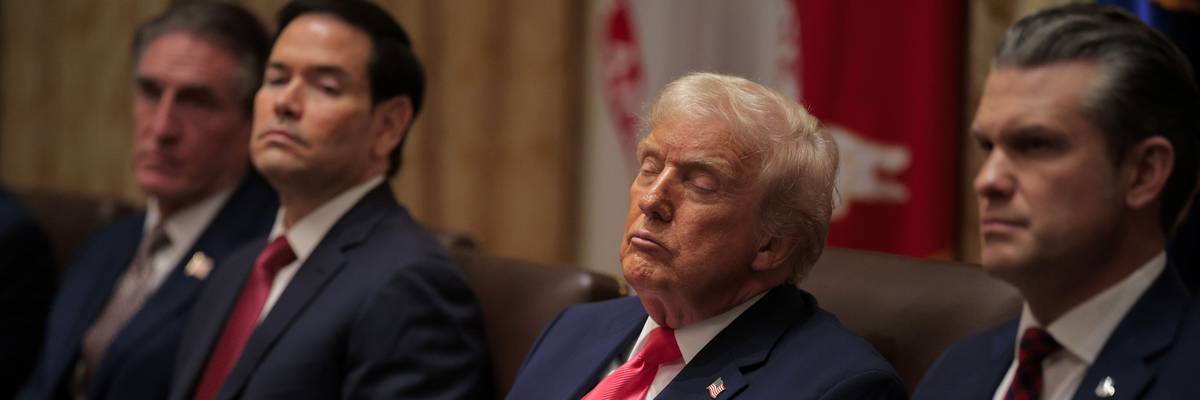
President Donald Trump attends a meeting of his Cabinet alongside (L-R) U.S. Interior Secretary Doug Burgum, U.S. Secretary of State Marco Rubio and U.S. Secretary of War Pete Hegseth in the Cabinet Room of the White House on December 02, 2025 in Washington, DC.
From Venezuela to Yemen to Iran, the extrajudicial slaughter of civilians has been allowed to continue. What we are witnessing in the Caribbean and elsewhere today has been years in the making. Who will put a stop to it?
It’s all good that members of Congress, mainstream headlines, and the various talking heads are discussing something we don’t hear about often enough—that the US is committing war crimes; how we need a new War Powers Resolution; or why heads should roll at the Pentagon over a series of boat bombings in the Pacific and Caribbean in recent months that are nothing less than premeditated murder.
It is important that—after years of the Pentagon using unchecked power to carry out violence all over the world—Congress is finally asking questions. The debate is rising over whether the Sept. 2 murder of two men who survived an initial US attack on their small boat in international waters of the Caribbean, only to be killed by a second US bombing designed specifically to eliminate them, constitutes a war crime.
But there are three huge problems this rising debate mostly ignores. First, some of these actions, like a president declaring unilaterally that a war exists (when it doesn't) and then bombing unarmed civilian boats in international waters, are inherently illegal, regardless of whether anyone is killed by the first, second, or tenth bomb. That’s an act of piracy and murder, not a legal use of armed force. Second, too few of the discussions of illegal US military actions take the issue of accountability seriously. How far up—and down—the chain of command does responsibility go? And third, congressional considerations of legality, accountability, and War Powers resolutions much too often are limited to situations in which US troops might be put in harm’s way. The actual deaths of civilians who happen to be Venezuelan or Yemeni or Iranian are simply not part of the calculus.
So, yes, of course, the secondary bombing of shipwrecked sailors on Sept. 2 was illegal and should be seen for what it was: murder in cold blood. That is because deliberately targeting and killing anyone at sea whose boat is sinking and who is waving for help, is a crime. But it must be said—loudly and repeatedly—that all the kill-them-all-with-one-bomb strikes on boats in the Caribbean and the eastern Pacific that the US has carried out since September were also illegal. As of December 6, US forces have killed at least 87 people—Venezuelan, Colombian, Trinidadian, and Ecuadoran victims—with US drones and bombs in the region. None of the people or boats are alleged to have been armed or to have been transferring weapons.
After September 11, 2001, the US declared a set of open-ended wars and military operations, in which Congress largely voluntarily surrendered its power to declare war and responsibility to provide oversight of wars through funding decisions.
A presidential pronouncement that unidentified people allegedly committing a crime are now to be considered “narco-terrorists” (without any evidence or legal definition) and that alleged drug smugglers are now to be treated as “combatants” in an “armed conflict” (which does not exist), does not make that claim true.
It’s also a classic “even if” situation. Even if we knew who was on the boats, and even if they were actually smuggling drugs, and even if there was a real war underway, no law, neither US nor international, allows for the extra-judicial killing of someone involved in a crime who does not present an immediate threat of armed attack. Such an act is murder, pure and simple, not a legal military act. Former President of the Philippines Rodrigo Duterte is currently in prison for exactly such acts: he remains in detention at the International Criminal Court in The Hague, charged with crimes against humanity for his involvement in the killings of thousands of people alleged to be drug dealers, killed by police and the military during his anti-drug campaigns.
This series of killings from above does not constitute an act of war, but rather a set of extrajudicial murders carried out on the orders of the US government's highest officials, namely President Donald Trump and Secretary of Defense Pete Hegseth.
As part of a lawsuit filed this week by the ACLU, Center for Constitutional Rights, and New York Civil Liberties Union aimed at forcing the Trump White House to release an internal Office of Legal Council opinion being used to justify the strikes, Jeffrey Stein, a staff attorney with the ACLU’s National Security Project, said, “The public deserves to know how our government is justifying the cold-blooded murder of civilians as lawful and why it believes it can hand out get-out-of-jail-free cards to people committing these crimes."
The Trump administration, Stein argued, "must stop these illegal and immoral strikes, and officials who have carried them out must be held accountable." That is exactly right.
And so yes, it’s good that outraged opposition is rising against the deliberate murders of the two survivors seen clinging to the sinking boat in the Caribbean. But it’s vitally important that the opposition, including lawmakers in Congress who are the frontlines of holding Trump and Hegseth to account, also challenge the illegality of every such bombing by the Pentagon. And that doesn’t seem to be happening. As the New York Times put it, “the idea that something was bad about that particular strike implicitly suggests the first one on that boat—and all the other attacks on other boats—was fine. And the exercise reinforced the premise that the situation should be thought about through the lens of an armed conflict.” Which does not exist.
As many rights experts have pointed out, there is no "war crime" when there is no war. These murders must be seen for what they are.
When the talk in Congress turns to whether these military operations should trigger a new War Powers Act resolution to rein in the out-of-control military, the debate generally focuses on whether these attacks count as “hostilities,” which would trigger the Act. The word isn’t defined in the Act, but US presidents have generally defined “hostilities” very narrowly, as something that puts US troops at risk. And too rarely has Congress challenged that position. The result is that Venezuelan and Colombian and Ecuadoran and other fisherfolk, other civilians, maybe some small-scale criminals, can all be put at risk without consequence. They are being killed without anyone having to state publicly who they are, what was in their boats, where they were heading, even their names—let alone how we know any of that–and apparently their lives have no significance on the legality or illegality of their murder.
Deliberately targeting and killing anyone at sea whose boat is sinking and who is waving for help, is a crime.
None of this should be surprising. Three weeks after the September 2 boat attack, Secretary of Defense Pete Hegseth addressed almost 1000 of the military's top brass summoned from all over the world to hear his talk. He said, “We also don't fight with stupid rules of engagement. We untie the hands of our warfighters to intimidate, demoralize, hunt, and kill the enemies of our country. No more politically correct and overbearing rules of engagement, just common sense, maximum lethality, and authority for warfighters.”
"Maximum lethality"—without even a modicum of justice–is what we’re seeing in all the boat attacks, not only the second strike that has generated the most concern. “Authority for warfighters” appears to be plentiful in the form of zero accountability for top commanders or ordinary troops of the anti-speedboat campaign. And that authority is visible as well in the targeting and threats against the six congressmembers, all former military and intelligence officers, who dared remind US troops that their oaths allow, indeed require them to refuse to carry out illegal orders.
Of course, the boat bombings are not the only recent examples of crimes by the military carried out without consequence.
A renewed level of outrage erupted recently when a new Pentagon investigation found that the secretary of defense had indeed put US troops in harm’s way during a seemingly casual, emoji-filled Signal chat involving top military and intelligence officials, in which he announced and discussed secret operational details of imminent US attacks on alleged Houthi targets in Yemen. Signalgate was a huge story back in March, when the news first broke that several unauthorized people were on the unsecure chat, including, apparently by mistake, the editor-in-chief of The Atlantic magazine.
Certainly, some level of alarm was justified because US troops were indeed put at risk, because normal security regulations were ignored, because the whole episode reeked of carelessness, and because military rules were violated with apparent impunity. But no one seemed concerned that the real outrage of this scheme was not the unauthorized Signal chat, but that the US military was off doing the job Hegseth proudly reminded them of in Quantico–“killing people and breaking things.” As it turned out, they were killing innocent Yemeni civilians and destroying Yemeni civilian infrastructure.
That time, it may have been a war crime, although the US was not officially at war with Yemen. There were a number of countries involved in military action in the Red Sea, but the US military forces there were deployed with no regard for international law or for the US Constitution, which says only Congress can declare war. It is exactly during wartime conditions that the Geneva Conventions and other laws of war apply–prohibiting collective punishment, attacks on civilians, failure to distinguish between military and civilian targets. For Hegseth, describing it during the Signal chat, the concern was not the illegality of the attacks, but how to justify them to the public: “Nobody knows who the Houthis are—which is why we would need to stay focused on 1) Biden failed and 2) Iran funded.” It was all just a partisan PR job. Now, of course, with the release of the latest Pentagon report this week, Signalgate outrage is returning—but the focus is still on how the unsecure call put US troops at risk—not on how many Yemeni civilians, how many children and elders, were killed and injured—a clear war crime.
Then there was Iran. In June, Israel launched 12 days of bombing raids against Iran, destroying military, energy, government, media, and residential targets. Iran’s government reported 935 people killed, including 38 children; almost all of Iran’s retaliatory missiles were intercepted by Israeli and US anti-missile systems, 28 people were killed in Israel. The US made no effort to criticize Israel’s use of US weapons in the initial assault, in clear violation of US laws restricting use of weapons it provided. Instead, the US joined Israel and launched its own attack targeting Iran’s nuclear facilities with 30,000-pound “bunker-buster” bombs, the largest non-nuclear bombs in the US arsenal. Trump immediately announced the US strikes had “completely and totally obliterated” Iran’s nuclear facilities. The claim was denied within hours by his own Chairman of the Joint Chiefs of Staff, Gen. Dan Caine, and within a couple of days by the Defense Intelligence Agency’s finding that the strikes had only set back Iran’s nuclear program three to six months.
We need to demand an end to all unchecked illegal US military action...
The public debate then focused almost entirely on which damage assessments were more likely correct—did the US strikes actually “obliterate” the equipment or did it only partly damage it? Was Iran’s nuclear capacity destroyed or only set back? Few analysts and virtually no one in Congress interrogated the illegality of both the Israeli and the US strikes to begin with. Violations of the Geneva Conventions’ prohibitions on collective punishment and failure to distinguish between military and civilian targets, specific international legal bans on targeting nuclear facilities—are all separate war crimes. But the US was not at war with Iran, it was Washington, not Tehran that withdrew from the JCPOA, the Iran nuclear deal, back in 2018. So the US attack on Iran was illegal, and would have been illegal even if none of the Geneva Convention’s laws of war were violated. Washington’s actions were probably not war crimes, they may have been crimes against humanity, they may have constituted the crime of aggression. But few policymakers or pundits were even considering those realities.
After September 11, 2001, the US declared a set of open-ended wars and military operations, in which Congress largely voluntarily surrendered its power to declare war and responsibility to provide oversight of wars through funding decisions. The US government and military became used to killing, wounding, and destroying without even explaining, let alone answering for their actions. Pete Hegseth deployed as an officer in that era. He commanded troops in two places where US forces notoriously violated the law and dehumanized people: the infamous US prison at Guantanamo Bay, and Iraq. Now he is in charge of the entire Pentagon. The violations that we are witnessing in the Caribbean and elsewhere today were years in the making. We cannot be satisfied with a Congressional challenge only on the most narrow and technical terms. We need to demand an end to all unchecked illegal US military action—and full accountability for the damage that it has already done.
Dear Common Dreams reader, It’s been nearly 30 years since I co-founded Common Dreams with my late wife, Lina Newhouser. We had the radical notion that journalism should serve the public good, not corporate profits. It was clear to us from the outset what it would take to build such a project. No paid advertisements. No corporate sponsors. No millionaire publisher telling us what to think or do. Many people said we wouldn't last a year, but we proved those doubters wrong. Together with a tremendous team of journalists and dedicated staff, we built an independent media outlet free from the constraints of profits and corporate control. Our mission has always been simple: To inform. To inspire. To ignite change for the common good. Building Common Dreams was not easy. Our survival was never guaranteed. When you take on the most powerful forces—Wall Street greed, fossil fuel industry destruction, Big Tech lobbyists, and uber-rich oligarchs who have spent billions upon billions rigging the economy and democracy in their favor—the only bulwark you have is supporters who believe in your work. But here’s the urgent message from me today. It's never been this bad out there. And it's never been this hard to keep us going. At the very moment Common Dreams is most needed, the threats we face are intensifying. We need your support now more than ever. We don't accept corporate advertising and never will. We don't have a paywall because we don't think people should be blocked from critical news based on their ability to pay. Everything we do is funded by the donations of readers like you. When everyone does the little they can afford, we are strong. But if that support retreats or dries up, so do we. Will you donate now to make sure Common Dreams not only survives but thrives? —Craig Brown, Co-founder |
It’s all good that members of Congress, mainstream headlines, and the various talking heads are discussing something we don’t hear about often enough—that the US is committing war crimes; how we need a new War Powers Resolution; or why heads should roll at the Pentagon over a series of boat bombings in the Pacific and Caribbean in recent months that are nothing less than premeditated murder.
It is important that—after years of the Pentagon using unchecked power to carry out violence all over the world—Congress is finally asking questions. The debate is rising over whether the Sept. 2 murder of two men who survived an initial US attack on their small boat in international waters of the Caribbean, only to be killed by a second US bombing designed specifically to eliminate them, constitutes a war crime.
But there are three huge problems this rising debate mostly ignores. First, some of these actions, like a president declaring unilaterally that a war exists (when it doesn't) and then bombing unarmed civilian boats in international waters, are inherently illegal, regardless of whether anyone is killed by the first, second, or tenth bomb. That’s an act of piracy and murder, not a legal use of armed force. Second, too few of the discussions of illegal US military actions take the issue of accountability seriously. How far up—and down—the chain of command does responsibility go? And third, congressional considerations of legality, accountability, and War Powers resolutions much too often are limited to situations in which US troops might be put in harm’s way. The actual deaths of civilians who happen to be Venezuelan or Yemeni or Iranian are simply not part of the calculus.
So, yes, of course, the secondary bombing of shipwrecked sailors on Sept. 2 was illegal and should be seen for what it was: murder in cold blood. That is because deliberately targeting and killing anyone at sea whose boat is sinking and who is waving for help, is a crime. But it must be said—loudly and repeatedly—that all the kill-them-all-with-one-bomb strikes on boats in the Caribbean and the eastern Pacific that the US has carried out since September were also illegal. As of December 6, US forces have killed at least 87 people—Venezuelan, Colombian, Trinidadian, and Ecuadoran victims—with US drones and bombs in the region. None of the people or boats are alleged to have been armed or to have been transferring weapons.
After September 11, 2001, the US declared a set of open-ended wars and military operations, in which Congress largely voluntarily surrendered its power to declare war and responsibility to provide oversight of wars through funding decisions.
A presidential pronouncement that unidentified people allegedly committing a crime are now to be considered “narco-terrorists” (without any evidence or legal definition) and that alleged drug smugglers are now to be treated as “combatants” in an “armed conflict” (which does not exist), does not make that claim true.
It’s also a classic “even if” situation. Even if we knew who was on the boats, and even if they were actually smuggling drugs, and even if there was a real war underway, no law, neither US nor international, allows for the extra-judicial killing of someone involved in a crime who does not present an immediate threat of armed attack. Such an act is murder, pure and simple, not a legal military act. Former President of the Philippines Rodrigo Duterte is currently in prison for exactly such acts: he remains in detention at the International Criminal Court in The Hague, charged with crimes against humanity for his involvement in the killings of thousands of people alleged to be drug dealers, killed by police and the military during his anti-drug campaigns.
This series of killings from above does not constitute an act of war, but rather a set of extrajudicial murders carried out on the orders of the US government's highest officials, namely President Donald Trump and Secretary of Defense Pete Hegseth.
As part of a lawsuit filed this week by the ACLU, Center for Constitutional Rights, and New York Civil Liberties Union aimed at forcing the Trump White House to release an internal Office of Legal Council opinion being used to justify the strikes, Jeffrey Stein, a staff attorney with the ACLU’s National Security Project, said, “The public deserves to know how our government is justifying the cold-blooded murder of civilians as lawful and why it believes it can hand out get-out-of-jail-free cards to people committing these crimes."
The Trump administration, Stein argued, "must stop these illegal and immoral strikes, and officials who have carried them out must be held accountable." That is exactly right.
And so yes, it’s good that outraged opposition is rising against the deliberate murders of the two survivors seen clinging to the sinking boat in the Caribbean. But it’s vitally important that the opposition, including lawmakers in Congress who are the frontlines of holding Trump and Hegseth to account, also challenge the illegality of every such bombing by the Pentagon. And that doesn’t seem to be happening. As the New York Times put it, “the idea that something was bad about that particular strike implicitly suggests the first one on that boat—and all the other attacks on other boats—was fine. And the exercise reinforced the premise that the situation should be thought about through the lens of an armed conflict.” Which does not exist.
As many rights experts have pointed out, there is no "war crime" when there is no war. These murders must be seen for what they are.
When the talk in Congress turns to whether these military operations should trigger a new War Powers Act resolution to rein in the out-of-control military, the debate generally focuses on whether these attacks count as “hostilities,” which would trigger the Act. The word isn’t defined in the Act, but US presidents have generally defined “hostilities” very narrowly, as something that puts US troops at risk. And too rarely has Congress challenged that position. The result is that Venezuelan and Colombian and Ecuadoran and other fisherfolk, other civilians, maybe some small-scale criminals, can all be put at risk without consequence. They are being killed without anyone having to state publicly who they are, what was in their boats, where they were heading, even their names—let alone how we know any of that–and apparently their lives have no significance on the legality or illegality of their murder.
Deliberately targeting and killing anyone at sea whose boat is sinking and who is waving for help, is a crime.
None of this should be surprising. Three weeks after the September 2 boat attack, Secretary of Defense Pete Hegseth addressed almost 1000 of the military's top brass summoned from all over the world to hear his talk. He said, “We also don't fight with stupid rules of engagement. We untie the hands of our warfighters to intimidate, demoralize, hunt, and kill the enemies of our country. No more politically correct and overbearing rules of engagement, just common sense, maximum lethality, and authority for warfighters.”
"Maximum lethality"—without even a modicum of justice–is what we’re seeing in all the boat attacks, not only the second strike that has generated the most concern. “Authority for warfighters” appears to be plentiful in the form of zero accountability for top commanders or ordinary troops of the anti-speedboat campaign. And that authority is visible as well in the targeting and threats against the six congressmembers, all former military and intelligence officers, who dared remind US troops that their oaths allow, indeed require them to refuse to carry out illegal orders.
Of course, the boat bombings are not the only recent examples of crimes by the military carried out without consequence.
A renewed level of outrage erupted recently when a new Pentagon investigation found that the secretary of defense had indeed put US troops in harm’s way during a seemingly casual, emoji-filled Signal chat involving top military and intelligence officials, in which he announced and discussed secret operational details of imminent US attacks on alleged Houthi targets in Yemen. Signalgate was a huge story back in March, when the news first broke that several unauthorized people were on the unsecure chat, including, apparently by mistake, the editor-in-chief of The Atlantic magazine.
Certainly, some level of alarm was justified because US troops were indeed put at risk, because normal security regulations were ignored, because the whole episode reeked of carelessness, and because military rules were violated with apparent impunity. But no one seemed concerned that the real outrage of this scheme was not the unauthorized Signal chat, but that the US military was off doing the job Hegseth proudly reminded them of in Quantico–“killing people and breaking things.” As it turned out, they were killing innocent Yemeni civilians and destroying Yemeni civilian infrastructure.
That time, it may have been a war crime, although the US was not officially at war with Yemen. There were a number of countries involved in military action in the Red Sea, but the US military forces there were deployed with no regard for international law or for the US Constitution, which says only Congress can declare war. It is exactly during wartime conditions that the Geneva Conventions and other laws of war apply–prohibiting collective punishment, attacks on civilians, failure to distinguish between military and civilian targets. For Hegseth, describing it during the Signal chat, the concern was not the illegality of the attacks, but how to justify them to the public: “Nobody knows who the Houthis are—which is why we would need to stay focused on 1) Biden failed and 2) Iran funded.” It was all just a partisan PR job. Now, of course, with the release of the latest Pentagon report this week, Signalgate outrage is returning—but the focus is still on how the unsecure call put US troops at risk—not on how many Yemeni civilians, how many children and elders, were killed and injured—a clear war crime.
Then there was Iran. In June, Israel launched 12 days of bombing raids against Iran, destroying military, energy, government, media, and residential targets. Iran’s government reported 935 people killed, including 38 children; almost all of Iran’s retaliatory missiles were intercepted by Israeli and US anti-missile systems, 28 people were killed in Israel. The US made no effort to criticize Israel’s use of US weapons in the initial assault, in clear violation of US laws restricting use of weapons it provided. Instead, the US joined Israel and launched its own attack targeting Iran’s nuclear facilities with 30,000-pound “bunker-buster” bombs, the largest non-nuclear bombs in the US arsenal. Trump immediately announced the US strikes had “completely and totally obliterated” Iran’s nuclear facilities. The claim was denied within hours by his own Chairman of the Joint Chiefs of Staff, Gen. Dan Caine, and within a couple of days by the Defense Intelligence Agency’s finding that the strikes had only set back Iran’s nuclear program three to six months.
We need to demand an end to all unchecked illegal US military action...
The public debate then focused almost entirely on which damage assessments were more likely correct—did the US strikes actually “obliterate” the equipment or did it only partly damage it? Was Iran’s nuclear capacity destroyed or only set back? Few analysts and virtually no one in Congress interrogated the illegality of both the Israeli and the US strikes to begin with. Violations of the Geneva Conventions’ prohibitions on collective punishment and failure to distinguish between military and civilian targets, specific international legal bans on targeting nuclear facilities—are all separate war crimes. But the US was not at war with Iran, it was Washington, not Tehran that withdrew from the JCPOA, the Iran nuclear deal, back in 2018. So the US attack on Iran was illegal, and would have been illegal even if none of the Geneva Convention’s laws of war were violated. Washington’s actions were probably not war crimes, they may have been crimes against humanity, they may have constituted the crime of aggression. But few policymakers or pundits were even considering those realities.
After September 11, 2001, the US declared a set of open-ended wars and military operations, in which Congress largely voluntarily surrendered its power to declare war and responsibility to provide oversight of wars through funding decisions. The US government and military became used to killing, wounding, and destroying without even explaining, let alone answering for their actions. Pete Hegseth deployed as an officer in that era. He commanded troops in two places where US forces notoriously violated the law and dehumanized people: the infamous US prison at Guantanamo Bay, and Iraq. Now he is in charge of the entire Pentagon. The violations that we are witnessing in the Caribbean and elsewhere today were years in the making. We cannot be satisfied with a Congressional challenge only on the most narrow and technical terms. We need to demand an end to all unchecked illegal US military action—and full accountability for the damage that it has already done.
It’s all good that members of Congress, mainstream headlines, and the various talking heads are discussing something we don’t hear about often enough—that the US is committing war crimes; how we need a new War Powers Resolution; or why heads should roll at the Pentagon over a series of boat bombings in the Pacific and Caribbean in recent months that are nothing less than premeditated murder.
It is important that—after years of the Pentagon using unchecked power to carry out violence all over the world—Congress is finally asking questions. The debate is rising over whether the Sept. 2 murder of two men who survived an initial US attack on their small boat in international waters of the Caribbean, only to be killed by a second US bombing designed specifically to eliminate them, constitutes a war crime.
But there are three huge problems this rising debate mostly ignores. First, some of these actions, like a president declaring unilaterally that a war exists (when it doesn't) and then bombing unarmed civilian boats in international waters, are inherently illegal, regardless of whether anyone is killed by the first, second, or tenth bomb. That’s an act of piracy and murder, not a legal use of armed force. Second, too few of the discussions of illegal US military actions take the issue of accountability seriously. How far up—and down—the chain of command does responsibility go? And third, congressional considerations of legality, accountability, and War Powers resolutions much too often are limited to situations in which US troops might be put in harm’s way. The actual deaths of civilians who happen to be Venezuelan or Yemeni or Iranian are simply not part of the calculus.
So, yes, of course, the secondary bombing of shipwrecked sailors on Sept. 2 was illegal and should be seen for what it was: murder in cold blood. That is because deliberately targeting and killing anyone at sea whose boat is sinking and who is waving for help, is a crime. But it must be said—loudly and repeatedly—that all the kill-them-all-with-one-bomb strikes on boats in the Caribbean and the eastern Pacific that the US has carried out since September were also illegal. As of December 6, US forces have killed at least 87 people—Venezuelan, Colombian, Trinidadian, and Ecuadoran victims—with US drones and bombs in the region. None of the people or boats are alleged to have been armed or to have been transferring weapons.
After September 11, 2001, the US declared a set of open-ended wars and military operations, in which Congress largely voluntarily surrendered its power to declare war and responsibility to provide oversight of wars through funding decisions.
A presidential pronouncement that unidentified people allegedly committing a crime are now to be considered “narco-terrorists” (without any evidence or legal definition) and that alleged drug smugglers are now to be treated as “combatants” in an “armed conflict” (which does not exist), does not make that claim true.
It’s also a classic “even if” situation. Even if we knew who was on the boats, and even if they were actually smuggling drugs, and even if there was a real war underway, no law, neither US nor international, allows for the extra-judicial killing of someone involved in a crime who does not present an immediate threat of armed attack. Such an act is murder, pure and simple, not a legal military act. Former President of the Philippines Rodrigo Duterte is currently in prison for exactly such acts: he remains in detention at the International Criminal Court in The Hague, charged with crimes against humanity for his involvement in the killings of thousands of people alleged to be drug dealers, killed by police and the military during his anti-drug campaigns.
This series of killings from above does not constitute an act of war, but rather a set of extrajudicial murders carried out on the orders of the US government's highest officials, namely President Donald Trump and Secretary of Defense Pete Hegseth.
As part of a lawsuit filed this week by the ACLU, Center for Constitutional Rights, and New York Civil Liberties Union aimed at forcing the Trump White House to release an internal Office of Legal Council opinion being used to justify the strikes, Jeffrey Stein, a staff attorney with the ACLU’s National Security Project, said, “The public deserves to know how our government is justifying the cold-blooded murder of civilians as lawful and why it believes it can hand out get-out-of-jail-free cards to people committing these crimes."
The Trump administration, Stein argued, "must stop these illegal and immoral strikes, and officials who have carried them out must be held accountable." That is exactly right.
And so yes, it’s good that outraged opposition is rising against the deliberate murders of the two survivors seen clinging to the sinking boat in the Caribbean. But it’s vitally important that the opposition, including lawmakers in Congress who are the frontlines of holding Trump and Hegseth to account, also challenge the illegality of every such bombing by the Pentagon. And that doesn’t seem to be happening. As the New York Times put it, “the idea that something was bad about that particular strike implicitly suggests the first one on that boat—and all the other attacks on other boats—was fine. And the exercise reinforced the premise that the situation should be thought about through the lens of an armed conflict.” Which does not exist.
As many rights experts have pointed out, there is no "war crime" when there is no war. These murders must be seen for what they are.
When the talk in Congress turns to whether these military operations should trigger a new War Powers Act resolution to rein in the out-of-control military, the debate generally focuses on whether these attacks count as “hostilities,” which would trigger the Act. The word isn’t defined in the Act, but US presidents have generally defined “hostilities” very narrowly, as something that puts US troops at risk. And too rarely has Congress challenged that position. The result is that Venezuelan and Colombian and Ecuadoran and other fisherfolk, other civilians, maybe some small-scale criminals, can all be put at risk without consequence. They are being killed without anyone having to state publicly who they are, what was in their boats, where they were heading, even their names—let alone how we know any of that–and apparently their lives have no significance on the legality or illegality of their murder.
Deliberately targeting and killing anyone at sea whose boat is sinking and who is waving for help, is a crime.
None of this should be surprising. Three weeks after the September 2 boat attack, Secretary of Defense Pete Hegseth addressed almost 1000 of the military's top brass summoned from all over the world to hear his talk. He said, “We also don't fight with stupid rules of engagement. We untie the hands of our warfighters to intimidate, demoralize, hunt, and kill the enemies of our country. No more politically correct and overbearing rules of engagement, just common sense, maximum lethality, and authority for warfighters.”
"Maximum lethality"—without even a modicum of justice–is what we’re seeing in all the boat attacks, not only the second strike that has generated the most concern. “Authority for warfighters” appears to be plentiful in the form of zero accountability for top commanders or ordinary troops of the anti-speedboat campaign. And that authority is visible as well in the targeting and threats against the six congressmembers, all former military and intelligence officers, who dared remind US troops that their oaths allow, indeed require them to refuse to carry out illegal orders.
Of course, the boat bombings are not the only recent examples of crimes by the military carried out without consequence.
A renewed level of outrage erupted recently when a new Pentagon investigation found that the secretary of defense had indeed put US troops in harm’s way during a seemingly casual, emoji-filled Signal chat involving top military and intelligence officials, in which he announced and discussed secret operational details of imminent US attacks on alleged Houthi targets in Yemen. Signalgate was a huge story back in March, when the news first broke that several unauthorized people were on the unsecure chat, including, apparently by mistake, the editor-in-chief of The Atlantic magazine.
Certainly, some level of alarm was justified because US troops were indeed put at risk, because normal security regulations were ignored, because the whole episode reeked of carelessness, and because military rules were violated with apparent impunity. But no one seemed concerned that the real outrage of this scheme was not the unauthorized Signal chat, but that the US military was off doing the job Hegseth proudly reminded them of in Quantico–“killing people and breaking things.” As it turned out, they were killing innocent Yemeni civilians and destroying Yemeni civilian infrastructure.
That time, it may have been a war crime, although the US was not officially at war with Yemen. There were a number of countries involved in military action in the Red Sea, but the US military forces there were deployed with no regard for international law or for the US Constitution, which says only Congress can declare war. It is exactly during wartime conditions that the Geneva Conventions and other laws of war apply–prohibiting collective punishment, attacks on civilians, failure to distinguish between military and civilian targets. For Hegseth, describing it during the Signal chat, the concern was not the illegality of the attacks, but how to justify them to the public: “Nobody knows who the Houthis are—which is why we would need to stay focused on 1) Biden failed and 2) Iran funded.” It was all just a partisan PR job. Now, of course, with the release of the latest Pentagon report this week, Signalgate outrage is returning—but the focus is still on how the unsecure call put US troops at risk—not on how many Yemeni civilians, how many children and elders, were killed and injured—a clear war crime.
Then there was Iran. In June, Israel launched 12 days of bombing raids against Iran, destroying military, energy, government, media, and residential targets. Iran’s government reported 935 people killed, including 38 children; almost all of Iran’s retaliatory missiles were intercepted by Israeli and US anti-missile systems, 28 people were killed in Israel. The US made no effort to criticize Israel’s use of US weapons in the initial assault, in clear violation of US laws restricting use of weapons it provided. Instead, the US joined Israel and launched its own attack targeting Iran’s nuclear facilities with 30,000-pound “bunker-buster” bombs, the largest non-nuclear bombs in the US arsenal. Trump immediately announced the US strikes had “completely and totally obliterated” Iran’s nuclear facilities. The claim was denied within hours by his own Chairman of the Joint Chiefs of Staff, Gen. Dan Caine, and within a couple of days by the Defense Intelligence Agency’s finding that the strikes had only set back Iran’s nuclear program three to six months.
We need to demand an end to all unchecked illegal US military action...
The public debate then focused almost entirely on which damage assessments were more likely correct—did the US strikes actually “obliterate” the equipment or did it only partly damage it? Was Iran’s nuclear capacity destroyed or only set back? Few analysts and virtually no one in Congress interrogated the illegality of both the Israeli and the US strikes to begin with. Violations of the Geneva Conventions’ prohibitions on collective punishment and failure to distinguish between military and civilian targets, specific international legal bans on targeting nuclear facilities—are all separate war crimes. But the US was not at war with Iran, it was Washington, not Tehran that withdrew from the JCPOA, the Iran nuclear deal, back in 2018. So the US attack on Iran was illegal, and would have been illegal even if none of the Geneva Convention’s laws of war were violated. Washington’s actions were probably not war crimes, they may have been crimes against humanity, they may have constituted the crime of aggression. But few policymakers or pundits were even considering those realities.
After September 11, 2001, the US declared a set of open-ended wars and military operations, in which Congress largely voluntarily surrendered its power to declare war and responsibility to provide oversight of wars through funding decisions. The US government and military became used to killing, wounding, and destroying without even explaining, let alone answering for their actions. Pete Hegseth deployed as an officer in that era. He commanded troops in two places where US forces notoriously violated the law and dehumanized people: the infamous US prison at Guantanamo Bay, and Iraq. Now he is in charge of the entire Pentagon. The violations that we are witnessing in the Caribbean and elsewhere today were years in the making. We cannot be satisfied with a Congressional challenge only on the most narrow and technical terms. We need to demand an end to all unchecked illegal US military action—and full accountability for the damage that it has already done.