5
#000000
#FFFFFF
To donate by check, phone, or other method, see our More Ways to Give page.
Daily news & progressive opinion—funded by the people, not the corporations—delivered straight to your inbox.
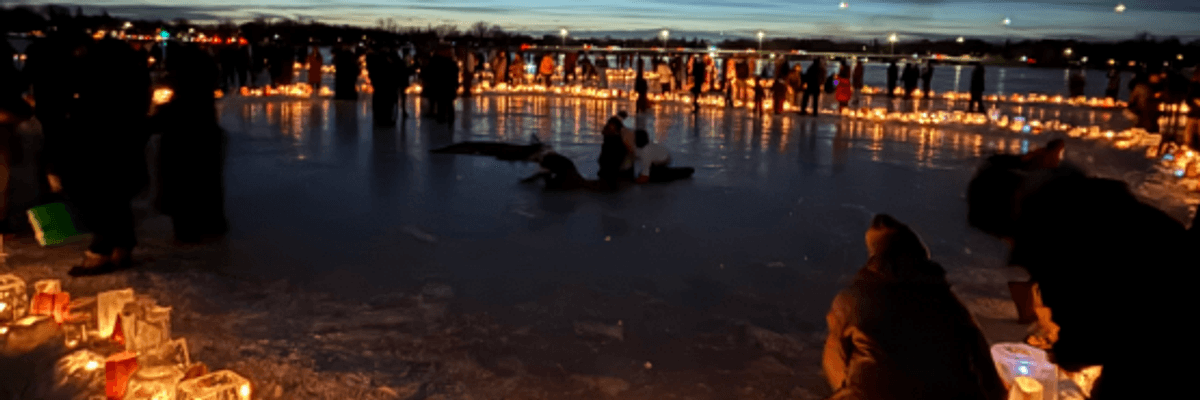
Residents gather on a frozen lake in Minneapolis, Minnesota during an ice lantern vigil organized in response to the federal immigration enforcement surge, February 2026.
Minnesota's artists aren't that different from artists anywhere, but there are some unique parts of Minnesota's ecosystem that explain the breadth and depth of the creative response to the federal immigration enforcement surge.
Two thousand of us were standing on a frozen lake in the dark.
My mittened hand was gripping the mittened hand of a stranger; tears were freezing on my cheeks. It was not a particularly Minnesotan thing to hold hands with a stranger, especially while expressing emotion so openly. But we were not in normal times.
We were there to light ice lanterns, to spell out "ICE OUT" on the lake in the hopes that the planes flying above would see our message. After long days of school patrols, protests, grocery deliveries, and trying to figure out how to raise more money to help neighbors pay rent, we needed to be together in person. We needed to sing, we needed to move, we needed to feel. And so we did, led in a call-and-response by Brass Solidarity, a community brass band: "Hold on, change is coming!" It was powerful and beautiful and deeply connected to our culture, holding this community together. This is what a creative response looks like when artists are already woven into the fabric of a community before the crisis arrives.
This Sunday, May 31, the people of the Twin Cities will accept the John F. Kennedy Profile in Courage Award in Boston, an honor previously awarded to former Vice President Mike Pence and the September 11 first responders. The Kennedy Foundation cited the neighbors who risked their safety to protect their community from an unprecedented federal law enforcement operation: the 30,000 who trained as observers and rapid responders; the schools that organized patrols; the parent group chats, book clubs, and faith groups that became webs of mutual aid, delivering groceries, raising rent and legal funds for neighbors trapped in their homes.
It is not just what Minnesotans did in this crisis. It is what they had already built: a state that had spent decades recognizing artists not as a luxury or an afterthought, but as neighbors with something essential to contribute.
Journalists and historians have spent months trying to explain why Minnesota responded as it did. Was it the history of the cooperative movement that helped build a state where people looked out for one another? Or the recovery community and the Minnesota Model's belief that people heal together? Almost no one has asked why the artists were ready. That's what I want to share.
Minnesota's artists aren't that different from artists anywhere. But there are some unique parts of Minnesota's ecosystem that explain the breadth and depth of the creative response here.
Minnesota spends more on the arts per capita than any other state, $9.67 per person, backed by the Legacy Amendment, a 25-year constitutional commitment to the state's arts and cultural heritage, alongside other quality of life investments like clean water, parks, and trails. That's not a program. That's a value system encoded into law. A blend of public support and private philanthropy has built statewide artist fellowship programs, regional arts councils serving every county, and local governments that regularly hire artists to address community challenges. The nation's longest-running Guaranteed Income Pilot for Artists, launched in Minnesota with private funds, gives artists a monthly stipend with no strings attached. Participants have reported volunteering more, deepening their roots in their communities, and taking on creative work they never could have afforded before.
But money alone doesn't explain what happened here. Minnesota’s arts support is rooted within an ecosystem of support for organizers, activists, and community leaders, creating an arts community with a deep understanding of the skills, values, and ethics of effective community work. Artists in Minnesota view their artistry as integral to, not separate from, their identity as a neighbor and community member.
In 2013, when St. Paul installed a new light rail line, hundreds of artists were engaged alongside businesses and community groups on the construction corridor, turning disruption into connection. Those artists didn't just make murals. They staged performances, built installations, and animated storefronts. They learned who worked at City Hall. They built relationships with power structures. Because artists in Minnesota have had numerous opportunities like this to bring their creativity to critical community issues, and had spent years doing that work, they weren't strangers to this movement. They were already inside it.
Drive down any street in the Twin Cities today, and you will see house after house with signs: "ICE Out." "We Keep Us Safe." "We Love Our Immigrant Neighbors." Nearly all are artist designed, many of them handmade prints. This doesn’t only represent the beauty and creativity that artists bring to a movement, but also symbolizes a movement that has turned away from mass production and corporate extraction, and toward the handmade and the local. As Immigration and Customs Enforcement (ICE) agents photograph us and catalog our faces in AI databases built for harassment and intimidation, artists like Sean Lim, Marlena Myles, and D Guzman have worked through the night to generate human-made expressions of resistance.
This is what Minnesota's artists have been doing for months: showing up, leading, organizing, making the movement visible and felt. Thousands gathered in the cold with Singing Resistance to send a message to ICE agents that they could change their minds and join a loving community. Their tactics were rooted in Otpor, the student movement that brought down Slobodan Milosevic's authoritarian regime in 1990s Serbia by spreading one simple message: "You might not join us today, but you can join us tomorrow." Singing Resistance is now sharing training tool kits with communities across the country.
Brass Solidarity, formed at George Floyd Square in 2020, has played at hundreds of gatherings, connecting this moment to the movement for Black lives and bringing joy and resolve to these spaces. Mixed Blood Theater has trained neighbors to speak clearly and confidently about their constitutional rights. Drummers have organized mass protests. Poets have told our story, including Renee Good, who was herself a poet. Art spaces and creative businesses have become food pantries, coat donation sites, and whistle distribution points. I've lost track of the sold-out cabarets, concerts, and pottery sales to benefit the immigrant legal aid and rental assistance, often appearing in hours, without marketing campaigns. Neighbors talk to neighbors.
The art being made for our community is happening outside the competition of grants, outside formal arts institutions, outside the commodification of collectors, outside the pressure for clicks. It is urgent and rooted in our community's needs. It feels sacred.
Many of Minnesota's artists put their lives on hold for months at great cost to their economic stability and at great risk to their safety. The thing I have said most when people outside Minnesota ask how I am: It is so much more terrifying than the media can show you. Every noise sounds like a whistle. Every unknown car could be bringing horror to our doorstep. The damage to our community's sense of safety will take years to repair.
But it is so much more beautiful than the media can show you, too.
There is a reason the Kennedy Foundation recognized the people of the Twin Cities with one of the most storied honors in American civic life. It is not just what Minnesotans did in this crisis. It is what they had already built: a state that had spent decades recognizing artists not as a luxury or an afterthought, but as neighbors with something essential to contribute, as vital to a community's health as any doctor, organizer, or teacher.
When the moment came, Minnesota's artists were ready, gathering us on frozen lakes, calling on us to hold hands with strangers, and spelling out in light for all the world to see what it means to take care of one another.
Dear Common Dreams reader, It’s been nearly 30 years since I co-founded Common Dreams with my late wife, Lina Newhouser. We had the radical notion that journalism should serve the public good, not corporate profits. It was clear to us from the outset what it would take to build such a project. No paid advertisements. No corporate sponsors. No millionaire publisher telling us what to think or do. Many people said we wouldn't last a year, but we proved those doubters wrong. Together with a tremendous team of journalists and dedicated staff, we built an independent media outlet free from the constraints of profits and corporate control. Our mission has always been simple: To inform. To inspire. To ignite change for the common good. Building Common Dreams was not easy. Our survival was never guaranteed. When you take on the most powerful forces—Wall Street greed, fossil fuel industry destruction, Big Tech lobbyists, and uber-rich oligarchs who have spent billions upon billions rigging the economy and democracy in their favor—the only bulwark you have is supporters who believe in your work. But here’s the urgent message from me today. It's never been this bad out there. And it's never been this hard to keep us going. At the very moment Common Dreams is most needed, the threats we face are intensifying. We need your support now more than ever. We don't accept corporate advertising and never will. We don't have a paywall because we don't think people should be blocked from critical news based on their ability to pay. Everything we do is funded by the donations of readers like you. When everyone does the little they can afford, we are strong. But if that support retreats or dries up, so do we. Will you donate now to make sure Common Dreams not only survives but thrives? —Craig Brown, Co-founder |
Two thousand of us were standing on a frozen lake in the dark.
My mittened hand was gripping the mittened hand of a stranger; tears were freezing on my cheeks. It was not a particularly Minnesotan thing to hold hands with a stranger, especially while expressing emotion so openly. But we were not in normal times.
We were there to light ice lanterns, to spell out "ICE OUT" on the lake in the hopes that the planes flying above would see our message. After long days of school patrols, protests, grocery deliveries, and trying to figure out how to raise more money to help neighbors pay rent, we needed to be together in person. We needed to sing, we needed to move, we needed to feel. And so we did, led in a call-and-response by Brass Solidarity, a community brass band: "Hold on, change is coming!" It was powerful and beautiful and deeply connected to our culture, holding this community together. This is what a creative response looks like when artists are already woven into the fabric of a community before the crisis arrives.
This Sunday, May 31, the people of the Twin Cities will accept the John F. Kennedy Profile in Courage Award in Boston, an honor previously awarded to former Vice President Mike Pence and the September 11 first responders. The Kennedy Foundation cited the neighbors who risked their safety to protect their community from an unprecedented federal law enforcement operation: the 30,000 who trained as observers and rapid responders; the schools that organized patrols; the parent group chats, book clubs, and faith groups that became webs of mutual aid, delivering groceries, raising rent and legal funds for neighbors trapped in their homes.
It is not just what Minnesotans did in this crisis. It is what they had already built: a state that had spent decades recognizing artists not as a luxury or an afterthought, but as neighbors with something essential to contribute.
Journalists and historians have spent months trying to explain why Minnesota responded as it did. Was it the history of the cooperative movement that helped build a state where people looked out for one another? Or the recovery community and the Minnesota Model's belief that people heal together? Almost no one has asked why the artists were ready. That's what I want to share.
Minnesota's artists aren't that different from artists anywhere. But there are some unique parts of Minnesota's ecosystem that explain the breadth and depth of the creative response here.
Minnesota spends more on the arts per capita than any other state, $9.67 per person, backed by the Legacy Amendment, a 25-year constitutional commitment to the state's arts and cultural heritage, alongside other quality of life investments like clean water, parks, and trails. That's not a program. That's a value system encoded into law. A blend of public support and private philanthropy has built statewide artist fellowship programs, regional arts councils serving every county, and local governments that regularly hire artists to address community challenges. The nation's longest-running Guaranteed Income Pilot for Artists, launched in Minnesota with private funds, gives artists a monthly stipend with no strings attached. Participants have reported volunteering more, deepening their roots in their communities, and taking on creative work they never could have afforded before.
But money alone doesn't explain what happened here. Minnesota’s arts support is rooted within an ecosystem of support for organizers, activists, and community leaders, creating an arts community with a deep understanding of the skills, values, and ethics of effective community work. Artists in Minnesota view their artistry as integral to, not separate from, their identity as a neighbor and community member.
In 2013, when St. Paul installed a new light rail line, hundreds of artists were engaged alongside businesses and community groups on the construction corridor, turning disruption into connection. Those artists didn't just make murals. They staged performances, built installations, and animated storefronts. They learned who worked at City Hall. They built relationships with power structures. Because artists in Minnesota have had numerous opportunities like this to bring their creativity to critical community issues, and had spent years doing that work, they weren't strangers to this movement. They were already inside it.
Drive down any street in the Twin Cities today, and you will see house after house with signs: "ICE Out." "We Keep Us Safe." "We Love Our Immigrant Neighbors." Nearly all are artist designed, many of them handmade prints. This doesn’t only represent the beauty and creativity that artists bring to a movement, but also symbolizes a movement that has turned away from mass production and corporate extraction, and toward the handmade and the local. As Immigration and Customs Enforcement (ICE) agents photograph us and catalog our faces in AI databases built for harassment and intimidation, artists like Sean Lim, Marlena Myles, and D Guzman have worked through the night to generate human-made expressions of resistance.
This is what Minnesota's artists have been doing for months: showing up, leading, organizing, making the movement visible and felt. Thousands gathered in the cold with Singing Resistance to send a message to ICE agents that they could change their minds and join a loving community. Their tactics were rooted in Otpor, the student movement that brought down Slobodan Milosevic's authoritarian regime in 1990s Serbia by spreading one simple message: "You might not join us today, but you can join us tomorrow." Singing Resistance is now sharing training tool kits with communities across the country.
Brass Solidarity, formed at George Floyd Square in 2020, has played at hundreds of gatherings, connecting this moment to the movement for Black lives and bringing joy and resolve to these spaces. Mixed Blood Theater has trained neighbors to speak clearly and confidently about their constitutional rights. Drummers have organized mass protests. Poets have told our story, including Renee Good, who was herself a poet. Art spaces and creative businesses have become food pantries, coat donation sites, and whistle distribution points. I've lost track of the sold-out cabarets, concerts, and pottery sales to benefit the immigrant legal aid and rental assistance, often appearing in hours, without marketing campaigns. Neighbors talk to neighbors.
The art being made for our community is happening outside the competition of grants, outside formal arts institutions, outside the commodification of collectors, outside the pressure for clicks. It is urgent and rooted in our community's needs. It feels sacred.
Many of Minnesota's artists put their lives on hold for months at great cost to their economic stability and at great risk to their safety. The thing I have said most when people outside Minnesota ask how I am: It is so much more terrifying than the media can show you. Every noise sounds like a whistle. Every unknown car could be bringing horror to our doorstep. The damage to our community's sense of safety will take years to repair.
But it is so much more beautiful than the media can show you, too.
There is a reason the Kennedy Foundation recognized the people of the Twin Cities with one of the most storied honors in American civic life. It is not just what Minnesotans did in this crisis. It is what they had already built: a state that had spent decades recognizing artists not as a luxury or an afterthought, but as neighbors with something essential to contribute, as vital to a community's health as any doctor, organizer, or teacher.
When the moment came, Minnesota's artists were ready, gathering us on frozen lakes, calling on us to hold hands with strangers, and spelling out in light for all the world to see what it means to take care of one another.
Two thousand of us were standing on a frozen lake in the dark.
My mittened hand was gripping the mittened hand of a stranger; tears were freezing on my cheeks. It was not a particularly Minnesotan thing to hold hands with a stranger, especially while expressing emotion so openly. But we were not in normal times.
We were there to light ice lanterns, to spell out "ICE OUT" on the lake in the hopes that the planes flying above would see our message. After long days of school patrols, protests, grocery deliveries, and trying to figure out how to raise more money to help neighbors pay rent, we needed to be together in person. We needed to sing, we needed to move, we needed to feel. And so we did, led in a call-and-response by Brass Solidarity, a community brass band: "Hold on, change is coming!" It was powerful and beautiful and deeply connected to our culture, holding this community together. This is what a creative response looks like when artists are already woven into the fabric of a community before the crisis arrives.
This Sunday, May 31, the people of the Twin Cities will accept the John F. Kennedy Profile in Courage Award in Boston, an honor previously awarded to former Vice President Mike Pence and the September 11 first responders. The Kennedy Foundation cited the neighbors who risked their safety to protect their community from an unprecedented federal law enforcement operation: the 30,000 who trained as observers and rapid responders; the schools that organized patrols; the parent group chats, book clubs, and faith groups that became webs of mutual aid, delivering groceries, raising rent and legal funds for neighbors trapped in their homes.
It is not just what Minnesotans did in this crisis. It is what they had already built: a state that had spent decades recognizing artists not as a luxury or an afterthought, but as neighbors with something essential to contribute.
Journalists and historians have spent months trying to explain why Minnesota responded as it did. Was it the history of the cooperative movement that helped build a state where people looked out for one another? Or the recovery community and the Minnesota Model's belief that people heal together? Almost no one has asked why the artists were ready. That's what I want to share.
Minnesota's artists aren't that different from artists anywhere. But there are some unique parts of Minnesota's ecosystem that explain the breadth and depth of the creative response here.
Minnesota spends more on the arts per capita than any other state, $9.67 per person, backed by the Legacy Amendment, a 25-year constitutional commitment to the state's arts and cultural heritage, alongside other quality of life investments like clean water, parks, and trails. That's not a program. That's a value system encoded into law. A blend of public support and private philanthropy has built statewide artist fellowship programs, regional arts councils serving every county, and local governments that regularly hire artists to address community challenges. The nation's longest-running Guaranteed Income Pilot for Artists, launched in Minnesota with private funds, gives artists a monthly stipend with no strings attached. Participants have reported volunteering more, deepening their roots in their communities, and taking on creative work they never could have afforded before.
But money alone doesn't explain what happened here. Minnesota’s arts support is rooted within an ecosystem of support for organizers, activists, and community leaders, creating an arts community with a deep understanding of the skills, values, and ethics of effective community work. Artists in Minnesota view their artistry as integral to, not separate from, their identity as a neighbor and community member.
In 2013, when St. Paul installed a new light rail line, hundreds of artists were engaged alongside businesses and community groups on the construction corridor, turning disruption into connection. Those artists didn't just make murals. They staged performances, built installations, and animated storefronts. They learned who worked at City Hall. They built relationships with power structures. Because artists in Minnesota have had numerous opportunities like this to bring their creativity to critical community issues, and had spent years doing that work, they weren't strangers to this movement. They were already inside it.
Drive down any street in the Twin Cities today, and you will see house after house with signs: "ICE Out." "We Keep Us Safe." "We Love Our Immigrant Neighbors." Nearly all are artist designed, many of them handmade prints. This doesn’t only represent the beauty and creativity that artists bring to a movement, but also symbolizes a movement that has turned away from mass production and corporate extraction, and toward the handmade and the local. As Immigration and Customs Enforcement (ICE) agents photograph us and catalog our faces in AI databases built for harassment and intimidation, artists like Sean Lim, Marlena Myles, and D Guzman have worked through the night to generate human-made expressions of resistance.
This is what Minnesota's artists have been doing for months: showing up, leading, organizing, making the movement visible and felt. Thousands gathered in the cold with Singing Resistance to send a message to ICE agents that they could change their minds and join a loving community. Their tactics were rooted in Otpor, the student movement that brought down Slobodan Milosevic's authoritarian regime in 1990s Serbia by spreading one simple message: "You might not join us today, but you can join us tomorrow." Singing Resistance is now sharing training tool kits with communities across the country.
Brass Solidarity, formed at George Floyd Square in 2020, has played at hundreds of gatherings, connecting this moment to the movement for Black lives and bringing joy and resolve to these spaces. Mixed Blood Theater has trained neighbors to speak clearly and confidently about their constitutional rights. Drummers have organized mass protests. Poets have told our story, including Renee Good, who was herself a poet. Art spaces and creative businesses have become food pantries, coat donation sites, and whistle distribution points. I've lost track of the sold-out cabarets, concerts, and pottery sales to benefit the immigrant legal aid and rental assistance, often appearing in hours, without marketing campaigns. Neighbors talk to neighbors.
The art being made for our community is happening outside the competition of grants, outside formal arts institutions, outside the commodification of collectors, outside the pressure for clicks. It is urgent and rooted in our community's needs. It feels sacred.
Many of Minnesota's artists put their lives on hold for months at great cost to their economic stability and at great risk to their safety. The thing I have said most when people outside Minnesota ask how I am: It is so much more terrifying than the media can show you. Every noise sounds like a whistle. Every unknown car could be bringing horror to our doorstep. The damage to our community's sense of safety will take years to repair.
But it is so much more beautiful than the media can show you, too.
There is a reason the Kennedy Foundation recognized the people of the Twin Cities with one of the most storied honors in American civic life. It is not just what Minnesotans did in this crisis. It is what they had already built: a state that had spent decades recognizing artists not as a luxury or an afterthought, but as neighbors with something essential to contribute, as vital to a community's health as any doctor, organizer, or teacher.
When the moment came, Minnesota's artists were ready, gathering us on frozen lakes, calling on us to hold hands with strangers, and spelling out in light for all the world to see what it means to take care of one another.