

SUBSCRIBE TO OUR FREE NEWSLETTER
Daily news & progressive opinion—funded by the people, not the corporations—delivered straight to your inbox.
5
#000000
#FFFFFF
To donate by check, phone, or other method, see our More Ways to Give page.
Daily news & progressive opinion—funded by the people, not the corporations—delivered straight to your inbox.

An international coalition of NGOs, civil society groups and political figures such as Naomi Klein and Susan George have called on the French president to lift the ban on protests during the COP 21 climate talks in Paris, which is due to start on the 30 November.
An international coalition of NGOs, civil society groups and political figures such as Naomi Klein and Susan George have called on the French president to lift the ban on protests during the COP 21 climate talks in Paris, which is due to start on the 30 November.
Following November's terror attacks in Paris, the French government has imposed a temporary state of emergency that has prevented any protests from taking place in France. The local coaltion of NGOs and trade unions in in France, Climat 21, had planned a series of protests in Paris before, during and at the end of the climate talks which have now been banned.
Over forty different groups and individuals from countries including Brazil, Belgium, India, the USA, Korea and the UK have signed on to the letter which tells President Hollande that, "we are deeply concerned by the decision of your government to prohibit the mobilisations in Paris during COP21. This will make it extremely difficult for ordinary citizens of the world to make their voices heard and to create the political space necessary to build a brighter future. We believe this strips the COP process of its legitimacy. "
Nick Dearden, the director of Global Justice Now said:
"People from all over the world are flocking to Paris to have their voices heard on one of the most urgent challenges of our lifetime - the threat of climate change. It is essential that there is robust participation from civil society during the climate talks and that world leaders are held accountable for how they engage with the issue.
One of the aims of terrorists in carrying out atrocities like we have seen in Paris is to attempt to disrupt and derail how ordinary people go about their lives. The French authorities have said that 'life must go one' with regards to public occasions like football matches, and we call on President Hollande to use similar logic in standing strong against these attacks by allowing people the fundamental right to protest on crucially important issues like climate change during the UN talks."
Thomas Coutrot, the spokesperson for Attac France, one of the NGOs that had been involved in organising demonstrations in Paris said:
"The French authorities are using the shock of the 13 November killings to cancel demonstrations throughout the country, even in small cities where no terrorist threat is plausible. Do they want to keep us silent in the face of the results of COP 21, and its probable failure to tackle effectively climate change? Attac and its partners will be pushing hard to ensure our voices are not silenced."
The letter has also been made into an online petition that members of the public are being invited to sign.
The letter and its signatories
Dear Mr President
We want to express our sympathy with the French people for the terrorist attacks that took place last weekend. The barbaric attacks on civilians in Paris, Ankara, Bamako and Beirut in recent weeks are the latest terrible symptoms of a world economy experiencing multiple crises.
One of those crises is climate change. As you will be aware, we have driven our planet to the verge of environmental catastrophe. The impacts are being felt everywhere to a greater or lesser degree. Indeed the conflict in Syria was partly fuelled by climatic events. And unless we start enacting very different policies, climate change will increasingly fuel war, migration, poverty and dispossession.
That's why many of us are coming to Paris in the next fortnight - to demand world leaders begin the radical transformation to a low carbon economy, with serious financing to assist less industrialised countries to build societies without resort to fossil fuels. We understand that the challenge is huge. It isn't possible for politicians to carry out the changes needed without massive movements and mobilisations creating political space and will.
For this reason we are deeply concerned by the decision of your government to prohibit the mobilisations in Paris during COP21. This will make it extremely difficult for ordinary citizens of the world to make their voices heard and to create the political space necessary to build a brighter future. We believe this strips the COP process of its legitimacy.
We urge you to reconsider the decision to prohibit the demonstrations in Paris. We understand the need to keep citizens safe, including those mobilising on climate change. It must be possible to find a way to do this short of banning our demonstrations. Many other mass events and gatherings continue to happen in Paris on a daily basis. We would also like to ensure that the police treat us with dignity and that you send a clear message that our civil liberties be respected.
We must not suspend democracy and freedom while proclaiming our commitment to democracy and freedom. A peaceful world can only be built on equality, solidarity and sustainability. We must be able to say this in Paris.
Yours,
Naomi Klein, writer
Avi Lewis, filmmaker
Shalmali Guttal, researcher and writer
Susan George, writer
Global Justice Now, UK
Bolivian Platform on Climate Change
Focus on the Global South
Fondacion Solon, Bolivia
Friends of the Earth, Scotland
Ecologistas en Accion (Spain)
Ekoloji Kolektifi / Ecology Collective Association, Turkey
Iniciativa Construyendo Puentes - Redes de Latinoamerica frente al cambio climatico
Campaign against Climate Change, UK
Bharat Jan Vigyan Jatha, India
Public & Commercial & Service Union, UK
Attac Japan
Transnational Institute
Engajamundo, Brazil
Beyond Copenhagen collective, India
End Ecocide on Earth
Asian Peoples' Movement on Debt and Development
Our Rivers, Our Life (OROL) - Philippines
Corporate Europe Observatory
IBON International
Philippine Movement for Climate Justice
Friends of the Earth Sweden
Public Advocacy Initiatives for Rights & Values in India (PAIRVI)
Energy and Climate Policy Institute for Just Transition, Korea
UK Tar Sands Network
Sentro ng mga Nagkakaisa at Progresibong Manggagawa (SENTRO), Phillipines
Platform, UK
Sanlakas, Philippines
Planet Defenders, Brazil
DeSmog, UK
Labor/Community Strategy Center, USA
WomanHealth, Phillipines
New Internationalist, UK
Institute for Policy Studies, Climate Policy Program, USA
York Climate Action, UK
Ecological Society of the Philippines
Global Justice Now is a democratic social justice organisation working as part of a global movement to challenge the powerful and create a more just and equal world. We mobilise people in the UK for change, and act in solidarity with those fighting injustice, particularly in the global south.
020 7820 4900
"Ordering a police visit to an individual’s home to discuss the individual’s speech can constitute a restriction on speech that would support a viewpoint discrimination claim," wrote a federal judge.
A federal judge has allowed a First Amendment lawsuit to proceed against Miami Beach Mayor Steven Meiner after he allegedly had police sent to a resident's house to question her over a social media post criticizing his support for Israel.
Judge Cecilia Altonaga of the US District Court for the Southern District of Florida on Monday denied defendants' motion to dismiss claims filed on behalf of Miami Beach resident and veteran Raquel Pacheco.
Altonaga said that "ordering a police visit to an individual’s home to discuss the individual’s speech can constitute a restriction on speech that would support a viewpoint discrimination claim."
On January 12, a pair of Miami Beach police officers showed up at Pacheco's door to question her about a post she made on Facebook criticizing Meiner, an outspoken supporter of Israel and its military assault on Gaza, which has killed more than 74,000 Palestinians, including over 21,000 children.
Pacheco referred to Meiner as someone who "consistently calls for the death of all Palestinians" and "tried to shut down a theater for showing a movie that hurt his feelings," referring to his attempt to have an independent theater's lease terminated after it held screenings of No Other Land, an Oscar-winning documentary made by Palestinian and Israeli filmmakers about the displacement of Palestinians and demolition of homes by Israeli settlers in the occupied West Bank.
Video of the interaction shows police asking Pacheco if the post came from her account and ignoring her as she told them she would not speak to them without a lawyer.
"This is freedom of speech," Pacheco responded. "This is America, right?”
The officers acknowledged that Pacheco was “not going to jail” and did not claim that she had threatened Meiner. One of the officers then explained that "what we’re just trying to prevent is someone else getting agitated or agreeing with the statement."
He added that Pacheco's statements could "probably incite somebody to do something" before telling Pacheco to “refrain from posting things like that." The officers then left and Pacheco was never charged with a crime.
Represented by the American-Arab Anti-Discrimination Committee (ADC), Pacheco filed a lawsuit in March alleging that Miami Beach officials had used police power to violate her First Amendment rights and deter her from criticizing the mayor and Israel. The lawsuit described it as part of a broader effort by officials to chill pro-Palestinian speech.
Emails released weeks after the incident revealed that Meiner personally flagged Pacheco's post to police, referring to it as a "dangerous escalation. Speaking to reporters on February 4, he defended his decision to alert the cops, saying that Pacheco's post was "absolutely false" and referring to it as "age-old antisemitism."
But Altonaga said Meiner's statements supported Pacheco's allegation that "her viewpoint motivated Meiner’s decision to send police to her home," allowing her viewpoint discrimination claim against him to proceed.
The court also allowed the ADC to proceed with its claim that the City of Miami Beach itself—including the mayor and police chief—had demonstrated a broader pattern of viewpoint discrimination against pro-Palestinian speech. The lawsuit cites Meiner's attempt to shut down the local theater, as well as its law banning government contractors from boycotting Israeli businesses, including those operating in territories illegally occupied by Israel.
It also cites Meiner and other Miami Beach officials' repeated pattern of arguing with and cutting off Pacheco and other pro-Palestinian speakers during city commission meetings while allowing pro-Israel speakers to talk with little obstruction.
During one meeting, Meiner reduced public comments for pro-Palestinian speakers to 60 seconds when they criticized the police response to Pacheco while allowing speakers who defended the police action or criticized Pacheco's pro-Palestine viewpoint to speak for around two minutes uninterrupted.
Jenin Younes, ADC's president and national legal director, said Monday's ruling was "a significant victory for Raquel Pacheco, for the First Amendment, and for all Americans who care about the right to free speech and dissent."
"The city downplayed what happened to Ms. Pacheco as a routine police visit," Younes said. "The court disagreed, recognizing that sending police to someone’s home to question and intimidate them over their protected political speech can itself violate the First Amendment."
"The government does not have to arrest you, prosecute you, or formally censor you to violate the First Amendment," he added. "The chilling effect of these actions is obvious.”

"No, Mr. Johnson," said Sen. Bernie Sanders. "The 75% of Americans who oppose data centers, including a majority of Republicans, have not fallen victim to a 'Chinese psyop.'"
They've been shown to raise electricity bills, pollute drinking water, do little to boost local employment while threatening millions of jobs in a variety of industries, and top executives have warned that the technology they support could wipe out all of humanity by the end of the decade.
But rather than take widespread public opposition to artificial intelligence data centers at face value, House Speaker Mike Johnson (R-La.) announced he had pinpointed what's behind the fact that 75% of Americans oppose the centers being built in their communities: "a Chinese psyop."
Fox News anchor Cheryl Casone asked Johnson on Monday about claims from "several tech executives and lawmakers" who say that the nationwide pushback against data centers—which President Donald Trump and Republicans are pushing to expand—is "coming from China."
The House speaker accused Democrats of fearmongering about AI and claiming that "everyone will die if we don't win"—although the gravest warnings about the technology's capabilities have actually come from the industry itself.
"It is a Chinese psyop, I really believe that. That's not a conspiracy theory," said Johnson.
Mike Johnson says opposition to data centers "is a Chinese psyop. I really believe that. That's not a conspiracy theory." pic.twitter.com/mQahEOX2gx
— Aaron Rupar (@atrupar) September 28, 2026
Sen. Bernie Sanders (I-Vt.), who has led efforts to pass bills imposing a nationwide moratorium on new large-scale data centers and a ban on artificial superintelligence, seized on Johnson's comments Tuesday.
"No, Mr. Johnson," said the progressive senator, who's previously been baselessly accused on Fox News of working with China to harm the AI industry. "The 75% of Americans who oppose data centers, including a majority of Republicans, have not fallen victim to a 'Chinese psyop.' They are rightly concerned about AI billionaires raising their electricity bills, destroying the environment, and threatening humanity."
While some influence campaigns from Russia and China have pushed negative messaging about AI data centers, one former official with the Office of the Director of National Intelligence told The New York Times in July that foreign countries are not "manufacturing" outrage about AI in the US, which has been made clear as communities have rallied to block nearly 120 projects worth $198 billion, according to Data Center Watch.
On Fox News, Johnson repeated a comment he made after Anthropic CEO Dario Amodei said the development of AI should be "paced" as companies have found that their models are able to hack websites without being directed to and are capable of "recursive self-improvement," or creating the next generation of AI on their own.
At the time, the House speaker said the industry should be able to regulate itself, lest China "overlap us" on AI development.
"We do not need a moratorium. We do not need to jump in and hyper-regulate this because we'll lose the race to China," Johnson said Monday. "The innovation is important to continue."
On the political podcast "Pod Save America," co-host Jon Lovett said that even if China did see a benefit to fanning the flames of widespread disapproval of data centers, "it wouldn't change the fact that these companies have gone about this in the most ham-fisted and kind of arrogant way."
AI companies have "dismissed the concerns of people" and have "tried to buy and sell politicians to try to get around persuading people that they might want these data centers in their communities," he said.
"The objections are very real from people who A) don't want these things in their backyard, and B) have come to expect that the benefits that accrue to the largest and most profitable corporations in the do not redound to the benefit of the broader community," said Lovett. "And that is not something China could convince us of."

The Cabinet of Prime Minister Pedro Sánchez approved two decrees aimed at protecting tenants, but Spain's leftist social rights minister called the two-part strategy a "trap."
Spain's Cabinet on Tuesday agreed to take other measures meant to address a growing housing crisis amid nationwide protests triggered by an 87-year-old woman's temporary eviction—but some leftists warned that splitting the proposed reforms into two parts was an intentional ruse designed for one key demand to be rejected by lawmakers.
María del Carmen Abascal Martín's eviction on September 23 sparked demonstrations in Madrid and cities across Spain, including Barcelona, Sevilla, Málaga, Santiago, Murcia, Palma, and Zamora. On Saturday, around 30,000 people marched in Madrid, while hundreds of tents subsequently sprang up in the Puerta del Sol, where protesters have been camping out for days, demanding major reforms to Spain's housing system. On Tuesday, protesters in Madrid also successfully stopped a planned eviction on Calle Navas de Tolosa, with the expulsion postponed until October 14.
Prime Minister Pedro Sánchez's Spanish Socialist Workers' Party (PSOE)-led Cabinet announced two decrees on Tuesday, which must now be approved by lawmakers if they are to take effect. One of the measures would guarantee protections against evictions of economically or socially vulnerable tenants through 2030, extend certain existing rental contracts until the end of 2028, regulate short-term and room rentals, and bar so-called vulture funds from purchasing homes until 2028.
The second decree seeks automatic renewal of rental contracts—a key demand of tenant organizers—although that measure faces a more uncertain path to parliamentary passage.
Abascal's eviction had quickly become a symbol of a housing crisis driven by rising costs and a supply shortage that has priced many people out of the market in Europe's fourth-largest economy. The 87-year-old, who had lived in her Retiro apartment since 1956, was evicted after the property was acquired by the real estate firm Urbagestión, which reportedly jacked up her monthly rent from roughly €500 to €1,650.
Images of Abascal being removed from her home on a stretcher by police sparked global outrage and demands for Spain's socialist-led government to halt her eviction and protect vulnerable tenants from forced displacement.
Under an agreement reached with Urbagestión, Abascal will return after leaving the hospital under an eight-year lease, paying no more than 30% of her income—approximately €500 a month. The agreement was reached after more than four hours of negotiations involving her family, lawyer, the Madrid municipal housing agency, and the Madrid Tenants Union.
Activists attributed both Abascal's return home and the government's concessions to the power of mass mobilized people.
"Seeing that this has an outcome gives us hope," one protester, Laura, told Spanish public broadcaster RTVE. Another demonstrator, Gracia, declared, "Every night here is a victory."
Simón, a protester who spent the night at the encampment, told EFE: "We’re not camping out just for the sake of camping. We’re making a demand. It’s great that Maricarmen is getting her apartment back, but more measures are needed.”
Fina Parra, a spokesperson for the Madrid Tenants Union, called Abascal's eviction “the straw that broke the camel's back because it touched all of our hearts.”
Parra stressed that the protesters' objective is not “a half-measure law,” but legislation that “actually stops the bleeding of evictions.”
Sara Barros, a protester interviewed by Democracy Now!, said, “What we are demanding is that the rental market be regulated, because rents are unaffordable and people simply cannot afford them.”
Progressive politicians also welcomed the reversal of Abascal's eviction—which Sánchez called a "social tragedy"—and looked forward to implementing reforms.
"The street got Maricarmen to stay," said Gerardo Pisarello, the leftist first secretary of the Congress of Deputies, the lower chamber of Spain's Parliament. "If we have already achieved one victory, we can achieve another."
Some leftists are wary of the Sánchez government's decision to split the housing package in a way that makes the most important tenant protection easier to defeat in Parliament.
Minister of Social Rights Ione Belarra of the Podemos party called the decision "a trap" whose "only objective" is to "whitewash the government and contain social mobilization."
Belarra further contended that Sánchez's strategy is "the opposite of what should be done when you really want to solve the housing problem."
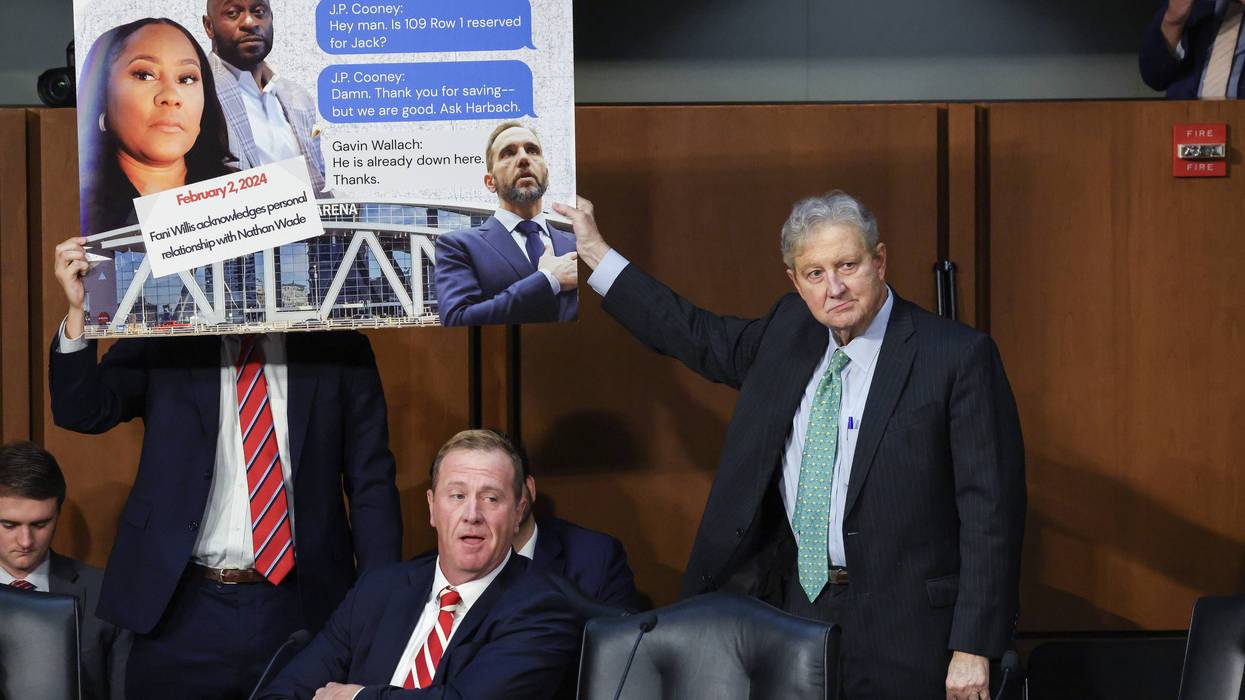
"I think people should have their facts straight before they accuse someone of being a dirtbag," said US Sen. Amy Klobuchar.
Sen. Eric Schmitt faced instant ridicule on Tuesday after his attempt to catch former special counsel Jack Smith in a perjury trap imploded.
During a Senate Judiciary Committee hearing, Schmitt asked Smith, who in 2023 indicted President Donald Trump in two separate criminal cases, whether he had attended a professional basketball game in Atlanta between the Atlanta Hawks and the Golden State Warriors on February 3, 2024.
Smith replied that he did not attend such a game on that date.
Shortly after, Schmitt asked Smith if he had ever met with Fulton County, Georgia District Attorney Fani Willis—who also indicted Trump and several alleged coconspirators for their attempts to overturn the results of the 2020 election—during his tenure as special counsel.
Smith again replied that he had not.
A phenomenal moment in the Senate.
Eric Schmitt, R-Mo., claims he has evidence Jack Smith went to a HAWKS game in Atlanta.
Smith denies it.
Schmitt declares he has busted Jack Smith for perjury.
Smith, vexed, says he went to HAWKEYES game in Maryland.
Watch the whole thing: pic.twitter.com/J07o5Uwfxi
— Sahil Kapur (@sahilkapur) September 29, 2026
"What would you say," Schmitt continued, "if I had a series of text messages from your team that said you were in Atlanta at a... game on February 3, 2024?"
Smith was then shown a poster displaying text messages between people on his team making references to Smith attending some kind of basketball game, though there was no mention anywhere in the displayed texts about the game taking place in Atlanta.
"I think you've already perjured yourself," Schmitt told the former special counsel.
After answering additional questions about his investigations into Trump, Smith asked if he could more thoroughly address the claim made by Schmitt that he attended a basketball game in Atlanta, where it was implied that he met up with Willis to share information about their respective cases against Trump.
"I recall going to a University of Maryland basketball game where [former Iowa college basketball star] Caitlin Clark was playing right around that time," he said. "You can check if that was the exact date, it was Maryland playing Iowa, I think, February of 2024."
Sen. Amy Klobuchar (D-Minn.) helpfully pointed out that the name of the Iowa college basketball team is the Hawkeyes, which is a similar name to the Atlanta Hawks.
Klobuchar then addressed Schmitt and chided him for the personal insults he'd lobbed at Smith during earlier questioning.
"I think people should have their facts straight," she said, "before they accuse someone of being a dirtbag, and not get the teams wrong."
Critics were quick to pile on Schmitt's apparent blunder.
"Schmitt should have to reimburse the public for the cost of printing out these posters," wrote Drop Site reporter Ryan Grim in a social media post. "This is so embarrassing."
ABC News' Jonathan Karl criticized Schmitt for flashing a poster featuring the texts in front of Smith and then quickly removing it from view before he could examine it.
"This was bizarre," wrote Karl. "I have never seen 'evidence' introduced so quickly and then hidden."
Chuck Todd, former host of NBC News' Meet the Press, called Schmitt's line of questioning "a disaster," and said the Missouri Republican suffered from "confirmation bias virus."
Columbia Journalism School professor Bill Grueskin predicted big trouble for any Senate staffer who may havd fed Schmitt faulty information about Smith attending an Atlanta Hawks game.
"I would give up a third of my 401K—make that half of it—to watch Senator Schmitt chew out the aide who came up with this scheme to entrap Jack Smith," Grueskin wrote.
Journalist Julian Sanchez reflected on the fact that someone as seemingly bumbling as Schmitt is one of just 100 people in the country who have been elected to serve in the US Senate.
"It’s somehow more depressing," wrote Sanchez, "that our constitutional order is being dismantled by people who demonstrably cannot find their own asses with both hands."

"This administration's repeated and flagrant violations of the law, including the Hatch Act, are an affront to taxpayers and our democracy."
The watchdog group Public Citizen this week filed a pair of complaints urging regulators and broadcasters to pull President Donald Trump's unlawful taxpayer-funded campaign advertisements off the air and demanding a federal investigation into them.
In recent weeks, amid mounting speculation that Republicans could lose their congressional majorities in the November midterm election, television stations have aired short videos that the White House claims are "public service announcements" but which a range of critics contend are obvious campaign ads—and illegal, as they clearly state they are "paid for by the US government."
Public Citizen's Tuesday complaint to the Federal Communications Commission (FCC), the Federal Trade Commission (FTC), and broadcasters highlights that "at least three campaign ads, paid for by taxpayer dollars, appear to violate the federal law against using taxpayer funds to finance propaganda (5 USC §3107) and related provisions of the appropriations laws as well as the Hatch Act (5 USC §7324)."
While "broadcast stations are strictly prohibited from censoring or rejecting ads sponsored by legally qualified political candidates," the complaint notes, they also "may be held liable for airing any advertisement that is in violation of federal law," which "explicitly prohibits using appropriated public funds for government propaganda, self-aggrandizement, or partisan political advertising."
The group urges the FCC and FTC "to direct broadcasters to stop broadcasting these apparently illegal campaign advertisements and call on individual broadcasters to cease airing the campaign advertisements," emphasizing the responsibility of both agencies and broadcasters "to keep the airwaves fair and honest and operate in the 'public interest, convenience, and necessity.'"
The first ad, initially posted to the White House YouTube account earlier this month, features Trump pledging to "defeat communism, socialism, and Marxism, in America," and the song "Love Me" by JMSN, who did not sign off on its use. The second one aired Friday and includes clips from the president's Fourth of July weekend speech at Mount Rushmore. A third, resembling one of Trump's 2024 campaign ads, was played during "Saturday Night Live," "Fox News Sunday," and several football games.
The administration's decision to reject widespread criticism and air yet another "piece of taxpayer-funded political propaganda during the mass-viewing moment of Sunday football is appalling and alarming," declared Public Citizen co-president Lisa Gilbert. "These illegal ads should immediately be pulled from the air, and the White House's many apparent violations of the law should be investigated."
After the first ad, Public Citizen submitted a complaint to the US Office of Special Counsel (OSC) and the Government Accountability Office (GAO) Forensic Audits and Investigative Service. The group sent another on Monday, arguing that the new "Final Battle" ad is a "brazen" violation of federal law that "doesn't even mention a pending government action. It simply tries to stir up hysteria among voters and depicts Trump as a great hero working to save the nation from grave threats."
"Like the other previous two campaign advertisements Trump and the White House are billing to taxpayers, these ads are designed to boost the character of Donald Trump, generally void of any legitimate government purpose, target the voting public shortly before the 2026 midterm elections, and constitute violations of the law against using government resources for propaganda purposes and the Hatch Act," the group continued.
"Public Citizen is once again writing your offices requesting an investigation into who produced these ads and at what cost to taxpayers, and to take appropriate remedial actions to enforce the federal law," the organization added.
Leading Democrats in the US Senate and House of Representatives said Monday that the White House used funding allocated for US Customs and Border Protection to pay for the ads. Government ethics experts, lawmakers, and other critics have ripped the ads, with some even pointing to them as further evidence that Trump should be impeached a historic third time.
"This administration's repeated and flagrant violations of the law, including the Hatch Act, are an affront to taxpayers and our democracy," said Craig Holman, a government ethics expert with Public Citizen. "The FCC and other oversight agencies are charged with ensuring this type of abuse of taxpayer funds does not happen. But that system only works if they take action."

"Demanding transparency and enforcing US laws governing military aid should be the bare minimum for any senator."
The US Senate is expected to vote as soon as Tuesday evening on a resolution that would require the Trump administration to produce an official report on Israel's human rights practices in the illegally occupied West Bank, where the US-backed Israeli government is engaging in large-scale land confiscations, displacing Palestinians en masse, and enabling deadly settler violence.
The Senate measure, known as S.Res.852, cites Section 502B(c) of the Foreign Assistance Act of 1961 to formally request "an unclassified statement" from the US State Department "regarding Israel’s human rights practices." The filibuster-proof resolution, led by Sen. Chris Van Hollen (D-Md.), notes that at least nine Palestinian Americans have been killed by Israeli settlers or security forces in the West Bank since 2022, and that "Israeli military authorities have detained, interrogated, prosecuted, and imprisoned approximately 13,000 Palestinian children" since 2000.
If passed by the Senate, Van Hollen's resolution would require the State Department to produce a report within 30 days on the Israeli government's human rights conduct in the West Bank. Some US military assistance to Israel would be frozen if the State Department failed to issue the mandated report by the deadline.
Following release of the potential State Department's report, "the Congress may at any time thereafter adopt a joint resolution terminating, restricting, or continuing security assistance for such country," according to the Foreign Assistance Act, which prohibits US military aid to any country that "engages in a consistent pattern of gross violations of internationally recognized human rights."
Cavan Kharrazian, senior policy adviser with the advocacy group Demand Progress, urged senators to back Van Hollen's resolution, saying that "US taxpayers deserve answers about what happened and what our government is doing to prevent its military aid from fueling human rights violations and ethnic cleansing in the West Bank."
"We know that Americans have been killed by Israeli forces and settlers and that Palestinian children face detention and abuse in Israeli military custody," said Kharrazian. "Demanding transparency and enforcing US laws governing military aid should be the bare minimum for any senator. This resolution is a long-overdue first step. Every senator should support it, then follow through by supporting resolutions to block any new arms sales to Israel."
Amnesty International USA also expressed support for the resolution, saying in a Monday statement that it "provides an important opportunity to press the Trump administration on its policies and the lack of accountability for the Israeli government’s human rights abuses and violations of international law."
"This vote comes at a critical juncture in the occupied Palestinian territory as Israel continues its ethnic cleansing campaign against Palestinians in the West Bank," said Elizabeth Rghebi, the group's advocacy director for the Middle East and North Africa. "This campaign must also be understood as occurring within a broader context of Israel’s ongoing genocide against Palestinians in the occupied Gaza Strip, illegal occupation, and an apartheid system over all Palestinians."
Last year, the Trump State Department—led by Marco Rubio—issued a sparse report on Israel's human rights practices that said nothing about Israel's annexation efforts, home demolitions, aiding of settler violence, and other abuses in the occupied West Bank.
Far from working to mitigate Israeli atrocities in the occupied Palestinian territories, the Trump administration is actively fueling them. Earlier this month, The Washington Post reported that the administration is planning to send Israel tens of thousands of additional 2,000-pound bombs in what the newspaper described as "the largest single sale of the controversial munition in recent years."
"For years, the US has failed to get justice for Americans—those killed in the West Bank and detained by the Israeli government—or accountability for Palestinians who are being brutalized with the government's complicity," Van Hollen wrote in a social media post on Monday. "This week I will force a vote on this resolution to get answers."

"Don't ever get immune to the inhumanity and dehumanization of what the Trump/Miller project is doing to children and families," said one advocate.
"We cannot allow this evil to continue," said one commentator after reading a CNN reporter's description of an immigration court hearing in Harlingen, Texas on Monday, where children as young as 3 appeared without legal representation and were asked by a judge whether they wanted a "voluntary" departure from the US or a deportation order.
The hearing, attended by Priscilla Alvarez of CNN, was one of many that are taking place in the US as President Donald Trump pushes to fast-track deportations with abruptly scheduled asylum interviews and court appearances, as the administration also sharply curtails the legal representation that's available to children.
There is no requirement for children, like the 1,883 who were being held by the US Health and Human Services (HHS) Department last month, to have an attorney throughout the asylum process, during which they are expected to present evidence that they have a credible fear of returning to their home country and should be granted asylum in the US.
But Shaina Aber, executive director of the Acacia Center for Justice, told CNN that before the group lost a $200 million contract in July when the administration allowed it to lapse, it was practically unheard of for children to appear in court without legal representation.
“Before, under our contract, it was mandatory to enter into representation if a child was moving forward to the pleading stage while in detention. You’d never have a child in detention being ordered removed without representation,” said Aber, whose group subcontracted with 100 legal service providers to help advocate for more than 20,000 unaccompanied migrant children, including those who were detained while trying to cross the US-Mexico border without their parents and others who were sent to detention when their family members were arrested by US Immigration and Customs Enforcement (ICE).
As family members and guardians face new vetting requirements to have their children released back into their custody from the Office of Refugee Resettlement (ORR) at HHS, children are increasingly being pushed into immigration court hearings without anyone to help them determine how to advocate for themselves.
A 13-year-old Honduran boy identified as Angel appeared in court Monday without a lawyer and was asked by a judge if there was a reason he couldn't return to his home country, which faces a displacement crisis due to violence, poverty, and climate disasters.
“My mom and almost my entire family are here. It’s too dangerous to go back," said Angel.
The judge told him he did not qualify for asylum and asked the 13-year-old to make a choice: a promise of a $3,000 stipend from the Department of Homeland Security to return to Honduras without his mother and family, or a deportation order.
“I don’t know,” Angel said before beginning to cry. “I have no one. I have nothing.”
The judge gave Angel a deportation order and said he had 30 days to appeal it.
The proceedings were observed virtually by an attorney from the US Committee for Refugees and Immigrants (USCRI), which was given a $20 million contract last month by ORR, ostensibly to provide legal services to children facing immigration hearings and asylum interviews.
The lawyer did not speak on behalf of Angel or any of the other children who were facing the judge, and attorneys and advocates have said in court filings that USCRI lawyers have either not shown up to hearings or have not spoken in defense of children facing deportation. USCRI did not respond to a request for comment from CNN regarding that claim.
One advocate told CNN that the fast-tracked deportation proceedings are "a complete violation of due process for a child."
“The kids who are unrepresented, they can’t read the form, much less figure out how to file it. And if they don’t put an asylum claim in, the judges are ordering their removal,” they said. “No one is asking a single question—who will you go to? Will you be safe?”
The hearing took place as Margaret Wurth, senior adviser at the children's rights division at Human Rights Watch (HRW), warned of the "anguish" the Trump administration is causing for families and children across the US as the number of people deported by Trump reaches 540,000.
HRW spoke to one Haitian man named Pierre, who had been living in Florida with his wife and son, who was born in the US. Pierre had protections under Temporary Protected Status, but Trump ended the program for Haitians, and the US Supreme Court upheld that decision in June.
Pierre was detained at a routine check-in with ICE, which told him his work permit had expired. He said he had a pending asylum case and had applied to renew his work permit on time, but was taken to two different detention centers before being sent back to Haiti.
“I worked so that he could grow up without the fear, violence, and uncertainty that I had known in Haiti,” Pierre told HRW. “I did not get to hug my son. My wife is now alone with the rent, the bills, and our child. She tells me that he still waits for me and asks whether I will be there when he comes home from school.”
Dylan Williams, executive vice president for the Center for International Policy, called the immigration hearing that was described on Monday as "monstrous."
"A society that allows this is deeply sick," he said.
Another observer wondered how proceedings like the ones described by CNN are going forward in courtrooms across the country without judges "rage-quitting," and labor advocate Charles Idelson called on Americans to not "normalize" the treatment of immigrant children by Trump and his top officials, including Homeland Security Adviser Stephen Miller.
"Don't ever get immune to the inhumanity and dehumanization of what the Trump/Miller project is doing to children and families," he said.
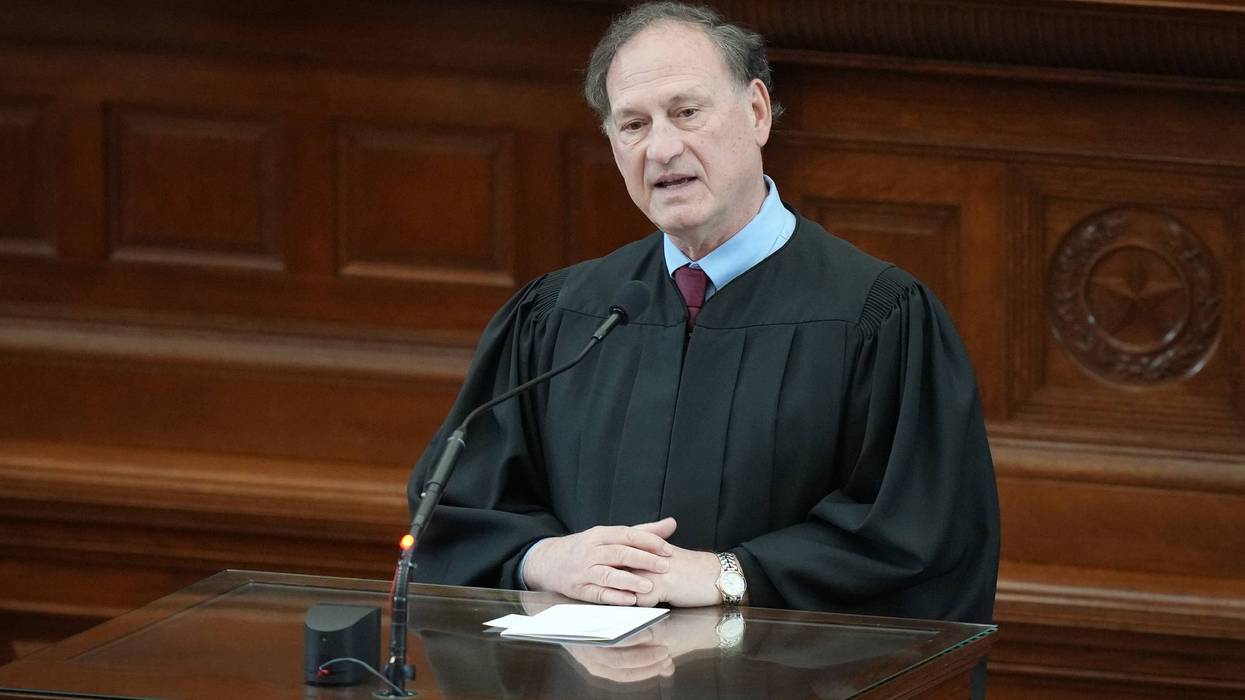
Oil companies warned Alito that if the Supreme Court didn't exempt them from state climate lawsuits, it could adversely affect his personal investments.
Following years of pressure from critics who called out his severe conflicts of interest, the right-wing Supreme Court Justice Samuel Alito has recused himself from a major climate case on Monday, just days before the lawsuit was scheduled to be heard.
Next week, the court is scheduled to hear oral arguments in Suncor Energy v. County Commissioners of Boulder County, a case nearly a decade in the making that could determine whether oil giants can face billions of dollars worth of lawsuits for climate-related damages and misleading the public about the planet-heating effects of fossil fuels.
A coalition of environmental groups and anti-corruption watchdogs has pushed for Alito to recuse himself from the case because the justice personally holds stock in ConocoPhillips and Phillips 66—companies that face around two dozen climate lawsuits that could be directly affected by his ruling.
As Hannah Story Brown, the deputy research director on climate and governance issues at the Revolving Door Project, explained back in 2023, the Suncor case was promoted strategically by oil companies to allow Alito to get around his oil investments.
"While most of the lawsuits were brought against a dozen or so different fossil fuel companies, the Colorado municipalities are only suing ExxonMobil and Suncor Energy—the stocks of which Alito does not own," she wrote for The American Prospect. "This presents an opportunity to get around Alito’s likely recusal from considering the other four petitions to which ConocoPhillips and Phillips 66 are parties."
In May, a Supreme Court spokesperson said Alito had declined to recuse because he had no financial interest in either company that is a party to the Boulder case and had been advised by court counsel that recusal was not required.
However, in September, just weeks before oral arguments, the group Consumer Watchdog found that shareholders, including Alito, had received warnings from the two companies that climate lawsuits could adversely impact their businesses and, in turn, his investments. Oil industry groups, meanwhile, told the court in briefs that a ruling in the Suncor case could make those lawsuits go away.
“Justice Alito has a direct and documented financial stake in the outcome of Suncor v. Boulder," explained Alexandra Nagy, Organizing Director of Consumer Watchdog. "Under the Supreme Court’s own Code of Conduct, Alito should recuse.”
Federal law expressly states that judges—including Supreme Court justices—must disqualify themselves from cases where their "impartiality might reasonably be questioned." However, there has historically been a lack of enforcement for Supreme Court justices, because there is no higher court to rule on whether those ethics rules have been violated.
In 2023, following revelations about Justice Clarence Thomas' receipt of gifts and travel from billionaire donor Harlan Crow, the Supreme Court adopted its own nonbinding ethics code.
Also informing that ethics policy were revelations about Alito, who was found to have taken a luxury fishing vacation with GOP billionaire investor Paul Singer, whose hedge fund has invested billions of dollars in Suncor. Singer’s hedge fund had business before the court at least 10 times, during which Alito did not recuse himself.
The justices ultimately still determine whether to disqualify themselves from cases, and critics have derided the ethics code as a “PR stunt.”
On Monday, however, the clerk of the Supreme Court sent a single-sentence notice to the parties in Suncor v. Boulder that "Justice Alito has determined that he will not continue to participate in this case." It provided no further explanation for the justice's decision.
In a post on social media, the Revolving Door Project called it “bad news for Exxon, and a win for the power of public pressure calling out the blatant corruption" of the court led by Chief Justice John Roberts, adding that the group had been “calling for [Alito’s] recusal for YEARS.”
Kathy Mulvey, director of the Fossil Fuel Accountability Program at the Union of Concerned Scientists (UCS), also celebrated the decision but emphasized that it should never have taken this long to come to fruition.
“Justice Alito’s recusal in this case should’ve been a foregone conclusion," Mulvey said. "While we welcome today's announcement as a step toward a fairer, more impartial process for all parties involved, Justice Alito's decision is the bare minimum we should expect from a justice on our nation’s highest court."
UCS filed an amicus curiae brief before the court last month documenting what it described as ExxonMobil and Suncor’s “concealment and denial of the hazards they knew would result from the normal use of their fossil fuel products.”
“Internal corporate documents and other evidence now in the public domain show that the fossil fuel industry employed many of the same deceptive strategies used by the tobacco and lead industries, which have been the subject of extensive litigation," Mulvey explained. "In those cases, courts addressed claims that manufacturers possessed substantial internal knowledge regarding the dangers of their products while simultaneously conducting coordinated public campaigns to minimize, obscure, or cast doubt upon those dangers."
She added that "communities like Boulder deserve their day in court, through a process protected from financial conflicts of interest and from an industry hell-bent on securing immunity from liability.”
Alito's recusal could have major ramifications for the case's outcome. With only eight justices participating, a 4-4 split would leave intact a Colorado Supreme Court ruling allowing Boulder’s climate lawsuit to proceed, while producing no nationwide precedent that could shut down similar cases elsewhere.
The question of whether states and municipalities can sue fossil fuel companies takes on new urgency as the Trump administration halts federal action on the climate crisis and states and municipalities are left to fend for themselves.
An analysis commissioned in 2018 projected that the area around Boulder County would require between $96 million and $157 million to make only some of the necessary adaptations to climate change through 2050.
"What [Boulder] was saying was: 'We want damages for this because we’re spending a ton of money dealing with climate change," explained Sam Sankar, senior vice president at Earthjustice, in an interview with Slate. "'We’re having to reinforce roads to deal with extreme heat or extreme precipitation. We’ve got to rebuild infrastructure to deal with hundred-year floods that are happening every other year now. We’re dealing with heat stress and heat stroke and all the things that the people in our town are being affected by. We’ve never had wildfire seasons like this in the past. It’s very hard for us to deal with, and we’re spending a ton of money to upgrade systems, to fight the fires, or even to deal with the aftermath of these things."'
"What Suncor and Exxon are trying to do right now is stop the case from going forward," Sankar said. "What they’re saying is that this kind of case shouldn’t even get off the ground. There shouldn’t be a trial; there shouldn’t be any kind of judgment. They should be let off the hook before the trial begins."

"Families are going further into the red just to cover basic essentials, all while the Trump administration touts hollow talking points about a booming economy."
Research published Tuesday shows that more than half of the income gains seen by the typical American worker since 2022 has been swallowed by debt payments, as high and still-rising costs of housing, groceries, utilities, and other essentials force families to turn to credit cards and other sources of borrowing to stay afloat.
The new report released by The Century Foundation and Protect Borrowers estimates that take-home income for a typical US household rose by approximately $109 per month while the average worker's debt payments rose by $57. In households with a single earner, the groups noted, "52 cents of every dollar a worker gained went to paying down their debt before they could actually spend it on other things."
In two-income households in which both earners faced the average debt payment increase, "the household’s entire real income gain was lost to debt, and then some."
Credit cards and auto loans—which often come with extremely high interest rates—account for most of the debt burden carried by typical US households, which have seen their debt payments grow more than eight times as fast as their income over the past four years, according to The Century Foundation and Protect Borrowers.
"The economy is rigged against working families, and this report shows one big reason why," US Sen. Elizabeth Warren (D-Mass.), the top Democrat on the Senate Banking Committee, said in a statement. "For the typical worker, more than half of every dollar of income growth is going right back out the door in debt payments. Instead of letting lenders rip off families, [President] Donald Trump and congressional Republicans should act today to protect families from getting trapped in cycles of debt, including a cap on credit card interest rates.”
Trump repeatedly vowed during his 2024 presidential campaign to cap credit card interest rates at 10%, but he has since done nothing substantive to fulfill that promise as the nation's credit card debt crisis continues to spiral amid deteriorating economic conditions, with sluggish hiring and inflation—fueled by the president's illegal war on Iran—outpacing wage growth.
"Families are going further into the red just to cover basic essentials, all while the Trump administration touts hollow talking points about a booming economy and fails to deliver on promises to lower costs,” said Aissa Canchola Bañez, policy director for Protect Borrowers. “Today’s report shows just how dire the affordability crisis is for working people who are being forced to surrender their hard-earned income gains to paying off debt and padding the pockets of credit card executives and debt collectors."
"Growing household debt is burying America’s workers," she added, "and policymakers must take action to get them real relief."
The new research warns that, in the absence of ambitious policy action, the debt emergency facing working-class US households "is about to get worse," with many student-loan borrowers about to be forced into expensive repayment plans due to the Trump administration's assault on Biden-era relief efforts.
"Cancelling student and medical debt, capping interest rates, and restraining employer debt traps are all examples of solutions available to provide help to struggling households," the new report states. "We should also address the ways workers end up in debt in the first place through stagnant wages, eroded bargaining power, and lack of public provisioning. Together these interventions represent a coherent alternative to the status quo so that economic growth is measured by what workers actually keep and not just by what employers pay."
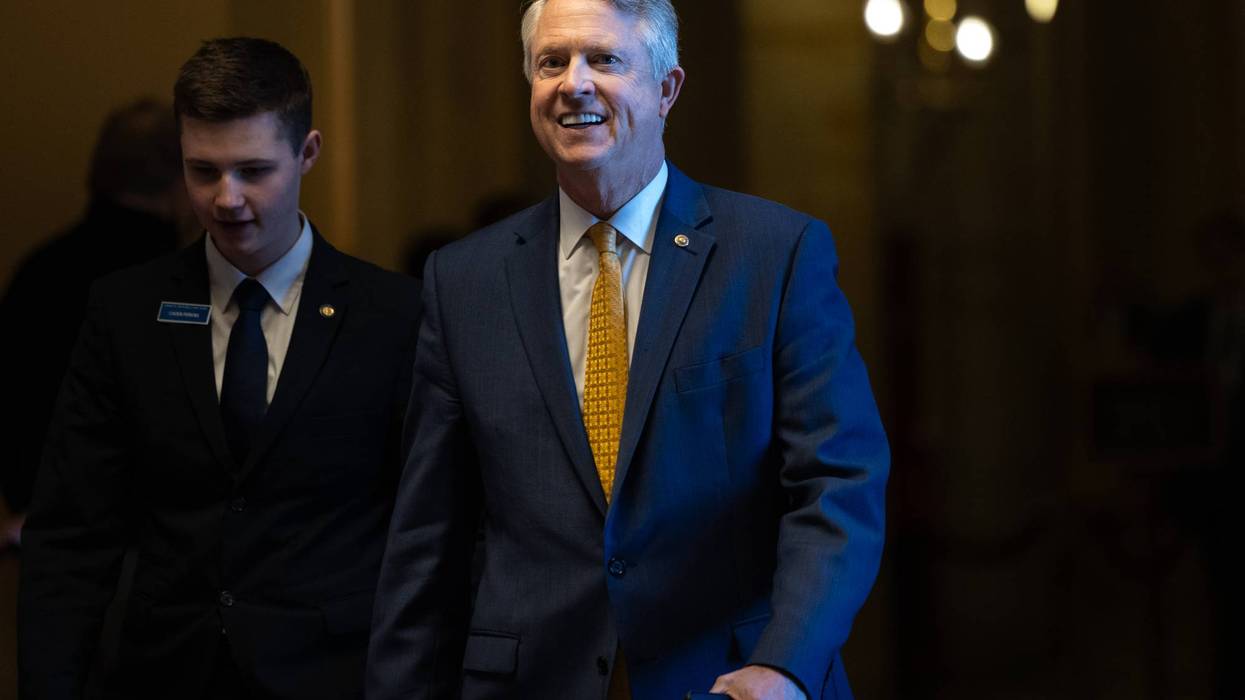
"Roger Marshall REALLY doesn't want you to see this ad," said Kansas Democratic US Senate candidate Adam Hamilton.
Attorneys representing Sen. Roger Marshall on Monday accused Democratic challenger Adam Hamilton of producing a "defamatory" ad centered on a former patient who was arrested for missing court dates related to unpaid medical debt owed to the Kansas Republican.
In a letter sent to Hamilton, Marshall's attorneys claimed that the ad released last week by the Kansas Democrat's campaign contained "false" information and must be taken down.
"We demand that you immediately cease and desist from any further publication, broadcast, distribution, or promotion of the advertisement," the letter said.
The ad in question features Meischa Zimmerman—a one-time patient of Marshall, a former obstetrician-gynecologist—who was arrested in 2011 after missing a $50 payment.
Meischa was Roger Marshall's patient. This is her story. pic.twitter.com/M6bmqK92gm
— Team Hamilton (@TeamHamiltonHQ) September 25, 2026
As The New York Times reported earlier this month, Zimmerman, who was eight months pregnant at the time of her arrest, owed Marshall nearly $3,600 for a C-section he performed while delivering one of her children. She had previously agreed to a $50 monthly repayment plan for the procedure after being sued by Marshall's office for unpaid medical debts.
Marshall's attorneys objected to the ad's portrayal of events, arguing that Zimmerman's $50 missed payment was only a fraction of the total that she owed to the future senator.
"Falsely accusing a physician of having a pregnant patient arrested over a $50 bill strikes directly at Senator Marshall’s professional integrity as a physician and his fitness for public office," they wrote, "and it has been broadcast to thousands of Kansas voters in the final weeks of an election."
The attorneys' letter does not appear to have deterred Hamilton, who continued to promote the ad featuring Zimmerman in a Monday social media post.
"Roger Marshall REALLY doesn't want you to see this ad," Hamilton wrote. "Meischa's story is true. Roger Marshall and his lawyers can’t hide the truth about his record from Kansas voters."
Tyson Brody, spokesperson for Hamilton's campaign, defended the ad in an interview with the Kansas Reflector.
“The lies in his letter are blatant and reek of desperation,” Brody said. “The truth is what Roger Marshall did is extreme and hurt Kansans. Voters should know the truth about who their senator is and what he’s done."
According to the Times' reporting, at least 81 one-time Marshall patients have been arrested for missing court dates stemming from their unpaid medical bills, with one patient taken into custody owing just $114.
The Times investigation also found that Marshall or his office sued more than 700 patients for unpaid bills throughout his two-decade career.
Kellie Clutts, another former patient of Marshall, told the Times she was sued by the Kansas Republican in 2015 over a $129 bill, which eventually resulted in her bank account being garnished.
"I was recently divorced, trying to do everything on my own," Clutts told the Times. "I told them I could make partial payments, but it seemed like no matter what I said, they wanted the full amount at once."