SUBSCRIBE TO OUR FREE NEWSLETTER
Daily news & progressive opinion—funded by the people, not the corporations—delivered straight to your inbox.
5
#000000
#FFFFFF
To donate by check, phone, or other method, see our More Ways to Give page.


Daily news & progressive opinion—funded by the people, not the corporations—delivered straight to your inbox.

Standard & Poor's (S&P), the bond-rating agency whose past practices have been tied to the mortgage crisis, is in negotiations with the U.S. Justice Department to settle allegations of civil fraud with a payout of up to a $1 billion. Unless the Justice Department specifically forbids it, the deal could allow S&P to claim the payment as a deductible business expense worth $350 million.
"These settlement agreements should strongly deter the kind of behavior that brought about the mortgage crisis," said Michelle Surka, program associate with US Public Interest Research Group. "That's lost if the agreements allow corporations to write off their misdeeds as just a cost of doing business."
The Department of Justice complaint alleges that S&P knowingly downplayed the risk on securities. Allegedly, S&P would often rate subprime securities inaccurately, giving them high ratings when in reality they were composed of risky mortgages likely to default. This practice won the rating agency business from banks like Morgan Stanley and JP Morgan, which have also settled numerous allegations with the Justice Department in connection with the mortgage crisis.
"If the Justice Department's settlement includes tax deductions, it would be a subprime deal for taxpayers. Americans have already paid the price for S&P's allegedly poor practices, thanks to the mortgage crisis and recession it helped bring about," said Surka. "S&P's deceptive reporting practices led to millions of Americans going financially underwater. The Justice Department itself needs to be forthright about whether this deal can become a write off for S&P."
Every dollar in tax windfalls claimed by deducting settlement agreements must be shouldered by everyday taxpayers in the form of higher taxes, more federal debt, or cuts to public programs.
In previous cases, the Justice Department has usually failed to prevent banks from taking tax deductions for payments meant to settle allegations of fraud in connection with the mortgage crisis. In August 2014, $11 billion of Bank of America's $16 billion settlement could be classified as an ordinary cost of doing business for tax purposes.
The Department of Justice has the power to explicitly deny corporations tax deductions for settlement payments. Specific language in the legal agreement, which other agencies like the Securities Exchange Commission and the Consumer Financial Protection Bureau use regularly in their deals with corporations, can prevent such deductions and save tax payers millions.
Typically, when a settlement agreement is likely to become a tax write off, the Department of Justice does not even divulge the real, after-tax value of the payment.
"The American public counts on S&P reporting real numbers and accurately rating these financial instruments. If the company knowingly failed to do that, they should face consequences," said Surka. "The Department of Justice should similarly report real, after tax numbers when announcing its settlements."
You can read U.S. PIRG's research report on the tax implications of legal settlements, "Subsidizing Bad Behavior: How Corporate Legal Settlements for Harming the Public Become Lucrative Tax Write-Offs.
U.S. PIRG created a fact sheet on use of the settlement loophole by Wall Street financial firms.
U.S. PIRG, the federation of state Public Interest Research Groups (PIRGs), stands up to powerful special interests on behalf of the American public, working to win concrete results for our health and our well-being. With a strong network of researchers, advocates, organizers and students in state capitols across the country, we take on the special interests on issues, such as product safety,political corruption, prescription drugs and voting rights,where these interests stand in the way of reform and progress.
"All of Beirut shook," said one resident who was forced to take shelter in the city after an Israeli displacement order forced her from her home in the suburbs.
An Israeli airstrike totally demolished a large apartment building in central Beirut on Wednesday, following a night of attacks on densely populated residential areas, several of which reportedly came without warning.
Videos shared to social media and by local media outlets show the 10-story building, located in the Bachoura neighbourhood in central Beirut, suddenly collapsing into rubble in the early hours of the morning after being struck with a missile.
Israeli authorities issued a forced displacement order to residents of the building over social media around 4 am local time, roughly an hour before the strike. It warned residents of buildings in the Bachoura area that they were "located near Hezbollah facilities" and needed to move at least 300 meters away.
Israel has claimed the building was used by the militant group Hezbollah to stash large sums of money, but has provided no evidence publicly.
Citing Lebanon's Health Ministry, the Associated Press reported that at least four people were wounded in the attack, which sent emergency teams rushing to the scene through a plume of black smoke.
Residents of the collapsed apartment building have taken to social media to describe their horror at seeing their home suddenly destroyed.
"I am a US citizen and surgeon who took care of the Boston Marathon bombing victims in 2013," said Haytham Kaafarani, a professor of surgery at Harvard Medical School. "I paid for seven years to own a small apartment in downtown Beirut for my three kids to enjoy summers there. Today, Israel reduced my dream home to rubble, with American weapons, paid by my taxes."
Another professor, Bilal R. Kaafarani, who teaches chemistry at the American University of Beirut, said something similar.
"Israel demolished the building I have an apartment in. It took 22 years of my work here and 20 years of my wife’s work to own this apartment," he said. "This madness has to stop."
The attack came after a night of intense airstrikes upon civilian areas in Lebanon's capital, which reportedly came without warning in the middle of the night and into the early morning.
According to Lebanese authorities, at least 20 people were killed in a series of attacks on Beirut and the southern and eastern parts of the country, while dozens more were injured.
Lebanon's health ministry reported that more than 900 people have been killed and 2,200 injured in Israel's latest round of attacks in Lebanon, which began on March 2 after Hezbollah retaliated against the US-Israeli war in Iran.
The attacks beginning Tuesday night came less than a day after Volker Türk, the United Nations High Commissioner for Human Rights, warned that "deliberately attacking civilians or civilian objects amounts to a war crime,” noting that hundreds of homes and other civilian infrastructure, including health facilities, had been destroyed by prior Israeli attacks in Beirut.
Israel has issued evacuation orders that have forced more than 1 million Lebanese people from their homes as part of an expanding ground invasion into southern Lebanon.
Sara Saleh, a 29-year-old taking shelter in a nearby school after being forced from her home in Beirut's southern suburbs, told the Agence France-Presse that she and her family "were asleep" when Israel's warning came down early Wednesday morning. She said they were left to flee for safety in their pajamas.
She said the attack on the apartment "was terrifying... all of Beirut shook." Speaking with a face mask to protect herself from dust kicked up by the demolished building, she said her sister's children "started crying and panicking, it was heartbreaking."
The mass displacement of civilians in Lebanon and Iran has been met with increasing criticism from UN experts and human rights organizations.
As reports of the apartment bombing rolled in, Philippe Lazzarini, the commissioner-general of the UN agency for Palestinian Refugees (UNRWA), said that "international law is being openly ignored" and that "impunity reigns and disproportionate actions are being normalized amid the escalating conflicts in the Middle East."
"It is a vicious circle," he said. "The more violations, the stronger the culture of impunity becomes."
One expert warned of a "direct hit on consumer prices" if the Iran war persists.
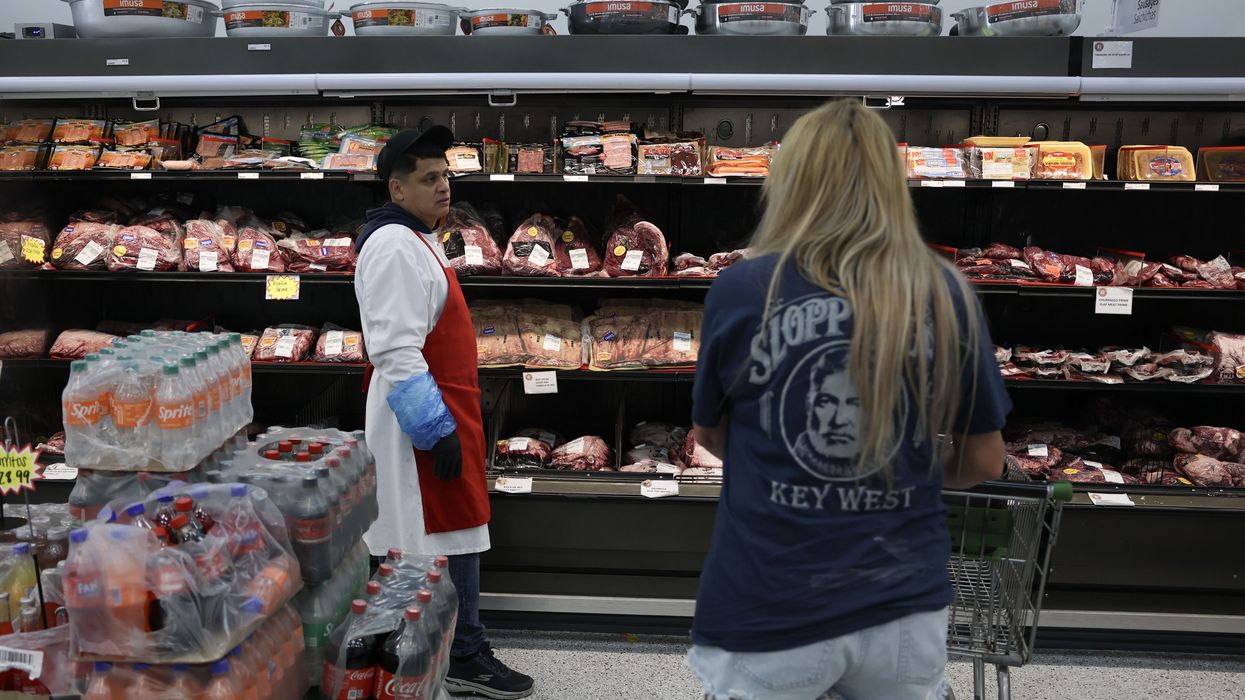
President Donald Trump's unprovoked and unconstitutional war against Iran has already been raising gas prices for US drivers, and could soon raise the cost of food both in the US and all over the world.
NBC News reported on Tuesday that the price of diesel fuel has now soared above $5 per gallon for the first time since December 2022. If the price of diesel remains high, the report explained, it will raise the price of all goods delivered by trucks throughout the US, including food.
Paul Dietrich, chief investment strategist at Wedbush Securities, told NBC News that diesel prices will become a "direct hit on consumer prices" if they remain elevated, as "groceries get more expensive, delivery costs rise, and household budgets are tightened."
"Diesel is what moves the real economy," explained Dietrich. "It hauls the food, the packages, the building supplies, and the inventory sitting on store shelves."
The cost of diesel isn't the only factor that could spike food prices, as the Iran war has also put a strain on fertilizer that farmers need to grow crops.
Al Jazeera reported on Wednesday that there is growing concern that the rising price of fertilizer caused by the closure of the Strait of Hormuz could lead to a global food crisis.
As Al Jazeera explained, almost half of the global supply of urea, the most commonly used fertilizer, is shipped from Middle Eastern nations through the Strait of Hormuz.
With the strait closed by Iran in response to US and Israeli attacks, Al Jazeera wrote, "urea export prices from the Middle East have surged by about 40%, rising from just less than $500 to a little more than $700 per metric ton as of last Friday."
Al Jazeera also cited an estimate from data and analytics firm Kpler projecting that up to one-third of the global fertilizer trade could be disrupted if the strait remains closed for a prolonged period.
Carl Skau, deputy executive director and chief operating officer of the World Food Program, warned on Tuesday that the Iran war could push millions of people into extreme hunger should it persist.
"If this conflict continues, it will send shockwaves across the globe, and families who already cannot afford their next meal will be hit the hardest," said Skau. "Without an adequately funded humanitarian response, it could spell catastrophe for millions already on the edge."
WFP said the disruption in fertilizer markets offers "the most recent proof that conflict is the number one driver of hunger."
"Conflict forces people from their homes, destroys infrastructure, fuels inflation, and wipes out jobs," said the agency. "All of this makes it nearly impossible for people to find or afford enough food to survive. And children are always hit hardest: A child living in a country ravaged by conflict is more than twice as likely to be malnourished and out of school than their peers in peaceful settings."
Warnings about the war's impact on the price of food come as the US economy is showing signs of accelerating inflation.
As reported by CNBC on Wednesday, wholesale prices in February surged by 0.7%, more than double economists' consensus estimate of 0.3%.
On a year-over-year basis, wholesale prices rose by 3.4% in February—the highest increase in a year.
Spikes in wholesale prices, which reflect the amount that firms pay for inputs for their products, typically also lead to increased consumer prices, as companies pass on their cost increases to customers.
"The report suggests that pipeline inflation pressures remain persistent, particularly on the services side, complicating the Fed’s path as it weighs how long to keep interest rates elevated," CNBC noted.
"The US publicly threatens Cuba, almost daily, with overthrowing the constitutional order by force," said Miguel Díaz-Canel.
Cuban President Miguel Díaz-Canel on Tuesday condemned US President Donald Trump's open threat to forcibly seize control of the island nation and vowed that any such aggression would be met with "impregnable resistance."
"The US publicly threatens Cuba, almost daily, with overthrowing the constitutional order by force," Díaz-Canel wrote on social media. "And it uses an outrageous pretext: the harsh limitations of the weakened economy that they have attacked and sought to isolate for more than six decades."
"They intend and announce plans to seize the country, its resources, its properties, and even the very economy they seek to strangle to make us surrender," the Cuban president added. "Only in this way can the fierce economic war be explained, which is applied as collective punishment against the entire people. In the face of the worst scenario, Cuba is accompanied by a certainty: Any external aggressor will clash with an impregnable resistance."
Díaz-Canel's statement came a day after Trump said from the Oval Office of the White House that he believes he will have "the honor of taking Cuba" as it faces a grave humanitarian crisis fueled by the administration's oil embargo, which began shortly after the US abducted Venezuelan President Nicolás Maduro in early January.
"I think I can do anything I want with it," Trump said of Cuba on Monday.
The New York Times reported earlier this week that Trump administration officials are demanding Díaz-Canel's ouster as part of any negotiated deal between the two countries.
US Secretary of State Marco Rubio, the son of Cuban immigrants and a longtime supporter of regime change on the island, said publicly on Tuesday that Cuba "has to get new people in charge." Trump said earlier this month that he's "going to put Marco over there and we’ll see how that works out."
A YouGov poll out this week shows that more Americans disapprove than approve of the US embargo on Cuba. The same survey found that only 13% of US voters would support attacking Cuba, and a mere 18% would support using military force to overthrow the country's government.
Trump's threats came as his oil embargo and the broader, decadeslong, and illegal economic warfare against Cuba continued to take their toll on the island's population, most recently in the form of an island-wide blackout that lasted nearly 30 hours.
On Wednesday, the first delegation of the Nuestra América Convoy arrived in Havana as part of an effort by individuals and organizations to deliver critical humanitarian aid to the Cuban people as the US besieges the island's economy and threatens its sovereignty.
Nathan J. Robinson and Alex Skopic, editors of the left-wing magazine Current Affairs, announced Wednesday that they are heading to Cuba to cover the mission, which they characterized as part of a "proud tradition of internationalism" on the American left.
"Beyond food, medicine, and energy infrastructure, this mission sends a message," Robinson and Skopic wrote. "As Americans, we want to make it crystal clear that the Trump administration does not speak for us when it talks about 'taking over' Cuba, and we’re sickened by what Trump and Rubio are doing to the Cuban people in the name of U.S. foreign policy. But we’re determined to do what we can, and we’re going to make sure the people of Cuba do not stand alone."