

SUBSCRIBE TO OUR FREE NEWSLETTER
Daily news & progressive opinion—funded by the people, not the corporations—delivered straight to your inbox.
5
#000000
#FFFFFF
To donate by check, phone, or other method, see our More Ways to Give page.
Daily news & progressive opinion—funded by the people, not the corporations—delivered straight to your inbox.

Jamie Henn, jamie@350.org, +44 07442 387880
Super Typhoon Haiyan--one of the most powerful storms ever recorded--should be an alarming wake up call for negotiators at the UN Climate Summit, said activists on Friday.
While no single weather event can be tied to global warming, climate change is loading the dice for extreme weather events like Haiyan. The storm's strength and rapid development have been aided by unusually warm ocean waters and warm, moist air (warm air holds more water vapor than cold). Global warming also causes sea level rise, increasing the risk of flooding from storm surges, especially in low-lying areas like much of the Philippines.
"Haiyan should be yet another wake-up call for rich countries to finally wake up and make serious commitments. Instead, they're hitting the snooze button and cuddling up with the coal industry," said Jamie Henn, Strategy Director for 350.org, an international climate campaign.
350.org will be mobilizing its international network to help with Haiyan relief efforts, as well as continuing to turn up pressure on negotiators to deliver results.
Activists are already labeling the Warsaw negotiations the "Coal COP" (Council of the Parties) and pushing the U.N. Secretariat and progressive countries to take a stronger stand against the industry.
In the weeks leading up the negotiations, the Polish government has doubled down on its embrace of the coal industry, making it clear they have no plans to seriously address consumption or emissions. The government is partnering with the World Coal Association to hold a major coal summit during the second week of the climate talks. Coal fired power plants are the largest source of greenhouse gas emission in the world, making coal the number one threat to the climate.
"Hosting a coal and climate summit side-by-side is like throwing a cigarette expo next to a meeting of cancer experts," said Henn.
All of the emphasis on coal, however, has only served to cast more of a spotlight on the fragile state of the industry.
In the United States, coal demand has fallen by about 20% over the last five years, while environmental regulations in Europe will force the closure of many coal fired power plants over the next decade. The drop in demand has resulted in a similar drop in share price for many coal companies, sometimes by as much as 75%.
The situation for the industry will only get worse. According to a slew of recent reports by institutions like the World Bank, HSBC, and the Intergovernmental Panel on Climate Change, 60-80% of current fossil fuel reserves must stay underground in order to limit global warming to below 2degC.
Coal, and other high-carbon, unconventional fuels such as tar sands, are likely to be the hardest hit by the tightening carbon budget. The threat of these reserves turning into stranded assets has led many investors to start shedding their coal industry stocks, and fueled fears of a carbon bubble resulting from the overvaluation of fossil fuel companies. The prices of some coal mining companies have plummeted 75%, while many others have gone out of business.
350 is building a future that's just, prosperous, equitable and safe from the effects of the climate crisis. We're an international movement of ordinary people working to end the age of fossil fuels and build a world of community-led renewable energy for all.

"The buffers that have historically protected water security—snow, ice, groundwater—are eroding in many regions on a timescale of years, not overnight," the agency leader said, stressing "a sense of urgency, not panic."
The world's water cycle "has become more erratic and unpredictable," and recent trends have "serious implications for people and economies in the future," the United Nations' weather agency said Thursday, announcing the release of its annual report on one of the planet's most important natural resources.
Speaking at the launch of the "State of Global Water Resources 2025," World Meteorological Organization (WMO) Secretary-General Celeste Saulo explained that "some parts of this cycle—such as precipitation, river flow, soil moisture—are fast. They respond to weather within hours, days, weeks. Others, like groundwater and glaciers, are slow. They accumulate or decline over seasons to decades or longer."
"Traditionally, these slow reserves have acted as the planet's savings account: a buffer that absorbs bad years so that a single drought or a single dry season does not translate directly into a water crisis," she continued. "One of the central stories of the 2025 report is what is happening to that savings account. And the simple answer is that we are depleting it. We are spending our reserves."
According to the WMO's new report, terrestrial water storage—or the total stored in groundwater, lakes, rivers, soil moisture, vegetation, ice, and snow—has been falling since the mid-2010s. Saulo stressed that "this is not a single bad year, but it is a persistent, decadelong signal."
The agency also found that 2025 was among the driest years for river discharge worldwide in more than three decades, with below-normal flows over a third of the global basin area—and for the seventh straight year in a row, the number of river basins with "normal" conditions was in the minority.
Last year was also the fourth straight to feature widespread glacier loss across all regions. The WMO noted that the losses from 2023-25 could fill about 560 million Olympic-sized swimming pools—or about a third of annual freshwater withdrawals.
The report also "shows that water-related extreme events continue to devastate communities and economies," Saulo noted, highlighting the Early Warnings for All Initiative. "Over the past five years, Asia and Africa have accounted for at least half of all reported hydrological extreme events and more than 80% of associated deaths. And precisely these regions often lack the observations necessary for forecasts and early warnings."
Her comments came a day after the death toll from the flooding disaster in Tibet and Nepal topped 1,400. Experts have emphasized that tragedy's connection to the fossil fuel-driven climate crisis, with University of Pennsylvania professor Michael Mann writing that the "glacial collapse and deluge... was not a freak weather event; it was the structural failure of a mountain itself, nature's latest commentary on the deadly consequences of human-caused planetary warming."
That warming has also intensified the naturally occurring warm phase of a key pattern in the Pacific Ocean called El Niño, according to a study published last month. The WMO chief warned in her Wednesday remarks that "the strengthening El Niño will increase the extremes—drought in some countries and floods in others."
The agency's latest forecast, also released Wednesday, anticipates an "exceptionally high likelihood of nearly 100%" that the warm phase will persist through to February 2027. UN Secretary-General António Guterres said that "El Niño is being supersized before our eyes. The science leaves no room for doubt: The planet is in uncharted waters, and those waters are heating up."
Only when the last glacier has melted and the last reservoir has dried up will you realize that you can't drink gasoline…#climatecrisis#climatecollapse
[image or embed]
— Jürgen Döschner (@jdoeschner.bsky.social) September 17, 2026 at 4:01 PM
While the related releases generated calls for action, Saulo said that "it is not all bad news. Some regions showed improvement in 2025," pointing out that "parts of South America saw a partial recovery in water storage during 2025 after a severe multiyear deficit," while "Central and Southern Africa maintained much-above-normal water levels across several major lakes."
Still, action is needed. As Saulo put it: "The State of Global Water Resources report calls for a sense of urgency, not panic. The buffers that have historically protected water security—snow, ice, groundwater—are eroding in many regions on a timescale of years, not overnight. We have a genuine window for action: expanding early warning coverage; investing in the hydrological monitoring infrastructure; and opting for water management policies to address both water supply and use/overuse."
"My concluding message is that this report exists because members share their data and their science," she said. "This level of understanding—global, standardized, comparable year to year—did not exist a decade ago. It is the product of sustained international cooperation under WMO's mandate. And my last call is for all of you to continue to invest in it."

The organizers said the "culture of bipartisan elite immunity" was why "Biden officials knew they could arm, defend, and cover up the genocide in Gaza for 15 months, and simply move back into liberal spaces."
As another presidential election approaches and a new Democratic administration may be on the horizon, human rights campaigners are trying to ensure that it won't be staffed with the same policy officials who architected former President Joe Biden's Gaza policy.
Most Democratic voters are now appalled by Israel's military campaign in Gaza, which leading human rights groups and scholars have recognized as a genocide. It has led to the deaths of at least 73,000 Palestinians, including more than 21,000 children, according to official totals, and left most of the population displaced and living amongst rubble.
But many of the Biden advisers and appointees who gave cover to Israel during its pivotal, exceptionally deadly early months have settled comfortably back into the respectable liberal intelligentsia, with roles at universities, think tanks, and media outlets.
As 2028 inches closer, a coalition of peace groups is urging these institutions to pledge that they will "drop the Genocide 20," a group of 20 ex-Biden officials they deemed "responsible for promoting, lying about, and covering up the Gaza genocide," even as Israeli officials made numerous statements indicating intent to fully destroy Gaza and its people.
The list, published Thursday on the coalition's website, includes:
"The purpose of the list is to demand these officials be removed from future Democratic administrations, as well as think tanks and academic and liberal spaces," said the coalition, which includes Just Foreign Policy; Palestinian Youth Movement; Track AIPAC, which tracks lobbying by pro-Israel donors; Peace Action; the Democratic Socialists of America; and About Face, a group representing anti-war veterans.
"The culture of bipartisan elite immunity is what drives US war crimes and support for war crimes. From the Vietnam War to post-9/11 torture to the Iraq War, elite war criminality never receives any meaningful sanction from either party. It is treated as a mere policy disagreement among friends," the coalition said. "This dynamic is a key reason Biden officials knew they could arm, defend, and cover up the genocide in Gaza for 15 months, and simply move back into liberal spaces, nonprofits, and future governments."
The campaign urged these organizations to oppose any efforts to give the 20 people on the list "institutional or political power that positions them to continue to perpetrate harm."
Rep. Rashida Tlaib (D-Mich.), the only Palestinian American lawmaker in the US House of Representatives, has signed the pledge, as has Pennsylvania state Rep. Chris Rabb, who is likely to enter the US House in January after winning the Democratic primary for Pennsylvania's 3rd Congressional District earlier this year.
Zeteo reporter Prem Thakker, who first broke news of the coalition's effort, said more lawmakers were expected to join in support.
The coalition noted that there were "far more than 20 people in the US government responsible for the US-backed genocide in Gaza" but acknowledged that it needed to limit itself to those most responsible to remain actionable.
It also said that a parallel effort was in the works to hold members of the Trump administration accountable for their own policies in Gaza and elsewhere.
"The Trump administration’s time will come, especially given its attack on Iran and war crimes against the Iranian people, the coalition said.
But for now, the activists are putting their focus on the Biden administration because “that’s who is currently out of power and actively engaging in reputation laundering and historical revisionism.”
The pledge comes as increasing numbers of Democratic politicians describe Israel's conduct in Gaza as constituting a genocide, a position shared by the majority of Democratic voters. The coalition said that without consequences, this is meaningless.
“The word ‘genocide’ has certain implications and obligations. It’s not a buzzword,” the coalition said. “If an elected [official] says Israel committed genocide, as 22 members of Congress have, then it logically follows they would agree to not hire, work with, or otherwise validate those most responsible for that which they themselves argue is a genocide. It’s common sense.”
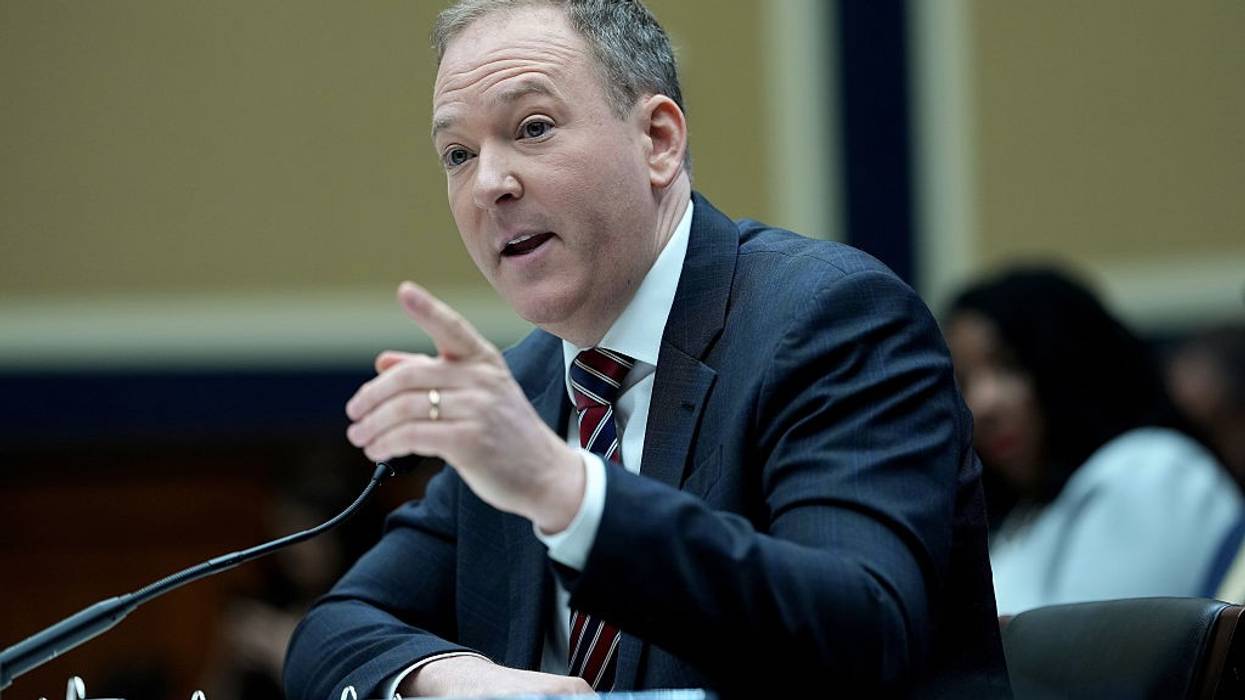
"Singling out medication abortion while ignoring the agricultural and industrial pollutants that are proven threats to our health makes clear that these efforts are about restricting access to abortion, not protecting our water.”
After a yearslong pressure campaign led by Students for Life, President Donald Trump's top environmental agency is including pills used in medication abortions in a new study of drinking water pollutants—part of what one rights advocate called a ramped-up effort to weaponize "environmental protections to restrict abortion medication"—and potentially birth control, as well.
Environmental Protection Agency (EPA) Administrator Lee Zeldin announced the study last week, saying that the agency has "heard loud and clear that Americans are concerned about potential unknown pollutants lurking in their drinking water."
But as Mother Jones pointed out, the Trump administration has shown little concern for drinking water safety as it has gutted the Clean Water Act as recently as this month, pushed for the expansion of artificial intelligence data centers despite evidence that they pollute water, and sought a reversal of rules to protect people from "forever chemicals" in drinking water.
In fact, the outlet noted, the announcement of the abortion pill study came days after Zeldin announced an elimination of pollution standards for power plants.
"The EPA’s unrelated but tandem announcements reveal an agency that has fundamentally overhauled its policies toward environmental and human health in pursuit of the Trump administration’s 'energy dominance' and 'Make America Healthy Again' agendas," wrote Rachel Santasiero at Mother Jones.
The MAHA agenda at the EPA appears to mean a study that will test for mifepristone and misoprostol, the drugs used in medication abortions, as well as levonorgestrel, which is used in contraception, including emergency contraception pills such as Plan B.
"This is the latest tactic of trying to weaponize laws that are meant to protect our environment and protect our wastewater.”
Nathan Donley, director of environmental science at the Center for Biological Diversity, emphasized in an interview with The Cut that the EPA's water-testing approach won't determine how much of a chemical is in drinking water—just that it exists at all in a sample, even in trace amounts.
"That doesn’t matter much, though, in terms of the politics," wrote Jessica Valenti, author of the blog Abortion, Every Day. "If the test finds any trace of abortion pills, conservatives will use it to legitimize their new legal front in the war on reproductive rights—one that includes weaponizing environmental protections to restrict abortion medication (and possibly contraception)."
Anna Bernstein, a federal policy adviser at the Guttmacher Institute, told The Cut that the study is part of an effort to convince Americans that medication abortions are unsafe, at a time when the number of abortions in the US has actually gone up since the Supreme Court overturned Roe v. Wade. Experts have attributed the increase to the expanded use of telehealth and the ability to mail medication abortion pill regimens to patients.
“The anti-abortion movement has become increasingly frustrated with that fact, so they really are throwing everything at the wall and seeing what sticks,” Bernstein told The Cut. “They are really ramping up disinformation campaigns about the safety of medication abortion. This is the latest tactic of trying to weaponize laws that are meant to protect our environment and protect our wastewater.”
She added that she is "concerned about the risk of added surveillance that testing for these chemicals could create in an environment where criminalization is already a factor."
Valenti noted that Kristi Hamrick, the vice president of Students for Life, has acknowledged that attempting to crack down on medication abortion access via environmental protections is "all bullshit."
"This is not because the environment was my first weapon of choice—it’s because it’s the one we have now," Hamrick said last year of the group's Clean Water campaign. "Environmental law has teeth. It already exists. And, frankly, I’m for using the devil’s own tools against them.”
The water study is part of an effort that also includes a push for legislation requiring women who have abortions and miscarriages to collect their pregnancy remains in "catch kits," which has been proposed by state lawmakers in Wisconsin and at the federal level earlier this year.
The Food and Drug Administration already confirmed decades ago—before mifepristone was approved—that it was safe to use “without any expected adverse environmental effects."
A study by Students for Life—published in a journal run by anti-abortion doctors—was called "misleading" by experts who told Politico earlier this year that the research "should not be considered in environmental or public health decision-making.”
Donley called the notion that a one-time dose of mifepristone—a drug that's been taken by about 1% of the US population—could be contaminating water supplies "a joke."
“If you think of most pharmaceutical drugs, you’re not just taking one pill. You’re taking a pill on a daily or semi-regular basis,” Donley told The Cut. What that means is that those drugs used by tens of thousands—sometimes millions—of Americans every day enter our wastewater system at a much larger scale than abortion pills."
“I’ve seen no credible evidence that these drugs are causing widespread environmental harm. There’s just no data to support that whatsoever. Including mifepristone and misoprostol on this list is just stupid, but then again, we’re in a stupid administration,” he added. “It’s completely ideologically driven."
Bernstein told Abortion, Every Day that "singling out medication abortion while ignoring the agricultural and industrial pollutants that are proven threats to our health makes clear that these efforts are about restricting access to abortion, not protecting our water.”
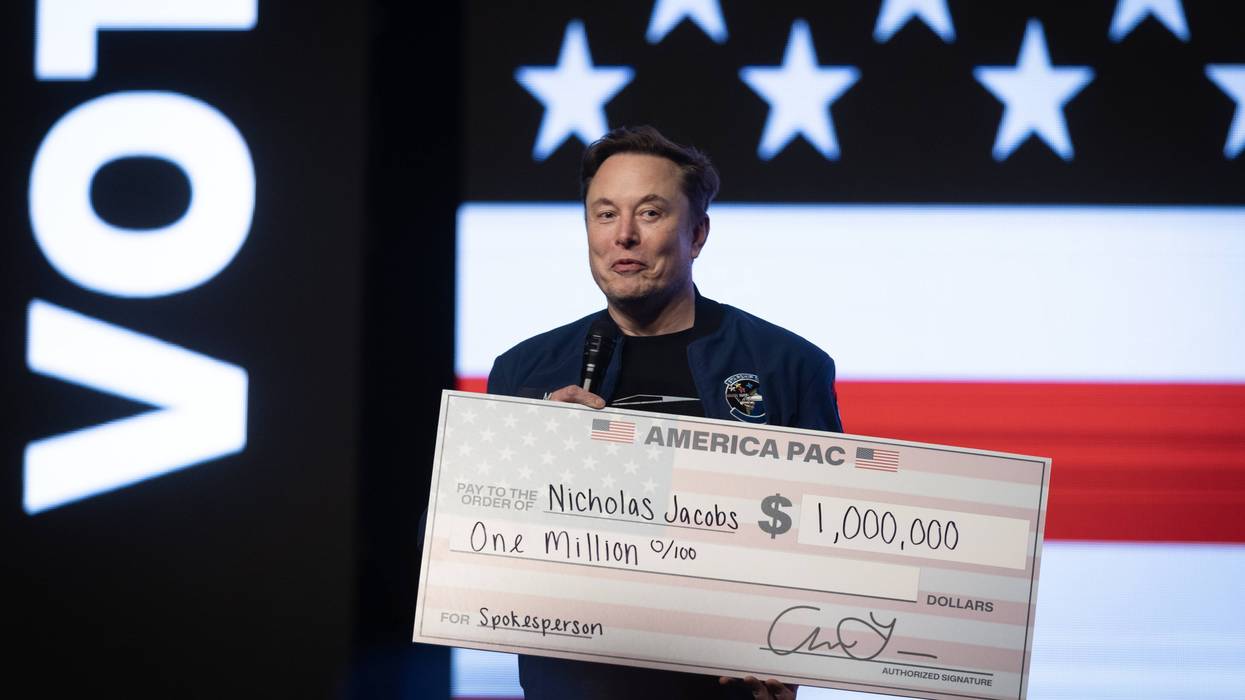
"Have I mentioned lately that oligarch-owned media consolidation is bad?" said one critic.
Filmmaker Alex Gibney's scathing four-hour documentary about SpaceX CEO Elon Musk has received rave reviews since its debut at the Venice Film Festival earlier this month, but it could soon be without an international distributor.
According to a Wednesday report from The Hollywood Reporter, Comcast-owned Universal Pictures, which holds distribution rights to the film outside the North American market, is getting "cold feet" about releasing it.
"The company has not dated the movie," explained The Hollywood Reporter, "has not communicated with the filmmaking team about its plans, and generally appears to be rethinking the release of a project that it once showed high enthusiasm for but is now politically sensitive for parts of the Trump administration."
Two sources told the publication that they wouldn't be surprised if Universal decided to not release the movie and returned its distribution rights to the filmmakers, even though doing so would require the studio to pay a kill fee.
The Hollywood Reporter noted, however, that it's unlikely that the film would be without an international distributor for long because "distributors in individual countries have been salivating over the film ever since the four-hour project began gaining buzz in recent weeks."
Slate culture writer Sam Adams pointed out in a social media post that independent distributor Bleecker Street "is holding steady on releasing Musk in the US, and actually moved up the opening to October 9."
Emmy Award-winning sports broadcaster Brian Webber noted that there is past precedent for Hollywood studios coming under pressure to not release a movie that is critical of a wealthy oligarch.
"William Randolph Hearst famously tried to... suppress Citizen Kane from being released," Webber explained in a social media post. "Hollywood had more guts in the 1940s—probably because there was real competition among the studios and not today's oligopoly problem."
Tech journalist Karl Bode reacted with dismay to news that Universal might spike its release of the documentary.
"Have I mentioned lately that oligarch-owned media consolidation is bad?" he asked rhetorically.

“Nobody tell us that we’re going to Guantánamo Bay,” said one victim. “Just like kidnapping.”
Anger is growing this week as more details emerge about the Trump administration's detention of Somali immigrants at Guantánamo Bay, including people with no criminal records and, in at least one case, a legal US resident.
At least eight Somali men are being held at the notorious US military base in Cuba, while as many as 12 Somali deportees have passed through the facility in recent weeks, according to Sahan Journal. Seven of those still there are being held at Camp 6, which was originally opened under the George W. Bush administration during the so-called War on Terror to imprison men and at least one child in a facility rife with torture and other abuse.
“I never expected to be arrested in a prison established for the terrorists who I fled from,” 31-year-old Hassan Abdi Abtidoon told Sahan Journal's Mohamud Farah on Tuesday.
Among the other Somalis held at Guantánamo is 31-year-old Adam Abdullah, a St. Paul, Minnesota, resident who came to the United States as a legal asylum seeker in 2023. Abdullah had a work permit and Social Security number, operated an auto repair business, and had no criminal record, according to Minnesota court records. His past involvement with law enforcement appeared to include nothing more than two parking tickets.
US Immigration and Customs Enforcement (ICE) agents arrested Abdullah in December during the Trump administration's deadly Operation Metro Surge campaign, which targeted Minnesota's large Somali community amid widespread racist demonization and dehumanization by Republicans, including President Donald Trump.
After months of detention in Minnesota, Kentucky, and Louisiana, Abdullah said officials told him he was being deported to Somalia.
"From Miami, they say, 'OK, now we go to Somalia. Then, first we go to Cuba for refueling, and then we go to some other countries to Somalia,'" Abdullah told Minnesota Public Radio (MPR) earlier this month.
The flight never left Cuba. Abdullah was taken to Camp 6, where he has remained.
Another Somali detainee, Sakariye Abdi Mohamed, described Camp 6 as "the worst place ever I've been in my life."
Mother Jones reported Wednesday that Mohamed was one of 12 Somali men forced onto a plane last month by ICE agents, who told them they were being deported to Somalia.
"Nobody tell us that we're going to Guantánamo Bay," Mohamed said. "Just like kidnapping."
This is APPALLING. The Trump administration is detaining multiple random Somali immigrants with no criminal record at Guantanamo Bay, seemingly because the White House ordered ICE specifically to detain Somalis at Gitmo as part of its effort to punish an ethnic group Trump has attacked.
[image or embed]
— Aaron Reichlin-Melnick (@reichlinmelnick.bsky.social) September 16, 2026 at 12:36 PM
Seven or eight of the men reportedly remain at Guantánamo, where some of them have described being shackled and subjected to frigid temperatures. Detainees also said they are subjected to constant surveillance, including cameras inside bathrooms.
The US Department of Homeland Security claimed the flight included "some of the worst of the worst" with criminal histories including assault, weapons offenses, robbery, theft, drug charges, and drunken driving.
However, Sahan Journal reported that the attorney for six of the eight detainees had found that all had final deportation orders but no additional criminal charges. Four were recent asylum seekers, and two had lived in the United States for decades.
“The administration says we send the worst of the worst to Guantánamo,” US Sen. Tina Smith (D-Minn.) told MPR Wednesday. “Yet in the case of Mr. Abdullah, there has been no evidence presented about what he has done, no explanation for why he has been detained. I mean, there is really has been no due process.”
The Trump administration's use of Guantánamo for immigration detention is not unprecedented. The facility—which experts have placed within the centuries-long story of American concentration camps—has a long history as an offshore immigration detention site that predates the post-9/11 military prison camp.
During the George H.W. Bush administration, thousands of Haitian refugees fleeing political violence were intercepted at sea and taken to Guantánamo. The Clinton administration continued the policy and, at its peak in 1994, roughly 14,300 Haitians were held there. Clinton officials subsequently used Guantánamo for Cuban migrants, more than 30,000 of whom were jailed at the base.
The treatment of Somali immigrants at Guantánamo has also drawn renewed criticism regarding who has and has not been targeted for deportation from the United States.
Human rights activist Suleiman Bolaleh, who has documented atrocities committed under former US-backed Somali President Mohamed Siad Barre, noted in a recent social media post that Somali immigrants with no criminal records are being rounded up and sent to Guantánamo, while members of the former dictatorship's ruling family and senior figures have lived in the United States.
"Men once positioned at the heart of a regime accused of mass killings, war crimes, and ethnic cleansing continue to reside openly in American communities," Bolaleh wrote. "The contrast is jarring: An immigrant [who] has no criminal record is detained at Guantánamo, while figures tied to that dictatorship’s violent apparatus remain unexamined and unaccountable."
Multiple legal challenges to the Trump administration's use of Guantánamo Bay for immigrant detention have been launched.
Meanwhile, the longstanding habeas litigation involving War on Terror detainees at Guantánamo continues. In May, Somali national Guled Hassan Duran—who has been held at Guantánamo since 2006 without being charged—asked a federal court to order his release after years of inaction on his habeas petition.
Duran was approved for release by senior US officials in 2021, but remains imprisoned at Guantánamo along with 14 other men—none of whom has ever been convicted of any terrorism-related crimes. Former Bush administration and US military officials have said that most of the men and boys who were ever imprisoned at Guantánamo were innocent, and that senior administration officials knew it but kept them locked up for political purposes.

With that additional $930 per household spent on energy, the analysis says the total cost due to higher prices from the war is closer to $1760.
A recently published economic analysis estimates that President Donald Trump’s illegal war with Iran has cost US consumers an average of $1,760 per household—including a total of $121 billion in extra spending on energy alone—since the conflict began less than 8 months ago.
The war, which Trump launched without congressional authorization in February, has sent energy prices spiking across the world, as Iran responded to US attacks by shutting down commercial shipping traffic in the Strait of Hormuz.
According to the estimate by Moody’s Analytics, US consumers have spent over $121 billion—or $930 per household—more on energy since the start of the war, accounting for more than half of the total added expenses imposed by the conflict.
Mark Zandi, chief economist at Moody’s, told CNBC in an interview published Wednesday that the analysis reflects the fact that "consumers are under a lot of financial pressure."
The analysis also finds that the average US household has spent an additional $425 due to higher interest rates caused by the war, as well as $405 for higher military spending, which Zandi explained to CNBC would come from footing the bill through either national debt expansion or increased taxes.
Karthik Sankaran, senior research fellow in geoeconomics at the Quincy Institute for Responsible Statecraft, argued in an analysis published Thursday that relief for US energy consumers could be a long way off given recent developments in the Middle East, including Houthi fighters seizing a key port city along the Red Sea and a drone strike on a Saudi oil pipeline.
Sankaran warned that nations worldwide have far fewer options now to cushion against energy shocks than they did at the start of the war.
"Seaborne storage on tankers has been depleted," Sankaran wrote, "the US Strategic Petroleum Reserve has released about 130 million barrels, and the world’s largest importer, China, is increasing imports to 7.2 million barrels per day, up from a low of 6 million barrels in June."
Sankaran noted that, as uncomfortable as high energy prices are for Americans, the situation is even more dire in the Global South.
"The spike in diesel prices is likely to hit countries in the Global South especially hard," Sankaran explained. "The higher energy density of diesel means that it is used to power trucks, buses, and agricultural equipment, making it the most important fuel in poorer countries where individual ownership of automobiles is much less widespread."
A Tuesday report from CNN highlighted how high fuel prices have led to protests across the globe, including in Syria, Guatemala, France, Portugal, and the Philippines.
The protests in Syria have been particularly intense, CNN noted, as demonstrators on Sunday "blocked the Hasaka–Deir ez-Zor highway, where they burned tires and stopped oil tankers."
Muaz Al Abdullah, Syria analyst at global conflict monitor Armed Conflict Location and Event Data (ACLED), told CNN that "fuel availability, rising prices, falling purchasing power, and poor services are all reasons that have accumulated public resentment," which have led to demands that the country oust its energy minister.
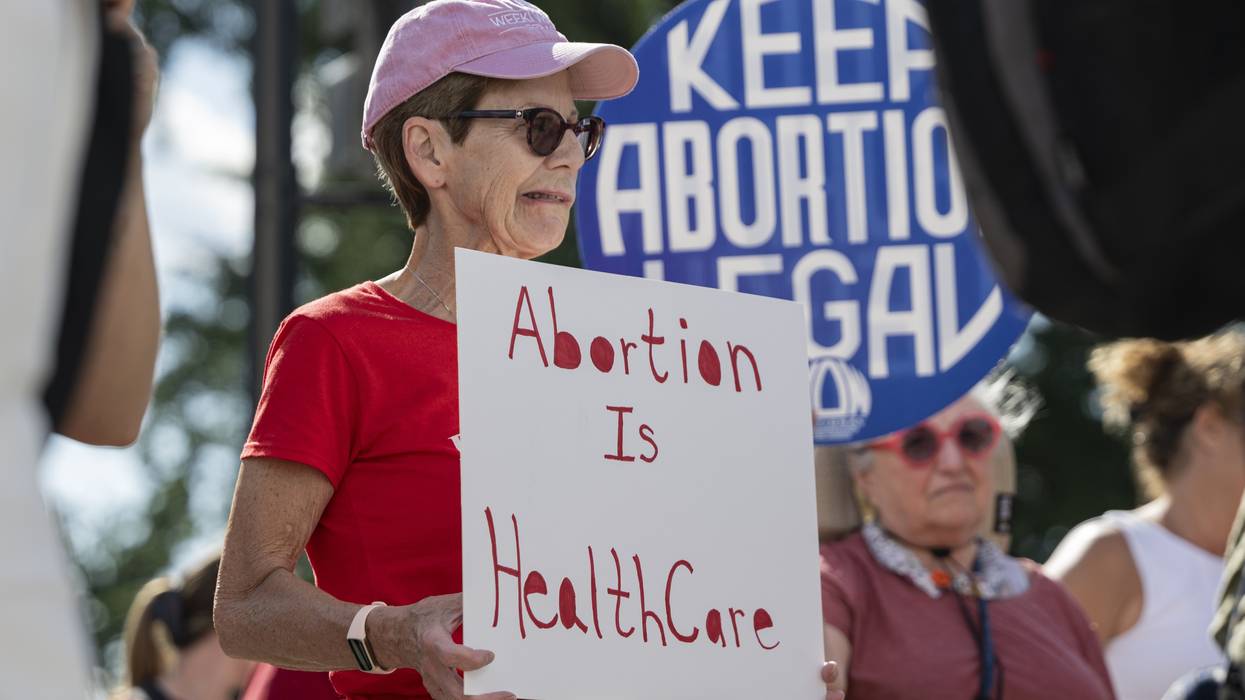
"My husband and I were crushed when we learned that we would never get to bring our daughter home. We wanted mercy for our daughter—but Oklahoma's laws denied us that."
When Sheena Hamlin found out she was pregnant with a daughter she named Ellie, she was "very excited," until her doctors discovered at around 21 weeks that the baby "might survive birth, but that her lungs were so severely underdeveloped that she would suffocate almost as soon as the umbilical cord was cut."
"The alternative would be to terminate the pregnancy," explains a lawsuit filed in state court on Wednesday, but that "was not an option in Oklahoma," where a pair of laws force patients whose "pregnancy will end in miscarriage, stillbirth, or the death of an infant shortly after birth" to leave the state if they choose abortion.
Hamlin and her husband, who have a son, "agreed that they did not want their daughter to suffer," so she flew to Illinois for care shortly before Thanksgiving in 2024, and spent nearly $4,000 out of pocket. After the "devastating" experience, the couple "underwent genetic testing and confirmed that Ellie had Meckel-Gruber syndrome."
They "pursued in vitro fertilization (IVF) and genetic counseling to ensure that they would not have another child affected by the condition," and while Hamlin is now expecting a baby, she "has found it anxiety-inducing to be pregnant in Oklahoma again, particularly in the period leading up to the anatomy scan," the suit says.
Hamlin is not alone. Magon Hoffman is also suing over the abortion bans that prevented her from receiving care. Hoffman and her husband were similarly "thrilled" to learn of her pregnancy in 2022, but a series of unfortunate revelations soon followed: a "huge blood clot," placenta previa, unusual growth measurements, and ultimately, anencephaly.
As Hoffman's doctor, a maternal-fetal medicine specialist, explained at her 19-week anatomy scan, her fetus had a "tiny bit of brain floating around," but "no skull." In other words, the complaint says, "her pregnancy was not viable. Her baby had no chance of survival. Ms. Hoffman was devastated."
Because Oklahoma only allows abortion care to save a patient's life, the doctor warned that she would have to leave the state to end the pregnancy. He then "tried to convince Ms. Hoffman to carry to term," the filing notes, even though "there was nothing they could do to help the baby survive," and if the child lived "for a few hours or a few days... she would be 'blind and 'dying.'"
Hoffman and her husband, who already had a daughter, drove eight hours and spent $3,000 to get abortion care in New Mexico. Afterward, the suit says, she "struggled with anxiety and depression from the loss of a pregnancy she desperately wanted and the stigma and fear she experienced in being forced to seek care out of state."
"In June 2024, while still using birth control, Ms. Hoffman unexpectedly became pregnant for a third time. She was terrified... At no point during the pregnancy was Ms. Hoffman able to believe she would bring home a healthy baby," the complaint continues. She was relieved to deliver another daughter—and does not want any more children, "so her husband decided to have a vasectomy, though he would have preferred to wait. Ms. Hoffman still fears another unexpected pregnancy."
The group Oklahoma Call for Reproductive Justice has joined Hoffman and Hamlin as plaintiffs, as have two of the OB-GYNs who treated them, Drs. Sarah Mashburn and Elizabeth Pinard, who were both born and raised in Oklahoma.
"I have dedicated my life to caring for women from all across our state, including those facing fatal fetal conditions. Doctors routinely provide care according to what our patients want for themselves and their families, but Oklahoma's abortion bans have left me feeling helpless," Pinard said in a statement.
"I don't want to tell my patients to leave the state when I can easily give them the care they need right here in my office," she stressed. "This is not how healthcare should work. My patients deserve access to all of their options for care, and the state needs to allow us to do our jobs."
Hamlin said that "my husband and I were crushed when we learned that we would never get to bring our daughter home. We wanted mercy for our daughter—but Oklahoma's laws denied us that."
Hoffman similarly said that "Oklahoma turned the hardest day of my life into weeks of needless suffering on top of our grief," and the state "is failing families like mine. I'm bringing this case so Oklahomans can have the power again to make the best decisions for our families."
The defendants in the case are the state attorney general and health commissioner, Oklahoma County's district attorney, and executive directors of the state's boards for medical licensing and osteopathic examiners, all of whom have yet to comment on the suit.
The plaintiffs are represented by attorneys at Herbert Smith Freehills Kramer and the Center for Reproductive Rights, a powerhouse that has fought for abortion rights in several high-profile state and federal cases. The legal group's president, Nancy Northup, said Wednesday that "it's unthinkable the pain these families went through because of Oklahoma's abortion bans."
"Forcing women to give birth knowing they won't be bringing a baby home is pure cruelty," she argued. "Every pregnant person should get to decide what is best for their family based on their own beliefs, values, and medical circumstances. The government should have no place in that. We're suing to hold the state accountable for the pain lawmakers have caused these families, and to make sure no other families suffer in this way."
Oklahoma is among the states where anti-choice policymakers have ramped up their longtime efforts to restrict reproductive freedom in the wake of the US Supreme Court's right-wing supermajority overturning Roe v. Wade. Another state on that list is Texas, whose abortion ban led to the 2022 reversal.
In Texas on Wednesday, Tierra Walker's family sued various state officials. The San Antonio woman died in December 2024, at the age of 37, after being denied an abortion. Although such denials have killed a growing number of pregnant people in Texas and beyond, this is the first case of its kind, tying a preventable death to a state abortion ban.
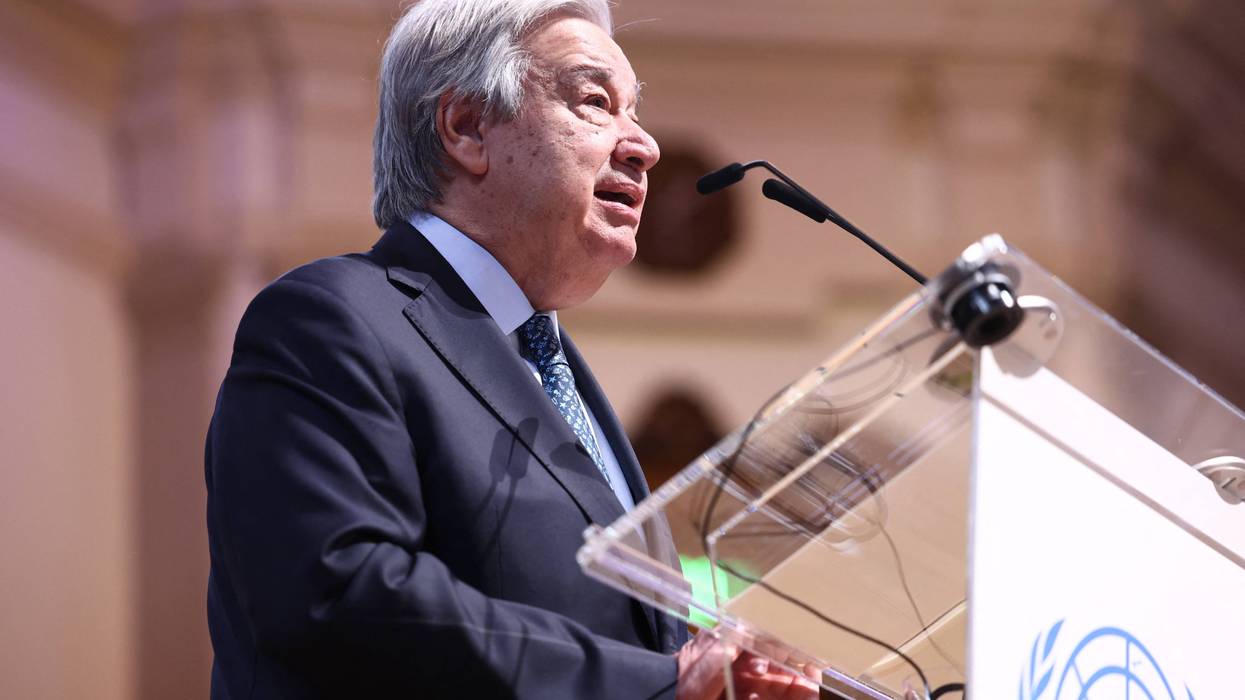
UN Secretary-General António Guterres called on leaders to work together to solve the growing problem of global inequality at the UN General Assembly.
High-level meetings at the United Nations General Assembly are set to begin next week, and they come at a time when the threats to humanity posed by the climate emergency and artificial intelligence have never been clearer.
Those crises demand that policymakers work together to prevent catastrophic, permanent planetary heating and the creation of "runaway" AI technology, suggested UN Secretary-General António Guterres on Wednesday, but he emphasized that another pernicious, destructive problem cannot be overlooked.
Guterres also named "the intolerable deepening of inequalities" as another "existential threat" that leaders must address at the upcoming meetings.
Earlier this year, the anti-poverty group Oxfam International released a report showing that combined billionaire wealth stood at $18.2 trillion in 2025, having risen from $3.6 trillion in 2009.
At the same time, the number of food-insecure people on Earth shot up to 2.2 billion in 2024, rising from 1.5 billion a decade earlier.
"Nearly half of the world lives in poverty while a select few continue to gain extreme wealth and power," said Oxfam at the time. "The amount of wealth owned by the poorest half of the world is less than the amount owned by just the 12 richest billionaires. This extreme concentration of wealth isn’t just making life less affordable for most of us, it’s creating harmful divisions. Billionaires, corporations, and politicians are taking away people’s basic ability to make choices about their futures and suppressing dissenting voices."
An analysis focused on wealth inequality in the US by the Center for American Progress (CAP) this week also showed that the gap between the ultrarich and the rest of the American public has gotten significantly wider in less than two years since President Donald Trump was reelected, with hundreds of billions of dollars in financial backing from billionaires including tech CEO Elon Musk.
"Since Trump took office, the ultrawealthy (top 0.1%) gained more than 8,000 times as much wealth per household as those in the bottom half of the wealth distribution," said CAP. "To provide an example of the extremity and exponential nature of wealth inequality in the United States, the 10 wealthiest Americans alone saw their real fortunes grow by a combined $259 billion over the same period, according to the Bloomberg Billionaires Index—about $26 billion per person, or 22 million times more than the bottom half’s $1,200 per household."
Economic experts have found that the growing inequality crisis is entirely solvable. As Common Dreams reported last year, research from the European Union Tax Observatory found that a global 2% minimum tax on billionaire wealth "would generate about $250 billion in tax revenue—from just 3,000 individuals," raising about $50 billion in Europe alone.
In 2024, finance ministers at a meeting of the Group of 20 in Rio de Janeiro agreed on the need to tax the richest people in the world at a higher rate to address persistent and worsening economic inequality.
As Common Dreams reported Tuesday, a study published in The Lancet found that the global inequality that's been worsened by Trump's foreign aid cuts could be addressed by a 3% wealth tax—raising a small amount of money compared to the total wealth of the world's richest people, but enough to save 29.5 million lives over the next four years.
Climate campaigners in Africa, who have demanded an end to French company Total Energies' East African Crude Oil Pipeline (EACOP), agreed with Guterres' point that "climate, inequality, and international cooperation are inseparable."
"People living along EACOP's path," said the group Stop EACOP, "are the first to bear the environmental and economic costs of decisions made far from their communities."

"The fact that Trump immediately resorts to new threats is further proof that stronger EU-Canada cooperation is both wise and necessary," said a Belgian member of the European Parliament.
In the wake of President Donald Trump's threats of annexation and economic warfare, Canada is distancing itself from the United States and moving toward a first-of-its-kind "associate membership" with the European Union. Trump suggested on Wednesday that this could be a "hostile act."
European Commission President Ursula von der Leyen first introduced the idea earlier that day of Canada deepening its ties with the EU economic bloc during a meeting of the European Parliament in Strasbourg, France.
"Democracies have the freedom to choose with whom to work," Von der Leyen said, suggesting that an "Alliance for the Future" between the EU and Canada would expand cooperation on technology, economic security, and military industry, among other critical areas.
She described such cooperation as a necessity in an "openly hostile world."
This was, in part, a not-so-subtle dig at Trump, who has antagonized Canada during his second term by slapping 50% tariffs on roughly $20 billion of Canadian imports and repeatedly floating the idea of making it the "51st state."
Europe, too, has been targeted by Trump's trade war, while the president has repeatedly threatened the sovereignty of Greenland, an autonomous territory of Denmark, by suggesting the United States could take control of it—including by military force.
An "associate membership" in the EU for a non-European nation has no formal basis in EU statute. One EU diplomat told Reuters that "nobody really knows what it means."
However, Trump described it as an unmistakable slight and issued more threats.
"I think it’s laughable, the whole thing with Canada," he told reporters on Wednesday. "Canada’s been a terrible trade partner."
If the two reached an agreement, Trump said he may retaliate further, heightening the tariffs that have led to sharp declines in European exports to the US and driven up costs for American consumers, especially low-income households.
"If they do that, if I think it’s at all a hostile act, I will put very serious tariffs or stop trading with Europe on many things," Trump said. "So if they do that, if Europe does that with a bad intention, if it’s a good intention, that’s fine.”
"If it’s a bad intention, we’ll put very heavy tariffs on Europe," he reiterated.
Speaking at the European Parliament on Thursday, Canadian Prime Minister Mark Carney—whose compatriots are now more inclined to view the US as an "enemy" than an "ally," according to a recent poll—said of Von der Leyen's proposal, "We welcome this ambition."
While he did not discuss the specifics of becoming an associate member, he agreed that Canada's relationship with the EU should move beyond the current Canada-European Union Comprehensive Economic and Trade Agreement (CETA).
"Canada and Europe should secure our strategic autonomy through deep cooperation in the full range of strategic capabilities, including critical minerals, defense industrial capacity, AI and compute, energy security, space, and payments," he said.
Carney stressed that the act was not one of hostility toward the United States and that he did not seek to form "a third bloc in order to become a great-power rival." But he also seemed to draw a contrast with Trump's bellicosity.
"We do not seek power to dominate others," he said. "On the contrary, we are pursuing resilience so that no one can control our open markets, impair our sovereignty, threaten our territorial integrity, or undermine our freedoms, our democracies, our rule of law."
Trump has not yet specified what tariff rate he'd seek to impose against Europe or what would signify that the alliance with Canada had a "bad intention."
But Kathleen Van Brempt, a Belgian social-democratic politician and member of the European Parliament, said that "the fact that Trump immediately resorts to new threats is further proof that stronger EU-Canada cooperation is both wise and necessary."
"He does not find the idea ridiculous; he fears it because it would weaken his divide-and-conquer tactics and his ability to wield illegal tariffs as political and economic weapons," she wrote on social media.
"He might not react when you lift a finger," she added. "But he will understand when you raise a fist."
"Voters see this election not just as a referendum on Trump... but as a repudiation of the entire political system."
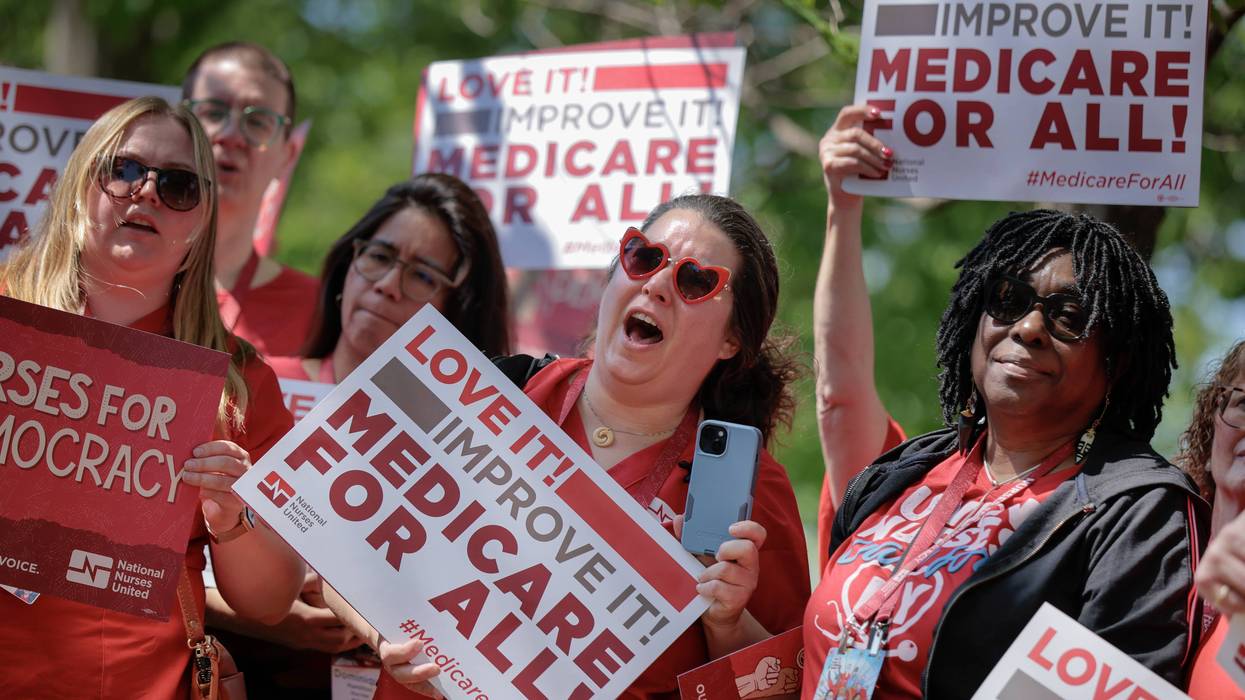
A poll released by the Cook Political Report on Thursday shows US voters in key swing districts overwhelmingly dislike artificial intelligence companies—but are feeling warm about Medicare for All.
In total, the poll finds that voters in 37 swing districts across the US view AI companies unfavorably by a two-to-one margin, with 64% of voters saying they're more concerned than excited about the technology, compared to just 31% who say they're more excited than concerned.
Opposition to AI data centers is even stronger, as 63% of voters say they would oppose building one in their communities, compared to just 28% in favor. Additionally, 44% express strong opposition to local data center construction, making strong opposition higher than overall support.
At the same time, the poll finds much stronger support for Medicare for All, with 62% of swing-district voters having a favorable view of the policy, compared to 34% who said they were opposed. The intensity gap is also notable, as 41% of voters sat they have a strongly favorable view of Medicare for All, while just 25% have a strongly unfavorable view.
This does not mean that these voters are socialists, however, as the poll shows just 32% expressing a positive view of socialism, compared to 58% expressing a negative view. When it comes to Democratic Socialists of America (DSA), 37% of voters say they have a favorable view of the group, compared to 56% who say they have an unfavorable view.
Regardless of specifics about policy and ideology, the poll shows a deep dissatisfaction with the American political system and an openness to major changes.
Amy Walter, editor-in-chief of the Cook Political Report, commented in a social media post that "the most interesting finding was that these voters see this election not just as a referendum on Trump (who’s underwater by 16 points), but as a repudiation of the entire political system."
Walter pointed to a striking finding among independent voters in the survey, who vastly preferred a candidate promising to change the whole political system compared to a candidate who would just be a check on Trump.
"This also suggests," Walter added, "that these voters would want a Dem-led Congress that focuses more on an agenda that tackles corruption and institutional rot than one that focuses solely on Trump and his overreach."
Yasmin Radjy, executive director of Swing Left, said that the Cook Political poll "tracks with everything we're hearing" in conversations with voters.
The idea that the "system is broken," wrote Radjy, "is overwhelmingly the top issue/theme we hear from voters across the ideological and partisan spectrum—even more than affordability!”