The Trump administration has failed to use military means to force Iran to open the Strait of Hormuz after it began restricting travel in retaliation for US and Israeli attacks in late February.
On Thursday, Bessent told CNBC that the new approach is to impose the "toughest sanctions in history” on Iran, ramping up a strategy that has inflicted suffering on the Iranian people but failed to force its leaders out of power for nearly 50 years.
Bessent emphasized that it would only work with the help of "all of our allies" carrying out the "greatest coordinated economic isolation in the history of the world."
He made very explicit the goal of ratcheting up pressure on the regime by inflicting pain on the nation's 90 million people, by causing "substantial inflation, both food inflation and ordinary inflation in Iran." He compared the effort to the use of sanctions to strangle the economies of Venezuela and Cuba, which have fueled humanitarian crises in both countries.
Bessent gave an ultimatum that every nation is "either with us or against us," and warned those who refuse to help with the administration's effort to "squash the economy" of Iran that the US would "put its full might and force toward enforcing against you."
He promised that any country that provides a "lifeline" to Iran would itself be sent into "economic oblivion."
Iran responded to the threats by vowing a fearsome retaliation. "With preparedness across land, sea, air, air defense, and cyberspace, Iran's armed forces will respond to the enemy's new threats with crushing, punishing, and devastating responses," said the chief of staff of Iran's armed forces, Maj. Gen. Ali Abdollahi.
Iran's parliament speaker, Mohammad Baqer Ghalibaf, acknowledged that the impact of further sanctions could indeed be devastating.
"We must make plans to deal with the unjust sanctions so that we can overcome them," he said. "No matter how much military power we have, we won't survive if people are hungry and we don't have financial turnover, economic growth, and national production."
As the US imposes its own blockade on Iran's oil exports, Bessent called on China to "get with the program." China buys about 80% of the oil exported from Iran, and Bessent emphasized that half of China's energy comes from the Persian Gulf.
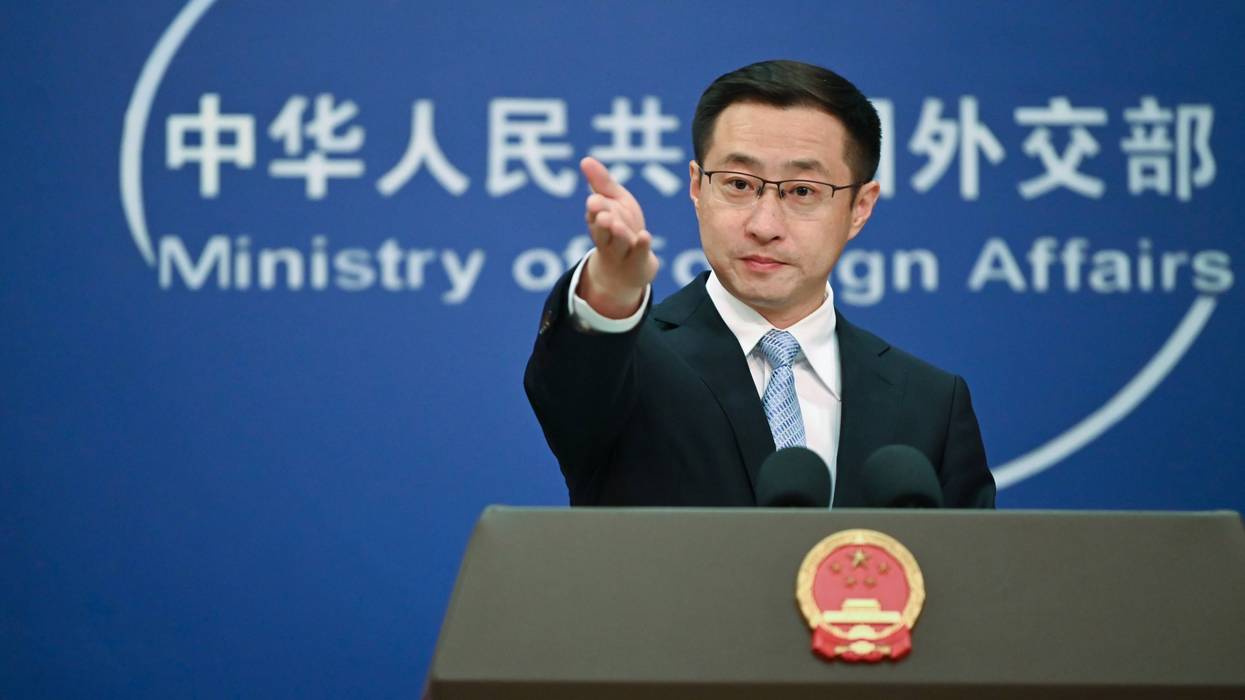
But Lin Jian, a spokesperson for China's Ministry of Foreign Affairs, said during a press conference on Friday that China would not cooperate with efforts to isolate Iran.
"China believes that military means, sanctions, and pressure tactics are not the solution. On the contrary, they will only lead to escalation that serves no one’s interests. We call for efforts to solve disputes through dialogue and negotiation," Lin told an Iranian government broadcaster.
Asked about the potential effects on China's energy imports from Iran, he reiterated, "China opposes illicit unilateral sanctions that lack basis in international law and UN Security Council mandate."
The question now is whether Trump will make good on his administration's threats and retaliate against China. It's likely easier said than done, as an economic war with the US's third-largest trading partner could further exacerbate the economic turmoil Trump is seeking to ameliorate before the midterm elections in November.
Danny Citrinowicz, a senior researcher at Israel's Institute for National Security Studies, suggested that China would be unlikely to surrender easily in that fight.
"China has a strong interest in preserving Iran under the Islamic Republic and maintaining Tehran’s strategic relationship, and growing dependence, on Beijing," he wrote on social media. "Any economic strategy that assumes China will eventually fall in line with Washington risks being built on a fundamentally flawed premise."
Shipping traffic through the Strait of Hormuz is still far below prewar levels, with the daily number of ships passing through in the single digits, according to Reuters.
Crude oil prices are still 30% higher than at the start of the war, while US gas prices are still up by more than a dollar per gallon.
But Trump, seemingly unwilling to admit that his campaign there has been anything less than successful, is continuing to claim that the strait is wide open thanks to US military action.
As Gregory Brew, a senior analyst on Iran and oil policy at the Eurasia Group, explained, this has left the administration's messaging on why exactly it is now pivoting to ruthless economic warfare appear like disjointed doublespeak.
"Bessent and others cannot say what this policy is meant to achieve—reopening the strait—because in the admin's telling, the strait is already open," Brew said. "As a result, this return to maximum pressure feels oddly devoid of purpose. The US is inflicting economic pain, felt mostly by Iran's people, rather than its rulers, for no clear reason."