

SUBSCRIBE TO OUR FREE NEWSLETTER
Daily news & progressive opinion—funded by the people, not the corporations—delivered straight to your inbox.
5
#000000
#FFFFFF
To donate by check, phone, or other method, see our More Ways to Give page.
Daily news & progressive opinion—funded by the people, not the corporations—delivered straight to your inbox.
Greta Berlin (English/French) or
Caoimhe Butterly (Arabic/English/Spanish)
Tel: +357 99 081 767 / email: friends@freegaza.org
The Free Gaza boat the "Spirit of Humanity"
departed Cyprus at 7:30am on Monday, 29 July. Twenty-one human rights
and solidarity workers representing eleven different countries were
aboard. The passengers include Nobel laureate Mairead Maguire and
former U.S. congresswoman Cynthia McKinney. The ship also carries three
tons of medical aid, children's toys, and rehabilitation and
reconstruction kits for twenty family homes.
Over 2,400 homes were destroyed in Gaza during
the Israeli massacre in December/January, 490 of them by F-16
airstrikes, as well as 30 mosques, 29 educational institutions, 29
medical centers, 10 charitable organizations, and 5 cement factories.
Each kit carries a small amount of supplies for a
single family, representing sectors of civil society currently being
blockaded by Israel: Agriculture, Building & Reconstruction,
Education, Electricity, Health, and Water & Sanitation. Although
over 4 billion dollars in aid was promised to Gaza in the aftermath of
the Israeli onslaught, little humanitarian aid and no reconstruction
supplies have been allowed in.
Photos of leaving this morning:
https://www.flickr.com/photos/29205195@N02/
Quotes:
Mairead Maguire, co-winner of the 1977 Nobel Peace prize for her work in Northern Ireland:
"[The Palestinians of Gaza] must know that we have not and will not forget them."
Congresswoman Cynthia McKinney:
"[T]he U.S. should send a message to Israel
reiterating the reported White House position that the blockade of Gaza
should be eased, and that medical supplies and building materials,
including cement, should be allowed in ... Will [President Obama] stand
by his own words and allow us to provide relief for Gaza or will he
back down?"
Huwaida Arraf, Chairperson of the Free Gaza Movement:
"Israel's closure policy is a blatant violation
of international law. We call upon our governments to take action to
uphold their obligations under the Fourth Geneva Conventions. Until
they do, we will act.
Khalad Abdelkader, Bahrain
Khalad is an engineer representing the Islamic Charitable Association of Bahrain.
Othman Abufalah, Jordan
Othman is a world-renowned journalist with al-Jazeera TV.
Khaled Al-Shenoo, Bahrain
Khaled is a lecturer with the University of Bahrain.
Mansour Al-Abi, Yemen
Mansour is a cameraman with Al-Jazeera TV.
Fatima Al-Attawi, Bahrain
Fatima is a relief worker and community activist from Bahrain.
Juhaina Alqaed, Bahrain
Juhaina is a journalist & human rights activist.
Huwaida Arraf, US
Huwaida is the Chair of the Free Gaza Movement and delegation co-coordinator for this voyage.
Ishmahil Blagrove, UK
Ishmahil is a
Jamaican-born journalist, documentary film maker and founder of the
Rice & Peas film production company. His documentaries focus on
international struggles for social justice.
Kaltham Ghloom, Bahrain
Kaltham is a community activist.
Derek Graham, Ireland
Derek Graham is an electrician, Free Gaza organizer, and first mate aboard the Spirit of Humanity.
Alex Harrison, UK
Alex is a solidarity worker from Britain. She is traveling to Gaza to do long-term human rights monitoring.
Denis Healey, UK
Denis is Captain of the Spirit of Humanity. This will be his fifth voyage to Gaza.
Fathi Jaouadi, UK/Tunisia
Fathi is a British journalist, Free Gaza organizer, and delegation co-coordinator for this voyage.
Mairead Maguire, Ireland
Mairead is a Nobel laureate and renowned peace activist.
Lubna Masarwa, Palestine/Israel
Lubna is a Palestinian human rights activist and Free Gaza organizer.
Theresa McDermott, Scotland
Theresa is a solidarity worker from Scotland. She is traveling to Gaza to do long-term human rights monitoring.
Cynthia McKinney, US
Cynthia McKinney is an
outspoken advocate for human rights and social justice issues, as well
as a former U.S. congressperson and presidential candidate.
Adnan Mormesh, UK
Adnan is a solidarity worker from Britain. He is traveling to Gaza to do long-term human rights monitoring.
Adam Qvist, Denmark
Adam is a solidarity worker from Denmark. He is traveling to Gaza to do human rights monitoring.
Adam Shapiro, US
Adam is an American documentary film maker and human rights activist.
Kathy Sheetz, US
Kathy is a nurse and film maker, traveling to Gaza to do human rights monitoring.
Free Gaza is a human rights group founded in 2006. Our mission is to break the Israel's illegal siege on Gaza's 1.8 million civilians, since it inflicts collective punishment on the Palestinians who live there and has destroyed its economy. Free Gaza believes in direct action in confronting Israel's abuse of Palestinians using non-violent means and has found these voyages to be one of the most effective ways to alert the world to the prison-like conditions of Gaza. Ultimately, there is no better example of direct action than Free Gaza's sustained attempts to break the siege on Gaza which Israel claims it no longer occupies
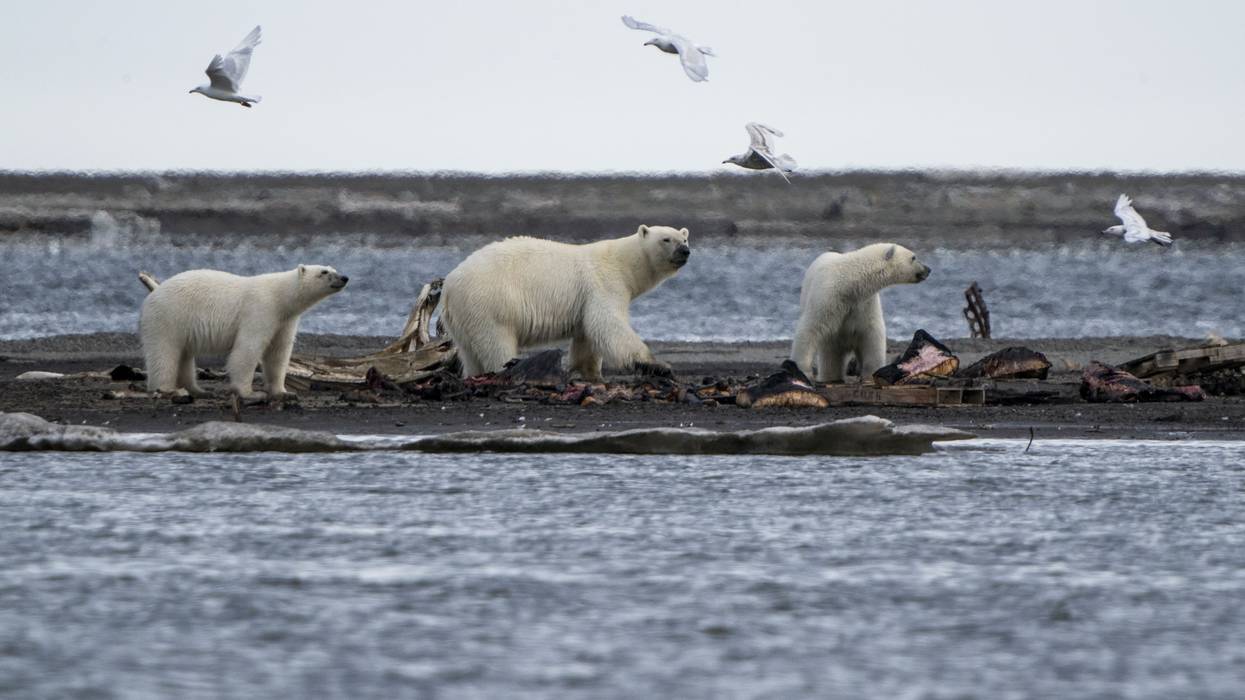
"Even though the interest in today’s sale was tepid, the new leasing still poses significant threats to habitat, iconic wildlife, and Indigenous ways of life," said Earthjustice.
In an embarrassment for President Donald Trump and his "drill, baby, drill" energy policy, Friday's third oil and gas lease sale in Alaska's Arctic National Wildlife Refuge once again drew no bids from Big Oil—but conservationists stressed that fossil fuel expansion still poses a serious threat to the pristine wilderness and its human and animal inhabitants.
The US Department of the Interior’s Bureau of Land Management (BLM) offered 60 tracts on 689,000 acres in the ANWR in northeastern Alaska's Coastal Plain for lease sales. Just two companies—the government-owned Alaska Industrial Development and Export Authority and Hex LLC, an Alaska firm—bought five leases that generated a paltry $3.7 million in total receipts.
“Yet again, no major oil and gas companies showed up to bid, because they know that drilling in the Arctic Refuge is a losing proposition,” said Kristen Moreland, executive director of the Gwich'in Steering Committee, which represents the Gwich'in Indigenous people and opposes drilling.
“We will continue to fight the Trump administration’s leasing program, and work with our friends and allies to protect this sacred and irreplaceable landscape from development of any kind," Moreland added.
The Trump administration had touted fossil fuel lease sales as a way to help pay for tax cuts in the so-called One Big Beautiful Bill Act that mostly benefited corporations and wealthy individuals. The law, which was signed last July by Trump and extends tax cuts the president enacted in 2017, is expected to result in over $5 trillion in lost revenue through 2034, according to an analysis by the Tax Foundation, the world's leading independent tax policy nonprofit.
Despite the underwhelming result, the BLM described Friday's ANWR lease sale as "successful," with agency Director Steve Pearce calling it "another important step toward restoring American Energy Dominance and responsibly developing the vast resources Congress directed us to make available in the Coastal Plain."
Friday's lease sale was the third such auction, the first of which was held in 2021 during Trump's first term and generated just 1% of the administration's projected revenue. The Biden administration—which canceled the leases issued in the 2021 sale—held another lease auction last year because Trump's 2017 tax cut law required two ANWR lease sales within seven years. The 2025 auction drew no bidders.
Green groups and other drilling opponents warned that Friday's flop does not diminish the threat posed by fossil fuel development in ANWR, which is home to the North Slope Iñupiat and the Gwich’in peoples and 270 animal species, including all of the world’s remaining South Beaufort Sea polar bears and the 200,000 porcupine caribou upon which the Gwich'in—who call the area the "sacred place where life begins—rely upon for their survival. The North Slope Iñupiat broadly support drilling and called Friday's lease sale "an important milestone."
"Even though the interest in today’s sale was tepid, the new leasing still poses significant threats to habitat, iconic wildlife, and Indigenous ways of life in one of the nation’s most wild and beautiful landscapes," Earthjustice—one of the groups leading a lawsuit challenging the lease sales—said in a statement. "All of today’s leases are in important polar bear habitat, for example."
Athan Manuel, the Sierra Club's director of lands protection, said that "today's lease sale was another embarrassment and broken promise. The Trump administration has pushed leasing out the Arctic Refuge as the way to finance huge tax cuts, yet today generated $3.7 million for the federal government."
“Let's call that what it is, another scam to trick Americans into giving away our precious natural world," Manuel continued. "It does nothing to change the reality that drilling in the Arctic National Wildlife Refuge remains a risky, controversial, and fundamentally flawed proposition."
"For years, the public was promised that sacrificing the refuge would generate significant economic benefits," Manuel added. "Instead, this leasing program has been plagued by uncertainty while putting one of America's most important public lands at risk."
Autumn Hanna, vice president of the advocacy group Taxpayers for Common Sense, said, "From two previous failed lease sales that delivered less than 1% of promised revenue, taxpayers already know that drilling in the Arctic Refuge is a bad deal."
"Today’s lease sale is yet another reminder that oil and gas development in the refuge is high-risk, low-reward, with zero interest from real industry players," Hanna added. "Americans will not see relief at the pump and, instead, face greater risks from the drilling in a sensitive region.”

Middle-income households were "squeezing more life out of every dollar before deciding to spend it" last month, while low-income families and individuals "showed greater financial strain."
The Beige Book, a monthly report on consumer spending, labor markets, and inflation from the Federal Reserve's 12 districts across the country, offers an up-to-date look on how the US economy is impacting households across the US—and this week, the report for May showed a continuation of the trend that accelerated after President Donald Trump joined Israel in attacking Iran more than three months ago.
"This month’s report, the third since the escalation of the conflict in the Middle East, reveals that soaring input costs are triggering price hikes for consumers," said the progressive think tank Groundwork Collaborative.
The report notes that regional contacts at the Federal Reserve's districts described middle-income households as "squeezing more life out of every dollar before deciding to spend it,” while low-income families and individuals "showed greater financial strain."
"Overall, there were reports of increased credit card usage, fewer retail visits, and stronger demand for necessities," reads the Beige Book.
"Higher-income households remained resilient and less sensitive to price increase," the Federal Reserve reported, indicating a "K-shaped economy"—in which wealthy Americans are represented by the top angled line and middle- and lower-income households are represented by the line angled toward the lower right.
The report comes as peace talks with Iran are stalled and the Strait of Hormuz—a key waterway for trade, particularly for the world's oil supply, remains effectively closed following the US-Israeli invasion. Iran's retaliatory move has sent global oil prices soaring, with gas now costing $4.22 per gallon on average.
"High prices for essentials like groceries and a tank of gas are busting household budgets and eliminating breathing room for middle- and low-income families."
"Numerous contacts mentioned the conflict in the Middle East as a source of cost pressures and heightened business uncertainty," reads the Beige Book. "Higher energy and fertilizer prices contributed to a moderate increase in food prices, especially for fresh produce."
Manufacturers and retailers are also facing increased shipping costs, while auto repair rates and used-car financing rates "remained very high" in parts of the country.
The report was released days after the administration launched new strikes against Iran last weekend, and as Iran announced it was suspending peace talks with the US over Israel's continued targeting of Lebanon.
Alex Jacquez, Groundwork's chief of policy and advocacy, said that "Trump is choosing to keep prices high for working families."
"High prices for essentials like groceries and a tank of gas are busting household budgets and eliminating breathing room for middle- and low-income families," said Jacquez. "Despite his own party’s opposition, the president is forging ahead with his reckless, costly war—and leaving working Americans in the dust.”
The Beige Book also describes a "low-hire, low-fire" job market, "with workers increasingly reluctant to change jobs because of economic uncertainty."
"Widespread economic uncertainty from continued tariffs and persistent inflation means businesses are delaying expansion, leading cautious employees to remain in their current roles—even if it means staying in worse-paying jobs," said Groundwork.
The Federal Reserve pointed to a contact in the construction industry in Cleveland, Ohio who said employees are "nervous and stressed, as well as a human resources firm in Richmond, Virginia that reported "that clients have explicitly slowed hiring for new roles due to uncertainty, while their existing employees seemed reluctant to leave 'something stable' for new opportunities."
Jacquez said that based on the report, "Americans lucky enough to be employed full-time are losing faith in their ability to keep up with inflation as paychecks lag and the labor market stalls out."

“The international community cannot remain silent while a respected physician is reportedly subjected to harsh conditions, denied adequate medical care, and isolated from the outside world."
A prominent human rights group on Friday sounded alarms upon learning that Dr. Hussam Abu Safiya, director of the Kamal Adwan Hospital in Gaza, has been sent to solitary confinement.
As reported by Haaretz, Physicians for Human Rights Israel (PHRI) said it learned on Thursday that Abu Safiya was moved to solitary confinement this week without any explanation.
According to a report from The Palestine Chronicle, an attorney representing Abu Safiya claimed that his client was placed into solitary confinement in retaliation for appealing his continued detention.
Abu Safiya was first taken into custody by Israeli forces in December 2024 and has been held since then without being charged with any criminal offenses.
In a Friday statement, the Council of American-Islamic Relations said news of Abu Safiya's solitary confinement was "deeply disturbing" and raised "even more urgent concerns about his welfare and basic human rights."
"Congress must demand his immediate release and insist that Israel end the arbitrary detention, abuse, and mistreatment of Palestinian medical professionals and civilians," CAIR added. “The international community cannot remain silent while a respected physician is reportedly subjected to harsh conditions, denied adequate medical care, and isolated from the outside world without any legal justification. Dr. Abu Safiya must be released immediately."
PHRI has for months been raising concerns about Abu Safiya's detention, long before he was transferred to solitary confinement.
While demanding the physician's release in April, for instance, PHRI said Abu Safiya was being held "in harsh conditions, without access to medication or medical care, as his health continues to deteriorate."
A 2025 report from Amnesty International, which has also called for Abu Safiya’s release, said that the Gaza-based physician “was detained in the course of caring for his patients and carrying out his medical duties.”
Amnesty also noted that, prior to his detention, Abu Safiya and other colleagues at the Kamal Adwan Hospital had “provided human rights and humanitarian organizations with reliable information about the health situation” in Gaza, which has been left devastated by years of Israeli attacks that have killed at least 72,000 Palestinians.