SUBSCRIBE TO OUR FREE NEWSLETTER
Daily news & progressive opinion—funded by the people, not the corporations—delivered straight to your inbox.
5
#000000
#FFFFFF
To donate by check, phone, or other method, see our More Ways to Give page.
Daily news & progressive opinion—funded by the people, not the corporations—delivered straight to your inbox.
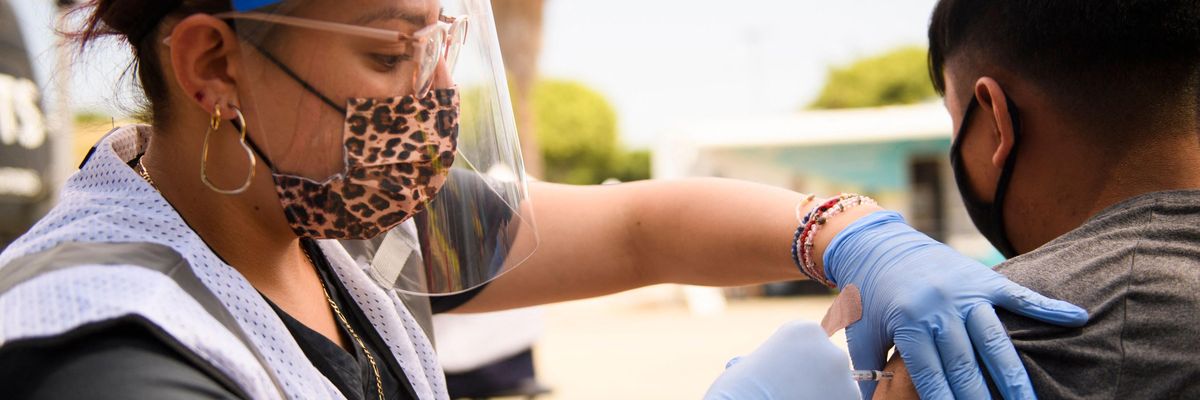
A 17-year-old receives a first dose of the Pfizer Covid-19 vaccine at a mobile clinic during a back-to-school event at the Weingart East Los Angeles YMCA in California on August 7, 2021.
"A fairer, more equitable response to the next public health outbreak is in everyone's interest."
This week's high-stakes negotiations on a new global treaty inspired by the Covid-19 crisis "present an historic opportunity to prepare for future pandemics, to protect lives and livelihoods, and to demonstrate political leadership the world will long remember," a dozen progressive U.S. lawmakers wrote to President Joe Biden on Tuesday.
The members of Congress told Biden that "as the U.S. participates in the negotiation of the pandemic accord at the World Health Organization (WHO), we urge you to push for strong, binding equitable access standards to ensure that tests, treatments, and vaccines for the next global public health threat are available to everyone who needs them as soon as possible."
"You can help make sure the next pandemic is shorter and less deadly than the last."
"Nearly 15 million people died during the first two years of the pandemic," they noted. "Most tragically, millions of people died needlessly after the vaccines were developed, but before they became widely available in low-and-middle income countries. Major manufacturers chose not to share the vaccine recipe to expand global production."
"But vaccine inequity did not just hurt people abroad. Major gaps in access to vaccines globally also increased the risk of deadly new variants that changed the course of the pandemic at home," the lawmakers highlighted, stressing that "we must act on the lessons learned from the Covid-19 pandemic."
The letter was led by Sens. Bernie Sanders (I-Vt.) along with Reps. Lloyd Doggett (D-Texas) and Jan Schakowsky (D-Ill.). They were joined by Sens. Jeff Merkley (D-Ore.), Elizabeth Warren (D-Mass.), and Peter Welch (D-Vt.), as well as Reps. Sara Jacobs (D-Calif.), Ro Khanna (D-Calif.), Barbara Lee (D-Calif.), Ilhan Omar (D-Minn.), Cori Bush (D-Mo.), and Mark Pocan (D-Wis.).
During the WHO talks on pandemic prevention, preparedness, and response—which began Monday and are scheduled to run through March 28—they want the Biden administration to champion three foundational commitments:
The letter specifically calls out Pfizer and Moderna, asserting that the latter "serves as a powerful reminder for why American leadership is so critical," because the Massachusetts-based company "worked hand-in-hand with scientists at the U.S. National Institutes of Health" to invent one of the multiple coronavirus vaccines created during the pandemic.
"U.S. taxpayers spent $12 billion to research, develop, and procure the vaccine," the letter explains. "Yet Moderna refused to share its technology with other manufacturers to increase global production, charged some poorer countries more for doses than wealthy countries, and then quadrupled the price of the Covid vaccine to $128—at a time when it costs just $2.85 to manufacture the vaccine."
"A fairer, more equitable response to the next public health outbreak is in everyone's interest," the lawmakers wrote to Biden. "By supporting strong, binding equitable access standards, you can help make sure the next pandemic is shorter and less deadly than the last."
Reporting on the negotiations Monday, Axios pointed out that "a key sticking point is whether countries must provide viral specimens or genome sequences to a global repository managed by the World Health Organization, which would enable others to use that information to create vaccines, diagnostic tests, and treatments."
Nithin Ramakrishnan of the global advocacy group Third World Network told the outlet that the treaty's current draft "serves the interests of developed countries and their biotech industries by forcing developing countries to share biological materials and information without adequate legal certainty of benefit sharing."
Dear Common Dreams reader, It’s been nearly 30 years since I co-founded Common Dreams with my late wife, Lina Newhouser. We had the radical notion that journalism should serve the public good, not corporate profits. It was clear to us from the outset what it would take to build such a project. No paid advertisements. No corporate sponsors. No millionaire publisher telling us what to think or do. Many people said we wouldn't last a year, but we proved those doubters wrong. Together with a tremendous team of journalists and dedicated staff, we built an independent media outlet free from the constraints of profits and corporate control. Our mission has always been simple: To inform. To inspire. To ignite change for the common good. Building Common Dreams was not easy. Our survival was never guaranteed. When you take on the most powerful forces—Wall Street greed, fossil fuel industry destruction, Big Tech lobbyists, and uber-rich oligarchs who have spent billions upon billions rigging the economy and democracy in their favor—the only bulwark you have is supporters who believe in your work. But here’s the urgent message from me today. It's never been this bad out there. And it's never been this hard to keep us going. At the very moment Common Dreams is most needed, the threats we face are intensifying. We need your support now more than ever. We don't accept corporate advertising and never will. We don't have a paywall because we don't think people should be blocked from critical news based on their ability to pay. Everything we do is funded by the donations of readers like you. When everyone does the little they can afford, we are strong. But if that support retreats or dries up, so do we. Will you donate now to make sure Common Dreams not only survives but thrives? —Craig Brown, Co-founder |
This week's high-stakes negotiations on a new global treaty inspired by the Covid-19 crisis "present an historic opportunity to prepare for future pandemics, to protect lives and livelihoods, and to demonstrate political leadership the world will long remember," a dozen progressive U.S. lawmakers wrote to President Joe Biden on Tuesday.
The members of Congress told Biden that "as the U.S. participates in the negotiation of the pandemic accord at the World Health Organization (WHO), we urge you to push for strong, binding equitable access standards to ensure that tests, treatments, and vaccines for the next global public health threat are available to everyone who needs them as soon as possible."
"You can help make sure the next pandemic is shorter and less deadly than the last."
"Nearly 15 million people died during the first two years of the pandemic," they noted. "Most tragically, millions of people died needlessly after the vaccines were developed, but before they became widely available in low-and-middle income countries. Major manufacturers chose not to share the vaccine recipe to expand global production."
"But vaccine inequity did not just hurt people abroad. Major gaps in access to vaccines globally also increased the risk of deadly new variants that changed the course of the pandemic at home," the lawmakers highlighted, stressing that "we must act on the lessons learned from the Covid-19 pandemic."
The letter was led by Sens. Bernie Sanders (I-Vt.) along with Reps. Lloyd Doggett (D-Texas) and Jan Schakowsky (D-Ill.). They were joined by Sens. Jeff Merkley (D-Ore.), Elizabeth Warren (D-Mass.), and Peter Welch (D-Vt.), as well as Reps. Sara Jacobs (D-Calif.), Ro Khanna (D-Calif.), Barbara Lee (D-Calif.), Ilhan Omar (D-Minn.), Cori Bush (D-Mo.), and Mark Pocan (D-Wis.).
During the WHO talks on pandemic prevention, preparedness, and response—which began Monday and are scheduled to run through March 28—they want the Biden administration to champion three foundational commitments:
The letter specifically calls out Pfizer and Moderna, asserting that the latter "serves as a powerful reminder for why American leadership is so critical," because the Massachusetts-based company "worked hand-in-hand with scientists at the U.S. National Institutes of Health" to invent one of the multiple coronavirus vaccines created during the pandemic.
"U.S. taxpayers spent $12 billion to research, develop, and procure the vaccine," the letter explains. "Yet Moderna refused to share its technology with other manufacturers to increase global production, charged some poorer countries more for doses than wealthy countries, and then quadrupled the price of the Covid vaccine to $128—at a time when it costs just $2.85 to manufacture the vaccine."
"A fairer, more equitable response to the next public health outbreak is in everyone's interest," the lawmakers wrote to Biden. "By supporting strong, binding equitable access standards, you can help make sure the next pandemic is shorter and less deadly than the last."
Reporting on the negotiations Monday, Axios pointed out that "a key sticking point is whether countries must provide viral specimens or genome sequences to a global repository managed by the World Health Organization, which would enable others to use that information to create vaccines, diagnostic tests, and treatments."
Nithin Ramakrishnan of the global advocacy group Third World Network told the outlet that the treaty's current draft "serves the interests of developed countries and their biotech industries by forcing developing countries to share biological materials and information without adequate legal certainty of benefit sharing."
This week's high-stakes negotiations on a new global treaty inspired by the Covid-19 crisis "present an historic opportunity to prepare for future pandemics, to protect lives and livelihoods, and to demonstrate political leadership the world will long remember," a dozen progressive U.S. lawmakers wrote to President Joe Biden on Tuesday.
The members of Congress told Biden that "as the U.S. participates in the negotiation of the pandemic accord at the World Health Organization (WHO), we urge you to push for strong, binding equitable access standards to ensure that tests, treatments, and vaccines for the next global public health threat are available to everyone who needs them as soon as possible."
"You can help make sure the next pandemic is shorter and less deadly than the last."
"Nearly 15 million people died during the first two years of the pandemic," they noted. "Most tragically, millions of people died needlessly after the vaccines were developed, but before they became widely available in low-and-middle income countries. Major manufacturers chose not to share the vaccine recipe to expand global production."
"But vaccine inequity did not just hurt people abroad. Major gaps in access to vaccines globally also increased the risk of deadly new variants that changed the course of the pandemic at home," the lawmakers highlighted, stressing that "we must act on the lessons learned from the Covid-19 pandemic."
The letter was led by Sens. Bernie Sanders (I-Vt.) along with Reps. Lloyd Doggett (D-Texas) and Jan Schakowsky (D-Ill.). They were joined by Sens. Jeff Merkley (D-Ore.), Elizabeth Warren (D-Mass.), and Peter Welch (D-Vt.), as well as Reps. Sara Jacobs (D-Calif.), Ro Khanna (D-Calif.), Barbara Lee (D-Calif.), Ilhan Omar (D-Minn.), Cori Bush (D-Mo.), and Mark Pocan (D-Wis.).
During the WHO talks on pandemic prevention, preparedness, and response—which began Monday and are scheduled to run through March 28—they want the Biden administration to champion three foundational commitments:
The letter specifically calls out Pfizer and Moderna, asserting that the latter "serves as a powerful reminder for why American leadership is so critical," because the Massachusetts-based company "worked hand-in-hand with scientists at the U.S. National Institutes of Health" to invent one of the multiple coronavirus vaccines created during the pandemic.
"U.S. taxpayers spent $12 billion to research, develop, and procure the vaccine," the letter explains. "Yet Moderna refused to share its technology with other manufacturers to increase global production, charged some poorer countries more for doses than wealthy countries, and then quadrupled the price of the Covid vaccine to $128—at a time when it costs just $2.85 to manufacture the vaccine."
"A fairer, more equitable response to the next public health outbreak is in everyone's interest," the lawmakers wrote to Biden. "By supporting strong, binding equitable access standards, you can help make sure the next pandemic is shorter and less deadly than the last."
Reporting on the negotiations Monday, Axios pointed out that "a key sticking point is whether countries must provide viral specimens or genome sequences to a global repository managed by the World Health Organization, which would enable others to use that information to create vaccines, diagnostic tests, and treatments."
Nithin Ramakrishnan of the global advocacy group Third World Network told the outlet that the treaty's current draft "serves the interests of developed countries and their biotech industries by forcing developing countries to share biological materials and information without adequate legal certainty of benefit sharing."