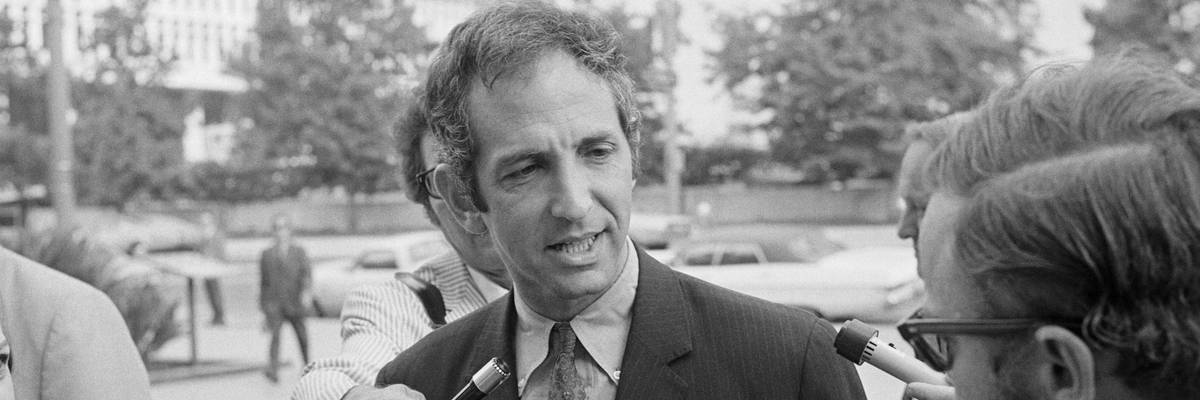
Whistleblower Daniel Ellsberg talks with reporters as he arrives for arraignment at courthouse in the wake of the release of the Pentagon Papers, which he leaked to the press in 1971.
Named for Daniel Ellsberg, Tlaib Proposal Would Protect Whistleblowers and Journalists
"With whistleblowers, journalists, and civil liberties under significant attack and government decision-making shrouded in increasing secrecy, reining in the abuses of the Espionage Act could not be more urgent.”
Warning that the Espionage Act has been used to "persecute and criminalize" dissenters, journalists, and whistleblowers numerous times since it was passed into law, US Rep. Rashida Tlaib on Thursday introduced the Daniel Ellsberg Press Freedom and Whistleblower Protection Act to "rein in" the 109-year-old law.
The proposal is named for the military analyst-turned-activist who disclosed decades of deception by the US government regarding Vietnam when he leaked the Pentagon Papers to the press in 1971—an act that led the government to charge Ellsberg with espionage, conspiracy, and other crimes before the case was thrown out over the Nixon administration's misconduct.
In the cases of Ellsberg, former National Security Agency contractor Edward Snowden, WikiLeaks founder Julian Assange, and other journalists and whistleblowers, "Espionage Act prosecutions have been used to silence dissent and undermine government transparency and are a clear violation of the First Amendment and the fundamental right to due process," said Tlaib (D-Mich.).
“Alerting the public to government wrongdoing is not a crime,” said the congresswoman. “The Espionage Act has been abused by administrations of both parties to target whistleblowers and journalists for sharing critically important information with the public. With whistleblowers, journalists, and civil liberties under significant attack and government decision-making shrouded in increasing secrecy, reining in the abuses of the Espionage Act could not be more urgent.”
Tlaib noted that in addition to past administrations using the Espionage Act to prosecute media sources and whistleblowers who alerted the public about mass surveillance, torture, drone assassinations, and war crimes in Iraq and Afghanistan, the FBI raided the home of a Washington Post reporter in January in connection to the prosecution of a government whistleblower.
The proposed legislation would limit the scope of the Espionage Act to foreign agents and government employees who have a legal duty to protect classified information—prohibiting the use of the law to prosecute publishers, journalists, or members of the public.
It would also increase due process standards and safeguards for whistleblowers who disclose government wrongdoing, war crimes, or abuses of power to the public. The legislation would create and affirmative public interest defense and require the government to prove that a whistleblower acted with the specific intent of harming the US or aiding a foreign power.
Under the Daniel Ellsberg Press Freedom and Whistleblower Protection Act, said Jenna Leventoff, senior policy counsel for the ACLU, "the government could no longer abuse [the Espionage Act] to silence those sharing information that is beneficial to the public."
“For too long the Espionage Act has been used to persecute and silence whistleblowers, journalists and publishers,” said Leventoff. “But journalism is not a crime—it is a First Amendment protected activity that protects our democracy by allowing the public to hold our nation’s leaders to account."
The Espionage Act was originally passed to crack down on those who spread information that could interfere with the war effort during World War I, and "from its inception," said Chip Gibbons, policy director at Defending Rights and Dissent, "the law has been used to stifle public debate and has become the go to weapon against whistleblowers and now journalists."
"Public servants who witness egregious crimes like torture, mass surveillance of Americans, or the killing of civilians, and seek to alert the American people about them are whistleblowers," said Gibbons. "Yet, using the Espionage Act the government prosecutes them as though they were spies. And with the government going further and prosecuting a journalist under the Espionage Act, the threat not just to press freedom, but to our very democracy, posed by this antiquated law is growing. Rep. Tlaib’s bill is desperately needed as it is well past time to bring the Espionage Act in line with the First Amendment.”
Tlaib noted that before his death in 2023, Ellsberg expressed public support for the reforms the congresswoman had proposed, when she introduced them as an amendment to the National Defense Authorization Act.
“For half a century, starting with my own prosecution, no whistleblower charged with violating the Espionage Act of 1917 has had, or could have, a fair trial," said Ellsberg in 2022. "These long-overdue amendments would remedy that injustice, protect the First Amendment freedom of the press, and encourage vitally needed truth-telling.”
We are at a crossroads
This country and this world are at a monumental crossroads. In a few short weeks, US voters will have an opportunity to beat back the forces of fascism and confront the billionaires who are rigging the economy, our media system, and our democracy, making it increasingly impossible for ordinary people to get by. We’re not just talking about the election. We’re talking about what must be done once these fascist elements are vanquished from power. We need a bolder set of solutions than what either major party has so far been willing to offer and a working-class movement ready to fight like hell for it. Trump didn't emerge from nowhere. The conditions that fueled MAGA authoritarianism were created by decades of radical neoliberal economic policies and a corrupt political system dominated by corporate interests. They slashed taxes on the super-rich, promising that the benefits would trickle down. They said giveaways to the corporate titans would make life more affordable for the rest of us. It was all bullshit. And when a bitter, betrayed populace searches for someone to blame, right-wing demagogues have little trouble finding scapegoats. People know when they're being lied to, but you won't hear any of this from the corporate media. Only independent journalism—powered and funded by people who believe in building a better world—can deliver truly trustworthy daily news. Our Fall Campaign is underway, and we need your help. To power our newsroom through the rest of the year, we need to raise $125,000 by midnight on October 31. So if you share our vision, please contribute whatever you can to sustain our work. |
Warning that the Espionage Act has been used to "persecute and criminalize" dissenters, journalists, and whistleblowers numerous times since it was passed into law, US Rep. Rashida Tlaib on Thursday introduced the Daniel Ellsberg Press Freedom and Whistleblower Protection Act to "rein in" the 109-year-old law.
The proposal is named for the military analyst-turned-activist who disclosed decades of deception by the US government regarding Vietnam when he leaked the Pentagon Papers to the press in 1971—an act that led the government to charge Ellsberg with espionage, conspiracy, and other crimes before the case was thrown out over the Nixon administration's misconduct.
In the cases of Ellsberg, former National Security Agency contractor Edward Snowden, WikiLeaks founder Julian Assange, and other journalists and whistleblowers, "Espionage Act prosecutions have been used to silence dissent and undermine government transparency and are a clear violation of the First Amendment and the fundamental right to due process," said Tlaib (D-Mich.).
“Alerting the public to government wrongdoing is not a crime,” said the congresswoman. “The Espionage Act has been abused by administrations of both parties to target whistleblowers and journalists for sharing critically important information with the public. With whistleblowers, journalists, and civil liberties under significant attack and government decision-making shrouded in increasing secrecy, reining in the abuses of the Espionage Act could not be more urgent.”
Tlaib noted that in addition to past administrations using the Espionage Act to prosecute media sources and whistleblowers who alerted the public about mass surveillance, torture, drone assassinations, and war crimes in Iraq and Afghanistan, the FBI raided the home of a Washington Post reporter in January in connection to the prosecution of a government whistleblower.
The proposed legislation would limit the scope of the Espionage Act to foreign agents and government employees who have a legal duty to protect classified information—prohibiting the use of the law to prosecute publishers, journalists, or members of the public.
It would also increase due process standards and safeguards for whistleblowers who disclose government wrongdoing, war crimes, or abuses of power to the public. The legislation would create and affirmative public interest defense and require the government to prove that a whistleblower acted with the specific intent of harming the US or aiding a foreign power.
Under the Daniel Ellsberg Press Freedom and Whistleblower Protection Act, said Jenna Leventoff, senior policy counsel for the ACLU, "the government could no longer abuse [the Espionage Act] to silence those sharing information that is beneficial to the public."
“For too long the Espionage Act has been used to persecute and silence whistleblowers, journalists and publishers,” said Leventoff. “But journalism is not a crime—it is a First Amendment protected activity that protects our democracy by allowing the public to hold our nation’s leaders to account."
The Espionage Act was originally passed to crack down on those who spread information that could interfere with the war effort during World War I, and "from its inception," said Chip Gibbons, policy director at Defending Rights and Dissent, "the law has been used to stifle public debate and has become the go to weapon against whistleblowers and now journalists."
"Public servants who witness egregious crimes like torture, mass surveillance of Americans, or the killing of civilians, and seek to alert the American people about them are whistleblowers," said Gibbons. "Yet, using the Espionage Act the government prosecutes them as though they were spies. And with the government going further and prosecuting a journalist under the Espionage Act, the threat not just to press freedom, but to our very democracy, posed by this antiquated law is growing. Rep. Tlaib’s bill is desperately needed as it is well past time to bring the Espionage Act in line with the First Amendment.”
Tlaib noted that before his death in 2023, Ellsberg expressed public support for the reforms the congresswoman had proposed, when she introduced them as an amendment to the National Defense Authorization Act.
“For half a century, starting with my own prosecution, no whistleblower charged with violating the Espionage Act of 1917 has had, or could have, a fair trial," said Ellsberg in 2022. "These long-overdue amendments would remedy that injustice, protect the First Amendment freedom of the press, and encourage vitally needed truth-telling.”
Warning that the Espionage Act has been used to "persecute and criminalize" dissenters, journalists, and whistleblowers numerous times since it was passed into law, US Rep. Rashida Tlaib on Thursday introduced the Daniel Ellsberg Press Freedom and Whistleblower Protection Act to "rein in" the 109-year-old law.
The proposal is named for the military analyst-turned-activist who disclosed decades of deception by the US government regarding Vietnam when he leaked the Pentagon Papers to the press in 1971—an act that led the government to charge Ellsberg with espionage, conspiracy, and other crimes before the case was thrown out over the Nixon administration's misconduct.
In the cases of Ellsberg, former National Security Agency contractor Edward Snowden, WikiLeaks founder Julian Assange, and other journalists and whistleblowers, "Espionage Act prosecutions have been used to silence dissent and undermine government transparency and are a clear violation of the First Amendment and the fundamental right to due process," said Tlaib (D-Mich.).
“Alerting the public to government wrongdoing is not a crime,” said the congresswoman. “The Espionage Act has been abused by administrations of both parties to target whistleblowers and journalists for sharing critically important information with the public. With whistleblowers, journalists, and civil liberties under significant attack and government decision-making shrouded in increasing secrecy, reining in the abuses of the Espionage Act could not be more urgent.”
Tlaib noted that in addition to past administrations using the Espionage Act to prosecute media sources and whistleblowers who alerted the public about mass surveillance, torture, drone assassinations, and war crimes in Iraq and Afghanistan, the FBI raided the home of a Washington Post reporter in January in connection to the prosecution of a government whistleblower.
The proposed legislation would limit the scope of the Espionage Act to foreign agents and government employees who have a legal duty to protect classified information—prohibiting the use of the law to prosecute publishers, journalists, or members of the public.
It would also increase due process standards and safeguards for whistleblowers who disclose government wrongdoing, war crimes, or abuses of power to the public. The legislation would create and affirmative public interest defense and require the government to prove that a whistleblower acted with the specific intent of harming the US or aiding a foreign power.
Under the Daniel Ellsberg Press Freedom and Whistleblower Protection Act, said Jenna Leventoff, senior policy counsel for the ACLU, "the government could no longer abuse [the Espionage Act] to silence those sharing information that is beneficial to the public."
“For too long the Espionage Act has been used to persecute and silence whistleblowers, journalists and publishers,” said Leventoff. “But journalism is not a crime—it is a First Amendment protected activity that protects our democracy by allowing the public to hold our nation’s leaders to account."
The Espionage Act was originally passed to crack down on those who spread information that could interfere with the war effort during World War I, and "from its inception," said Chip Gibbons, policy director at Defending Rights and Dissent, "the law has been used to stifle public debate and has become the go to weapon against whistleblowers and now journalists."
"Public servants who witness egregious crimes like torture, mass surveillance of Americans, or the killing of civilians, and seek to alert the American people about them are whistleblowers," said Gibbons. "Yet, using the Espionage Act the government prosecutes them as though they were spies. And with the government going further and prosecuting a journalist under the Espionage Act, the threat not just to press freedom, but to our very democracy, posed by this antiquated law is growing. Rep. Tlaib’s bill is desperately needed as it is well past time to bring the Espionage Act in line with the First Amendment.”
Tlaib noted that before his death in 2023, Ellsberg expressed public support for the reforms the congresswoman had proposed, when she introduced them as an amendment to the National Defense Authorization Act.
“For half a century, starting with my own prosecution, no whistleblower charged with violating the Espionage Act of 1917 has had, or could have, a fair trial," said Ellsberg in 2022. "These long-overdue amendments would remedy that injustice, protect the First Amendment freedom of the press, and encourage vitally needed truth-telling.”