SUBSCRIBE TO OUR FREE NEWSLETTER
Daily news & progressive opinion—funded by the people, not the corporations—delivered straight to your inbox.
5
#000000
#FFFFFF
To donate by check, phone, or other method, see our More Ways to Give page.
Daily news & progressive opinion—funded by the people, not the corporations—delivered straight to your inbox.
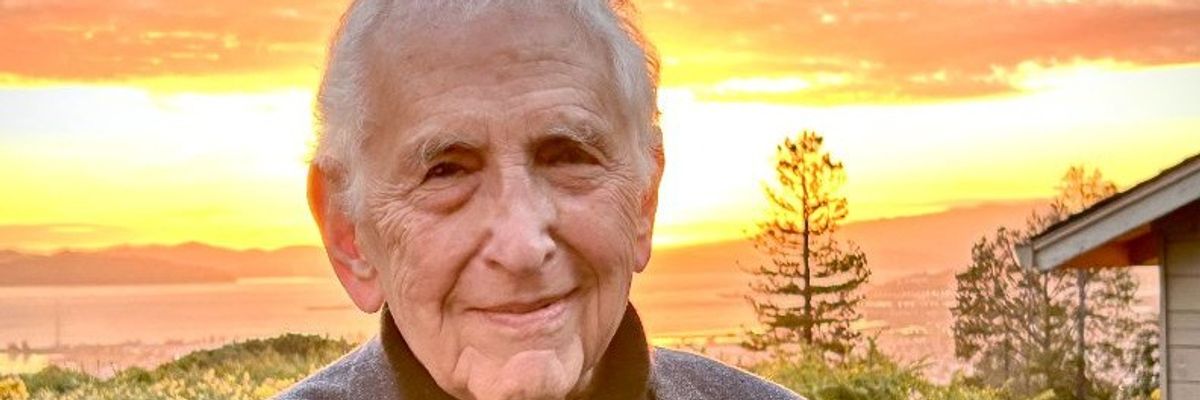
Daniel Ellsberg is pictured outside his home with the sun setting over the Pacific Ocean behind him.
After leaking the Pentagon Papers in 1971, the former military analyst joined the anti-Vietnam War and anti-nuclear movements.
Daniel Ellsberg, the military analyst-turned-peace activist who revealed that the U.S. government had been lying about its devastating war on Vietnam, died Friday, four months after he was diagnosed with pancreatic cancer. He was 92.
Ellsberg (1931-2023) was best known as the whistleblower who leaked the Pentagon Papers to news outlets in 1971, exposing damning information about the Vietnam War that Washington had concealed from the American people and the world.
Ellsberg became an outspoken anti-war campaigner who issued stark warnings about nuclear weapons and the detrimental impacts of the military-industrial complex.
He died at his home in California surrounded by family members, according to a social media post by his son Robert.
Progressives mourned the passing of Ellsberg.
Current Affairs editor Nathan Robinson called Ellsberg "a model of integrity and courage who exposed hideous crimes by the U.S. government in Vietnam and documented the insanity of U.S. nuclear war planning," adding, "We should all follow his example and heed his warnings."
"Huge loss for this country," journalist Mehdi Hasan said. "An inspiring, brave, and patriotic American. Rest in power, Dan, rest in power."
"RIP my friend," said social justice activist and actor John Cusack.
"Today we lost a movement giant, a dear friend, and a hero," said CodePink. "Daniel Ellsberg, who faced decades in prison for telling the American people the truth about the Vietnam War, passed away from cancer. He was a peace activist until the very end. We love you, Dan."
In a 2019 interview, Ellsberg said, "My experience with the Pentagon Papers showed that an act of truth-telling, of exposing the realities about which the public had been misled, can indeed help end an unnecessary, deadly conflict."
"This example is a lesson applicable to both the nuclear and climate crises we face," he added. "When everything is at stake, it is worth risking one's life or sacrificing one's freedom in order to help bring about radical change."
In a March essay he penned to announce his terminal cancer diagnosis, Ellsberg elaborated: "When I copied the Pentagon Papers in 1969, I had every reason to think I would be spending the rest of my life behind bars. It was a fate I would gladly have accepted if it meant hastening the end of the Vietnam War, unlikely as that seemed (and was). Yet in the end, that action—in ways I could not have foreseen, due to Nixon's illegal responses—did have an impact on shortening the war. In addition, thanks to Nixon's crimes, I was spared the imprisonment I expected, and I was able to spend the last 50 years with Patricia and my family, and with you, my friends."
"What's more, I was able to devote those years to doing everything I could think of to alert the world to the perils of nuclear war and wrongful interventions: lobbying, lecturing, writing, and joining with others in acts of protest and nonviolent resistance," he continued. "It is long past time—but not too late!—for the world's publics at last to challenge and resist the willed moral blindness of their past and current leaders."
Dear Common Dreams reader, It’s been nearly 30 years since I co-founded Common Dreams with my late wife, Lina Newhouser. We had the radical notion that journalism should serve the public good, not corporate profits. It was clear to us from the outset what it would take to build such a project. No paid advertisements. No corporate sponsors. No millionaire publisher telling us what to think or do. Many people said we wouldn't last a year, but we proved those doubters wrong. Together with a tremendous team of journalists and dedicated staff, we built an independent media outlet free from the constraints of profits and corporate control. Our mission has always been simple: To inform. To inspire. To ignite change for the common good. Building Common Dreams was not easy. Our survival was never guaranteed. When you take on the most powerful forces—Wall Street greed, fossil fuel industry destruction, Big Tech lobbyists, and uber-rich oligarchs who have spent billions upon billions rigging the economy and democracy in their favor—the only bulwark you have is supporters who believe in your work. But here’s the urgent message from me today. It's never been this bad out there. And it's never been this hard to keep us going. At the very moment Common Dreams is most needed, the threats we face are intensifying. We need your support now more than ever. We don't accept corporate advertising and never will. We don't have a paywall because we don't think people should be blocked from critical news based on their ability to pay. Everything we do is funded by the donations of readers like you. When everyone does the little they can afford, we are strong. But if that support retreats or dries up, so do we. Will you donate now to make sure Common Dreams not only survives but thrives? —Craig Brown, Co-founder |
Daniel Ellsberg, the military analyst-turned-peace activist who revealed that the U.S. government had been lying about its devastating war on Vietnam, died Friday, four months after he was diagnosed with pancreatic cancer. He was 92.
Ellsberg (1931-2023) was best known as the whistleblower who leaked the Pentagon Papers to news outlets in 1971, exposing damning information about the Vietnam War that Washington had concealed from the American people and the world.
Ellsberg became an outspoken anti-war campaigner who issued stark warnings about nuclear weapons and the detrimental impacts of the military-industrial complex.
He died at his home in California surrounded by family members, according to a social media post by his son Robert.
Progressives mourned the passing of Ellsberg.
Current Affairs editor Nathan Robinson called Ellsberg "a model of integrity and courage who exposed hideous crimes by the U.S. government in Vietnam and documented the insanity of U.S. nuclear war planning," adding, "We should all follow his example and heed his warnings."
"Huge loss for this country," journalist Mehdi Hasan said. "An inspiring, brave, and patriotic American. Rest in power, Dan, rest in power."
"RIP my friend," said social justice activist and actor John Cusack.
"Today we lost a movement giant, a dear friend, and a hero," said CodePink. "Daniel Ellsberg, who faced decades in prison for telling the American people the truth about the Vietnam War, passed away from cancer. He was a peace activist until the very end. We love you, Dan."
In a 2019 interview, Ellsberg said, "My experience with the Pentagon Papers showed that an act of truth-telling, of exposing the realities about which the public had been misled, can indeed help end an unnecessary, deadly conflict."
"This example is a lesson applicable to both the nuclear and climate crises we face," he added. "When everything is at stake, it is worth risking one's life or sacrificing one's freedom in order to help bring about radical change."
In a March essay he penned to announce his terminal cancer diagnosis, Ellsberg elaborated: "When I copied the Pentagon Papers in 1969, I had every reason to think I would be spending the rest of my life behind bars. It was a fate I would gladly have accepted if it meant hastening the end of the Vietnam War, unlikely as that seemed (and was). Yet in the end, that action—in ways I could not have foreseen, due to Nixon's illegal responses—did have an impact on shortening the war. In addition, thanks to Nixon's crimes, I was spared the imprisonment I expected, and I was able to spend the last 50 years with Patricia and my family, and with you, my friends."
"What's more, I was able to devote those years to doing everything I could think of to alert the world to the perils of nuclear war and wrongful interventions: lobbying, lecturing, writing, and joining with others in acts of protest and nonviolent resistance," he continued. "It is long past time—but not too late!—for the world's publics at last to challenge and resist the willed moral blindness of their past and current leaders."
Daniel Ellsberg, the military analyst-turned-peace activist who revealed that the U.S. government had been lying about its devastating war on Vietnam, died Friday, four months after he was diagnosed with pancreatic cancer. He was 92.
Ellsberg (1931-2023) was best known as the whistleblower who leaked the Pentagon Papers to news outlets in 1971, exposing damning information about the Vietnam War that Washington had concealed from the American people and the world.
Ellsberg became an outspoken anti-war campaigner who issued stark warnings about nuclear weapons and the detrimental impacts of the military-industrial complex.
He died at his home in California surrounded by family members, according to a social media post by his son Robert.
Progressives mourned the passing of Ellsberg.
Current Affairs editor Nathan Robinson called Ellsberg "a model of integrity and courage who exposed hideous crimes by the U.S. government in Vietnam and documented the insanity of U.S. nuclear war planning," adding, "We should all follow his example and heed his warnings."
"Huge loss for this country," journalist Mehdi Hasan said. "An inspiring, brave, and patriotic American. Rest in power, Dan, rest in power."
"RIP my friend," said social justice activist and actor John Cusack.
"Today we lost a movement giant, a dear friend, and a hero," said CodePink. "Daniel Ellsberg, who faced decades in prison for telling the American people the truth about the Vietnam War, passed away from cancer. He was a peace activist until the very end. We love you, Dan."
In a 2019 interview, Ellsberg said, "My experience with the Pentagon Papers showed that an act of truth-telling, of exposing the realities about which the public had been misled, can indeed help end an unnecessary, deadly conflict."
"This example is a lesson applicable to both the nuclear and climate crises we face," he added. "When everything is at stake, it is worth risking one's life or sacrificing one's freedom in order to help bring about radical change."
In a March essay he penned to announce his terminal cancer diagnosis, Ellsberg elaborated: "When I copied the Pentagon Papers in 1969, I had every reason to think I would be spending the rest of my life behind bars. It was a fate I would gladly have accepted if it meant hastening the end of the Vietnam War, unlikely as that seemed (and was). Yet in the end, that action—in ways I could not have foreseen, due to Nixon's illegal responses—did have an impact on shortening the war. In addition, thanks to Nixon's crimes, I was spared the imprisonment I expected, and I was able to spend the last 50 years with Patricia and my family, and with you, my friends."
"What's more, I was able to devote those years to doing everything I could think of to alert the world to the perils of nuclear war and wrongful interventions: lobbying, lecturing, writing, and joining with others in acts of protest and nonviolent resistance," he continued. "It is long past time—but not too late!—for the world's publics at last to challenge and resist the willed moral blindness of their past and current leaders."