5
#000000
#FFFFFF
To donate by check, phone, or other method, see our More Ways to Give page.
Daily news & progressive opinion—funded by the people, not the corporations—delivered straight to your inbox.
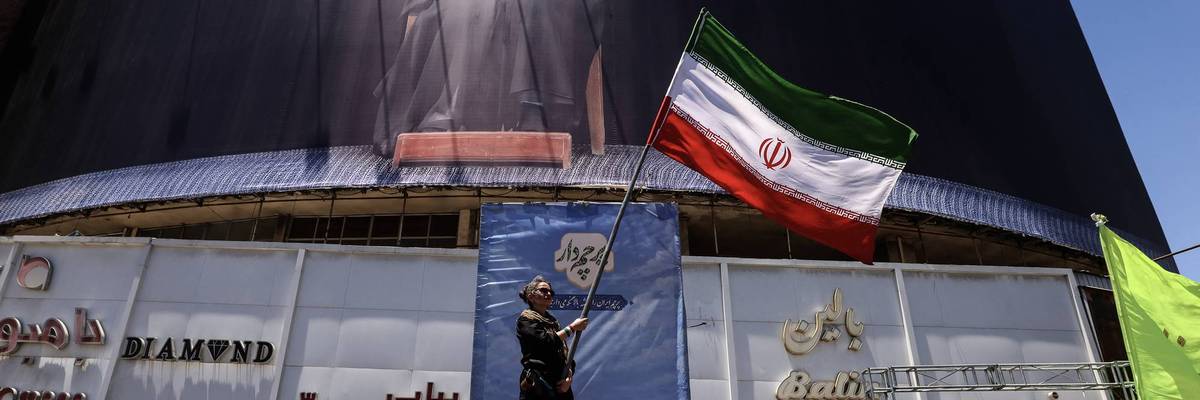
An Iranian woman waves a national flag next to a billboard depicting slain supreme leader Ayatollah Ali Khamenei at Valiasr Square in Tehran on June 15, 2026. The United States and Iran agreed a peace deal and an "immediate and permanent" end to military operations on all fronts including Lebanon, mediator Pakistan said, signaling the apparent end to more than three months of war in Middle East.
The announcement, said one advocate for the end of the conflict, "should mark not merely the end of this war, but the beginning of a new US approach rooted in diplomacy, accountability, and the simple truth that peace is the only way forward.”
After the Trump administration in the United States and the government of Iran both acknowledged late Sunday that a memorandum of understanding, or MOU, had been reached to end the war initiated by the US and Israel in February, advocates for peace heralded the interim deal but also noted that difficult hurdles remain to secure a lasting peace in the region.
"This Great Deal will bring Peace and Security to the whole Region. Many presidents have tried to make Peace with Iran, and all have failed before me," declared a social media post from President Donald Trump, who failed to mention that he was the one who started the war, alongside Israeli forces, on February 28.
While the MOU, a text of which has yet to be formally released but is scheduled to be signed on Friday in Geneva, reportedly includes an end to hostilities for 60 days, the opening of the Strait of Hormuz as soon as this week, and a halt to the US-imposed naval blockade on Iran. Tougher issues—including Iran's nuclear program, the release of seized Iranian assets, possible war reparations, and Israel's ongoing assault on Lebanon—have yet to be fully ironed out.
Kazem Gharibabadi, Iran’s deputy foreign minister, said a broader deal that would cover sanctions relief for Iran would be worked out during the 60-day ceasefire.
“We have incorporated all our important positions into the draft MOU,” Gharibabadi said Sunday. “This memorandum does not mean trusting the enemy; it has been written with active distrust. We will monitor the implementation of US commitments.”
Speaking Monday on state television, Gharibabadi reiterated that "Iran’s approach combines diplomacy with readiness for defense," stressing that even with agreements in place, Iran "remains fully prepared to counter any future threats" from the US and Israel.
UN Secretary-General António Guterres was among those to welcome the diplomatic development, calling it a “critical step” toward resolving the regional conflict that has caused global economic pain far beyond the Middle East. In a statement from Guterres' office, the UN chief expressed hopes "that the parties will build on this new momentum and redouble their efforts towards a final resolution of the conflict" that includes a “durable and comprehensive peace."
Foreign policy experts said the deal must be embraced, even if all the details are not yet clear, to bring about much-needed peace and to begin healing the human and economic suffering it unleashed.
Jamal Abdi, president of the National Iranian American Council (NIAC), said the deal to "end the disastrous US-Israeli war on Iran" should be seen as "welcome news," but noted that the situation—not forgetting previous claims of a resolution that proved false—remains fragile.
The deal, said Abdi, "was finalized despite the considerable effort of [Israeli Prime Minister] Benjamin Netanyahu to sabotage it, striking into the southern suburbs of Beirut in a clear provocation intended to deter Iran from signing the deal. It didn’t work—this time—but his motivation to drag the US back into war with Iran will remain so long as he is in office. President Trump was right to sharply criticize Netanyahu again, and he will have to keep one eye on the Israeli Prime Minister if he wants his peace with Iran to stick."
While an end to Israel's bombing and incursion into southern Lebanon has been a key demand of Iran since the war began, Israel has continued to pound targets, including civilian infrastructure, as part of its ongoing effort to sabotage peace efforts in the region. Israel's Defense Minister Israel Katz told Haaretz on Monday that Israeli forces would not withdraw from positions in occupied Syria, Lebanon, or the Gaza Strip.
National Security Minister Itamar Ben-Gvir said, "Trump's agreement doesn't bind us. Israel is not subordinate to the United States; we are an independent and sovereign state."
Joe Kent, former director of the National Counterterrorism Center who resigned from the Trump administration in March in protest over the Iran war, said a change of US policy towards Israel is vital if the peace deal is to hold.
"We can strengthen our chances of this deal holding," said Kent, "by cutting all military and intelligence assistance to Israel, [which] took every opportunity to tank this deal and will likely do so again unless we take action."
US lawmakers opposed to Trump's invasion and ongoing policies in the region also welcomed the news of the agreement.
"The ceasefire agreement with Iran with the opening of the Strait of Hormuz is welcome news," said Rep. Ro Khanna (D-Calif.) in a statement late Sunday. "Democrats should support it. I am glad it includes a provision for mutual respect of the US and Iran's sovereignty so we do not launch a dumb war of choice again."
"The war was a costly lesson for the US," added Khanna. "As expected, Trump failed to bring about regime change. The terms seem no better than what [President Barack] Obama secured under the [Joint Comprehensive Plan of Action] JCPOA nearly a decade ago. America lost 14 precious service members and wasted billions of dollars on this foolish endeavor. But today, we can be relieved that gas and food costs will start coming down for Americans. And that no more American or civilian lives will be lost."
According to Abdi at NIAC, the US policy choice regarding Iran has always been "between peace and war," but the deal on the table now means there are no excuses not to choose peace going forward.
"We know the price of war, and so we must do the hard work to forge a stronger peace. We have seen where maximum pressure, sabotage, and military escalation lead: impoverishment, repression, regional instability, and finally a disastrous war with global consequences. The lesson could not be clearer," Abdi said.
"The United States and Iran must now implement this deal in good faith, resist efforts to sabotage it, and use this opening to build a broader path away from sanctions, war, and collective punishment," he continued. "Today’s announcement should mark not merely the end of this war, but the beginning of a new US approach rooted in diplomacy, accountability, and the simple truth that peace is the only way forward."
Dear Common Dreams reader, It’s been nearly 30 years since I co-founded Common Dreams with my late wife, Lina Newhouser. We had the radical notion that journalism should serve the public good, not corporate profits. It was clear to us from the outset what it would take to build such a project. No paid advertisements. No corporate sponsors. No millionaire publisher telling us what to think or do. Many people said we wouldn't last a year, but we proved those doubters wrong. Together with a tremendous team of journalists and dedicated staff, we built an independent media outlet free from the constraints of profits and corporate control. Our mission has always been simple: To inform. To inspire. To ignite change for the common good. Building Common Dreams was not easy. Our survival was never guaranteed. When you take on the most powerful forces—Wall Street greed, fossil fuel industry destruction, Big Tech lobbyists, and uber-rich oligarchs who have spent billions upon billions rigging the economy and democracy in their favor—the only bulwark you have is supporters who believe in your work. But here’s the urgent message from me today. It's never been this bad out there. And it's never been this hard to keep us going. At the very moment Common Dreams is most needed, the threats we face are intensifying. We need your support now more than ever. We don't accept corporate advertising and never will. We don't have a paywall because we don't think people should be blocked from critical news based on their ability to pay. Everything we do is funded by the donations of readers like you. When everyone does the little they can afford, we are strong. But if that support retreats or dries up, so do we. Will you donate now to make sure Common Dreams not only survives but thrives? —Craig Brown, Co-founder |
After the Trump administration in the United States and the government of Iran both acknowledged late Sunday that a memorandum of understanding, or MOU, had been reached to end the war initiated by the US and Israel in February, advocates for peace heralded the interim deal but also noted that difficult hurdles remain to secure a lasting peace in the region.
"This Great Deal will bring Peace and Security to the whole Region. Many presidents have tried to make Peace with Iran, and all have failed before me," declared a social media post from President Donald Trump, who failed to mention that he was the one who started the war, alongside Israeli forces, on February 28.
While the MOU, a text of which has yet to be formally released but is scheduled to be signed on Friday in Geneva, reportedly includes an end to hostilities for 60 days, the opening of the Strait of Hormuz as soon as this week, and a halt to the US-imposed naval blockade on Iran. Tougher issues—including Iran's nuclear program, the release of seized Iranian assets, possible war reparations, and Israel's ongoing assault on Lebanon—have yet to be fully ironed out.
Kazem Gharibabadi, Iran’s deputy foreign minister, said a broader deal that would cover sanctions relief for Iran would be worked out during the 60-day ceasefire.
“We have incorporated all our important positions into the draft MOU,” Gharibabadi said Sunday. “This memorandum does not mean trusting the enemy; it has been written with active distrust. We will monitor the implementation of US commitments.”
Speaking Monday on state television, Gharibabadi reiterated that "Iran’s approach combines diplomacy with readiness for defense," stressing that even with agreements in place, Iran "remains fully prepared to counter any future threats" from the US and Israel.
UN Secretary-General António Guterres was among those to welcome the diplomatic development, calling it a “critical step” toward resolving the regional conflict that has caused global economic pain far beyond the Middle East. In a statement from Guterres' office, the UN chief expressed hopes "that the parties will build on this new momentum and redouble their efforts towards a final resolution of the conflict" that includes a “durable and comprehensive peace."
Foreign policy experts said the deal must be embraced, even if all the details are not yet clear, to bring about much-needed peace and to begin healing the human and economic suffering it unleashed.
Jamal Abdi, president of the National Iranian American Council (NIAC), said the deal to "end the disastrous US-Israeli war on Iran" should be seen as "welcome news," but noted that the situation—not forgetting previous claims of a resolution that proved false—remains fragile.
The deal, said Abdi, "was finalized despite the considerable effort of [Israeli Prime Minister] Benjamin Netanyahu to sabotage it, striking into the southern suburbs of Beirut in a clear provocation intended to deter Iran from signing the deal. It didn’t work—this time—but his motivation to drag the US back into war with Iran will remain so long as he is in office. President Trump was right to sharply criticize Netanyahu again, and he will have to keep one eye on the Israeli Prime Minister if he wants his peace with Iran to stick."
While an end to Israel's bombing and incursion into southern Lebanon has been a key demand of Iran since the war began, Israel has continued to pound targets, including civilian infrastructure, as part of its ongoing effort to sabotage peace efforts in the region. Israel's Defense Minister Israel Katz told Haaretz on Monday that Israeli forces would not withdraw from positions in occupied Syria, Lebanon, or the Gaza Strip.
National Security Minister Itamar Ben-Gvir said, "Trump's agreement doesn't bind us. Israel is not subordinate to the United States; we are an independent and sovereign state."
Joe Kent, former director of the National Counterterrorism Center who resigned from the Trump administration in March in protest over the Iran war, said a change of US policy towards Israel is vital if the peace deal is to hold.
"We can strengthen our chances of this deal holding," said Kent, "by cutting all military and intelligence assistance to Israel, [which] took every opportunity to tank this deal and will likely do so again unless we take action."
US lawmakers opposed to Trump's invasion and ongoing policies in the region also welcomed the news of the agreement.
"The ceasefire agreement with Iran with the opening of the Strait of Hormuz is welcome news," said Rep. Ro Khanna (D-Calif.) in a statement late Sunday. "Democrats should support it. I am glad it includes a provision for mutual respect of the US and Iran's sovereignty so we do not launch a dumb war of choice again."
"The war was a costly lesson for the US," added Khanna. "As expected, Trump failed to bring about regime change. The terms seem no better than what [President Barack] Obama secured under the [Joint Comprehensive Plan of Action] JCPOA nearly a decade ago. America lost 14 precious service members and wasted billions of dollars on this foolish endeavor. But today, we can be relieved that gas and food costs will start coming down for Americans. And that no more American or civilian lives will be lost."
According to Abdi at NIAC, the US policy choice regarding Iran has always been "between peace and war," but the deal on the table now means there are no excuses not to choose peace going forward.
"We know the price of war, and so we must do the hard work to forge a stronger peace. We have seen where maximum pressure, sabotage, and military escalation lead: impoverishment, repression, regional instability, and finally a disastrous war with global consequences. The lesson could not be clearer," Abdi said.
"The United States and Iran must now implement this deal in good faith, resist efforts to sabotage it, and use this opening to build a broader path away from sanctions, war, and collective punishment," he continued. "Today’s announcement should mark not merely the end of this war, but the beginning of a new US approach rooted in diplomacy, accountability, and the simple truth that peace is the only way forward."
After the Trump administration in the United States and the government of Iran both acknowledged late Sunday that a memorandum of understanding, or MOU, had been reached to end the war initiated by the US and Israel in February, advocates for peace heralded the interim deal but also noted that difficult hurdles remain to secure a lasting peace in the region.
"This Great Deal will bring Peace and Security to the whole Region. Many presidents have tried to make Peace with Iran, and all have failed before me," declared a social media post from President Donald Trump, who failed to mention that he was the one who started the war, alongside Israeli forces, on February 28.
While the MOU, a text of which has yet to be formally released but is scheduled to be signed on Friday in Geneva, reportedly includes an end to hostilities for 60 days, the opening of the Strait of Hormuz as soon as this week, and a halt to the US-imposed naval blockade on Iran. Tougher issues—including Iran's nuclear program, the release of seized Iranian assets, possible war reparations, and Israel's ongoing assault on Lebanon—have yet to be fully ironed out.
Kazem Gharibabadi, Iran’s deputy foreign minister, said a broader deal that would cover sanctions relief for Iran would be worked out during the 60-day ceasefire.
“We have incorporated all our important positions into the draft MOU,” Gharibabadi said Sunday. “This memorandum does not mean trusting the enemy; it has been written with active distrust. We will monitor the implementation of US commitments.”
Speaking Monday on state television, Gharibabadi reiterated that "Iran’s approach combines diplomacy with readiness for defense," stressing that even with agreements in place, Iran "remains fully prepared to counter any future threats" from the US and Israel.
UN Secretary-General António Guterres was among those to welcome the diplomatic development, calling it a “critical step” toward resolving the regional conflict that has caused global economic pain far beyond the Middle East. In a statement from Guterres' office, the UN chief expressed hopes "that the parties will build on this new momentum and redouble their efforts towards a final resolution of the conflict" that includes a “durable and comprehensive peace."
Foreign policy experts said the deal must be embraced, even if all the details are not yet clear, to bring about much-needed peace and to begin healing the human and economic suffering it unleashed.
Jamal Abdi, president of the National Iranian American Council (NIAC), said the deal to "end the disastrous US-Israeli war on Iran" should be seen as "welcome news," but noted that the situation—not forgetting previous claims of a resolution that proved false—remains fragile.
The deal, said Abdi, "was finalized despite the considerable effort of [Israeli Prime Minister] Benjamin Netanyahu to sabotage it, striking into the southern suburbs of Beirut in a clear provocation intended to deter Iran from signing the deal. It didn’t work—this time—but his motivation to drag the US back into war with Iran will remain so long as he is in office. President Trump was right to sharply criticize Netanyahu again, and he will have to keep one eye on the Israeli Prime Minister if he wants his peace with Iran to stick."
While an end to Israel's bombing and incursion into southern Lebanon has been a key demand of Iran since the war began, Israel has continued to pound targets, including civilian infrastructure, as part of its ongoing effort to sabotage peace efforts in the region. Israel's Defense Minister Israel Katz told Haaretz on Monday that Israeli forces would not withdraw from positions in occupied Syria, Lebanon, or the Gaza Strip.
National Security Minister Itamar Ben-Gvir said, "Trump's agreement doesn't bind us. Israel is not subordinate to the United States; we are an independent and sovereign state."
Joe Kent, former director of the National Counterterrorism Center who resigned from the Trump administration in March in protest over the Iran war, said a change of US policy towards Israel is vital if the peace deal is to hold.
"We can strengthen our chances of this deal holding," said Kent, "by cutting all military and intelligence assistance to Israel, [which] took every opportunity to tank this deal and will likely do so again unless we take action."
US lawmakers opposed to Trump's invasion and ongoing policies in the region also welcomed the news of the agreement.
"The ceasefire agreement with Iran with the opening of the Strait of Hormuz is welcome news," said Rep. Ro Khanna (D-Calif.) in a statement late Sunday. "Democrats should support it. I am glad it includes a provision for mutual respect of the US and Iran's sovereignty so we do not launch a dumb war of choice again."
"The war was a costly lesson for the US," added Khanna. "As expected, Trump failed to bring about regime change. The terms seem no better than what [President Barack] Obama secured under the [Joint Comprehensive Plan of Action] JCPOA nearly a decade ago. America lost 14 precious service members and wasted billions of dollars on this foolish endeavor. But today, we can be relieved that gas and food costs will start coming down for Americans. And that no more American or civilian lives will be lost."
According to Abdi at NIAC, the US policy choice regarding Iran has always been "between peace and war," but the deal on the table now means there are no excuses not to choose peace going forward.
"We know the price of war, and so we must do the hard work to forge a stronger peace. We have seen where maximum pressure, sabotage, and military escalation lead: impoverishment, repression, regional instability, and finally a disastrous war with global consequences. The lesson could not be clearer," Abdi said.
"The United States and Iran must now implement this deal in good faith, resist efforts to sabotage it, and use this opening to build a broader path away from sanctions, war, and collective punishment," he continued. "Today’s announcement should mark not merely the end of this war, but the beginning of a new US approach rooted in diplomacy, accountability, and the simple truth that peace is the only way forward."