SUBSCRIBE TO OUR FREE NEWSLETTER
Daily news & progressive opinion—funded by the people, not the corporations—delivered straight to your inbox.
5
#000000
#FFFFFF
To donate by check, phone, or other method, see our More Ways to Give page.
Daily news & progressive opinion—funded by the people, not the corporations—delivered straight to your inbox.
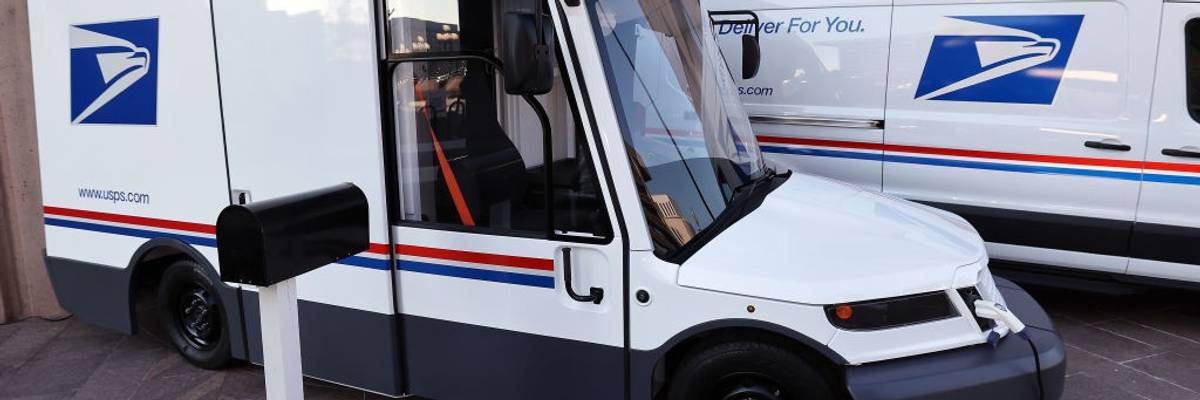
The United States Postal Service unveils two of its battery-powered vehicles at USPS Headquarters on December 20, 2022 in Washington, D.C.
"It's stuff like this that will cost us manufacturing jobs/opportunities," warned one critic.
As part of President-elect Donald Trump's mission to roll back the Biden administration's climate policies, the Republican may cancel contracts to electrify the U.S. Postal Service's fleet, Reuters revealed Friday, citing unnamed sources familiar with transition team discussions.
"The sources told Reuters that Trump's transition team is now reviewing how it can unwind the Postal Service's multibillion-dollar contracts, including with Oshkosh and Ford for tens of thousands of battery-driven delivery trucks and charging stations," according to the news agency.
The USPS in December 2022 announced a five-year $9.6 billion investment that involved electrifying 75% of its next-generation delivery vehicles and installing modern charging infrastructure. That came just months after President Joe Biden signed the Inflation Reduction Act, which included $3 billion in funding for the endeavor.
Ford did not respond to Reuters' requests for comment on Friday, while Oshkosh said that it "is fully committed to our strong partnership with the USPS and looks forward to continuing to provide our postal carriers with reliable, safe, and sustainable modern delivery vehicles, even as USPS' needs continue to evolve."
The USPS also did not respond to requests for comment and Trump transition team spokesperson Karoline Leavitt declined to address his Postal Service plans, only saying that "President Trump will protect the freedom of Americans to drive whichever vehicle they choose, enhance his tough tariffs on Chinese-imported cars, and save the U.S. auto industry for generations to come. No policy should be deemed official unless it comes directly from President Trump."
During the campaign, Trump pledged to roll back Biden's climate policies if Big Oil poured $1 billion into getting him elected. He also attacked the Democrat's efforts to promote a shift to electric vehicles (EVs). Transportation accounts for the largest portion of all U.S. greenhouse gas emissions and the United States is the world's top historic emitter.
Even under Biden, U.S. plans to limit planet-heating pollution did not align with the country's contributions to the fossil fuel-driven climate emergency—but climate scientists and advocates widely backed his and later Vice President Kamala Harris' campaign leading up to last month's election, recognizing the threat posed by Trump.
John Hanger, a Democrat who previously held various envirnomental and energy positions in Pennsylvania's government, responded to the Reuters reporting on social media: "Ugh! Canceling contracts to electrify transportation of USPS would be dirty and dumb!"
Meanwhile, Scott Paul, president of the Alliance for American Manufacturing, said that "it's stuff like this that will cost us manufacturing jobs/opportunities."
Some critics also speculated whether such contracts may be redone to benefit Tesla. The company's CEO is Elon Musk, who is the richest man in the world, dumped around $270 million into super political action committees backing Trump's reelection bid, and is set to co-lead his forthcoming Department of Government Efficiency (DOGE) with fellow billionaire Vivek Ramaswamy.
Last month, Reuters reported on the Trump transition team's plans to kill Biden's fuel efficiency standards and a $7,500 consumer tax credit for EV purchases, which Musk was asked about while he and Ramaswamy were on Capitol Hill Thursday to meet with Republican lawmakers.
"I think we should get rid of all credits," Musk told reporters—despite his own company's reliance on Biden's EV policies.
Responding to Musk's comment in a Friday statement, Will Anderson, EV policy advocate with Public Citizen's Climate Program, said that "as someone who's asking to work for the American people through his so-called DOGE, Musk should not perpetuate crony capitalism that only benefits himself and others with access to Trump."
"If we want the American automobile industry to stay competitive in a global market," he added, "then not only should Musk recognize the benefit of the EV tax credit for American-made vehicles, but he should also recognize the negative impact billions of dollars in continuing oil and gas subsidies will have on a society that needs to transition to a zero-emission and clean-energy future."
Dear Common Dreams reader, It’s been nearly 30 years since I co-founded Common Dreams with my late wife, Lina Newhouser. We had the radical notion that journalism should serve the public good, not corporate profits. It was clear to us from the outset what it would take to build such a project. No paid advertisements. No corporate sponsors. No millionaire publisher telling us what to think or do. Many people said we wouldn't last a year, but we proved those doubters wrong. Together with a tremendous team of journalists and dedicated staff, we built an independent media outlet free from the constraints of profits and corporate control. Our mission has always been simple: To inform. To inspire. To ignite change for the common good. Building Common Dreams was not easy. Our survival was never guaranteed. When you take on the most powerful forces—Wall Street greed, fossil fuel industry destruction, Big Tech lobbyists, and uber-rich oligarchs who have spent billions upon billions rigging the economy and democracy in their favor—the only bulwark you have is supporters who believe in your work. But here’s the urgent message from me today. It's never been this bad out there. And it's never been this hard to keep us going. At the very moment Common Dreams is most needed, the threats we face are intensifying. We need your support now more than ever. We don't accept corporate advertising and never will. We don't have a paywall because we don't think people should be blocked from critical news based on their ability to pay. Everything we do is funded by the donations of readers like you. When everyone does the little they can afford, we are strong. But if that support retreats or dries up, so do we. Will you donate now to make sure Common Dreams not only survives but thrives? —Craig Brown, Co-founder |
As part of President-elect Donald Trump's mission to roll back the Biden administration's climate policies, the Republican may cancel contracts to electrify the U.S. Postal Service's fleet, Reuters revealed Friday, citing unnamed sources familiar with transition team discussions.
"The sources told Reuters that Trump's transition team is now reviewing how it can unwind the Postal Service's multibillion-dollar contracts, including with Oshkosh and Ford for tens of thousands of battery-driven delivery trucks and charging stations," according to the news agency.
The USPS in December 2022 announced a five-year $9.6 billion investment that involved electrifying 75% of its next-generation delivery vehicles and installing modern charging infrastructure. That came just months after President Joe Biden signed the Inflation Reduction Act, which included $3 billion in funding for the endeavor.
Ford did not respond to Reuters' requests for comment on Friday, while Oshkosh said that it "is fully committed to our strong partnership with the USPS and looks forward to continuing to provide our postal carriers with reliable, safe, and sustainable modern delivery vehicles, even as USPS' needs continue to evolve."
The USPS also did not respond to requests for comment and Trump transition team spokesperson Karoline Leavitt declined to address his Postal Service plans, only saying that "President Trump will protect the freedom of Americans to drive whichever vehicle they choose, enhance his tough tariffs on Chinese-imported cars, and save the U.S. auto industry for generations to come. No policy should be deemed official unless it comes directly from President Trump."
During the campaign, Trump pledged to roll back Biden's climate policies if Big Oil poured $1 billion into getting him elected. He also attacked the Democrat's efforts to promote a shift to electric vehicles (EVs). Transportation accounts for the largest portion of all U.S. greenhouse gas emissions and the United States is the world's top historic emitter.
Even under Biden, U.S. plans to limit planet-heating pollution did not align with the country's contributions to the fossil fuel-driven climate emergency—but climate scientists and advocates widely backed his and later Vice President Kamala Harris' campaign leading up to last month's election, recognizing the threat posed by Trump.
John Hanger, a Democrat who previously held various envirnomental and energy positions in Pennsylvania's government, responded to the Reuters reporting on social media: "Ugh! Canceling contracts to electrify transportation of USPS would be dirty and dumb!"
Meanwhile, Scott Paul, president of the Alliance for American Manufacturing, said that "it's stuff like this that will cost us manufacturing jobs/opportunities."
Some critics also speculated whether such contracts may be redone to benefit Tesla. The company's CEO is Elon Musk, who is the richest man in the world, dumped around $270 million into super political action committees backing Trump's reelection bid, and is set to co-lead his forthcoming Department of Government Efficiency (DOGE) with fellow billionaire Vivek Ramaswamy.
Last month, Reuters reported on the Trump transition team's plans to kill Biden's fuel efficiency standards and a $7,500 consumer tax credit for EV purchases, which Musk was asked about while he and Ramaswamy were on Capitol Hill Thursday to meet with Republican lawmakers.
"I think we should get rid of all credits," Musk told reporters—despite his own company's reliance on Biden's EV policies.
Responding to Musk's comment in a Friday statement, Will Anderson, EV policy advocate with Public Citizen's Climate Program, said that "as someone who's asking to work for the American people through his so-called DOGE, Musk should not perpetuate crony capitalism that only benefits himself and others with access to Trump."
"If we want the American automobile industry to stay competitive in a global market," he added, "then not only should Musk recognize the benefit of the EV tax credit for American-made vehicles, but he should also recognize the negative impact billions of dollars in continuing oil and gas subsidies will have on a society that needs to transition to a zero-emission and clean-energy future."
As part of President-elect Donald Trump's mission to roll back the Biden administration's climate policies, the Republican may cancel contracts to electrify the U.S. Postal Service's fleet, Reuters revealed Friday, citing unnamed sources familiar with transition team discussions.
"The sources told Reuters that Trump's transition team is now reviewing how it can unwind the Postal Service's multibillion-dollar contracts, including with Oshkosh and Ford for tens of thousands of battery-driven delivery trucks and charging stations," according to the news agency.
The USPS in December 2022 announced a five-year $9.6 billion investment that involved electrifying 75% of its next-generation delivery vehicles and installing modern charging infrastructure. That came just months after President Joe Biden signed the Inflation Reduction Act, which included $3 billion in funding for the endeavor.
Ford did not respond to Reuters' requests for comment on Friday, while Oshkosh said that it "is fully committed to our strong partnership with the USPS and looks forward to continuing to provide our postal carriers with reliable, safe, and sustainable modern delivery vehicles, even as USPS' needs continue to evolve."
The USPS also did not respond to requests for comment and Trump transition team spokesperson Karoline Leavitt declined to address his Postal Service plans, only saying that "President Trump will protect the freedom of Americans to drive whichever vehicle they choose, enhance his tough tariffs on Chinese-imported cars, and save the U.S. auto industry for generations to come. No policy should be deemed official unless it comes directly from President Trump."
During the campaign, Trump pledged to roll back Biden's climate policies if Big Oil poured $1 billion into getting him elected. He also attacked the Democrat's efforts to promote a shift to electric vehicles (EVs). Transportation accounts for the largest portion of all U.S. greenhouse gas emissions and the United States is the world's top historic emitter.
Even under Biden, U.S. plans to limit planet-heating pollution did not align with the country's contributions to the fossil fuel-driven climate emergency—but climate scientists and advocates widely backed his and later Vice President Kamala Harris' campaign leading up to last month's election, recognizing the threat posed by Trump.
John Hanger, a Democrat who previously held various envirnomental and energy positions in Pennsylvania's government, responded to the Reuters reporting on social media: "Ugh! Canceling contracts to electrify transportation of USPS would be dirty and dumb!"
Meanwhile, Scott Paul, president of the Alliance for American Manufacturing, said that "it's stuff like this that will cost us manufacturing jobs/opportunities."
Some critics also speculated whether such contracts may be redone to benefit Tesla. The company's CEO is Elon Musk, who is the richest man in the world, dumped around $270 million into super political action committees backing Trump's reelection bid, and is set to co-lead his forthcoming Department of Government Efficiency (DOGE) with fellow billionaire Vivek Ramaswamy.
Last month, Reuters reported on the Trump transition team's plans to kill Biden's fuel efficiency standards and a $7,500 consumer tax credit for EV purchases, which Musk was asked about while he and Ramaswamy were on Capitol Hill Thursday to meet with Republican lawmakers.
"I think we should get rid of all credits," Musk told reporters—despite his own company's reliance on Biden's EV policies.
Responding to Musk's comment in a Friday statement, Will Anderson, EV policy advocate with Public Citizen's Climate Program, said that "as someone who's asking to work for the American people through his so-called DOGE, Musk should not perpetuate crony capitalism that only benefits himself and others with access to Trump."
"If we want the American automobile industry to stay competitive in a global market," he added, "then not only should Musk recognize the benefit of the EV tax credit for American-made vehicles, but he should also recognize the negative impact billions of dollars in continuing oil and gas subsidies will have on a society that needs to transition to a zero-emission and clean-energy future."