
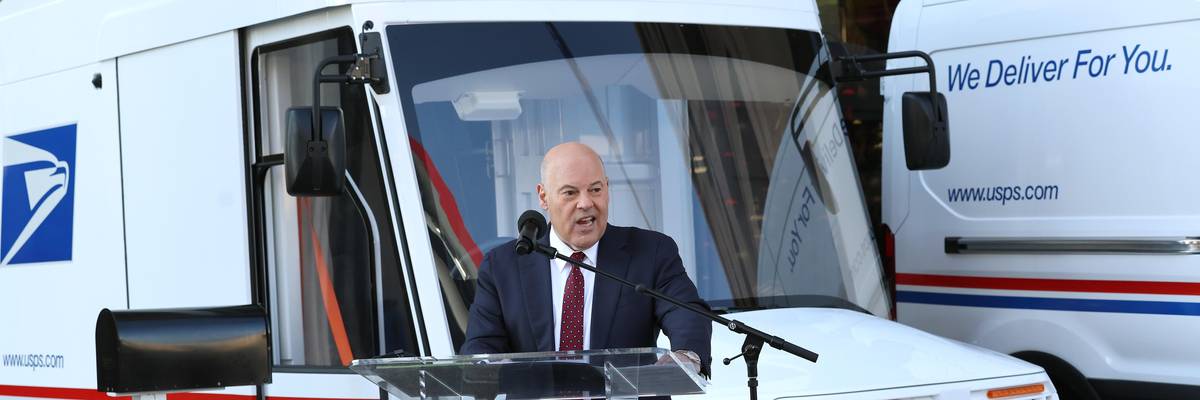
Postmaster General Louis DeJoy speaks at a press conference at the Postal Service Headquarters on December 20, 2022 in Washington, D.C.
Even After Electric Vehicle Progress, Advocates Say DeJoy Should Still Be Fired
"Any increase in E.V. acquisition at USPS is in spite of DeJoy, not because of him."
Postmaster General Louis DeJoy's widely praised announcement last week that the Postal Service will buy tens of thousands of electric vehicles in the coming years to help replace its aging delivery fleet should not be enough to save the scandal-plagued USPS chief's job, advocates said, pointing to his refusal to support a more ambitious electrification plan and his ongoing efforts to slash jobs, consolidate mail facilities, and hike prices for consumers.
"The bottom line is that any increase in E.V. acquisition at USPS is in spite of DeJoy, not because of him," Vishal Narayanaswamy of the Revolving Door Project, told The New Republic's Kate Aronoff. "Electrification would be proceeding much faster if we had a board that could fire him."
DeJoy, a Trump and GOP megadonor, was selected to serve as postmaster general in May 2020, and even news last year that he was facing an FBI investigation for potentially unlawful campaign finance activity during his time as a private logistics executive wasn't enough to harm his job security.
The postmaster general is chosen by—and can only be removed by—the USPS Board of Governors, a body composed of nine officials nominated by the president.
In the face of massive pressure to force out DeJoy, Biden has nominated and the narrowly Democratic Senate has confirmed five board governors, giving the president's picks a majority on the postal board and enough votes to remove the postmaster general, who does not serve a fixed term.
While Biden's nominees have raised questions and concerns about DeJoy's 10-year plan to overhaul USPS operations, calling it "strategically ill-conceived" and "dangerous," they have yet to mount a serious push for his removal.
"Electrification would be proceeding much faster if we had a board that could fire him."
Narayanaswamy lamented that the White House, too, appears uninterested in ousting DeJoy. The Biden administration "does not seem to care about replacing DeJoy and has more or less dropped it as a priority," Narayanaswamy told Aronoff, who argued in a column last week that "the potential of the USPS to propel an energy transition will continue to go untapped" as long as DeJoy is at the helm.
Though the new electric vehicle plan is a significant improvement over DeJoy's earlier proposal—which called for the purchase of 90% gas-guzzling trucks—"the USPS only plans to electrify 40% of its fleet" in total, Aronoff noted.
"The newly announced purchases also only represent about 10% of the existing federal fleet of cars, SUVs, and trucks, which is the largest in the world," Aronoff continued. "That means the majority of the fleet will still run on gasoline for the foreseeable future. What's more, the internal combustion engine–powered versions of the USPS's 'Next Generation Delivery Vehicles,' or NGDVs, get just 8.6 miles per gallon."
"The potential for the USPS to act as an engine of decarbonization and set industry-wide standards for electrification is vast. But DeJoy—who's talked repeatedly about downsizing and privatizing the USPS and has lucrative ties to private logistics firms—is unlikely to see things that way," she added. "It's still possible for Biden to replace pro-DeJoy members of the USPS Board of Governors, paving the way for them to replace DeJoy himself."
Two Trump-nominated board members who have defended DeJoy—Donald Moak and William Zollars—are currently in holdover years after their terms expired earlier this month, but Biden has yet to announce any new board picks despite grassroots pressure.
In late October, the Save the Post Office Coalition—a network of more than 300 public interest groups—urged Biden to replace Moak and Zollars with retiring Rep. Brenda Lawrence (D-Mich.) and policy expert Sarah Anderson.
Before her election to Congress, Lawrence worked for the Postal Service for three decades. Anderson, director of the Global Economy Project at the Institute for Policy Studies, has written about and researched the USPS for years, and her grandfather was a Postal Service employee.
"Congresswoman Lawrence and Ms. Anderson are public servants who would bring needed perspectives and expertise to the USPS Board of Governors at a time when the nation is looking to the board to start asking the tough questions of Louis DeJoy," said Porter McConnell, co-founder of the Save the Post Office Coalition.
We are at a crossroads
This country and this world are at a monumental crossroads. In a few short weeks, US voters will have an opportunity to beat back the forces of fascism and confront the billionaires who are rigging the economy, our media system, and our democracy, making it increasingly impossible for ordinary people to get by. We’re not just talking about the election. We’re talking about what must be done once these fascist elements are vanquished from power. We need a bolder set of solutions than what either major party has so far been willing to offer and a working-class movement ready to fight like hell for it. Trump didn't emerge from nowhere. The conditions that fueled MAGA authoritarianism were created by decades of radical neoliberal economic policies and a corrupt political system dominated by corporate interests. They slashed taxes on the super-rich, promising that the benefits would trickle down. They said giveaways to the corporate titans would make life more affordable for the rest of us. It was all bullshit. And when a bitter, betrayed populace searches for someone to blame, right-wing demagogues have little trouble finding scapegoats. People know when they're being lied to, but you won't hear any of this from the corporate media. Only independent journalism—powered and funded by people who believe in building a better world—can deliver truly trustworthy daily news. Our Fall Campaign is underway, and we need your help. To power our newsroom through the rest of the year, we need to raise $125,000 by midnight on October 31. So if you share our vision, please contribute whatever you can to sustain our work. |
Postmaster General Louis DeJoy's widely praised announcement last week that the Postal Service will buy tens of thousands of electric vehicles in the coming years to help replace its aging delivery fleet should not be enough to save the scandal-plagued USPS chief's job, advocates said, pointing to his refusal to support a more ambitious electrification plan and his ongoing efforts to slash jobs, consolidate mail facilities, and hike prices for consumers.
"The bottom line is that any increase in E.V. acquisition at USPS is in spite of DeJoy, not because of him," Vishal Narayanaswamy of the Revolving Door Project, told The New Republic's Kate Aronoff. "Electrification would be proceeding much faster if we had a board that could fire him."
DeJoy, a Trump and GOP megadonor, was selected to serve as postmaster general in May 2020, and even news last year that he was facing an FBI investigation for potentially unlawful campaign finance activity during his time as a private logistics executive wasn't enough to harm his job security.
The postmaster general is chosen by—and can only be removed by—the USPS Board of Governors, a body composed of nine officials nominated by the president.
In the face of massive pressure to force out DeJoy, Biden has nominated and the narrowly Democratic Senate has confirmed five board governors, giving the president's picks a majority on the postal board and enough votes to remove the postmaster general, who does not serve a fixed term.
While Biden's nominees have raised questions and concerns about DeJoy's 10-year plan to overhaul USPS operations, calling it "strategically ill-conceived" and "dangerous," they have yet to mount a serious push for his removal.
"Electrification would be proceeding much faster if we had a board that could fire him."
Narayanaswamy lamented that the White House, too, appears uninterested in ousting DeJoy. The Biden administration "does not seem to care about replacing DeJoy and has more or less dropped it as a priority," Narayanaswamy told Aronoff, who argued in a column last week that "the potential of the USPS to propel an energy transition will continue to go untapped" as long as DeJoy is at the helm.
Though the new electric vehicle plan is a significant improvement over DeJoy's earlier proposal—which called for the purchase of 90% gas-guzzling trucks—"the USPS only plans to electrify 40% of its fleet" in total, Aronoff noted.
"The newly announced purchases also only represent about 10% of the existing federal fleet of cars, SUVs, and trucks, which is the largest in the world," Aronoff continued. "That means the majority of the fleet will still run on gasoline for the foreseeable future. What's more, the internal combustion engine–powered versions of the USPS's 'Next Generation Delivery Vehicles,' or NGDVs, get just 8.6 miles per gallon."
"The potential for the USPS to act as an engine of decarbonization and set industry-wide standards for electrification is vast. But DeJoy—who's talked repeatedly about downsizing and privatizing the USPS and has lucrative ties to private logistics firms—is unlikely to see things that way," she added. "It's still possible for Biden to replace pro-DeJoy members of the USPS Board of Governors, paving the way for them to replace DeJoy himself."
Two Trump-nominated board members who have defended DeJoy—Donald Moak and William Zollars—are currently in holdover years after their terms expired earlier this month, but Biden has yet to announce any new board picks despite grassroots pressure.
In late October, the Save the Post Office Coalition—a network of more than 300 public interest groups—urged Biden to replace Moak and Zollars with retiring Rep. Brenda Lawrence (D-Mich.) and policy expert Sarah Anderson.
Before her election to Congress, Lawrence worked for the Postal Service for three decades. Anderson, director of the Global Economy Project at the Institute for Policy Studies, has written about and researched the USPS for years, and her grandfather was a Postal Service employee.
"Congresswoman Lawrence and Ms. Anderson are public servants who would bring needed perspectives and expertise to the USPS Board of Governors at a time when the nation is looking to the board to start asking the tough questions of Louis DeJoy," said Porter McConnell, co-founder of the Save the Post Office Coalition.
- 'Fire DeJoy' Demand Intensifies as 10-Year Plan to Sabotage Postal Service Takes Effect ›
- 'A True Danger to the Public Post Office': DeJoy Moves to Consolidate USPS Facilities ›
- Biden Urged to Take Steps to Finally Get Rid of DeJoy as He Plows Ahead With Job Cuts ›
- Opinion | DeJoy Is Still Dragging His Feet at Every Step Toward Electrifying the Postal Fleet | Common Dreams ›
- Tlaib Asks USPS IG to Probe Impacts of Postmaster General DeJoy's Overhaul ›
- 'Dirty and Dumb!' Trump May Cancel Contracts to Electrify USPS Fleet | Common Dreams ›
Postmaster General Louis DeJoy's widely praised announcement last week that the Postal Service will buy tens of thousands of electric vehicles in the coming years to help replace its aging delivery fleet should not be enough to save the scandal-plagued USPS chief's job, advocates said, pointing to his refusal to support a more ambitious electrification plan and his ongoing efforts to slash jobs, consolidate mail facilities, and hike prices for consumers.
"The bottom line is that any increase in E.V. acquisition at USPS is in spite of DeJoy, not because of him," Vishal Narayanaswamy of the Revolving Door Project, told The New Republic's Kate Aronoff. "Electrification would be proceeding much faster if we had a board that could fire him."
DeJoy, a Trump and GOP megadonor, was selected to serve as postmaster general in May 2020, and even news last year that he was facing an FBI investigation for potentially unlawful campaign finance activity during his time as a private logistics executive wasn't enough to harm his job security.
The postmaster general is chosen by—and can only be removed by—the USPS Board of Governors, a body composed of nine officials nominated by the president.
In the face of massive pressure to force out DeJoy, Biden has nominated and the narrowly Democratic Senate has confirmed five board governors, giving the president's picks a majority on the postal board and enough votes to remove the postmaster general, who does not serve a fixed term.
While Biden's nominees have raised questions and concerns about DeJoy's 10-year plan to overhaul USPS operations, calling it "strategically ill-conceived" and "dangerous," they have yet to mount a serious push for his removal.
"Electrification would be proceeding much faster if we had a board that could fire him."
Narayanaswamy lamented that the White House, too, appears uninterested in ousting DeJoy. The Biden administration "does not seem to care about replacing DeJoy and has more or less dropped it as a priority," Narayanaswamy told Aronoff, who argued in a column last week that "the potential of the USPS to propel an energy transition will continue to go untapped" as long as DeJoy is at the helm.
Though the new electric vehicle plan is a significant improvement over DeJoy's earlier proposal—which called for the purchase of 90% gas-guzzling trucks—"the USPS only plans to electrify 40% of its fleet" in total, Aronoff noted.
"The newly announced purchases also only represent about 10% of the existing federal fleet of cars, SUVs, and trucks, which is the largest in the world," Aronoff continued. "That means the majority of the fleet will still run on gasoline for the foreseeable future. What's more, the internal combustion engine–powered versions of the USPS's 'Next Generation Delivery Vehicles,' or NGDVs, get just 8.6 miles per gallon."
"The potential for the USPS to act as an engine of decarbonization and set industry-wide standards for electrification is vast. But DeJoy—who's talked repeatedly about downsizing and privatizing the USPS and has lucrative ties to private logistics firms—is unlikely to see things that way," she added. "It's still possible for Biden to replace pro-DeJoy members of the USPS Board of Governors, paving the way for them to replace DeJoy himself."
Two Trump-nominated board members who have defended DeJoy—Donald Moak and William Zollars—are currently in holdover years after their terms expired earlier this month, but Biden has yet to announce any new board picks despite grassroots pressure.
In late October, the Save the Post Office Coalition—a network of more than 300 public interest groups—urged Biden to replace Moak and Zollars with retiring Rep. Brenda Lawrence (D-Mich.) and policy expert Sarah Anderson.
Before her election to Congress, Lawrence worked for the Postal Service for three decades. Anderson, director of the Global Economy Project at the Institute for Policy Studies, has written about and researched the USPS for years, and her grandfather was a Postal Service employee.
"Congresswoman Lawrence and Ms. Anderson are public servants who would bring needed perspectives and expertise to the USPS Board of Governors at a time when the nation is looking to the board to start asking the tough questions of Louis DeJoy," said Porter McConnell, co-founder of the Save the Post Office Coalition.
- 'Fire DeJoy' Demand Intensifies as 10-Year Plan to Sabotage Postal Service Takes Effect ›
- 'A True Danger to the Public Post Office': DeJoy Moves to Consolidate USPS Facilities ›
- Biden Urged to Take Steps to Finally Get Rid of DeJoy as He Plows Ahead With Job Cuts ›
- Opinion | DeJoy Is Still Dragging His Feet at Every Step Toward Electrifying the Postal Fleet | Common Dreams ›
- Tlaib Asks USPS IG to Probe Impacts of Postmaster General DeJoy's Overhaul ›
- 'Dirty and Dumb!' Trump May Cancel Contracts to Electrify USPS Fleet | Common Dreams ›