SUBSCRIBE TO OUR FREE NEWSLETTER
Daily news & progressive opinion—funded by the people, not the corporations—delivered straight to your inbox.
5
#000000
#FFFFFF
To donate by check, phone, or other method, see our More Ways to Give page.
Daily news & progressive opinion—funded by the people, not the corporations—delivered straight to your inbox.
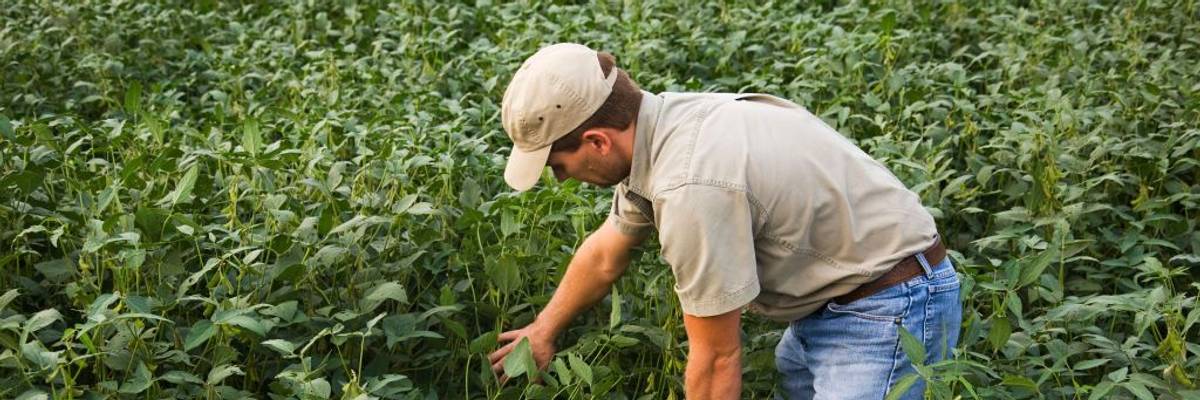
A crop consultant examines the pod set of a mid growth soybean crop in Northeast Arkansas.
"The average soybean acre in the United States this year is going to lose $109 an acre, and that's well over two dollars a bushel," said one farmer. "It's bloody."
President Donald Trump has announced a $12 billion relief package for US farmers hurt by his global trade war, but there are already signs that it will be woefully insufficient.
The Guardian reported on Monday that many US farmers are concerned that the bailout offered by the Trump administration won't come close to making up for the damage done by Trump's tariffs over the last nine months.
The report cited data from the American Farm Bureau showing that US crop farmers have collectively lost $34.6 billion this year, a total that is nearly three times the size of Trump's farm aid proposal.
Dan Wright, president of the Arkansas Farm Bureau, told the Guardian that Trump's plan is both too little to make up for lost sales and too late to prevent many farms from going under.
"A program that provides roughly $50 an acre will not save the thousands of family farms that will go bankrupt before the end of the year," Wright explained.
The Guardian noted that farms in Arkansas are expected to be hit particularly hard by bankruptcies this year, although farmers across the US report being under duress.
Ohio Capital Journal reported last week on new data from the Atlantic Council’s Tariff Tracker showing that Ohio farmers lost $76 million worth of exports to China this year after the Chinese government cut off all US soy purchases in retaliation for Trump restarting his trade war.
A Monday report from the Times-Picayune quoted Louisiana Commissioner of Agriculture and Foresty Mike Strain saying recently that roughly half of Louisiana farmers "are facing significant challenges" in which they're dealing not only with lost sales to foreign nations, but also increased costs for supplies and equipment thanks to Trump's tariffs.
"The cost has gone up, but the price the farmers receive went down," Strain explained.
Kentucky farmer Caleb Ragland, chairman of the American Soybean Association, told Spectrum News 1 on Monday that soy farmers were bracing for major losses from their crops as they get hit from both sides by depressed soy prices and increased input costs.
"The average soybean acre in the United States this year is going to lose $109 an acre, and that's well over two dollars a bushel," Ragland explained. "It's bloody."
While China recently pledged to start buying more soy from US farmers, the country has been gradually increasing its reliance on Brazil and other countries so that it no longer has to deal with unpredictable US trade policies.
Andrew Muhammad, a professor of agricultural policy at the University of Tennessee, said in an interview with local public radio station WPLN that China's shift toward Latin American markets means it is no longer held hostage to Trump's whims, and it can now ensure a steady supply of soy regardless of the US president's tariff policies.
Dear Common Dreams reader, It’s been nearly 30 years since I co-founded Common Dreams with my late wife, Lina Newhouser. We had the radical notion that journalism should serve the public good, not corporate profits. It was clear to us from the outset what it would take to build such a project. No paid advertisements. No corporate sponsors. No millionaire publisher telling us what to think or do. Many people said we wouldn't last a year, but we proved those doubters wrong. Together with a tremendous team of journalists and dedicated staff, we built an independent media outlet free from the constraints of profits and corporate control. Our mission has always been simple: To inform. To inspire. To ignite change for the common good. Building Common Dreams was not easy. Our survival was never guaranteed. When you take on the most powerful forces—Wall Street greed, fossil fuel industry destruction, Big Tech lobbyists, and uber-rich oligarchs who have spent billions upon billions rigging the economy and democracy in their favor—the only bulwark you have is supporters who believe in your work. But here’s the urgent message from me today. It's never been this bad out there. And it's never been this hard to keep us going. At the very moment Common Dreams is most needed, the threats we face are intensifying. We need your support now more than ever. We don't accept corporate advertising and never will. We don't have a paywall because we don't think people should be blocked from critical news based on their ability to pay. Everything we do is funded by the donations of readers like you. When everyone does the little they can afford, we are strong. But if that support retreats or dries up, so do we. Will you donate now to make sure Common Dreams not only survives but thrives? —Craig Brown, Co-founder |
President Donald Trump has announced a $12 billion relief package for US farmers hurt by his global trade war, but there are already signs that it will be woefully insufficient.
The Guardian reported on Monday that many US farmers are concerned that the bailout offered by the Trump administration won't come close to making up for the damage done by Trump's tariffs over the last nine months.
The report cited data from the American Farm Bureau showing that US crop farmers have collectively lost $34.6 billion this year, a total that is nearly three times the size of Trump's farm aid proposal.
Dan Wright, president of the Arkansas Farm Bureau, told the Guardian that Trump's plan is both too little to make up for lost sales and too late to prevent many farms from going under.
"A program that provides roughly $50 an acre will not save the thousands of family farms that will go bankrupt before the end of the year," Wright explained.
The Guardian noted that farms in Arkansas are expected to be hit particularly hard by bankruptcies this year, although farmers across the US report being under duress.
Ohio Capital Journal reported last week on new data from the Atlantic Council’s Tariff Tracker showing that Ohio farmers lost $76 million worth of exports to China this year after the Chinese government cut off all US soy purchases in retaliation for Trump restarting his trade war.
A Monday report from the Times-Picayune quoted Louisiana Commissioner of Agriculture and Foresty Mike Strain saying recently that roughly half of Louisiana farmers "are facing significant challenges" in which they're dealing not only with lost sales to foreign nations, but also increased costs for supplies and equipment thanks to Trump's tariffs.
"The cost has gone up, but the price the farmers receive went down," Strain explained.
Kentucky farmer Caleb Ragland, chairman of the American Soybean Association, told Spectrum News 1 on Monday that soy farmers were bracing for major losses from their crops as they get hit from both sides by depressed soy prices and increased input costs.
"The average soybean acre in the United States this year is going to lose $109 an acre, and that's well over two dollars a bushel," Ragland explained. "It's bloody."
While China recently pledged to start buying more soy from US farmers, the country has been gradually increasing its reliance on Brazil and other countries so that it no longer has to deal with unpredictable US trade policies.
Andrew Muhammad, a professor of agricultural policy at the University of Tennessee, said in an interview with local public radio station WPLN that China's shift toward Latin American markets means it is no longer held hostage to Trump's whims, and it can now ensure a steady supply of soy regardless of the US president's tariff policies.
President Donald Trump has announced a $12 billion relief package for US farmers hurt by his global trade war, but there are already signs that it will be woefully insufficient.
The Guardian reported on Monday that many US farmers are concerned that the bailout offered by the Trump administration won't come close to making up for the damage done by Trump's tariffs over the last nine months.
The report cited data from the American Farm Bureau showing that US crop farmers have collectively lost $34.6 billion this year, a total that is nearly three times the size of Trump's farm aid proposal.
Dan Wright, president of the Arkansas Farm Bureau, told the Guardian that Trump's plan is both too little to make up for lost sales and too late to prevent many farms from going under.
"A program that provides roughly $50 an acre will not save the thousands of family farms that will go bankrupt before the end of the year," Wright explained.
The Guardian noted that farms in Arkansas are expected to be hit particularly hard by bankruptcies this year, although farmers across the US report being under duress.
Ohio Capital Journal reported last week on new data from the Atlantic Council’s Tariff Tracker showing that Ohio farmers lost $76 million worth of exports to China this year after the Chinese government cut off all US soy purchases in retaliation for Trump restarting his trade war.
A Monday report from the Times-Picayune quoted Louisiana Commissioner of Agriculture and Foresty Mike Strain saying recently that roughly half of Louisiana farmers "are facing significant challenges" in which they're dealing not only with lost sales to foreign nations, but also increased costs for supplies and equipment thanks to Trump's tariffs.
"The cost has gone up, but the price the farmers receive went down," Strain explained.
Kentucky farmer Caleb Ragland, chairman of the American Soybean Association, told Spectrum News 1 on Monday that soy farmers were bracing for major losses from their crops as they get hit from both sides by depressed soy prices and increased input costs.
"The average soybean acre in the United States this year is going to lose $109 an acre, and that's well over two dollars a bushel," Ragland explained. "It's bloody."
While China recently pledged to start buying more soy from US farmers, the country has been gradually increasing its reliance on Brazil and other countries so that it no longer has to deal with unpredictable US trade policies.
Andrew Muhammad, a professor of agricultural policy at the University of Tennessee, said in an interview with local public radio station WPLN that China's shift toward Latin American markets means it is no longer held hostage to Trump's whims, and it can now ensure a steady supply of soy regardless of the US president's tariff policies.