SUBSCRIBE TO OUR FREE NEWSLETTER
Daily news & progressive opinion—funded by the people, not the corporations—delivered straight to your inbox.
5
#000000
#FFFFFF
To donate by check, phone, or other method, see our More Ways to Give page.
Daily news & progressive opinion—funded by the people, not the corporations—delivered straight to your inbox.
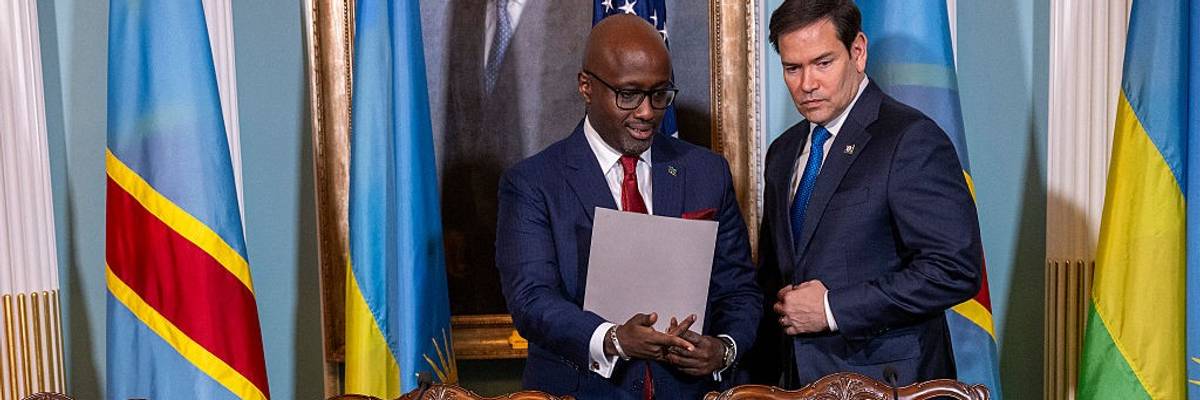
Rwandan Foreign Minister Olivier Nduhungirehe (left) and U.S. Secretary of State Marco Rubio (right) meet at the U.S. State Department in Washington, D.C. on April 25, 2025.
"As we did with the U.K.-Rwanda deportation deal... let us unapologetically and loudly oppose this again," said one Rwandan human rights defender.
Rwanda's foreign minister confirmed Sunday that the East African nation's government is in "early stage" talks with the Trump administration about possibly taking in migrants deported from the United States.
"It has not yet reached a stage where we can say exactly how things will proceed, but the talks are ongoing," Rwandan Foreign Minister Olivier Nduhungirehe told Rwanda TV. He added that the Rwandan government is in the "spirit" of offering "another chance to migrants who have problems across the world."
Last week, U.S. Secretary of State Marco Rubio said the Trump administration is seeking nations that are willing to accept its deportees.
"We want to send you some of the most despicable human beings to your countries."
"We are working with other countries to say, 'We want to send you some of the most despicable human beings to your countries. Will you do that as a favor to us?'" Rubio said. "And the farther away from America, the better, so they can't come back across the border."
The Wall Street Journal reported last month that Trump administration officials have also asked other countries including Benin, Eswatini, Kosovo, Libya, Moldova, and Mongolia about resettling U.S. deportees.
In 2022, Rwanda agreed to take in some people seeking asylum in the United Kingdom while their claims were being processed. However, the scheme was shelved amid legal and human rights concerns following the return to power of the center-left Labour Party. Rwanda is still seeking to collect £50 million ($66.4 million) from Britain despite the canceled deal.
The United Nations refugee agency condemned the U.K.-Rwanda deal, asserting that "externalizing asylum obligations poses serious risks for the safety of refugees" and "is not compatible with international refugee law."
Local human rights defenders strongly oppose any resettlement of third-country migrants in Rwanda.
"I with other concerned and responsible Rwandans are going to wage a legal war to challenge this arrangement between [Trump's] government and the dictatorial regime of [Rwandan President Paul Kagame]," investigative journalist Samuel Baker Byansi said on social media Sunday.
"Rwanda is not a dumping site of migrants with criminal records who have served their sentence in the U.S.," he added. "As we did with the U.K.-Rwanda deportation deal, fellow Rwandans in the country and abroad, let us unapologetically and loudly oppose this again."
Last month, the U.S. deported Omar Abdulsattar Ameen, an Iraqi refugee who had lived in the United States since 2014, to Rwanda after officials in Baghdad accused him of being a former Islamic State militant who murdered an Iraqi police officer. This, despite a U.S. judge's order blocking his deportation on the grounds that the murder allegation was "not plausible" since Ameen was living in Turkey at the time of the officer's killing.
Critics have sounded the alarm over potential perils migrants might face in Rwanda, including human rights violations and the possibility that they could be sent to third countries where they are at risk of violence and persecution.
The Trump administration is facing legal challenges to its mass deportation efforts, which include sending immigrants to the U.S. military base at Guantánamo Bay and the notorious Terrorism Confinement Center (CECOT) prison in El Salvador. President Donald Trump has even proposed deporting U.S. citizens to CECOT.
Trump appeared on NBC News' "Meet the Press" Sunday and was pressed by moderator Kristen Welker about the legality of his mass deportation program. Asked whether every person in the United States is entitled to due process, Trump replied: "I don't know. I'm not a lawyer."
Dear Common Dreams reader, It’s been nearly 30 years since I co-founded Common Dreams with my late wife, Lina Newhouser. We had the radical notion that journalism should serve the public good, not corporate profits. It was clear to us from the outset what it would take to build such a project. No paid advertisements. No corporate sponsors. No millionaire publisher telling us what to think or do. Many people said we wouldn't last a year, but we proved those doubters wrong. Together with a tremendous team of journalists and dedicated staff, we built an independent media outlet free from the constraints of profits and corporate control. Our mission has always been simple: To inform. To inspire. To ignite change for the common good. Building Common Dreams was not easy. Our survival was never guaranteed. When you take on the most powerful forces—Wall Street greed, fossil fuel industry destruction, Big Tech lobbyists, and uber-rich oligarchs who have spent billions upon billions rigging the economy and democracy in their favor—the only bulwark you have is supporters who believe in your work. But here’s the urgent message from me today. It's never been this bad out there. And it's never been this hard to keep us going. At the very moment Common Dreams is most needed, the threats we face are intensifying. We need your support now more than ever. We don't accept corporate advertising and never will. We don't have a paywall because we don't think people should be blocked from critical news based on their ability to pay. Everything we do is funded by the donations of readers like you. When everyone does the little they can afford, we are strong. But if that support retreats or dries up, so do we. Will you donate now to make sure Common Dreams not only survives but thrives? —Craig Brown, Co-founder |
Rwanda's foreign minister confirmed Sunday that the East African nation's government is in "early stage" talks with the Trump administration about possibly taking in migrants deported from the United States.
"It has not yet reached a stage where we can say exactly how things will proceed, but the talks are ongoing," Rwandan Foreign Minister Olivier Nduhungirehe told Rwanda TV. He added that the Rwandan government is in the "spirit" of offering "another chance to migrants who have problems across the world."
Last week, U.S. Secretary of State Marco Rubio said the Trump administration is seeking nations that are willing to accept its deportees.
"We want to send you some of the most despicable human beings to your countries."
"We are working with other countries to say, 'We want to send you some of the most despicable human beings to your countries. Will you do that as a favor to us?'" Rubio said. "And the farther away from America, the better, so they can't come back across the border."
The Wall Street Journal reported last month that Trump administration officials have also asked other countries including Benin, Eswatini, Kosovo, Libya, Moldova, and Mongolia about resettling U.S. deportees.
In 2022, Rwanda agreed to take in some people seeking asylum in the United Kingdom while their claims were being processed. However, the scheme was shelved amid legal and human rights concerns following the return to power of the center-left Labour Party. Rwanda is still seeking to collect £50 million ($66.4 million) from Britain despite the canceled deal.
The United Nations refugee agency condemned the U.K.-Rwanda deal, asserting that "externalizing asylum obligations poses serious risks for the safety of refugees" and "is not compatible with international refugee law."
Local human rights defenders strongly oppose any resettlement of third-country migrants in Rwanda.
"I with other concerned and responsible Rwandans are going to wage a legal war to challenge this arrangement between [Trump's] government and the dictatorial regime of [Rwandan President Paul Kagame]," investigative journalist Samuel Baker Byansi said on social media Sunday.
"Rwanda is not a dumping site of migrants with criminal records who have served their sentence in the U.S.," he added. "As we did with the U.K.-Rwanda deportation deal, fellow Rwandans in the country and abroad, let us unapologetically and loudly oppose this again."
Last month, the U.S. deported Omar Abdulsattar Ameen, an Iraqi refugee who had lived in the United States since 2014, to Rwanda after officials in Baghdad accused him of being a former Islamic State militant who murdered an Iraqi police officer. This, despite a U.S. judge's order blocking his deportation on the grounds that the murder allegation was "not plausible" since Ameen was living in Turkey at the time of the officer's killing.
Critics have sounded the alarm over potential perils migrants might face in Rwanda, including human rights violations and the possibility that they could be sent to third countries where they are at risk of violence and persecution.
The Trump administration is facing legal challenges to its mass deportation efforts, which include sending immigrants to the U.S. military base at Guantánamo Bay and the notorious Terrorism Confinement Center (CECOT) prison in El Salvador. President Donald Trump has even proposed deporting U.S. citizens to CECOT.
Trump appeared on NBC News' "Meet the Press" Sunday and was pressed by moderator Kristen Welker about the legality of his mass deportation program. Asked whether every person in the United States is entitled to due process, Trump replied: "I don't know. I'm not a lawyer."
Rwanda's foreign minister confirmed Sunday that the East African nation's government is in "early stage" talks with the Trump administration about possibly taking in migrants deported from the United States.
"It has not yet reached a stage where we can say exactly how things will proceed, but the talks are ongoing," Rwandan Foreign Minister Olivier Nduhungirehe told Rwanda TV. He added that the Rwandan government is in the "spirit" of offering "another chance to migrants who have problems across the world."
Last week, U.S. Secretary of State Marco Rubio said the Trump administration is seeking nations that are willing to accept its deportees.
"We want to send you some of the most despicable human beings to your countries."
"We are working with other countries to say, 'We want to send you some of the most despicable human beings to your countries. Will you do that as a favor to us?'" Rubio said. "And the farther away from America, the better, so they can't come back across the border."
The Wall Street Journal reported last month that Trump administration officials have also asked other countries including Benin, Eswatini, Kosovo, Libya, Moldova, and Mongolia about resettling U.S. deportees.
In 2022, Rwanda agreed to take in some people seeking asylum in the United Kingdom while their claims were being processed. However, the scheme was shelved amid legal and human rights concerns following the return to power of the center-left Labour Party. Rwanda is still seeking to collect £50 million ($66.4 million) from Britain despite the canceled deal.
The United Nations refugee agency condemned the U.K.-Rwanda deal, asserting that "externalizing asylum obligations poses serious risks for the safety of refugees" and "is not compatible with international refugee law."
Local human rights defenders strongly oppose any resettlement of third-country migrants in Rwanda.
"I with other concerned and responsible Rwandans are going to wage a legal war to challenge this arrangement between [Trump's] government and the dictatorial regime of [Rwandan President Paul Kagame]," investigative journalist Samuel Baker Byansi said on social media Sunday.
"Rwanda is not a dumping site of migrants with criminal records who have served their sentence in the U.S.," he added. "As we did with the U.K.-Rwanda deportation deal, fellow Rwandans in the country and abroad, let us unapologetically and loudly oppose this again."
Last month, the U.S. deported Omar Abdulsattar Ameen, an Iraqi refugee who had lived in the United States since 2014, to Rwanda after officials in Baghdad accused him of being a former Islamic State militant who murdered an Iraqi police officer. This, despite a U.S. judge's order blocking his deportation on the grounds that the murder allegation was "not plausible" since Ameen was living in Turkey at the time of the officer's killing.
Critics have sounded the alarm over potential perils migrants might face in Rwanda, including human rights violations and the possibility that they could be sent to third countries where they are at risk of violence and persecution.
The Trump administration is facing legal challenges to its mass deportation efforts, which include sending immigrants to the U.S. military base at Guantánamo Bay and the notorious Terrorism Confinement Center (CECOT) prison in El Salvador. President Donald Trump has even proposed deporting U.S. citizens to CECOT.
Trump appeared on NBC News' "Meet the Press" Sunday and was pressed by moderator Kristen Welker about the legality of his mass deportation program. Asked whether every person in the United States is entitled to due process, Trump replied: "I don't know. I'm not a lawyer."