
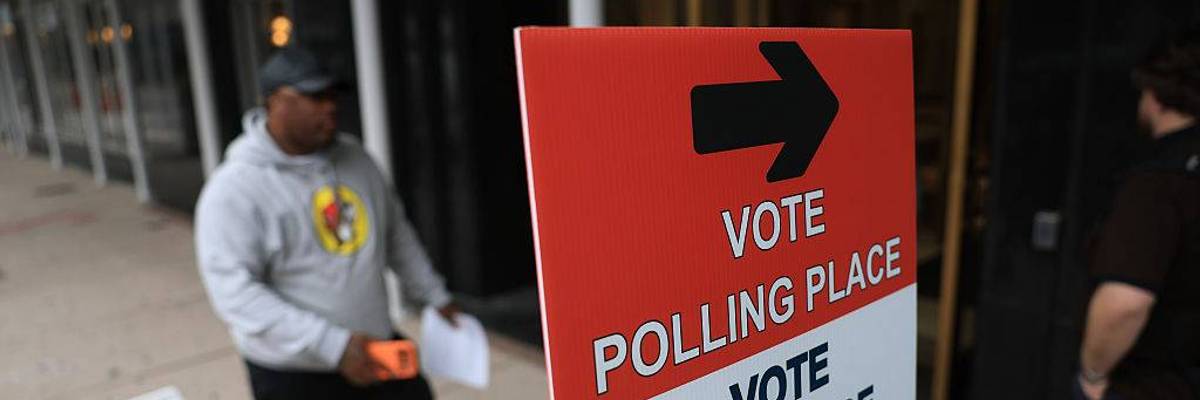
A sign points to a polling station setup on election day on December 9, 2025 in Miami, Florida.
It Would Be a ‘Mistake’ for Dems to Assume Trump Won't Try to Subvert 2026 Elections: Experts
"What are the remaining checks? Every check is gone."
While polling currently indicates that Democrats are well positioned to retake the US House of Representatives in the 2026 midterms, experts are warning that this year's elections may be neither free nor fair.
In a column published by the Guardian on Friday, Amherst College political scientist Austin Sarat pointed to a recent New York Times interview in which President Donald Trump said he regretted not ordering the US military to seize voting machines after losing the 2020 presidential election.
Sarat said Trump's musings about having the military interfere in the electoral process should be taken "seriously," but so far he's seen little evidence that Democrats are preparing for such a possibility.
The political scientist also flagged reporting from the Washington Post two weeks ago revealing that Trump "is using every tool he can find to try to influence the 2026 midterm elections and, if his party loses, sow doubt in their validity."
Furthermore, Sarat argued that these plans are not a hidden secret but have been sketched out as part of Project 2025, the far-right policy blueprint drawn up by the Heritage Foundation in 2022.
Among other things, wrote Sarat, Project 2025 featured proposals "to transfer the responsibility for investigating and prosecuting election crimes to the Department of Justice’s criminal division" and "to withdraw from arrangements that in the past have helped election officials do their jobs."
Sarat concluded that "Democrats are making a mistake by underestimating the likelihood that, for all the artful campaigning and the many unpopular things they can pin on Republicans, none of that will matter."
"They, and all the rest of us, must mobilize to avoid that result," he added. "We have no time to waste."
Dmitri Mehlhorn, a former Democratic strategist, said in an interview with the Atlantic published Thursday that he similarly feels Democrats are completely unprepared for what is to come in both the 2026 and 2028 elections, especially since Trump has already shown himself willing to go to extreme lengths to maintain power.
"If the president has proven in his first term that he will ignore subpoenas and ignore congressional budget authorizations and pardon anybody who also does, then suddenly, there’s no power," Mehlhorn explained. "What are the remaining checks? Every check is gone."
According to the Atlantic, Mehlhorn believes that federal law enforcement officials are going to follow Trump's orders, no matter how flagrantly illegal, and that Democratic-run states are going to have to consider radical deterrence strategies, including "threats of federal-tax boycotts, an expansive embrace of states’ rights," and "a new understanding of the importance of gun ownership."
Another potential risk to US election integrity not mentioned by Sarat or Mehlhorn is the danger of targeted propaganda being pumped out at an unprecedented pace using artificial intelligence (AI).
As reported by Wired on Thursday, new research has found that a single person can now use AI tools to deploy "'swarms' of thousands of social media accounts, capable not only of crafting unique posts indistinguishable from human content, but of evolving independently and in real time—all without constant human oversight."
Lukasz Olejnik, a visiting senior research fellow at King’s College London's Department of War Studies, told Wired that targeting "chosen individuals or communities is going to be much easier and powerful" thanks to AI.
"This is an extremely challenging environment for a democratic society," Olejnik added. "We're in big trouble.”
We are at a crossroads
This country and this world are at a monumental crossroads. In a few short weeks, US voters will have an opportunity to beat back the forces of fascism and confront the billionaires who are rigging the economy, our media system, and our democracy, making it increasingly impossible for ordinary people to get by. We’re not just talking about the election. We’re talking about what must be done once these fascist elements are vanquished from power. We need a bolder set of solutions than what either major party has so far been willing to offer and a working-class movement ready to fight like hell for it. Trump didn't emerge from nowhere. The conditions that fueled MAGA authoritarianism were created by decades of radical neoliberal economic policies and a corrupt political system dominated by corporate interests. They slashed taxes on the super-rich, promising that the benefits would trickle down. They said giveaways to the corporate titans would make life more affordable for the rest of us. It was all bullshit. And when a bitter, betrayed populace searches for someone to blame, right-wing demagogues have little trouble finding scapegoats. People know when they're being lied to, but you won't hear any of this from the corporate media. Only independent journalism—powered and funded by people who believe in building a better world—can deliver truly trustworthy daily news. Our Fall Campaign is underway, and we need your help. To power our newsroom through the rest of the year, we need to raise $125,000 by midnight on October 31. So if you share our vision, please contribute whatever you can to sustain our work. |
While polling currently indicates that Democrats are well positioned to retake the US House of Representatives in the 2026 midterms, experts are warning that this year's elections may be neither free nor fair.
In a column published by the Guardian on Friday, Amherst College political scientist Austin Sarat pointed to a recent New York Times interview in which President Donald Trump said he regretted not ordering the US military to seize voting machines after losing the 2020 presidential election.
Sarat said Trump's musings about having the military interfere in the electoral process should be taken "seriously," but so far he's seen little evidence that Democrats are preparing for such a possibility.
The political scientist also flagged reporting from the Washington Post two weeks ago revealing that Trump "is using every tool he can find to try to influence the 2026 midterm elections and, if his party loses, sow doubt in their validity."
Furthermore, Sarat argued that these plans are not a hidden secret but have been sketched out as part of Project 2025, the far-right policy blueprint drawn up by the Heritage Foundation in 2022.
Among other things, wrote Sarat, Project 2025 featured proposals "to transfer the responsibility for investigating and prosecuting election crimes to the Department of Justice’s criminal division" and "to withdraw from arrangements that in the past have helped election officials do their jobs."
Sarat concluded that "Democrats are making a mistake by underestimating the likelihood that, for all the artful campaigning and the many unpopular things they can pin on Republicans, none of that will matter."
"They, and all the rest of us, must mobilize to avoid that result," he added. "We have no time to waste."
Dmitri Mehlhorn, a former Democratic strategist, said in an interview with the Atlantic published Thursday that he similarly feels Democrats are completely unprepared for what is to come in both the 2026 and 2028 elections, especially since Trump has already shown himself willing to go to extreme lengths to maintain power.
"If the president has proven in his first term that he will ignore subpoenas and ignore congressional budget authorizations and pardon anybody who also does, then suddenly, there’s no power," Mehlhorn explained. "What are the remaining checks? Every check is gone."
According to the Atlantic, Mehlhorn believes that federal law enforcement officials are going to follow Trump's orders, no matter how flagrantly illegal, and that Democratic-run states are going to have to consider radical deterrence strategies, including "threats of federal-tax boycotts, an expansive embrace of states’ rights," and "a new understanding of the importance of gun ownership."
Another potential risk to US election integrity not mentioned by Sarat or Mehlhorn is the danger of targeted propaganda being pumped out at an unprecedented pace using artificial intelligence (AI).
As reported by Wired on Thursday, new research has found that a single person can now use AI tools to deploy "'swarms' of thousands of social media accounts, capable not only of crafting unique posts indistinguishable from human content, but of evolving independently and in real time—all without constant human oversight."
Lukasz Olejnik, a visiting senior research fellow at King’s College London's Department of War Studies, told Wired that targeting "chosen individuals or communities is going to be much easier and powerful" thanks to AI.
"This is an extremely challenging environment for a democratic society," Olejnik added. "We're in big trouble.”
- The Democrats Must Regain the Working-Class Vote in 2026 ›
- Under Trump, 'The Federal Government Itself Is a Threat': Report Details Plot to Subvert 2026 Elections ›
- Officials Plot to Have Trump Declare National Emergency in 2026, Raising Fears He May 'Hijack' the Next Election ›
- ‘He Will Try Anything’: Democratic AGs Preparing for Trump to Send Military to Polls, Seize Ballots | Common Dreams ›
- Opinion | How Journalists Can Cover the Midterms to Help Protect Their Legitimacy | Common Dreams ›
- Analysis Identifies 50+ Election Deniers Vying to Oversee Voting Across US | Common Dreams ›
- Opinion | The Dems Must Adapt an Aggressive, Progressive Midterm Strategy | Common Dreams ›
- Opinion | Trump Is Already Telling Us He Will Steal the Midterms (If We Let Him) | Common Dreams ›
- Opinion | A Warning From Britain for Centrist US Dems Afraid of Real Reform | Common Dreams ›
- Trump Doesn't Rule Out 'National Security Emergency for Elections' Floated by Far-Right Host | Common Dreams ›
- ‘Almost All of Those Efforts Are Illegal’: Watchdogs Raise Alarm About Trump Election Threats | Common Dreams ›
- Opinion | Warning Signs Are Flashing Red for American Democracy | Common Dreams ›
- 'Go Vote': Poll Shows 70% of US Voters Doubt Trump Will Accept Midterm GOP Walloping | Common Dreams ›
While polling currently indicates that Democrats are well positioned to retake the US House of Representatives in the 2026 midterms, experts are warning that this year's elections may be neither free nor fair.
In a column published by the Guardian on Friday, Amherst College political scientist Austin Sarat pointed to a recent New York Times interview in which President Donald Trump said he regretted not ordering the US military to seize voting machines after losing the 2020 presidential election.
Sarat said Trump's musings about having the military interfere in the electoral process should be taken "seriously," but so far he's seen little evidence that Democrats are preparing for such a possibility.
The political scientist also flagged reporting from the Washington Post two weeks ago revealing that Trump "is using every tool he can find to try to influence the 2026 midterm elections and, if his party loses, sow doubt in their validity."
Furthermore, Sarat argued that these plans are not a hidden secret but have been sketched out as part of Project 2025, the far-right policy blueprint drawn up by the Heritage Foundation in 2022.
Among other things, wrote Sarat, Project 2025 featured proposals "to transfer the responsibility for investigating and prosecuting election crimes to the Department of Justice’s criminal division" and "to withdraw from arrangements that in the past have helped election officials do their jobs."
Sarat concluded that "Democrats are making a mistake by underestimating the likelihood that, for all the artful campaigning and the many unpopular things they can pin on Republicans, none of that will matter."
"They, and all the rest of us, must mobilize to avoid that result," he added. "We have no time to waste."
Dmitri Mehlhorn, a former Democratic strategist, said in an interview with the Atlantic published Thursday that he similarly feels Democrats are completely unprepared for what is to come in both the 2026 and 2028 elections, especially since Trump has already shown himself willing to go to extreme lengths to maintain power.
"If the president has proven in his first term that he will ignore subpoenas and ignore congressional budget authorizations and pardon anybody who also does, then suddenly, there’s no power," Mehlhorn explained. "What are the remaining checks? Every check is gone."
According to the Atlantic, Mehlhorn believes that federal law enforcement officials are going to follow Trump's orders, no matter how flagrantly illegal, and that Democratic-run states are going to have to consider radical deterrence strategies, including "threats of federal-tax boycotts, an expansive embrace of states’ rights," and "a new understanding of the importance of gun ownership."
Another potential risk to US election integrity not mentioned by Sarat or Mehlhorn is the danger of targeted propaganda being pumped out at an unprecedented pace using artificial intelligence (AI).
As reported by Wired on Thursday, new research has found that a single person can now use AI tools to deploy "'swarms' of thousands of social media accounts, capable not only of crafting unique posts indistinguishable from human content, but of evolving independently and in real time—all without constant human oversight."
Lukasz Olejnik, a visiting senior research fellow at King’s College London's Department of War Studies, told Wired that targeting "chosen individuals or communities is going to be much easier and powerful" thanks to AI.
"This is an extremely challenging environment for a democratic society," Olejnik added. "We're in big trouble.”
- The Democrats Must Regain the Working-Class Vote in 2026 ›
- Under Trump, 'The Federal Government Itself Is a Threat': Report Details Plot to Subvert 2026 Elections ›
- Officials Plot to Have Trump Declare National Emergency in 2026, Raising Fears He May 'Hijack' the Next Election ›
- ‘He Will Try Anything’: Democratic AGs Preparing for Trump to Send Military to Polls, Seize Ballots | Common Dreams ›
- Opinion | How Journalists Can Cover the Midterms to Help Protect Their Legitimacy | Common Dreams ›
- Analysis Identifies 50+ Election Deniers Vying to Oversee Voting Across US | Common Dreams ›
- Opinion | The Dems Must Adapt an Aggressive, Progressive Midterm Strategy | Common Dreams ›
- Opinion | Trump Is Already Telling Us He Will Steal the Midterms (If We Let Him) | Common Dreams ›
- Opinion | A Warning From Britain for Centrist US Dems Afraid of Real Reform | Common Dreams ›
- Trump Doesn't Rule Out 'National Security Emergency for Elections' Floated by Far-Right Host | Common Dreams ›
- ‘Almost All of Those Efforts Are Illegal’: Watchdogs Raise Alarm About Trump Election Threats | Common Dreams ›
- Opinion | Warning Signs Are Flashing Red for American Democracy | Common Dreams ›
- 'Go Vote': Poll Shows 70% of US Voters Doubt Trump Will Accept Midterm GOP Walloping | Common Dreams ›