SUBSCRIBE TO OUR FREE NEWSLETTER
Daily news & progressive opinion—funded by the people, not the corporations—delivered straight to your inbox.
5
#000000
#FFFFFF
To donate by check, phone, or other method, see our More Ways to Give page.
Daily news & progressive opinion—funded by the people, not the corporations—delivered straight to your inbox.
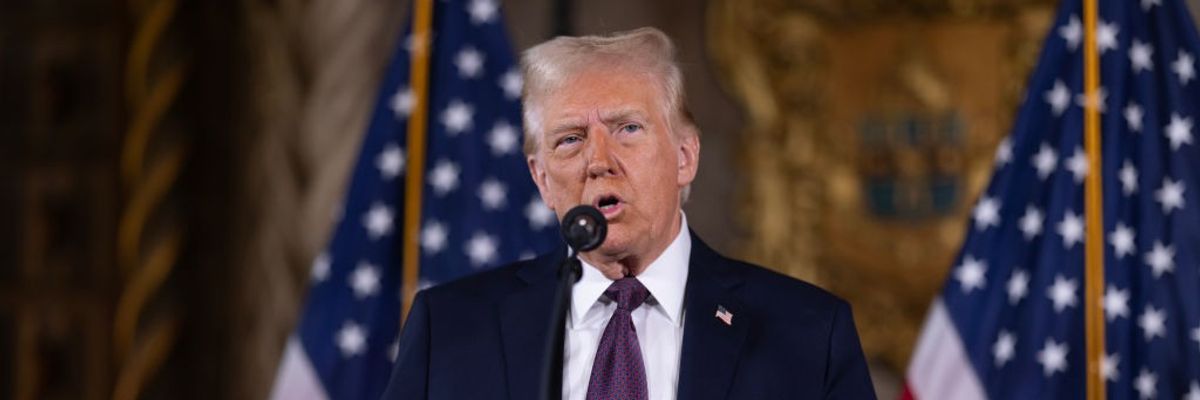
U.S. President-elect Donald Trump speaks to members of the media during a press conference on January 7, 2025 in Palm Beach, Florida.
"No amount of silly rebranding will hide the fact that Trump is planning a multitrillion-dollar tax hike on American families and small businesses to pay for another round of tax handouts to the rich," said Sen. Ron Wyden.
The top Democrat on the Senate Finance Committee said Tuesday that President-elect Donald Trump's proposed creation of an "External Revenue Service" to collect tariff proceeds can't conceal his plans for a massive tax giveaway to the wealthy and large corporations.
"No amount of silly rebranding will hide the fact that Trump is planning a multitrillion-dollar tax hike on American families and small businesses to pay for another round of tax handouts to the rich," Sen. Ron Wyden (D-Ore.) said in a brief statement after Trump announced his proposal in a social media post.
The president-elect wrote that on the first day of his new term, he intends to create "the EXTERNAL REVENUE SERVICE to collect our Tariffs, Duties, and all Revenue that come from Foreign sources."
"We will begin charging those that make money off of us with Trade, and they will start paying, FINALLY, their fair share," Trump added. "January 20, 2025, will be the birth date of the External Revenue Service."
Only Congress can establish new executive branch agencies, so it's unclear how Trump's proposed External Revenue Service would be established. Currently, U.S. Customs and Border Protection collects tariff revenue.
Outside advisers to Trump anonymously told The Washington Post that the president-elect's plan "could involve renaming an existing office within the Treasury Department."
Trump and Republican lawmakers have pointed to tariff revenue—along with deep cuts to Medicaid, federal nutrition assistance, and other key programs—as a potential way to help offset the huge projected cost of their proposed extension of the 2017 tax cuts, parts of which are set to expire at the end of the year.
But the Institute on Taxation and Economic Policy (ITEP) noted in an analysis conducted shortly before the November election that the sweeping tariffs Trump has floated "would largely be passed onto consumers as increased prices." Those price increases "would more than offset" Trump's proposed tax cuts "for all income groups outside the richest 5%."
"If these proposals were in effect in 2026, the richest 1% would receive an average tax cut of about $36,300 and the next richest 4% would receive an average tax cut of about $7,200," ITEP found. "All other groups would see a tax increase, with the hike on the middle 20% at about $1,500 and the increase on the lowest-income 20% of Americans at about $800."
Trump's call for the creation of an "External Revenue Service" comes days after CNN reported that the president-elect is "considering declaring a national economic emergency to provide legal justification for a large swath of universal tariffs on allies and adversaries."
"The declaration would allow Trump to construct a new tariff program by using the International Economic Emergency Powers Act, known as 'IEEPA,' which unilaterally authorizes a president to manage imports during a national emergency," the outlet continued, citing unnamed sources. "Trump, one of the sources noted, has a fondness for the law, since it grants wide-ranging jurisdiction over how tariffs are implemented without strict requirements to prove the tariffs are needed on national security grounds."
The emergency declaration could come as soon as Inauguration Day, according to Axios.
Dear Common Dreams reader, It’s been nearly 30 years since I co-founded Common Dreams with my late wife, Lina Newhouser. We had the radical notion that journalism should serve the public good, not corporate profits. It was clear to us from the outset what it would take to build such a project. No paid advertisements. No corporate sponsors. No millionaire publisher telling us what to think or do. Many people said we wouldn't last a year, but we proved those doubters wrong. Together with a tremendous team of journalists and dedicated staff, we built an independent media outlet free from the constraints of profits and corporate control. Our mission has always been simple: To inform. To inspire. To ignite change for the common good. Building Common Dreams was not easy. Our survival was never guaranteed. When you take on the most powerful forces—Wall Street greed, fossil fuel industry destruction, Big Tech lobbyists, and uber-rich oligarchs who have spent billions upon billions rigging the economy and democracy in their favor—the only bulwark you have is supporters who believe in your work. But here’s the urgent message from me today. It's never been this bad out there. And it's never been this hard to keep us going. At the very moment Common Dreams is most needed, the threats we face are intensifying. We need your support now more than ever. We don't accept corporate advertising and never will. We don't have a paywall because we don't think people should be blocked from critical news based on their ability to pay. Everything we do is funded by the donations of readers like you. When everyone does the little they can afford, we are strong. But if that support retreats or dries up, so do we. Will you donate now to make sure Common Dreams not only survives but thrives? —Craig Brown, Co-founder |
The top Democrat on the Senate Finance Committee said Tuesday that President-elect Donald Trump's proposed creation of an "External Revenue Service" to collect tariff proceeds can't conceal his plans for a massive tax giveaway to the wealthy and large corporations.
"No amount of silly rebranding will hide the fact that Trump is planning a multitrillion-dollar tax hike on American families and small businesses to pay for another round of tax handouts to the rich," Sen. Ron Wyden (D-Ore.) said in a brief statement after Trump announced his proposal in a social media post.
The president-elect wrote that on the first day of his new term, he intends to create "the EXTERNAL REVENUE SERVICE to collect our Tariffs, Duties, and all Revenue that come from Foreign sources."
"We will begin charging those that make money off of us with Trade, and they will start paying, FINALLY, their fair share," Trump added. "January 20, 2025, will be the birth date of the External Revenue Service."
Only Congress can establish new executive branch agencies, so it's unclear how Trump's proposed External Revenue Service would be established. Currently, U.S. Customs and Border Protection collects tariff revenue.
Outside advisers to Trump anonymously told The Washington Post that the president-elect's plan "could involve renaming an existing office within the Treasury Department."
Trump and Republican lawmakers have pointed to tariff revenue—along with deep cuts to Medicaid, federal nutrition assistance, and other key programs—as a potential way to help offset the huge projected cost of their proposed extension of the 2017 tax cuts, parts of which are set to expire at the end of the year.
But the Institute on Taxation and Economic Policy (ITEP) noted in an analysis conducted shortly before the November election that the sweeping tariffs Trump has floated "would largely be passed onto consumers as increased prices." Those price increases "would more than offset" Trump's proposed tax cuts "for all income groups outside the richest 5%."
"If these proposals were in effect in 2026, the richest 1% would receive an average tax cut of about $36,300 and the next richest 4% would receive an average tax cut of about $7,200," ITEP found. "All other groups would see a tax increase, with the hike on the middle 20% at about $1,500 and the increase on the lowest-income 20% of Americans at about $800."
Trump's call for the creation of an "External Revenue Service" comes days after CNN reported that the president-elect is "considering declaring a national economic emergency to provide legal justification for a large swath of universal tariffs on allies and adversaries."
"The declaration would allow Trump to construct a new tariff program by using the International Economic Emergency Powers Act, known as 'IEEPA,' which unilaterally authorizes a president to manage imports during a national emergency," the outlet continued, citing unnamed sources. "Trump, one of the sources noted, has a fondness for the law, since it grants wide-ranging jurisdiction over how tariffs are implemented without strict requirements to prove the tariffs are needed on national security grounds."
The emergency declaration could come as soon as Inauguration Day, according to Axios.
The top Democrat on the Senate Finance Committee said Tuesday that President-elect Donald Trump's proposed creation of an "External Revenue Service" to collect tariff proceeds can't conceal his plans for a massive tax giveaway to the wealthy and large corporations.
"No amount of silly rebranding will hide the fact that Trump is planning a multitrillion-dollar tax hike on American families and small businesses to pay for another round of tax handouts to the rich," Sen. Ron Wyden (D-Ore.) said in a brief statement after Trump announced his proposal in a social media post.
The president-elect wrote that on the first day of his new term, he intends to create "the EXTERNAL REVENUE SERVICE to collect our Tariffs, Duties, and all Revenue that come from Foreign sources."
"We will begin charging those that make money off of us with Trade, and they will start paying, FINALLY, their fair share," Trump added. "January 20, 2025, will be the birth date of the External Revenue Service."
Only Congress can establish new executive branch agencies, so it's unclear how Trump's proposed External Revenue Service would be established. Currently, U.S. Customs and Border Protection collects tariff revenue.
Outside advisers to Trump anonymously told The Washington Post that the president-elect's plan "could involve renaming an existing office within the Treasury Department."
Trump and Republican lawmakers have pointed to tariff revenue—along with deep cuts to Medicaid, federal nutrition assistance, and other key programs—as a potential way to help offset the huge projected cost of their proposed extension of the 2017 tax cuts, parts of which are set to expire at the end of the year.
But the Institute on Taxation and Economic Policy (ITEP) noted in an analysis conducted shortly before the November election that the sweeping tariffs Trump has floated "would largely be passed onto consumers as increased prices." Those price increases "would more than offset" Trump's proposed tax cuts "for all income groups outside the richest 5%."
"If these proposals were in effect in 2026, the richest 1% would receive an average tax cut of about $36,300 and the next richest 4% would receive an average tax cut of about $7,200," ITEP found. "All other groups would see a tax increase, with the hike on the middle 20% at about $1,500 and the increase on the lowest-income 20% of Americans at about $800."
Trump's call for the creation of an "External Revenue Service" comes days after CNN reported that the president-elect is "considering declaring a national economic emergency to provide legal justification for a large swath of universal tariffs on allies and adversaries."
"The declaration would allow Trump to construct a new tariff program by using the International Economic Emergency Powers Act, known as 'IEEPA,' which unilaterally authorizes a president to manage imports during a national emergency," the outlet continued, citing unnamed sources. "Trump, one of the sources noted, has a fondness for the law, since it grants wide-ranging jurisdiction over how tariffs are implemented without strict requirements to prove the tariffs are needed on national security grounds."
The emergency declaration could come as soon as Inauguration Day, according to Axios.