5
#000000
#FFFFFF
To donate by check, phone, or other method, see our More Ways to Give page.
Daily news & progressive opinion—funded by the people, not the corporations—delivered straight to your inbox.
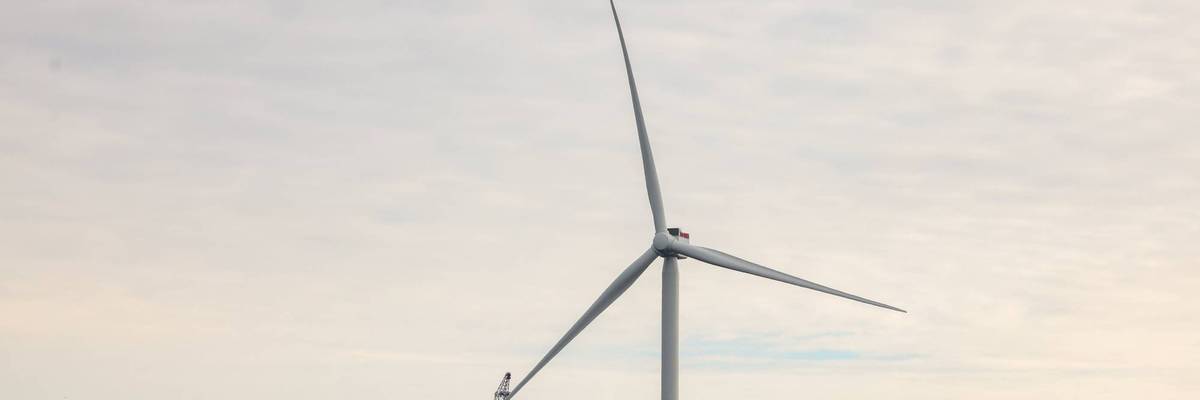
An operational wind turbine, along with two under construction behind it, and a lifting barge, are seen in this photo taken at the South Fork Wind Farm in the Atlantic Ocean, on December 7, 2023.
"Electricity costs are slamming Americans as a result of a not-so-covert Trump plan to stall or block inexpensive clean energy," said Sen. Sheldon Whitehouse.
As oil prices soar, driving up gas and electric bills and straining Americans' wallets, the Trump administration is "extrajudicially blocking" all new wind energy projects in the United States through the US Department of Defense, according to recent reports.
The Financial Times reported over the weekend that as part of the president's "crusade against renewable energy," the department had stalled approvals for about 165 onshore wind projects on private lands—including ones awaiting final sign-off, others in the midst of negotiations, and some that would not typically need oversight from the department at all, according to the American Clean Power Association (ACP).
The Associated Press then reported on Thursday that the number of blocked projects was as high as 250 and that they spanned more than 30 states.
In total, the projects could produce about 30 gigawatts of energy, enough to power 15 million American homes, according to FT.
Trump, who has called wind power the "worst form of energy" and said his "goal is to not let any windmill be built” in the US, has tried many methods to kill the industry, all of which have been struck down in court.
"His Day 1 executive order against the wind industry was found unconstitutional. Each of his stop-work orders trying to shut down wind farms was overruled. Numerous moves by his Interior Department were ruled illegal," explained Heatmap senior reporter Jael Holzman.
But she said that even amid these failures, "renewable energy industry insiders have been quietly skittish about a potential secret weapon: the Federal Aviation Administration" (FAA).
Structures over 200 feet must be approved by the FAA before construction, which involves an assessment by the Defense Department.
Holzman wrote that according to industry insiders, including those at the ACP, "the issues started last summer but were limited in scale, primarily impacting projects that may have required some sort of deal to mitigate potential impacts on radar or other military functions."
But over the past few weeks, Holzman said ACP told her that "this once-routine process has fully deteriorated, and companies are operating with the understanding FAA approvals are on pause because the Department of Defense... refuses to sign off on anything."
The group said the refusals have been indiscriminate and that they have affected projects where there are "no obvious impacts to military operations."
Tony Irish, a former career attorney for the Department of the Interior who served during Trump's first term, told Heatmap that amid continued legal failures, the administration is trying to "find ways to avoid courts altogether" and acting upon "a unilateral desire to achieve an end regardless of the legality of it, just using brute force.”
The administration's attempt to strangle the wind industry comes amid ongoing but fragile negotiations between Democrats and Republicans in Congress over permitting reforms that the GOP hopes will speed up approval of fossil fuel projects.
Democrats previously shut down talks in response to the Trump administration halting construction of several wind projects, but said they'd be open to a compromise if the administration agreed to treat renewables fairly.
Last month, Sen. Martin Heinrich (D-NM), a leader of the negotiations on the Democratic side, told Interior Secretary Doug Burgum that if any deal is to be reached, the Trump administration must create confidence that it will not "slow walk" wind and solar permits.
Heinrich told Heatmap on Thursday that the administration's apparent action to halt wind approvals entirely "undercuts their credibility and bipartisan permitting reform.”
Heatmap correspondent Matthew Zeitlin remarked: "At no point did Congress say, 'We want to make new wind power illegal.' If someone presented such a bill, it would lose overwhelmingly. But the president is pulling every possible administrative lever he has to functionally ban it."
The Pentagon acknowledged to Heatmap that it is "actively" reviewing land-based wind projects. However, the FAA declined to comment on whether it was effectively banning new wind projects. White House deputy press secretary Anna Kelly said the Pentagon's statement "does not confirm" that a de facto ban is in place.
Efforts to crush clean energy loom especially large amid the ongoing fuel crisis caused by Trump's war in Iran. In addition to causing gas prices to spike to about $4.50/gallon on average, wholesale electricity prices surged by 8.5% in March after the war was launched, according to The Associated Press.
Countries with large amounts of renewable energy production have proven more capable of avoiding massive spikes in energy costs, while the US has seen some of the worst in the world despite Trump's claims that "energy independence" is saving the day.
Wind energy already accounts for about 10% of America's electricity use and is often cheaper to produce in the long run than fossil fuels, not to mention better for the climate.
As high energy prices and inflation have driven the president's approval rating to its lowest level ever, Jordan Weissmann, the editorial director at the Progressive Policy Project, marveled that "Trump is actively raising voters' electric bills because he hates wind turbines."
"This isn’t energy dominance," agreed Sen. Alex Padilla (D-Calif.). "This is sacrificing American jobs, weakening the American grid, and forcing American families to pay even higher prices."
Sen. Sheldon Whitehouse (D-RI) said that "electricity costs are slamming Americans, as a result of a not-so-covert Trump plan to stall or block inexpensive clean energy. Every blocked kilowatt of clean energy comes instead from fossil fuel. Customers' rates go way up, and all that extra cost families pay goes to (cue drumroll) Trump's corrupt fossil fuel donors. It's on purpose."
The Sunrise Movement argued that Trump's war on wind energy is quite consistent with his method of governing, which has often explicitly involved taking actions meant to maximize the profits of the fossil fuel interests that have backed him and his political movement.
"Trump's energy policy has one priority: help his Big Oil donors make a final cash grab before their industry goes extinct," the group said. "If energy prices spike and the climate crisis worsens... well, that's working people's price to pay."
Dear Common Dreams reader, It’s been nearly 30 years since I co-founded Common Dreams with my late wife, Lina Newhouser. We had the radical notion that journalism should serve the public good, not corporate profits. It was clear to us from the outset what it would take to build such a project. No paid advertisements. No corporate sponsors. No millionaire publisher telling us what to think or do. Many people said we wouldn't last a year, but we proved those doubters wrong. Together with a tremendous team of journalists and dedicated staff, we built an independent media outlet free from the constraints of profits and corporate control. Our mission has always been simple: To inform. To inspire. To ignite change for the common good. Building Common Dreams was not easy. Our survival was never guaranteed. When you take on the most powerful forces—Wall Street greed, fossil fuel industry destruction, Big Tech lobbyists, and uber-rich oligarchs who have spent billions upon billions rigging the economy and democracy in their favor—the only bulwark you have is supporters who believe in your work. But here’s the urgent message from me today. It's never been this bad out there. And it's never been this hard to keep us going. At the very moment Common Dreams is most needed, the threats we face are intensifying. We need your support now more than ever. We don't accept corporate advertising and never will. We don't have a paywall because we don't think people should be blocked from critical news based on their ability to pay. Everything we do is funded by the donations of readers like you. When everyone does the little they can afford, we are strong. But if that support retreats or dries up, so do we. Will you donate now to make sure Common Dreams not only survives but thrives? —Craig Brown, Co-founder |
As oil prices soar, driving up gas and electric bills and straining Americans' wallets, the Trump administration is "extrajudicially blocking" all new wind energy projects in the United States through the US Department of Defense, according to recent reports.
The Financial Times reported over the weekend that as part of the president's "crusade against renewable energy," the department had stalled approvals for about 165 onshore wind projects on private lands—including ones awaiting final sign-off, others in the midst of negotiations, and some that would not typically need oversight from the department at all, according to the American Clean Power Association (ACP).
The Associated Press then reported on Thursday that the number of blocked projects was as high as 250 and that they spanned more than 30 states.
In total, the projects could produce about 30 gigawatts of energy, enough to power 15 million American homes, according to FT.
Trump, who has called wind power the "worst form of energy" and said his "goal is to not let any windmill be built” in the US, has tried many methods to kill the industry, all of which have been struck down in court.
"His Day 1 executive order against the wind industry was found unconstitutional. Each of his stop-work orders trying to shut down wind farms was overruled. Numerous moves by his Interior Department were ruled illegal," explained Heatmap senior reporter Jael Holzman.
But she said that even amid these failures, "renewable energy industry insiders have been quietly skittish about a potential secret weapon: the Federal Aviation Administration" (FAA).
Structures over 200 feet must be approved by the FAA before construction, which involves an assessment by the Defense Department.
Holzman wrote that according to industry insiders, including those at the ACP, "the issues started last summer but were limited in scale, primarily impacting projects that may have required some sort of deal to mitigate potential impacts on radar or other military functions."
But over the past few weeks, Holzman said ACP told her that "this once-routine process has fully deteriorated, and companies are operating with the understanding FAA approvals are on pause because the Department of Defense... refuses to sign off on anything."
The group said the refusals have been indiscriminate and that they have affected projects where there are "no obvious impacts to military operations."
Tony Irish, a former career attorney for the Department of the Interior who served during Trump's first term, told Heatmap that amid continued legal failures, the administration is trying to "find ways to avoid courts altogether" and acting upon "a unilateral desire to achieve an end regardless of the legality of it, just using brute force.”
The administration's attempt to strangle the wind industry comes amid ongoing but fragile negotiations between Democrats and Republicans in Congress over permitting reforms that the GOP hopes will speed up approval of fossil fuel projects.
Democrats previously shut down talks in response to the Trump administration halting construction of several wind projects, but said they'd be open to a compromise if the administration agreed to treat renewables fairly.
Last month, Sen. Martin Heinrich (D-NM), a leader of the negotiations on the Democratic side, told Interior Secretary Doug Burgum that if any deal is to be reached, the Trump administration must create confidence that it will not "slow walk" wind and solar permits.
Heinrich told Heatmap on Thursday that the administration's apparent action to halt wind approvals entirely "undercuts their credibility and bipartisan permitting reform.”
Heatmap correspondent Matthew Zeitlin remarked: "At no point did Congress say, 'We want to make new wind power illegal.' If someone presented such a bill, it would lose overwhelmingly. But the president is pulling every possible administrative lever he has to functionally ban it."
The Pentagon acknowledged to Heatmap that it is "actively" reviewing land-based wind projects. However, the FAA declined to comment on whether it was effectively banning new wind projects. White House deputy press secretary Anna Kelly said the Pentagon's statement "does not confirm" that a de facto ban is in place.
Efforts to crush clean energy loom especially large amid the ongoing fuel crisis caused by Trump's war in Iran. In addition to causing gas prices to spike to about $4.50/gallon on average, wholesale electricity prices surged by 8.5% in March after the war was launched, according to The Associated Press.
Countries with large amounts of renewable energy production have proven more capable of avoiding massive spikes in energy costs, while the US has seen some of the worst in the world despite Trump's claims that "energy independence" is saving the day.
Wind energy already accounts for about 10% of America's electricity use and is often cheaper to produce in the long run than fossil fuels, not to mention better for the climate.
As high energy prices and inflation have driven the president's approval rating to its lowest level ever, Jordan Weissmann, the editorial director at the Progressive Policy Project, marveled that "Trump is actively raising voters' electric bills because he hates wind turbines."
"This isn’t energy dominance," agreed Sen. Alex Padilla (D-Calif.). "This is sacrificing American jobs, weakening the American grid, and forcing American families to pay even higher prices."
Sen. Sheldon Whitehouse (D-RI) said that "electricity costs are slamming Americans, as a result of a not-so-covert Trump plan to stall or block inexpensive clean energy. Every blocked kilowatt of clean energy comes instead from fossil fuel. Customers' rates go way up, and all that extra cost families pay goes to (cue drumroll) Trump's corrupt fossil fuel donors. It's on purpose."
The Sunrise Movement argued that Trump's war on wind energy is quite consistent with his method of governing, which has often explicitly involved taking actions meant to maximize the profits of the fossil fuel interests that have backed him and his political movement.
"Trump's energy policy has one priority: help his Big Oil donors make a final cash grab before their industry goes extinct," the group said. "If energy prices spike and the climate crisis worsens... well, that's working people's price to pay."
As oil prices soar, driving up gas and electric bills and straining Americans' wallets, the Trump administration is "extrajudicially blocking" all new wind energy projects in the United States through the US Department of Defense, according to recent reports.
The Financial Times reported over the weekend that as part of the president's "crusade against renewable energy," the department had stalled approvals for about 165 onshore wind projects on private lands—including ones awaiting final sign-off, others in the midst of negotiations, and some that would not typically need oversight from the department at all, according to the American Clean Power Association (ACP).
The Associated Press then reported on Thursday that the number of blocked projects was as high as 250 and that they spanned more than 30 states.
In total, the projects could produce about 30 gigawatts of energy, enough to power 15 million American homes, according to FT.
Trump, who has called wind power the "worst form of energy" and said his "goal is to not let any windmill be built” in the US, has tried many methods to kill the industry, all of which have been struck down in court.
"His Day 1 executive order against the wind industry was found unconstitutional. Each of his stop-work orders trying to shut down wind farms was overruled. Numerous moves by his Interior Department were ruled illegal," explained Heatmap senior reporter Jael Holzman.
But she said that even amid these failures, "renewable energy industry insiders have been quietly skittish about a potential secret weapon: the Federal Aviation Administration" (FAA).
Structures over 200 feet must be approved by the FAA before construction, which involves an assessment by the Defense Department.
Holzman wrote that according to industry insiders, including those at the ACP, "the issues started last summer but were limited in scale, primarily impacting projects that may have required some sort of deal to mitigate potential impacts on radar or other military functions."
But over the past few weeks, Holzman said ACP told her that "this once-routine process has fully deteriorated, and companies are operating with the understanding FAA approvals are on pause because the Department of Defense... refuses to sign off on anything."
The group said the refusals have been indiscriminate and that they have affected projects where there are "no obvious impacts to military operations."
Tony Irish, a former career attorney for the Department of the Interior who served during Trump's first term, told Heatmap that amid continued legal failures, the administration is trying to "find ways to avoid courts altogether" and acting upon "a unilateral desire to achieve an end regardless of the legality of it, just using brute force.”
The administration's attempt to strangle the wind industry comes amid ongoing but fragile negotiations between Democrats and Republicans in Congress over permitting reforms that the GOP hopes will speed up approval of fossil fuel projects.
Democrats previously shut down talks in response to the Trump administration halting construction of several wind projects, but said they'd be open to a compromise if the administration agreed to treat renewables fairly.
Last month, Sen. Martin Heinrich (D-NM), a leader of the negotiations on the Democratic side, told Interior Secretary Doug Burgum that if any deal is to be reached, the Trump administration must create confidence that it will not "slow walk" wind and solar permits.
Heinrich told Heatmap on Thursday that the administration's apparent action to halt wind approvals entirely "undercuts their credibility and bipartisan permitting reform.”
Heatmap correspondent Matthew Zeitlin remarked: "At no point did Congress say, 'We want to make new wind power illegal.' If someone presented such a bill, it would lose overwhelmingly. But the president is pulling every possible administrative lever he has to functionally ban it."
The Pentagon acknowledged to Heatmap that it is "actively" reviewing land-based wind projects. However, the FAA declined to comment on whether it was effectively banning new wind projects. White House deputy press secretary Anna Kelly said the Pentagon's statement "does not confirm" that a de facto ban is in place.
Efforts to crush clean energy loom especially large amid the ongoing fuel crisis caused by Trump's war in Iran. In addition to causing gas prices to spike to about $4.50/gallon on average, wholesale electricity prices surged by 8.5% in March after the war was launched, according to The Associated Press.
Countries with large amounts of renewable energy production have proven more capable of avoiding massive spikes in energy costs, while the US has seen some of the worst in the world despite Trump's claims that "energy independence" is saving the day.
Wind energy already accounts for about 10% of America's electricity use and is often cheaper to produce in the long run than fossil fuels, not to mention better for the climate.
As high energy prices and inflation have driven the president's approval rating to its lowest level ever, Jordan Weissmann, the editorial director at the Progressive Policy Project, marveled that "Trump is actively raising voters' electric bills because he hates wind turbines."
"This isn’t energy dominance," agreed Sen. Alex Padilla (D-Calif.). "This is sacrificing American jobs, weakening the American grid, and forcing American families to pay even higher prices."
Sen. Sheldon Whitehouse (D-RI) said that "electricity costs are slamming Americans, as a result of a not-so-covert Trump plan to stall or block inexpensive clean energy. Every blocked kilowatt of clean energy comes instead from fossil fuel. Customers' rates go way up, and all that extra cost families pay goes to (cue drumroll) Trump's corrupt fossil fuel donors. It's on purpose."
The Sunrise Movement argued that Trump's war on wind energy is quite consistent with his method of governing, which has often explicitly involved taking actions meant to maximize the profits of the fossil fuel interests that have backed him and his political movement.
"Trump's energy policy has one priority: help his Big Oil donors make a final cash grab before their industry goes extinct," the group said. "If energy prices spike and the climate crisis worsens... well, that's working people's price to pay."