5
#000000
#FFFFFF
To donate by check, phone, or other method, see our More Ways to Give page.
Daily news & progressive opinion—funded by the people, not the corporations—delivered straight to your inbox.
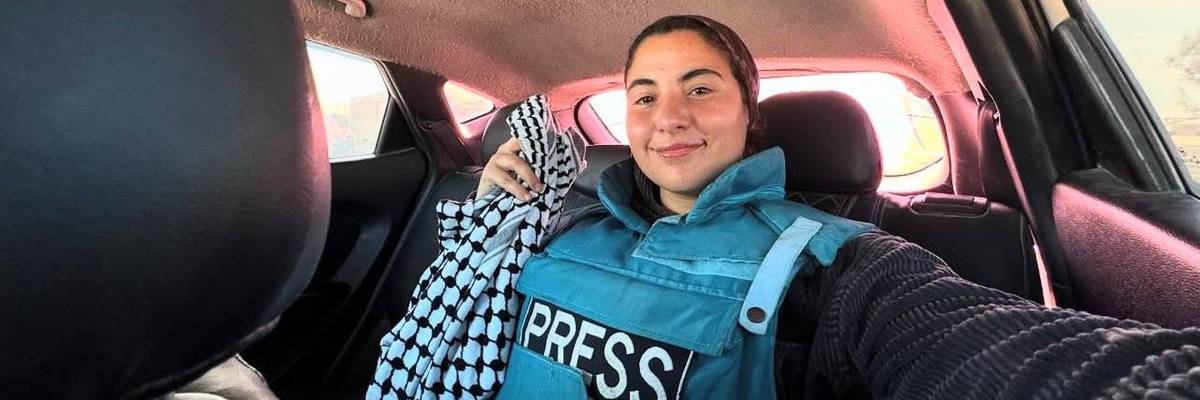
Palestinian journalist Bisan Owda wears a press vest in a car in the Gaza Strip on July 4, 2025.
The ban of journalist Bisan Owda comes amid an alleged wave of censorship after the platform was taken over by a clique of Trump-aligned investors, including the pro-Israel megadonor Larry Ellison.
Bisan Owda is still alive, but not on TikTok.
The award-winning Palestinian journalist and filmmaker found that her social media account had been suddenly terminated days ago, as part of an alleged wave of censorship following the platform's formal takeover by American investors last Thursday.
“TikTok deleted my account. I had 1.4 million followers there, and I have been building that platform for four years,” the 28-year-old Owda said in a video posted to her other social media accounts on Wednesday, just days after TikTok's new owners assumed control.
“I expected that it would be restricted," she said, "not banned forever."
Owda had achieved a massive following for her daily vlogs documenting life amid Israel's genocide in the Gaza Strip. She showed herself constantly on the move, one of the nearly 2 million residents in the strip forcibly displaced by the military onslaught, and gave viewers a firsthand account of Israel's attacks on hospitals, its leveling of neighborhoods, and its assassinations of journalists.
Each of them began with the signature phrase: "It's Bisan from Gaza, and I'm still alive."
A documentary with that title, produced with the Al Jazeera media network, won multiple awards, including an Emmy in 2024 for news and documentary filmmaking.
Owda's videos, which are mostly in English, gave Western audiences a humanizing glimpse into the lives of Palestinian people victimized by the war. She was one of many Palestinians who shared their stories on platforms like TikTok, which American legislators blamed for the titanic shift in youth public opinion against Israel since the genocide began in October 2023.
In 2024, then-Sen. Mitt Romney (R-Utah) infamously justified the bipartisan push to ban the platform by decrying the "overwhelming" volume of "mentions of Palestinians" on it.
Others, including Sen. Josh Hawley (R-Mo.) and then-Sen. Marco Rubio (R-Fla.), who is now the secretary of state, expressed similar sentiments that TikTok was a critical front in an information war for the minds of young people.
In the video announcing her ban, Owda drew attention to comments by Israeli Prime Minister Benjamin Netanyahu, who said in September that social media was the most important "battlefield" on which Israel needed to engage.
Netanyahu said the "most important purchase" going on at the time was the sale of TikTok from the Chinese company ByteDance to American investors, which had been enforced via an executive order from US President Donald Trump.
Among those investors was Oracle CEO Larry Ellison, who now holds both a 15% stake in TikTok and the primary responsibility for data security and algorithm oversight. In addition to being a major donor to Republican causes, Ellison describes himself as having a "deep emotional connection to the state of Israel," has been listed as the largest private donor to Israeli military causes, and is a close personal friend of Netanyahu.
Other major stakeholders include the US-based private equity firm Silver Lake, which has close ties to Trump's son-in-law Jared Kushner, and the Emirati investment firm MGX, which contributed an unprecedented $2 billion in a deal to help Trump's lucrative cryptocurrency startup, World Liberty Financial.
Owda also highlighted comments made by Adam Presser, the new CEO of TikTok, describing changes he'd help to make to the platform while working as its head of operations in the US that limited use of the word "Zionist" in a negative context.
"We made a change to designate the use of the term 'Zionist' as a proxy for a protected attribute as hate speech," Presser said. "So if someone were to use 'Zionist,' of course, you can use it in the sense of you're a proud Zionist. But if you're using it in the context of degrading somebody, calling somebody a Zionist as a dirty name, then that gets designated as hate speech to be moderated against."
The apparent censorship of Owda comes as many other users report that their content critical of the Trump administration has been throttled in the days following the takeover by the new owners.
Users have found themselves unable to upload content critical of US Immigration and Customs Enforcement (ICE) and unable to send direct messages containing the word "Epstein," referring to the late sex trafficker Jeffrey Epstein, whose relationship with Trump has come under scrutiny of late.
TikTok's owners have denied censoring content, blaming the issues on a power outage at an Oracle data center.
Following these reports, Democratic California Gov. Gavin Newsom launched an investigation into whether the platform was censoring anti-Trump content.
According to CNBC, the daily average number of users deleting TikTok has shot up by 150% since the new owners took over.
Over the past week, hundreds of thousands of users have flocked to a new platform called UpScrolled, which was launched in July 2025 by Palestinian-Australian app developer Issam Hijazi, who said he created it as a counter to the overwhelming presence of pro-Israel content on established platforms.
Dear Common Dreams reader, The U.S. is on a fast track to authoritarianism like nothing I've ever seen. Meanwhile, corporate news outlets are utterly capitulating to Trump, twisting their coverage to avoid drawing his ire while lining up to stuff cash in his pockets. That's why I believe that Common Dreams is doing the best and most consequential reporting that we've ever done. Our small but mighty team is a progressive reporting powerhouse, covering the news every day that the corporate media never will. Our mission has always been simple: To inform. To inspire. And to ignite change for the common good. Now here's the key piece that I want all our readers to understand: None of this would be possible without your financial support. That's not just some fundraising cliche. It's the absolute and literal truth. We don't accept corporate advertising and never will. We don't have a paywall because we don't think people should be blocked from critical news based on their ability to pay. Everything we do is funded by the donations of readers like you. Will you donate now to help power the nonprofit, independent reporting of Common Dreams? Thank you for being a vital member of our community. Together, we can keep independent journalism alive when it’s needed most. - Craig Brown, Co-founder |
Bisan Owda is still alive, but not on TikTok.
The award-winning Palestinian journalist and filmmaker found that her social media account had been suddenly terminated days ago, as part of an alleged wave of censorship following the platform's formal takeover by American investors last Thursday.
“TikTok deleted my account. I had 1.4 million followers there, and I have been building that platform for four years,” the 28-year-old Owda said in a video posted to her other social media accounts on Wednesday, just days after TikTok's new owners assumed control.
“I expected that it would be restricted," she said, "not banned forever."
Owda had achieved a massive following for her daily vlogs documenting life amid Israel's genocide in the Gaza Strip. She showed herself constantly on the move, one of the nearly 2 million residents in the strip forcibly displaced by the military onslaught, and gave viewers a firsthand account of Israel's attacks on hospitals, its leveling of neighborhoods, and its assassinations of journalists.
Each of them began with the signature phrase: "It's Bisan from Gaza, and I'm still alive."
A documentary with that title, produced with the Al Jazeera media network, won multiple awards, including an Emmy in 2024 for news and documentary filmmaking.
Owda's videos, which are mostly in English, gave Western audiences a humanizing glimpse into the lives of Palestinian people victimized by the war. She was one of many Palestinians who shared their stories on platforms like TikTok, which American legislators blamed for the titanic shift in youth public opinion against Israel since the genocide began in October 2023.
In 2024, then-Sen. Mitt Romney (R-Utah) infamously justified the bipartisan push to ban the platform by decrying the "overwhelming" volume of "mentions of Palestinians" on it.
Others, including Sen. Josh Hawley (R-Mo.) and then-Sen. Marco Rubio (R-Fla.), who is now the secretary of state, expressed similar sentiments that TikTok was a critical front in an information war for the minds of young people.
In the video announcing her ban, Owda drew attention to comments by Israeli Prime Minister Benjamin Netanyahu, who said in September that social media was the most important "battlefield" on which Israel needed to engage.
Netanyahu said the "most important purchase" going on at the time was the sale of TikTok from the Chinese company ByteDance to American investors, which had been enforced via an executive order from US President Donald Trump.
Among those investors was Oracle CEO Larry Ellison, who now holds both a 15% stake in TikTok and the primary responsibility for data security and algorithm oversight. In addition to being a major donor to Republican causes, Ellison describes himself as having a "deep emotional connection to the state of Israel," has been listed as the largest private donor to Israeli military causes, and is a close personal friend of Netanyahu.
Other major stakeholders include the US-based private equity firm Silver Lake, which has close ties to Trump's son-in-law Jared Kushner, and the Emirati investment firm MGX, which contributed an unprecedented $2 billion in a deal to help Trump's lucrative cryptocurrency startup, World Liberty Financial.
Owda also highlighted comments made by Adam Presser, the new CEO of TikTok, describing changes he'd help to make to the platform while working as its head of operations in the US that limited use of the word "Zionist" in a negative context.
"We made a change to designate the use of the term 'Zionist' as a proxy for a protected attribute as hate speech," Presser said. "So if someone were to use 'Zionist,' of course, you can use it in the sense of you're a proud Zionist. But if you're using it in the context of degrading somebody, calling somebody a Zionist as a dirty name, then that gets designated as hate speech to be moderated against."
The apparent censorship of Owda comes as many other users report that their content critical of the Trump administration has been throttled in the days following the takeover by the new owners.
Users have found themselves unable to upload content critical of US Immigration and Customs Enforcement (ICE) and unable to send direct messages containing the word "Epstein," referring to the late sex trafficker Jeffrey Epstein, whose relationship with Trump has come under scrutiny of late.
TikTok's owners have denied censoring content, blaming the issues on a power outage at an Oracle data center.
Following these reports, Democratic California Gov. Gavin Newsom launched an investigation into whether the platform was censoring anti-Trump content.
According to CNBC, the daily average number of users deleting TikTok has shot up by 150% since the new owners took over.
Over the past week, hundreds of thousands of users have flocked to a new platform called UpScrolled, which was launched in July 2025 by Palestinian-Australian app developer Issam Hijazi, who said he created it as a counter to the overwhelming presence of pro-Israel content on established platforms.
Bisan Owda is still alive, but not on TikTok.
The award-winning Palestinian journalist and filmmaker found that her social media account had been suddenly terminated days ago, as part of an alleged wave of censorship following the platform's formal takeover by American investors last Thursday.
“TikTok deleted my account. I had 1.4 million followers there, and I have been building that platform for four years,” the 28-year-old Owda said in a video posted to her other social media accounts on Wednesday, just days after TikTok's new owners assumed control.
“I expected that it would be restricted," she said, "not banned forever."
Owda had achieved a massive following for her daily vlogs documenting life amid Israel's genocide in the Gaza Strip. She showed herself constantly on the move, one of the nearly 2 million residents in the strip forcibly displaced by the military onslaught, and gave viewers a firsthand account of Israel's attacks on hospitals, its leveling of neighborhoods, and its assassinations of journalists.
Each of them began with the signature phrase: "It's Bisan from Gaza, and I'm still alive."
A documentary with that title, produced with the Al Jazeera media network, won multiple awards, including an Emmy in 2024 for news and documentary filmmaking.
Owda's videos, which are mostly in English, gave Western audiences a humanizing glimpse into the lives of Palestinian people victimized by the war. She was one of many Palestinians who shared their stories on platforms like TikTok, which American legislators blamed for the titanic shift in youth public opinion against Israel since the genocide began in October 2023.
In 2024, then-Sen. Mitt Romney (R-Utah) infamously justified the bipartisan push to ban the platform by decrying the "overwhelming" volume of "mentions of Palestinians" on it.
Others, including Sen. Josh Hawley (R-Mo.) and then-Sen. Marco Rubio (R-Fla.), who is now the secretary of state, expressed similar sentiments that TikTok was a critical front in an information war for the minds of young people.
In the video announcing her ban, Owda drew attention to comments by Israeli Prime Minister Benjamin Netanyahu, who said in September that social media was the most important "battlefield" on which Israel needed to engage.
Netanyahu said the "most important purchase" going on at the time was the sale of TikTok from the Chinese company ByteDance to American investors, which had been enforced via an executive order from US President Donald Trump.
Among those investors was Oracle CEO Larry Ellison, who now holds both a 15% stake in TikTok and the primary responsibility for data security and algorithm oversight. In addition to being a major donor to Republican causes, Ellison describes himself as having a "deep emotional connection to the state of Israel," has been listed as the largest private donor to Israeli military causes, and is a close personal friend of Netanyahu.
Other major stakeholders include the US-based private equity firm Silver Lake, which has close ties to Trump's son-in-law Jared Kushner, and the Emirati investment firm MGX, which contributed an unprecedented $2 billion in a deal to help Trump's lucrative cryptocurrency startup, World Liberty Financial.
Owda also highlighted comments made by Adam Presser, the new CEO of TikTok, describing changes he'd help to make to the platform while working as its head of operations in the US that limited use of the word "Zionist" in a negative context.
"We made a change to designate the use of the term 'Zionist' as a proxy for a protected attribute as hate speech," Presser said. "So if someone were to use 'Zionist,' of course, you can use it in the sense of you're a proud Zionist. But if you're using it in the context of degrading somebody, calling somebody a Zionist as a dirty name, then that gets designated as hate speech to be moderated against."
The apparent censorship of Owda comes as many other users report that their content critical of the Trump administration has been throttled in the days following the takeover by the new owners.
Users have found themselves unable to upload content critical of US Immigration and Customs Enforcement (ICE) and unable to send direct messages containing the word "Epstein," referring to the late sex trafficker Jeffrey Epstein, whose relationship with Trump has come under scrutiny of late.
TikTok's owners have denied censoring content, blaming the issues on a power outage at an Oracle data center.
Following these reports, Democratic California Gov. Gavin Newsom launched an investigation into whether the platform was censoring anti-Trump content.
According to CNBC, the daily average number of users deleting TikTok has shot up by 150% since the new owners took over.
Over the past week, hundreds of thousands of users have flocked to a new platform called UpScrolled, which was launched in July 2025 by Palestinian-Australian app developer Issam Hijazi, who said he created it as a counter to the overwhelming presence of pro-Israel content on established platforms.