SUBSCRIBE TO OUR FREE NEWSLETTER
Daily news & progressive opinion—funded by the people, not the corporations—delivered straight to your inbox.
5
#000000
#FFFFFF
To donate by check, phone, or other method, see our More Ways to Give page.
Daily news & progressive opinion—funded by the people, not the corporations—delivered straight to your inbox.
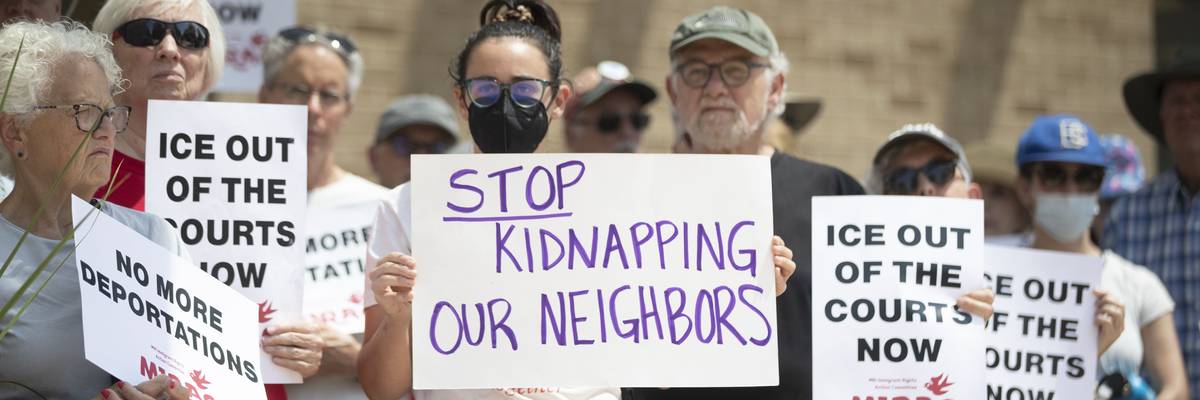
Demonstrators demand that US Immigration and Customs Enforcement (ICE) enforcers stay out of courtrooms during a July 14, 2025 protest in St. Paul, Minnesota.
“The administration’s reckless courthouse arrest policy is an affront to justice, designed to sabotage the immigration court system and force people to abandon their lawful claims," said one plaintiffs' attorney.
Civil rights groups on Thursday filed a pair of legal motions seeking a nationwide block of the Trump administration's mass arrest policy targeting people attending scheduled immigration court appearances and their extended detention in ill-equipped facilities.
The Lawyers' Committee for Civil Rights of the San Francisco Bay Area (LCCRSF), Central American Resource Center (CARECEN) San Francisco, ACLU of Northern California, and the law firm Coblentz Patch Duffy & Bass LLP filed the motions in the United States District Court for the Northern District of California.
One motion contests US Immigration and Customs Enforcement's Nationwide Hold Room Waiver, a policy enacted last June that extended the maximum amount of time people can be held by ICE in temporary detention cells from 12 to 72 hours. The other motion seeks to vacate ICE's and the Executive Office for Immigration Review’s courthouse arrest policy, arguing it violates the Administrative Procedure Act, which requires federal agencies to follow specific, standardized procedures during their rulemaking process.
“From arrest to detention, the Trump administration’s policies are a symptom of a lawless approach to governance," ACLU of Northern California director of appellate advocacy and plaintiffs' attorney Neil Sawhney said in a statement Friday. "One policy creates fear of the system, and the other inflicts suffering within it, creating a cycle of trauma. We are fighting to break this cycle by ending both the courthouse arrests and the prolonged, brutal detentions they feed."
The new motions stem from the ongoing class action lawsuit Sequen v. Albarran, a case challenging the Trump administration’s courthouse arrests and prolonged detention of immigrants in unsafe conditions in temporary lockups.
“The administration’s reckless courthouse arrest policy is an affront to justice, designed to sabotage the immigration court system and force people to abandon their lawful claims,” said LCCRSF program director Jordan Wells, a lawyer representing plaintiffs in the case. "This is a critical step in ensuring that immigrants can safely pursue their immigration cases without fear of arrest.”
Last month, US District Judge Casey Pitts granted a stay in Sequen v. Albarran, temporarily blocking ICE from making courthouse arrests within the agency's San Francisco Area of Responsibility, pending the outcome of the broader legal challenge.
Pitts had previously granted a preliminary injunction ordering ICE to immediately improve "inhumane" and "punitive" conditions at the agency's Sansome Street holding facility in San Francisco.
A separate lawsuit filed last July by the National Immigrant Justice Center, Democracy Forward, LCCRSF, and the Refugee and Immigrant Center for Legal Education and Services in the US District Court for the District of Columbia is also challenging the Trump administration's courthouse arrest policy.
“The Trump administration’s arbitrary policies are an assault on due process. Transforming immigration courthouses into sites of arrest eviscerates the right to access justice while prolonging detention in barren cells violates the Fifth Amendment’s core promise against punishment without trial," Nisha Kashyap, another LCCRSF lawyer for the plaintiffs, said Friday.
"Our fight is to restore the foundational principle that the government cannot detain people in inhumane conditions or terrorize them out of court,” she added.
While the Trump administration claims the ICE crackdown is primarily targeting dangerous criminals, critics have noted that people legally seeking asylum, families, relatives of American citizens, and even citizens themselves have been swept up in the mass deportation dragnet. According to a recent analysis by the libertarian Cato Institute, 73% of people taken by ICE had no criminal convictions.
CARECEN legal director Laura Sanchez said Friday that the Trump administration's arrest and detention policies "are a direct attack on the safety and dignity of our families" and "force parents to choose between appearing in court to fight for their right to stay with their children, or missing that hearing to avoid being snatched away by masked agents."
"We hear the trauma in our community’s voices every day," Sanchez added. "This legal action is our collective cry for justice. We ask the court to uphold the rule of law and restore human dignity."
Mark Hejinian, a partner at Coblentz Patch Duffy & Bass LLP, asserted that “the Administrative Procedure Act is a cornerstone of accountable government, requiring agencies to act with reason and transparency."
"The Trump administration has trampled on these requirements," he added. "The government failed to consider alternatives and disregarded profound constitutional and human costs. We hope the court will see these failures and vacate both policies.”
Dear Common Dreams reader, It’s been nearly 30 years since I co-founded Common Dreams with my late wife, Lina Newhouser. We had the radical notion that journalism should serve the public good, not corporate profits. It was clear to us from the outset what it would take to build such a project. No paid advertisements. No corporate sponsors. No millionaire publisher telling us what to think or do. Many people said we wouldn't last a year, but we proved those doubters wrong. Together with a tremendous team of journalists and dedicated staff, we built an independent media outlet free from the constraints of profits and corporate control. Our mission has always been simple: To inform. To inspire. To ignite change for the common good. Building Common Dreams was not easy. Our survival was never guaranteed. When you take on the most powerful forces—Wall Street greed, fossil fuel industry destruction, Big Tech lobbyists, and uber-rich oligarchs who have spent billions upon billions rigging the economy and democracy in their favor—the only bulwark you have is supporters who believe in your work. But here’s the urgent message from me today. It's never been this bad out there. And it's never been this hard to keep us going. At the very moment Common Dreams is most needed, the threats we face are intensifying. We need your support now more than ever. We don't accept corporate advertising and never will. We don't have a paywall because we don't think people should be blocked from critical news based on their ability to pay. Everything we do is funded by the donations of readers like you. When everyone does the little they can afford, we are strong. But if that support retreats or dries up, so do we. Will you donate now to make sure Common Dreams not only survives but thrives? —Craig Brown, Co-founder |
Civil rights groups on Thursday filed a pair of legal motions seeking a nationwide block of the Trump administration's mass arrest policy targeting people attending scheduled immigration court appearances and their extended detention in ill-equipped facilities.
The Lawyers' Committee for Civil Rights of the San Francisco Bay Area (LCCRSF), Central American Resource Center (CARECEN) San Francisco, ACLU of Northern California, and the law firm Coblentz Patch Duffy & Bass LLP filed the motions in the United States District Court for the Northern District of California.
One motion contests US Immigration and Customs Enforcement's Nationwide Hold Room Waiver, a policy enacted last June that extended the maximum amount of time people can be held by ICE in temporary detention cells from 12 to 72 hours. The other motion seeks to vacate ICE's and the Executive Office for Immigration Review’s courthouse arrest policy, arguing it violates the Administrative Procedure Act, which requires federal agencies to follow specific, standardized procedures during their rulemaking process.
“From arrest to detention, the Trump administration’s policies are a symptom of a lawless approach to governance," ACLU of Northern California director of appellate advocacy and plaintiffs' attorney Neil Sawhney said in a statement Friday. "One policy creates fear of the system, and the other inflicts suffering within it, creating a cycle of trauma. We are fighting to break this cycle by ending both the courthouse arrests and the prolonged, brutal detentions they feed."
The new motions stem from the ongoing class action lawsuit Sequen v. Albarran, a case challenging the Trump administration’s courthouse arrests and prolonged detention of immigrants in unsafe conditions in temporary lockups.
“The administration’s reckless courthouse arrest policy is an affront to justice, designed to sabotage the immigration court system and force people to abandon their lawful claims,” said LCCRSF program director Jordan Wells, a lawyer representing plaintiffs in the case. "This is a critical step in ensuring that immigrants can safely pursue their immigration cases without fear of arrest.”
Last month, US District Judge Casey Pitts granted a stay in Sequen v. Albarran, temporarily blocking ICE from making courthouse arrests within the agency's San Francisco Area of Responsibility, pending the outcome of the broader legal challenge.
Pitts had previously granted a preliminary injunction ordering ICE to immediately improve "inhumane" and "punitive" conditions at the agency's Sansome Street holding facility in San Francisco.
A separate lawsuit filed last July by the National Immigrant Justice Center, Democracy Forward, LCCRSF, and the Refugee and Immigrant Center for Legal Education and Services in the US District Court for the District of Columbia is also challenging the Trump administration's courthouse arrest policy.
“The Trump administration’s arbitrary policies are an assault on due process. Transforming immigration courthouses into sites of arrest eviscerates the right to access justice while prolonging detention in barren cells violates the Fifth Amendment’s core promise against punishment without trial," Nisha Kashyap, another LCCRSF lawyer for the plaintiffs, said Friday.
"Our fight is to restore the foundational principle that the government cannot detain people in inhumane conditions or terrorize them out of court,” she added.
While the Trump administration claims the ICE crackdown is primarily targeting dangerous criminals, critics have noted that people legally seeking asylum, families, relatives of American citizens, and even citizens themselves have been swept up in the mass deportation dragnet. According to a recent analysis by the libertarian Cato Institute, 73% of people taken by ICE had no criminal convictions.
CARECEN legal director Laura Sanchez said Friday that the Trump administration's arrest and detention policies "are a direct attack on the safety and dignity of our families" and "force parents to choose between appearing in court to fight for their right to stay with their children, or missing that hearing to avoid being snatched away by masked agents."
"We hear the trauma in our community’s voices every day," Sanchez added. "This legal action is our collective cry for justice. We ask the court to uphold the rule of law and restore human dignity."
Mark Hejinian, a partner at Coblentz Patch Duffy & Bass LLP, asserted that “the Administrative Procedure Act is a cornerstone of accountable government, requiring agencies to act with reason and transparency."
"The Trump administration has trampled on these requirements," he added. "The government failed to consider alternatives and disregarded profound constitutional and human costs. We hope the court will see these failures and vacate both policies.”
Civil rights groups on Thursday filed a pair of legal motions seeking a nationwide block of the Trump administration's mass arrest policy targeting people attending scheduled immigration court appearances and their extended detention in ill-equipped facilities.
The Lawyers' Committee for Civil Rights of the San Francisco Bay Area (LCCRSF), Central American Resource Center (CARECEN) San Francisco, ACLU of Northern California, and the law firm Coblentz Patch Duffy & Bass LLP filed the motions in the United States District Court for the Northern District of California.
One motion contests US Immigration and Customs Enforcement's Nationwide Hold Room Waiver, a policy enacted last June that extended the maximum amount of time people can be held by ICE in temporary detention cells from 12 to 72 hours. The other motion seeks to vacate ICE's and the Executive Office for Immigration Review’s courthouse arrest policy, arguing it violates the Administrative Procedure Act, which requires federal agencies to follow specific, standardized procedures during their rulemaking process.
“From arrest to detention, the Trump administration’s policies are a symptom of a lawless approach to governance," ACLU of Northern California director of appellate advocacy and plaintiffs' attorney Neil Sawhney said in a statement Friday. "One policy creates fear of the system, and the other inflicts suffering within it, creating a cycle of trauma. We are fighting to break this cycle by ending both the courthouse arrests and the prolonged, brutal detentions they feed."
The new motions stem from the ongoing class action lawsuit Sequen v. Albarran, a case challenging the Trump administration’s courthouse arrests and prolonged detention of immigrants in unsafe conditions in temporary lockups.
“The administration’s reckless courthouse arrest policy is an affront to justice, designed to sabotage the immigration court system and force people to abandon their lawful claims,” said LCCRSF program director Jordan Wells, a lawyer representing plaintiffs in the case. "This is a critical step in ensuring that immigrants can safely pursue their immigration cases without fear of arrest.”
Last month, US District Judge Casey Pitts granted a stay in Sequen v. Albarran, temporarily blocking ICE from making courthouse arrests within the agency's San Francisco Area of Responsibility, pending the outcome of the broader legal challenge.
Pitts had previously granted a preliminary injunction ordering ICE to immediately improve "inhumane" and "punitive" conditions at the agency's Sansome Street holding facility in San Francisco.
A separate lawsuit filed last July by the National Immigrant Justice Center, Democracy Forward, LCCRSF, and the Refugee and Immigrant Center for Legal Education and Services in the US District Court for the District of Columbia is also challenging the Trump administration's courthouse arrest policy.
“The Trump administration’s arbitrary policies are an assault on due process. Transforming immigration courthouses into sites of arrest eviscerates the right to access justice while prolonging detention in barren cells violates the Fifth Amendment’s core promise against punishment without trial," Nisha Kashyap, another LCCRSF lawyer for the plaintiffs, said Friday.
"Our fight is to restore the foundational principle that the government cannot detain people in inhumane conditions or terrorize them out of court,” she added.
While the Trump administration claims the ICE crackdown is primarily targeting dangerous criminals, critics have noted that people legally seeking asylum, families, relatives of American citizens, and even citizens themselves have been swept up in the mass deportation dragnet. According to a recent analysis by the libertarian Cato Institute, 73% of people taken by ICE had no criminal convictions.
CARECEN legal director Laura Sanchez said Friday that the Trump administration's arrest and detention policies "are a direct attack on the safety and dignity of our families" and "force parents to choose between appearing in court to fight for their right to stay with their children, or missing that hearing to avoid being snatched away by masked agents."
"We hear the trauma in our community’s voices every day," Sanchez added. "This legal action is our collective cry for justice. We ask the court to uphold the rule of law and restore human dignity."
Mark Hejinian, a partner at Coblentz Patch Duffy & Bass LLP, asserted that “the Administrative Procedure Act is a cornerstone of accountable government, requiring agencies to act with reason and transparency."
"The Trump administration has trampled on these requirements," he added. "The government failed to consider alternatives and disregarded profound constitutional and human costs. We hope the court will see these failures and vacate both policies.”