SUBSCRIBE TO OUR FREE NEWSLETTER
Daily news & progressive opinion—funded by the people, not the corporations—delivered straight to your inbox.
5
#000000
#FFFFFF
To donate by check, phone, or other method, see our More Ways to Give page.
Daily news & progressive opinion—funded by the people, not the corporations—delivered straight to your inbox.
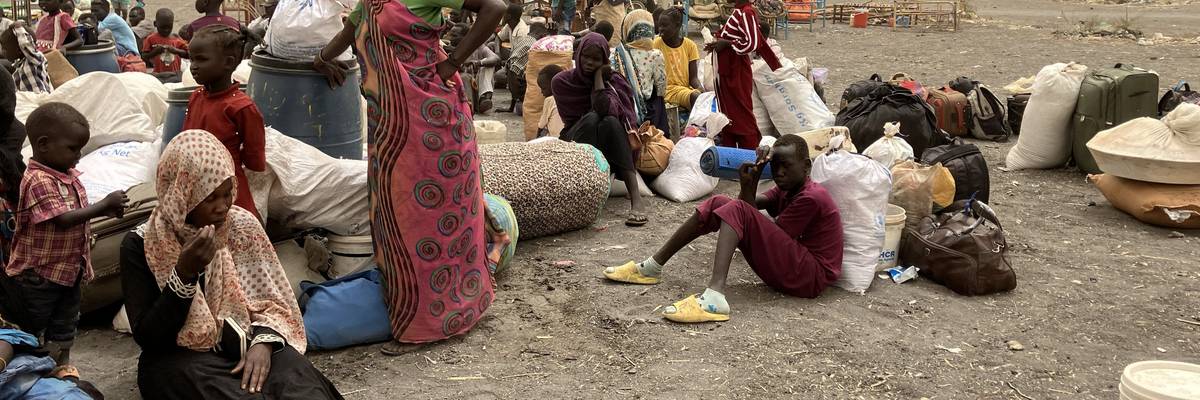
Refugees from Sudan wait to be transported to the transit camp in the town of Renk near the border after crossing the border into South Sudan on March 19, 2024.
Warring factions in North Darfur state must "avoid locating military installations within or near densely populated areas, including towns and camps for internally displaced people," said one U.N. official.
The United Nations' top humanitarian affairs officials on Friday called for an immediate deescalation of hostilities in Sudan, where rival factions in the military government have been fighting for a year and where an attack on the city of El Fasher is reportedly imminent.
About 800,000 people in the city, the capital of North Darfur state, are in "extreme and immediate danger," U.N. aid operations director, Edem Wosornu, told the U.N. Security Council earlier this week, as she reported that clashes between the Rapid Support Forces (RSF), a paramilitary group, and the Sudanese Armed Forces (SAF) are nearing El Fasher.
Fighting between the two groups has intensified in recent weeks, forcibly displacing an estimated 40,000 people.
The U.N. Office for the Coordination of Humanitarian Affairs said Friday that the security situation in North Darfur has left more than a dozen aid trucks with relief supplies for 122,000 people stranded in neighboring Northern state, unable to proceed into the only capital city in Darfur that is not controlled by RSF.
"A patchwork of armed actors, including the Darfur Joint Protection Forces, the SAF, and the RSF control different parts of the El Fasher area," Human Rights Watch reported this week. "Tense calm alternating with episodic fighting has prevailed for months."
Since April 14, when RSF began to push into El Fasher, at least 43 people—including women and children—have been killed due to fighting between the SAF and RSF.
"Civilians are trapped in the city, afraid of being killed should they attempt to flee," said Seif Magango, spokesperson for the U.N. high commissioner for human rights, Volker Türk. "This dire situation is compounded by a severe shortage of essential supplies as deliveries of commercial goods and humanitarian aid have been heavily constrained by the fighting, and delivery trucks are unable to freely transit through RSF-controlled territory."
The lack of humanitarian aid in North Darfur has pushed the state toward a famine, with one child dying of starvation every two hours, according to a February report by Doctors Without Borders.
In December, the U.S. State Department announced an $85 million sale of radar and other military equipment to the United Arab Emirates (UAE), which The New York Times reported last year has been covertly supporting the RSF.
U.S. Rep. Ilhan Omar (D-Minn.) proposed a joint resolution to block arms sales to the UAE in January, in light of its support for the paramilitary group.
Omar was among several lawmakers who wrote to President Joe Biden and Secretary of State Antony Blinken earlier this week, urging them to "deliver urgently-needed humanitarian assistance" and to help end the hostilities.
Sudanese-Australian writer Yassmin Abdel-Magied urged Americans on Friday to pressure lawmakers and the White House to take more action.
"There is a tiny window of opportunity for us to find a way to get the UAE... to make the RSF to stop in their tracks," said Abdel-Magied. "Maybe there's a way that we can avoid this massacre."
OCHA called on the warring parties to "take constant care to spare civilians and civilian objects in the conduct of military operations."
"They must, to the extent possible, avoid locating military installations within or near densely populated areas, including towns and camps for internally displaced people," said the office. "It is also imperative that the parties allow safe passage for civilians to leave El Fasher for safer areas."
Dear Common Dreams reader, It’s been nearly 30 years since I co-founded Common Dreams with my late wife, Lina Newhouser. We had the radical notion that journalism should serve the public good, not corporate profits. It was clear to us from the outset what it would take to build such a project. No paid advertisements. No corporate sponsors. No millionaire publisher telling us what to think or do. Many people said we wouldn't last a year, but we proved those doubters wrong. Together with a tremendous team of journalists and dedicated staff, we built an independent media outlet free from the constraints of profits and corporate control. Our mission has always been simple: To inform. To inspire. To ignite change for the common good. Building Common Dreams was not easy. Our survival was never guaranteed. When you take on the most powerful forces—Wall Street greed, fossil fuel industry destruction, Big Tech lobbyists, and uber-rich oligarchs who have spent billions upon billions rigging the economy and democracy in their favor—the only bulwark you have is supporters who believe in your work. But here’s the urgent message from me today. It's never been this bad out there. And it's never been this hard to keep us going. At the very moment Common Dreams is most needed, the threats we face are intensifying. We need your support now more than ever. We don't accept corporate advertising and never will. We don't have a paywall because we don't think people should be blocked from critical news based on their ability to pay. Everything we do is funded by the donations of readers like you. When everyone does the little they can afford, we are strong. But if that support retreats or dries up, so do we. Will you donate now to make sure Common Dreams not only survives but thrives? —Craig Brown, Co-founder |
The United Nations' top humanitarian affairs officials on Friday called for an immediate deescalation of hostilities in Sudan, where rival factions in the military government have been fighting for a year and where an attack on the city of El Fasher is reportedly imminent.
About 800,000 people in the city, the capital of North Darfur state, are in "extreme and immediate danger," U.N. aid operations director, Edem Wosornu, told the U.N. Security Council earlier this week, as she reported that clashes between the Rapid Support Forces (RSF), a paramilitary group, and the Sudanese Armed Forces (SAF) are nearing El Fasher.
Fighting between the two groups has intensified in recent weeks, forcibly displacing an estimated 40,000 people.
The U.N. Office for the Coordination of Humanitarian Affairs said Friday that the security situation in North Darfur has left more than a dozen aid trucks with relief supplies for 122,000 people stranded in neighboring Northern state, unable to proceed into the only capital city in Darfur that is not controlled by RSF.
"A patchwork of armed actors, including the Darfur Joint Protection Forces, the SAF, and the RSF control different parts of the El Fasher area," Human Rights Watch reported this week. "Tense calm alternating with episodic fighting has prevailed for months."
Since April 14, when RSF began to push into El Fasher, at least 43 people—including women and children—have been killed due to fighting between the SAF and RSF.
"Civilians are trapped in the city, afraid of being killed should they attempt to flee," said Seif Magango, spokesperson for the U.N. high commissioner for human rights, Volker Türk. "This dire situation is compounded by a severe shortage of essential supplies as deliveries of commercial goods and humanitarian aid have been heavily constrained by the fighting, and delivery trucks are unable to freely transit through RSF-controlled territory."
The lack of humanitarian aid in North Darfur has pushed the state toward a famine, with one child dying of starvation every two hours, according to a February report by Doctors Without Borders.
In December, the U.S. State Department announced an $85 million sale of radar and other military equipment to the United Arab Emirates (UAE), which The New York Times reported last year has been covertly supporting the RSF.
U.S. Rep. Ilhan Omar (D-Minn.) proposed a joint resolution to block arms sales to the UAE in January, in light of its support for the paramilitary group.
Omar was among several lawmakers who wrote to President Joe Biden and Secretary of State Antony Blinken earlier this week, urging them to "deliver urgently-needed humanitarian assistance" and to help end the hostilities.
Sudanese-Australian writer Yassmin Abdel-Magied urged Americans on Friday to pressure lawmakers and the White House to take more action.
"There is a tiny window of opportunity for us to find a way to get the UAE... to make the RSF to stop in their tracks," said Abdel-Magied. "Maybe there's a way that we can avoid this massacre."
OCHA called on the warring parties to "take constant care to spare civilians and civilian objects in the conduct of military operations."
"They must, to the extent possible, avoid locating military installations within or near densely populated areas, including towns and camps for internally displaced people," said the office. "It is also imperative that the parties allow safe passage for civilians to leave El Fasher for safer areas."
The United Nations' top humanitarian affairs officials on Friday called for an immediate deescalation of hostilities in Sudan, where rival factions in the military government have been fighting for a year and where an attack on the city of El Fasher is reportedly imminent.
About 800,000 people in the city, the capital of North Darfur state, are in "extreme and immediate danger," U.N. aid operations director, Edem Wosornu, told the U.N. Security Council earlier this week, as she reported that clashes between the Rapid Support Forces (RSF), a paramilitary group, and the Sudanese Armed Forces (SAF) are nearing El Fasher.
Fighting between the two groups has intensified in recent weeks, forcibly displacing an estimated 40,000 people.
The U.N. Office for the Coordination of Humanitarian Affairs said Friday that the security situation in North Darfur has left more than a dozen aid trucks with relief supplies for 122,000 people stranded in neighboring Northern state, unable to proceed into the only capital city in Darfur that is not controlled by RSF.
"A patchwork of armed actors, including the Darfur Joint Protection Forces, the SAF, and the RSF control different parts of the El Fasher area," Human Rights Watch reported this week. "Tense calm alternating with episodic fighting has prevailed for months."
Since April 14, when RSF began to push into El Fasher, at least 43 people—including women and children—have been killed due to fighting between the SAF and RSF.
"Civilians are trapped in the city, afraid of being killed should they attempt to flee," said Seif Magango, spokesperson for the U.N. high commissioner for human rights, Volker Türk. "This dire situation is compounded by a severe shortage of essential supplies as deliveries of commercial goods and humanitarian aid have been heavily constrained by the fighting, and delivery trucks are unable to freely transit through RSF-controlled territory."
The lack of humanitarian aid in North Darfur has pushed the state toward a famine, with one child dying of starvation every two hours, according to a February report by Doctors Without Borders.
In December, the U.S. State Department announced an $85 million sale of radar and other military equipment to the United Arab Emirates (UAE), which The New York Times reported last year has been covertly supporting the RSF.
U.S. Rep. Ilhan Omar (D-Minn.) proposed a joint resolution to block arms sales to the UAE in January, in light of its support for the paramilitary group.
Omar was among several lawmakers who wrote to President Joe Biden and Secretary of State Antony Blinken earlier this week, urging them to "deliver urgently-needed humanitarian assistance" and to help end the hostilities.
Sudanese-Australian writer Yassmin Abdel-Magied urged Americans on Friday to pressure lawmakers and the White House to take more action.
"There is a tiny window of opportunity for us to find a way to get the UAE... to make the RSF to stop in their tracks," said Abdel-Magied. "Maybe there's a way that we can avoid this massacre."
OCHA called on the warring parties to "take constant care to spare civilians and civilian objects in the conduct of military operations."
"They must, to the extent possible, avoid locating military installations within or near densely populated areas, including towns and camps for internally displaced people," said the office. "It is also imperative that the parties allow safe passage for civilians to leave El Fasher for safer areas."