

SUBSCRIBE TO OUR FREE NEWSLETTER
Daily news & progressive opinion—funded by the people, not the corporations—delivered straight to your inbox.
5
#000000
#FFFFFF
To donate by check, phone, or other method, see our More Ways to Give page.
Daily news & progressive opinion—funded by the people, not the corporations—delivered straight to your inbox.
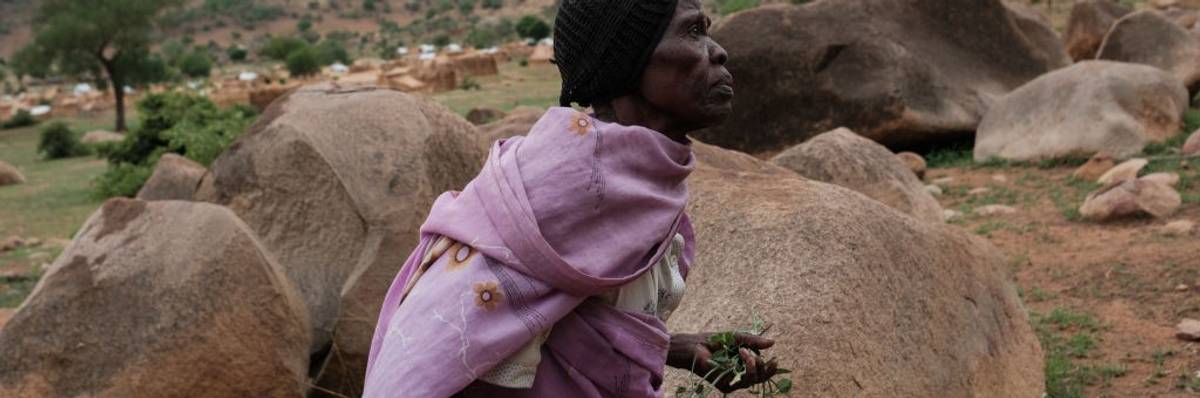
An elderly Sudanese woman gathers wild plants to use as vegetables near the Rabang camp for internally displaced persons in Rabang, Sudan on June 16, 2024.
"Let me be clear: It is still possible to stop this freight train of suffering that is charging through Sudan. But only if we respond with the urgency that this moment demands."
In an urgent appeal for financial and other resources, two top United Nations human rights officials on Tuesday condemned the world's inadequate response to a nascent famine in Sudan.
The U.N. Famine Review Committee announced last week that famine now exists in the Zamzam refugee camp near al-Fashir in North Darfur, where hundreds of thousands of displaced Sudanese are sheltering amid 15 months of a civil war that's displaced more than 10 million people and cut off delivery of desperately needed food and other aid.
Other parts of Sudan—including Greater Darfur, South Kordofan, and Khartoum—are at risk of famine.
"This announcement should stop all of us cold because when famine happens, it means we are too late," Edem Wosornu, director of the Operations and Advocacy Division at the U.N. Office for the Coordination of Humanitarian Affairs (OCHA), said Tuesday.
"It means we did not do enough. It means we, the international community, have failed," she added, pointing to the numerous warnings of imminent famine over recent months. "This is an entirely man-made crisis and a shameful stain on our collective conscience."
As U.N. News reported:
The Sudanese National Army and a rival, formerly allied military, known as the Rapid Support Forces (RSF), have been battling since April 2023, pushing "millions of civilians into a quagmire of violence and with it, death, injury, and inhumane suffering treatment."
A staggering 26 million people are facing acute hunger... More than 10 million people have been forced to flee their homes, including some 726,000 displaced from Sennar state following recent RSF advances.
Sudan's once vibrant capital, Khartoum, now lies in ruins, the national healthcare system has collapsed, and recent heavy rains in Kassala and North Darfur have increased the risk of cholera and other waterborne diseases. An entire generation of children is missing out on a second straight year of education.
"Let me be clear: It is still possible to stop this freight train of suffering that is charging through Sudan," Wosornu stressed. "But only if we respond with the urgency that this moment demands."
Justin Brady, who heads OCHA's Sudan office, told U.N. News on Monday that "if we don't have enough resources and we don't have enough access, it is going to be very difficult to stop famine conditions from taking hold" in other parts of Sudan.
"Access continues to be a major problem," he continued. "And some donors have seen that and said, well, we'll give you funding when you get access."
"Second of all, when we do get access, we need to take advantage of those openings very quickly," Brady added. "If we don't, they will close very quickly. So not having enough resources... Our appeal for this year is only a third funded, under $900 million received."
Echoing Brady, Wosornu said that "we are pushing from every possible angle to stop this catastrophe from getting worse, but we cannot go very far without the access and resources we need."
Wosornu outlined the humanitarian community's four key demands:
"Assistance delayed is assistance denied for the many Sudanese civilians who are literally dying of hunger during the time it takes for clearances to come through, permits to be granted, and flood waters to subside," Wosornu warned.
Dear Common Dreams reader, It’s been nearly 30 years since I co-founded Common Dreams with my late wife, Lina Newhouser. We had the radical notion that journalism should serve the public good, not corporate profits. It was clear to us from the outset what it would take to build such a project. No paid advertisements. No corporate sponsors. No millionaire publisher telling us what to think or do. Many people said we wouldn't last a year, but we proved those doubters wrong. Together with a tremendous team of journalists and dedicated staff, we built an independent media outlet free from the constraints of profits and corporate control. Our mission has always been simple: To inform. To inspire. To ignite change for the common good. Building Common Dreams was not easy. Our survival was never guaranteed. When you take on the most powerful forces—Wall Street greed, fossil fuel industry destruction, Big Tech lobbyists, and uber-rich oligarchs who have spent billions upon billions rigging the economy and democracy in their favor—the only bulwark you have is supporters who believe in your work. But here’s the urgent message from me today. It's never been this bad out there. And it's never been this hard to keep us going. At the very moment Common Dreams is most needed, the threats we face are intensifying. We need your support now more than ever. We don't accept corporate advertising and never will. We don't have a paywall because we don't think people should be blocked from critical news based on their ability to pay. Everything we do is funded by the donations of readers like you. When everyone does the little they can afford, we are strong. But if that support retreats or dries up, so do we. Will you donate now to make sure Common Dreams not only survives but thrives? —Craig Brown, Co-founder |
In an urgent appeal for financial and other resources, two top United Nations human rights officials on Tuesday condemned the world's inadequate response to a nascent famine in Sudan.
The U.N. Famine Review Committee announced last week that famine now exists in the Zamzam refugee camp near al-Fashir in North Darfur, where hundreds of thousands of displaced Sudanese are sheltering amid 15 months of a civil war that's displaced more than 10 million people and cut off delivery of desperately needed food and other aid.
Other parts of Sudan—including Greater Darfur, South Kordofan, and Khartoum—are at risk of famine.
"This announcement should stop all of us cold because when famine happens, it means we are too late," Edem Wosornu, director of the Operations and Advocacy Division at the U.N. Office for the Coordination of Humanitarian Affairs (OCHA), said Tuesday.
"It means we did not do enough. It means we, the international community, have failed," she added, pointing to the numerous warnings of imminent famine over recent months. "This is an entirely man-made crisis and a shameful stain on our collective conscience."
As U.N. News reported:
The Sudanese National Army and a rival, formerly allied military, known as the Rapid Support Forces (RSF), have been battling since April 2023, pushing "millions of civilians into a quagmire of violence and with it, death, injury, and inhumane suffering treatment."
A staggering 26 million people are facing acute hunger... More than 10 million people have been forced to flee their homes, including some 726,000 displaced from Sennar state following recent RSF advances.
Sudan's once vibrant capital, Khartoum, now lies in ruins, the national healthcare system has collapsed, and recent heavy rains in Kassala and North Darfur have increased the risk of cholera and other waterborne diseases. An entire generation of children is missing out on a second straight year of education.
"Let me be clear: It is still possible to stop this freight train of suffering that is charging through Sudan," Wosornu stressed. "But only if we respond with the urgency that this moment demands."
Justin Brady, who heads OCHA's Sudan office, told U.N. News on Monday that "if we don't have enough resources and we don't have enough access, it is going to be very difficult to stop famine conditions from taking hold" in other parts of Sudan.
"Access continues to be a major problem," he continued. "And some donors have seen that and said, well, we'll give you funding when you get access."
"Second of all, when we do get access, we need to take advantage of those openings very quickly," Brady added. "If we don't, they will close very quickly. So not having enough resources... Our appeal for this year is only a third funded, under $900 million received."
Echoing Brady, Wosornu said that "we are pushing from every possible angle to stop this catastrophe from getting worse, but we cannot go very far without the access and resources we need."
Wosornu outlined the humanitarian community's four key demands:
"Assistance delayed is assistance denied for the many Sudanese civilians who are literally dying of hunger during the time it takes for clearances to come through, permits to be granted, and flood waters to subside," Wosornu warned.
In an urgent appeal for financial and other resources, two top United Nations human rights officials on Tuesday condemned the world's inadequate response to a nascent famine in Sudan.
The U.N. Famine Review Committee announced last week that famine now exists in the Zamzam refugee camp near al-Fashir in North Darfur, where hundreds of thousands of displaced Sudanese are sheltering amid 15 months of a civil war that's displaced more than 10 million people and cut off delivery of desperately needed food and other aid.
Other parts of Sudan—including Greater Darfur, South Kordofan, and Khartoum—are at risk of famine.
"This announcement should stop all of us cold because when famine happens, it means we are too late," Edem Wosornu, director of the Operations and Advocacy Division at the U.N. Office for the Coordination of Humanitarian Affairs (OCHA), said Tuesday.
"It means we did not do enough. It means we, the international community, have failed," she added, pointing to the numerous warnings of imminent famine over recent months. "This is an entirely man-made crisis and a shameful stain on our collective conscience."
As U.N. News reported:
The Sudanese National Army and a rival, formerly allied military, known as the Rapid Support Forces (RSF), have been battling since April 2023, pushing "millions of civilians into a quagmire of violence and with it, death, injury, and inhumane suffering treatment."
A staggering 26 million people are facing acute hunger... More than 10 million people have been forced to flee their homes, including some 726,000 displaced from Sennar state following recent RSF advances.
Sudan's once vibrant capital, Khartoum, now lies in ruins, the national healthcare system has collapsed, and recent heavy rains in Kassala and North Darfur have increased the risk of cholera and other waterborne diseases. An entire generation of children is missing out on a second straight year of education.
"Let me be clear: It is still possible to stop this freight train of suffering that is charging through Sudan," Wosornu stressed. "But only if we respond with the urgency that this moment demands."
Justin Brady, who heads OCHA's Sudan office, told U.N. News on Monday that "if we don't have enough resources and we don't have enough access, it is going to be very difficult to stop famine conditions from taking hold" in other parts of Sudan.
"Access continues to be a major problem," he continued. "And some donors have seen that and said, well, we'll give you funding when you get access."
"Second of all, when we do get access, we need to take advantage of those openings very quickly," Brady added. "If we don't, they will close very quickly. So not having enough resources... Our appeal for this year is only a third funded, under $900 million received."
Echoing Brady, Wosornu said that "we are pushing from every possible angle to stop this catastrophe from getting worse, but we cannot go very far without the access and resources we need."
Wosornu outlined the humanitarian community's four key demands:
"Assistance delayed is assistance denied for the many Sudanese civilians who are literally dying of hunger during the time it takes for clearances to come through, permits to be granted, and flood waters to subside," Wosornu warned.

