5
#000000
#FFFFFF
To donate by check, phone, or other method, see our More Ways to Give page.
Daily news & progressive opinion—funded by the people, not the corporations—delivered straight to your inbox.
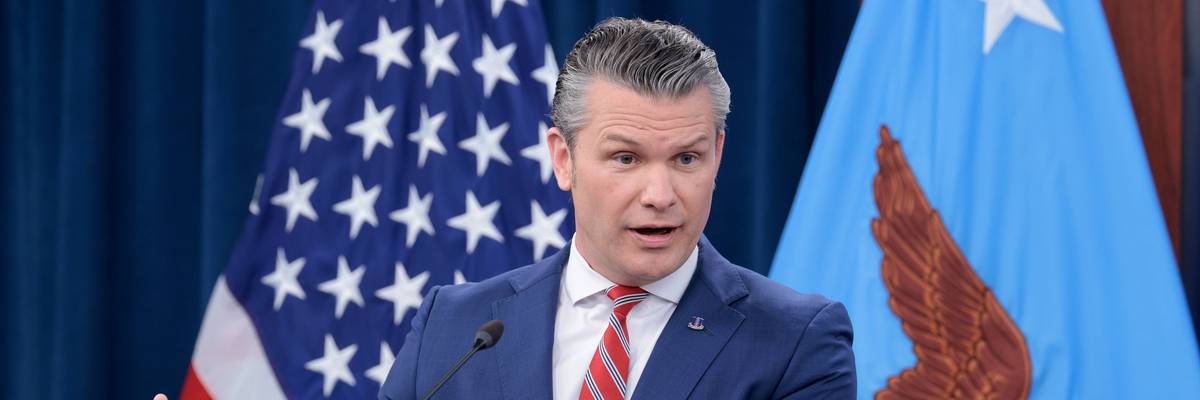
US Secretary of Defense Pete Hegseth speaks to reporters during a press briefing at the Pentagon on May 5, 2026 in Arlington, Virginia.
The president and defense secretary "want you to think we haven’t been at war with Iran for over 65 days," said one Democratic congressional candidate.
While assuring reporters that the ceasefire agreement reached last month between the Trump administration and Iran is holding, Defense Secretary Pete Hegseth on Tuesday said the American forces are acting "aggressively" in the Strait of Hormuz, where he said US Central Command has "established a powerful red, white, and blue dome" as a "direct gift from the US to the world."
The metaphorical "dome" the US has placed over the key shipping route for oil and other goods has taken the form of what the Trump administration is calling Project Freedom, which launched Monday and involves the US guiding ships out of the strait, according to President Donald Trump. Iran effectively shut the waterway more than two months ago in retaliation for the unprovoked US-Israeli war on the country, and the US Navy has blocked ships from going to or from Iran in response.
Hegseth emphasized Tuesday that Project Freedom is "separate and distinct" from the military assault on Iran that began on February 28 with the stated aim of eliminating the country's missile and nuclear capabilities.
"The ceasefire is not over," said the secretary. "We expected there would be some churn, which happened, and we said we would defend and defend aggressively, and we absolutely have."
He added that the US is "not looking for a fight."
Independent journalist Rachel Blevins responded sardonically: "'We are not looking for a fight'—we just murdered your leader, your schoolchildren, and your civilians, we bombed your infrastructure, and we've been trying to strangle your economy with sanctions for years."
Adm. Brad Cooper, the head of US Central Command, told reporters that US warships shot down Iranian cruise missiles that the Islamic Revolutionary Guard Corps (IRGC) had fired at the vessels Navy ships were guiding out of the strait on Monday, and Army helicopter gunships sank six military speedboats from Iran.
As Common Dreams reported Tuesday, an Islamic Revolutionary Guard Corps commander told Iran's state-affiliated media that US forces actually attacked "two small boats carrying people on their way from Khasab on the coast of Oman to the coast of Iran on Monday" and killed five civilians, but did not hit any IRGC ships.
At his press conference with Gen. Dan Caine, chairman of the US Joint Chiefs of Staff, Hegseth insisted that Iran is the "aggressor" even as he threatened the country with restarting "major combat operations" if Trump deems them "necessary."
Project Freedom, said Hegseth, "is about free flow of commerce, all the things that happened before, and only Iran is contesting, so right now the ceasefire certainly holds, but we're going to be watching very, very closely."
One reporter with the Epoch Times asked whether the president plans to seek congressional approval if he decides it is necessary to restart "major combat operations."
Days before the fighting in the strait, Trump notified Congress last Friday that hostilities with Iran had been terminated. The announcement came on the deadline set by the 1973 War Powers Act, which requires US presidents to end conflicts that have not been authorized by Congress no more than 60 days after notifying lawmakers of the hostilities.
Trump told Congress that the fighting has been effectively terminated since the US and Iran agreed to the ceasefire on April 7, a view that Hegseth pushed on Tuesday in response to the question about congressional authorization.
"Our view is... that ultimately with the ceasefire, the clock stops," said Hegseth. "If it were to restart that would be the president's decision. That option is always there and Iran knows that."
Q: Will this administration be seeking congressional approval for any further military operations if the ceasefire breaks down?
Hegseth: Our view is with the ceasefire, the clock stops. If it were to restart, that would be the president's decision. That option is always there.… pic.twitter.com/cz3bIpLeIC
— Acyn (@Acyn) May 5, 2026
NBC News senior national politics reporter Jonathan Allen responded that he had "never heard" of Hegseth and Trump's reasoning for not planning to seek congressional approval for more combat operations.
"Understand that what he is doing here is desperately trying to avoid the War Powers Act," said Fred Wellman, a Democratic congressional candidate in Missouri. "They made up a new interpretation that says the 60-day clock is 'paused' for a ceasefire. Now they are lying and saying this is an all-new, shiny war and not the same one."
He added, "This clown and [the administration's] Republican congressional doormats want you to think we haven’t been at war with Iran for over 65 days."
Dear Common Dreams reader, It’s been nearly 30 years since I co-founded Common Dreams with my late wife, Lina Newhouser. We had the radical notion that journalism should serve the public good, not corporate profits. It was clear to us from the outset what it would take to build such a project. No paid advertisements. No corporate sponsors. No millionaire publisher telling us what to think or do. Many people said we wouldn't last a year, but we proved those doubters wrong. Together with a tremendous team of journalists and dedicated staff, we built an independent media outlet free from the constraints of profits and corporate control. Our mission has always been simple: To inform. To inspire. To ignite change for the common good. Building Common Dreams was not easy. Our survival was never guaranteed. When you take on the most powerful forces—Wall Street greed, fossil fuel industry destruction, Big Tech lobbyists, and uber-rich oligarchs who have spent billions upon billions rigging the economy and democracy in their favor—the only bulwark you have is supporters who believe in your work. But here’s the urgent message from me today. It's never been this bad out there. And it's never been this hard to keep us going. At the very moment Common Dreams is most needed, the threats we face are intensifying. We need your support now more than ever. We don't accept corporate advertising and never will. We don't have a paywall because we don't think people should be blocked from critical news based on their ability to pay. Everything we do is funded by the donations of readers like you. When everyone does the little they can afford, we are strong. But if that support retreats or dries up, so do we. Will you donate now to make sure Common Dreams not only survives but thrives? —Craig Brown, Co-founder |
While assuring reporters that the ceasefire agreement reached last month between the Trump administration and Iran is holding, Defense Secretary Pete Hegseth on Tuesday said the American forces are acting "aggressively" in the Strait of Hormuz, where he said US Central Command has "established a powerful red, white, and blue dome" as a "direct gift from the US to the world."
The metaphorical "dome" the US has placed over the key shipping route for oil and other goods has taken the form of what the Trump administration is calling Project Freedom, which launched Monday and involves the US guiding ships out of the strait, according to President Donald Trump. Iran effectively shut the waterway more than two months ago in retaliation for the unprovoked US-Israeli war on the country, and the US Navy has blocked ships from going to or from Iran in response.
Hegseth emphasized Tuesday that Project Freedom is "separate and distinct" from the military assault on Iran that began on February 28 with the stated aim of eliminating the country's missile and nuclear capabilities.
"The ceasefire is not over," said the secretary. "We expected there would be some churn, which happened, and we said we would defend and defend aggressively, and we absolutely have."
He added that the US is "not looking for a fight."
Independent journalist Rachel Blevins responded sardonically: "'We are not looking for a fight'—we just murdered your leader, your schoolchildren, and your civilians, we bombed your infrastructure, and we've been trying to strangle your economy with sanctions for years."
Adm. Brad Cooper, the head of US Central Command, told reporters that US warships shot down Iranian cruise missiles that the Islamic Revolutionary Guard Corps (IRGC) had fired at the vessels Navy ships were guiding out of the strait on Monday, and Army helicopter gunships sank six military speedboats from Iran.
As Common Dreams reported Tuesday, an Islamic Revolutionary Guard Corps commander told Iran's state-affiliated media that US forces actually attacked "two small boats carrying people on their way from Khasab on the coast of Oman to the coast of Iran on Monday" and killed five civilians, but did not hit any IRGC ships.
At his press conference with Gen. Dan Caine, chairman of the US Joint Chiefs of Staff, Hegseth insisted that Iran is the "aggressor" even as he threatened the country with restarting "major combat operations" if Trump deems them "necessary."
Project Freedom, said Hegseth, "is about free flow of commerce, all the things that happened before, and only Iran is contesting, so right now the ceasefire certainly holds, but we're going to be watching very, very closely."
One reporter with the Epoch Times asked whether the president plans to seek congressional approval if he decides it is necessary to restart "major combat operations."
Days before the fighting in the strait, Trump notified Congress last Friday that hostilities with Iran had been terminated. The announcement came on the deadline set by the 1973 War Powers Act, which requires US presidents to end conflicts that have not been authorized by Congress no more than 60 days after notifying lawmakers of the hostilities.
Trump told Congress that the fighting has been effectively terminated since the US and Iran agreed to the ceasefire on April 7, a view that Hegseth pushed on Tuesday in response to the question about congressional authorization.
"Our view is... that ultimately with the ceasefire, the clock stops," said Hegseth. "If it were to restart that would be the president's decision. That option is always there and Iran knows that."
Q: Will this administration be seeking congressional approval for any further military operations if the ceasefire breaks down?
Hegseth: Our view is with the ceasefire, the clock stops. If it were to restart, that would be the president's decision. That option is always there.… pic.twitter.com/cz3bIpLeIC
— Acyn (@Acyn) May 5, 2026
NBC News senior national politics reporter Jonathan Allen responded that he had "never heard" of Hegseth and Trump's reasoning for not planning to seek congressional approval for more combat operations.
"Understand that what he is doing here is desperately trying to avoid the War Powers Act," said Fred Wellman, a Democratic congressional candidate in Missouri. "They made up a new interpretation that says the 60-day clock is 'paused' for a ceasefire. Now they are lying and saying this is an all-new, shiny war and not the same one."
He added, "This clown and [the administration's] Republican congressional doormats want you to think we haven’t been at war with Iran for over 65 days."
While assuring reporters that the ceasefire agreement reached last month between the Trump administration and Iran is holding, Defense Secretary Pete Hegseth on Tuesday said the American forces are acting "aggressively" in the Strait of Hormuz, where he said US Central Command has "established a powerful red, white, and blue dome" as a "direct gift from the US to the world."
The metaphorical "dome" the US has placed over the key shipping route for oil and other goods has taken the form of what the Trump administration is calling Project Freedom, which launched Monday and involves the US guiding ships out of the strait, according to President Donald Trump. Iran effectively shut the waterway more than two months ago in retaliation for the unprovoked US-Israeli war on the country, and the US Navy has blocked ships from going to or from Iran in response.
Hegseth emphasized Tuesday that Project Freedom is "separate and distinct" from the military assault on Iran that began on February 28 with the stated aim of eliminating the country's missile and nuclear capabilities.
"The ceasefire is not over," said the secretary. "We expected there would be some churn, which happened, and we said we would defend and defend aggressively, and we absolutely have."
He added that the US is "not looking for a fight."
Independent journalist Rachel Blevins responded sardonically: "'We are not looking for a fight'—we just murdered your leader, your schoolchildren, and your civilians, we bombed your infrastructure, and we've been trying to strangle your economy with sanctions for years."
Adm. Brad Cooper, the head of US Central Command, told reporters that US warships shot down Iranian cruise missiles that the Islamic Revolutionary Guard Corps (IRGC) had fired at the vessels Navy ships were guiding out of the strait on Monday, and Army helicopter gunships sank six military speedboats from Iran.
As Common Dreams reported Tuesday, an Islamic Revolutionary Guard Corps commander told Iran's state-affiliated media that US forces actually attacked "two small boats carrying people on their way from Khasab on the coast of Oman to the coast of Iran on Monday" and killed five civilians, but did not hit any IRGC ships.
At his press conference with Gen. Dan Caine, chairman of the US Joint Chiefs of Staff, Hegseth insisted that Iran is the "aggressor" even as he threatened the country with restarting "major combat operations" if Trump deems them "necessary."
Project Freedom, said Hegseth, "is about free flow of commerce, all the things that happened before, and only Iran is contesting, so right now the ceasefire certainly holds, but we're going to be watching very, very closely."
One reporter with the Epoch Times asked whether the president plans to seek congressional approval if he decides it is necessary to restart "major combat operations."
Days before the fighting in the strait, Trump notified Congress last Friday that hostilities with Iran had been terminated. The announcement came on the deadline set by the 1973 War Powers Act, which requires US presidents to end conflicts that have not been authorized by Congress no more than 60 days after notifying lawmakers of the hostilities.
Trump told Congress that the fighting has been effectively terminated since the US and Iran agreed to the ceasefire on April 7, a view that Hegseth pushed on Tuesday in response to the question about congressional authorization.
"Our view is... that ultimately with the ceasefire, the clock stops," said Hegseth. "If it were to restart that would be the president's decision. That option is always there and Iran knows that."
Q: Will this administration be seeking congressional approval for any further military operations if the ceasefire breaks down?
Hegseth: Our view is with the ceasefire, the clock stops. If it were to restart, that would be the president's decision. That option is always there.… pic.twitter.com/cz3bIpLeIC
— Acyn (@Acyn) May 5, 2026
NBC News senior national politics reporter Jonathan Allen responded that he had "never heard" of Hegseth and Trump's reasoning for not planning to seek congressional approval for more combat operations.
"Understand that what he is doing here is desperately trying to avoid the War Powers Act," said Fred Wellman, a Democratic congressional candidate in Missouri. "They made up a new interpretation that says the 60-day clock is 'paused' for a ceasefire. Now they are lying and saying this is an all-new, shiny war and not the same one."
He added, "This clown and [the administration's] Republican congressional doormats want you to think we haven’t been at war with Iran for over 65 days."