SUBSCRIBE TO OUR FREE NEWSLETTER
Daily news & progressive opinion—funded by the people, not the corporations—delivered straight to your inbox.
5
#000000
#FFFFFF
To donate by check, phone, or other method, see our More Ways to Give page.
Daily news & progressive opinion—funded by the people, not the corporations—delivered straight to your inbox.
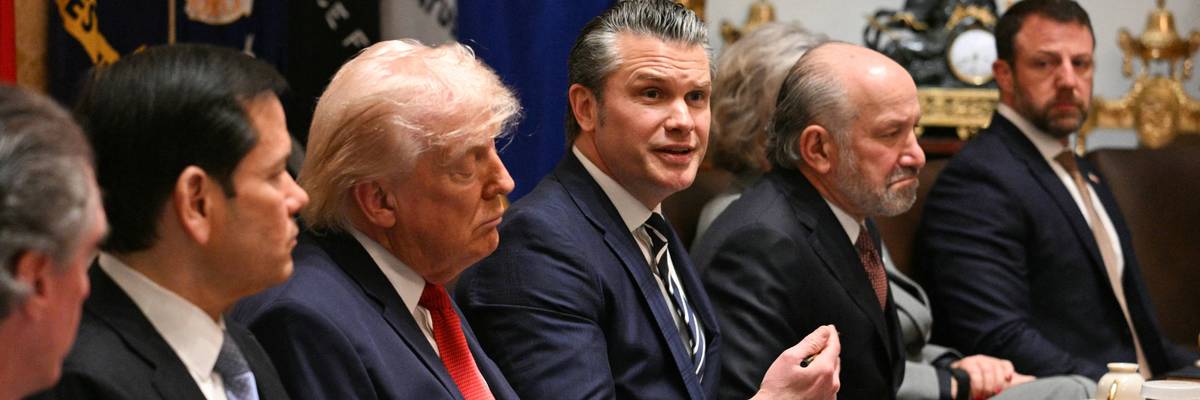
Pentagon Secretary Pete Hegseth speaks during a White House Cabinet meeting on March 26, 2026.
"In a functional democracy, he would offer his resignation tonight."
A broker for Pentagon Secretary Pete Hegseth reportedly tried to make a "big investment" in a bundle of weapons stocks just weeks before the US and Israel launched their war on Iran, an unpopular assault that Hegseth has aggressively championed.
Citing three unnamed people familiar with the matter, The Financial Times reported on Monday that Hegseth's "broker at Morgan Stanley contacted BlackRock in February about making a multimillion-dollar investment in the asset manager’s Defense Industrials Active ETF... shortly before the US launched military action against Tehran." The bombing began on February 28.
A spokesperson for the Pentagon denied the story, calling it "entirely false and fabricated" and insisting that neither Hegseth nor any of his representatives approached BlackRock about such an investment. But the FT reported that the broker's "inquiry on behalf of the high-profile potential client was flagged internally at BlackRock."
The investment was not ultimately made because the fund—which includes behemoths such as RTX, Lockheed Martin, Boeing, and Northrop Grumman—was not available for Morgan Stanley clients to buy at the time.
The purchase would not have been immediately lucrative: Over the past month, the Defense Industrials Active ETF is down over 12%. But the reported allegation that Hegseth's broker sought to make the largest investment in the weapons industry set off alarm bells, particularly amid growing concerns that Trump administration officials are using inside knowledge and manipulating markets to cash in on the war.
"You know, back when the [US government] gave a damn about anti-corruption, this is something we would've seen as a 'no no,'" said Richard Nephew, a former anti-corruption coordinator at the US State Department.
Economist Justin Wolfers wrote of Hegseth that, "in a functional democracy, he would offer his resignation tonight."
Instead, Pentagon spokesperson Sean Parnell demanded that the FT issue an "immediate retraction," dismissing the newspaper's story as "yet another baseless, dishonest smear designed to mislead the public."
Hegseth has emerged as the most prominent and belligerent cheerleader of the Iran war in the US, and—according to President Donald Trump—the Pentagon chief was the first of the president's advisers to "speak up" in favor of the assault during the internal decision-making process.
Trump has also suggested Hegseth does not want the war to end, saying last week that the Pentagon chief was "quite disappointed" when the president claimed the conflict would be over shortly.
"I don’t want to say this, but I have to," Trump told reporters at the White House. "I said, Pete and General Razin’ Caine, this thing is going to be settled very soon, and they go, ‘Oh, that’s too bad.'"
Dear Common Dreams reader, It’s been nearly 30 years since I co-founded Common Dreams with my late wife, Lina Newhouser. We had the radical notion that journalism should serve the public good, not corporate profits. It was clear to us from the outset what it would take to build such a project. No paid advertisements. No corporate sponsors. No millionaire publisher telling us what to think or do. Many people said we wouldn't last a year, but we proved those doubters wrong. Together with a tremendous team of journalists and dedicated staff, we built an independent media outlet free from the constraints of profits and corporate control. Our mission has always been simple: To inform. To inspire. To ignite change for the common good. Building Common Dreams was not easy. Our survival was never guaranteed. When you take on the most powerful forces—Wall Street greed, fossil fuel industry destruction, Big Tech lobbyists, and uber-rich oligarchs who have spent billions upon billions rigging the economy and democracy in their favor—the only bulwark you have is supporters who believe in your work. But here’s the urgent message from me today. It's never been this bad out there. And it's never been this hard to keep us going. At the very moment Common Dreams is most needed, the threats we face are intensifying. We need your support now more than ever. We don't accept corporate advertising and never will. We don't have a paywall because we don't think people should be blocked from critical news based on their ability to pay. Everything we do is funded by the donations of readers like you. When everyone does the little they can afford, we are strong. But if that support retreats or dries up, so do we. Will you donate now to make sure Common Dreams not only survives but thrives? —Craig Brown, Co-founder |
A broker for Pentagon Secretary Pete Hegseth reportedly tried to make a "big investment" in a bundle of weapons stocks just weeks before the US and Israel launched their war on Iran, an unpopular assault that Hegseth has aggressively championed.
Citing three unnamed people familiar with the matter, The Financial Times reported on Monday that Hegseth's "broker at Morgan Stanley contacted BlackRock in February about making a multimillion-dollar investment in the asset manager’s Defense Industrials Active ETF... shortly before the US launched military action against Tehran." The bombing began on February 28.
A spokesperson for the Pentagon denied the story, calling it "entirely false and fabricated" and insisting that neither Hegseth nor any of his representatives approached BlackRock about such an investment. But the FT reported that the broker's "inquiry on behalf of the high-profile potential client was flagged internally at BlackRock."
The investment was not ultimately made because the fund—which includes behemoths such as RTX, Lockheed Martin, Boeing, and Northrop Grumman—was not available for Morgan Stanley clients to buy at the time.
The purchase would not have been immediately lucrative: Over the past month, the Defense Industrials Active ETF is down over 12%. But the reported allegation that Hegseth's broker sought to make the largest investment in the weapons industry set off alarm bells, particularly amid growing concerns that Trump administration officials are using inside knowledge and manipulating markets to cash in on the war.
"You know, back when the [US government] gave a damn about anti-corruption, this is something we would've seen as a 'no no,'" said Richard Nephew, a former anti-corruption coordinator at the US State Department.
Economist Justin Wolfers wrote of Hegseth that, "in a functional democracy, he would offer his resignation tonight."
Instead, Pentagon spokesperson Sean Parnell demanded that the FT issue an "immediate retraction," dismissing the newspaper's story as "yet another baseless, dishonest smear designed to mislead the public."
Hegseth has emerged as the most prominent and belligerent cheerleader of the Iran war in the US, and—according to President Donald Trump—the Pentagon chief was the first of the president's advisers to "speak up" in favor of the assault during the internal decision-making process.
Trump has also suggested Hegseth does not want the war to end, saying last week that the Pentagon chief was "quite disappointed" when the president claimed the conflict would be over shortly.
"I don’t want to say this, but I have to," Trump told reporters at the White House. "I said, Pete and General Razin’ Caine, this thing is going to be settled very soon, and they go, ‘Oh, that’s too bad.'"
A broker for Pentagon Secretary Pete Hegseth reportedly tried to make a "big investment" in a bundle of weapons stocks just weeks before the US and Israel launched their war on Iran, an unpopular assault that Hegseth has aggressively championed.
Citing three unnamed people familiar with the matter, The Financial Times reported on Monday that Hegseth's "broker at Morgan Stanley contacted BlackRock in February about making a multimillion-dollar investment in the asset manager’s Defense Industrials Active ETF... shortly before the US launched military action against Tehran." The bombing began on February 28.
A spokesperson for the Pentagon denied the story, calling it "entirely false and fabricated" and insisting that neither Hegseth nor any of his representatives approached BlackRock about such an investment. But the FT reported that the broker's "inquiry on behalf of the high-profile potential client was flagged internally at BlackRock."
The investment was not ultimately made because the fund—which includes behemoths such as RTX, Lockheed Martin, Boeing, and Northrop Grumman—was not available for Morgan Stanley clients to buy at the time.
The purchase would not have been immediately lucrative: Over the past month, the Defense Industrials Active ETF is down over 12%. But the reported allegation that Hegseth's broker sought to make the largest investment in the weapons industry set off alarm bells, particularly amid growing concerns that Trump administration officials are using inside knowledge and manipulating markets to cash in on the war.
"You know, back when the [US government] gave a damn about anti-corruption, this is something we would've seen as a 'no no,'" said Richard Nephew, a former anti-corruption coordinator at the US State Department.
Economist Justin Wolfers wrote of Hegseth that, "in a functional democracy, he would offer his resignation tonight."
Instead, Pentagon spokesperson Sean Parnell demanded that the FT issue an "immediate retraction," dismissing the newspaper's story as "yet another baseless, dishonest smear designed to mislead the public."
Hegseth has emerged as the most prominent and belligerent cheerleader of the Iran war in the US, and—according to President Donald Trump—the Pentagon chief was the first of the president's advisers to "speak up" in favor of the assault during the internal decision-making process.
Trump has also suggested Hegseth does not want the war to end, saying last week that the Pentagon chief was "quite disappointed" when the president claimed the conflict would be over shortly.
"I don’t want to say this, but I have to," Trump told reporters at the White House. "I said, Pete and General Razin’ Caine, this thing is going to be settled very soon, and they go, ‘Oh, that’s too bad.'"