SUBSCRIBE TO OUR FREE NEWSLETTER
Daily news & progressive opinion—funded by the people, not the corporations—delivered straight to your inbox.
5
#000000
#FFFFFF
To donate by check, phone, or other method, see our More Ways to Give page.
Daily news & progressive opinion—funded by the people, not the corporations—delivered straight to your inbox.
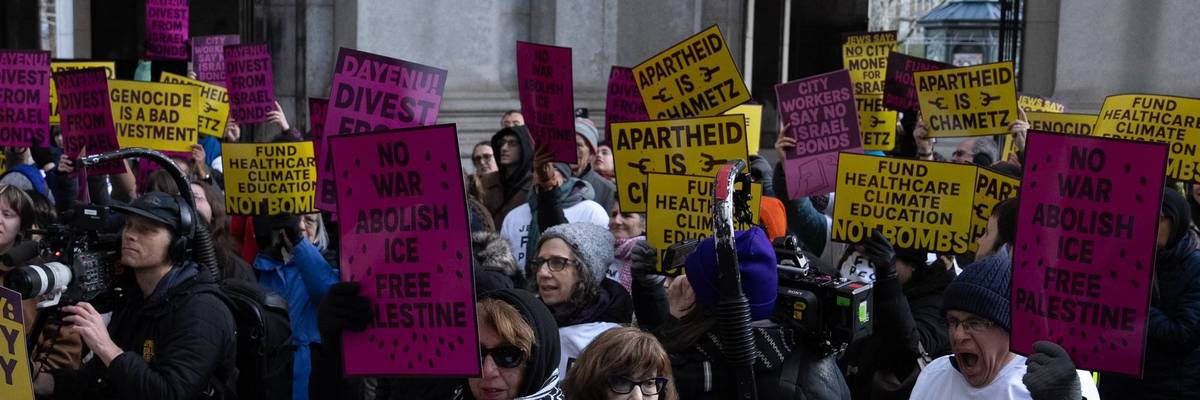
Activists with Jewish Voice for Peace gather outside the office of New York City Comptroller Mark Levine on April 8, 2026.
"Passover, our festival of liberation, compels us to ensure that our city’s funds do not underwrite the Israeli government carrying out genocide," said an activist with Jewish Voice for Peace.
More than 500 New Yorkers gathered for an "emergency Passover Seder" outside the office of New York City comptroller Mark Levine on Wednesday, where they called for him to divest the city's pension fund from bonds tied to Israel.
The city's former comptroller, Brad Lander, chose not to renew the nearly $40 million worth of investments in 2023. But in January, Levine reversed course, announcing plans to resume investment in the bonds, describing them as sound assets.
After Israel helped pressure the US to launch a war against Iran and began a new invasion of Lebanon—campaigns that have collectively killed more than 3,000 people—the city's chief fiscal officer is facing renewed pressure to stop what Jewish Voice for Peace (JVP) described as a "plan to fund Israeli bombs with city pensions."i
Protesters with the group stood outside the comptroller's office holding signs reading "Apartheid is chametz" and "Genocide is a bad investment."
"Passover, our festival of liberation, compels us to ensure that our city’s funds do not underwrite the Israeli government carrying out genocide in Gaza, enabling rampant settler violence in the West Bank, bombing Iran, and destroying entire villages in Southern Lebanon," said Jay Saper, an activist with JVP who works as a children's teacher and Yiddish translator. "Comptroller Levine’s plan goes against the will of New Yorkers who do not want our city's money to be used to fund genocide and war."
Levine took office in January after Lander left the post to challenge Democratic Rep. Dan Goldman for his seat representing New York's 10th congressional district.
Mayor Zohran Mamdani has been a vocal opponent of using any city funds to support Israel. But while he has publicly pushed back against the decision to resume purchasing Israeli bonds, he lacks the power, as mayor, to personally overrule it.
"I don’t think we should purchase Israel bonds,” Mamdani said in January. “We don’t purchase bonds for any other sovereign nation’s debt, and the comptroller has also made his position clear, and I continue to stand by mine.”
Though Levine has expressed strong support for Israel, saying he has "very deep personal ties" to the country, the attendees at Wednesday's Seder said the money spent on Israeli bonds could be better used to help New Yorkers.
"New Yorkers deserve to have their city funds in bonds that prioritize financial stability, accountability, and the long-term security for city workers," said New York City Public Advocate Jumaane Williams. "They should invest in life and the livelihoods of our communities, not the complete opposite. We cannot go backward to something financially unstable and, more importantly, morally bankrupt."
Last year's JVP Seder was held to call for the release of Columbia student Mahmoud Khalil, who was imprisoned by immigration agents and threatened with deportation by the Trump administration for activism on campus against Israel's genocide in Gaza. More than 100 JVP activists were arrested after occupying Trump Tower in Manhattan to demand his freedom last spring.
This year, Khalil—released from detention after a judge's order last June—was in attendance at the Seder.
“Just as you prayed for my freedom last year, today let us all pray together that by next Seder the Israeli genocide will have ended,” said Khalil.
(Video by Jewish Voice for Peace)
The Seder comes amid a public reckoning for Israel, including among many American Jews. A Pew Research poll released on Tuesday found that an unprecedented 60% of American adults view Israel negatively, compared to just 37% who view it positively.
A majority of American Jews have expressed disapproval of the war launched by President Donald Trump and Benjamin Netanyahu in Iran. Meanwhile, a poll last year found that around 4 in 10 American Jews believed Israel's actions in Gaza constituted genocide.
Rabbi Abby Stein of the Jewish Voice for Peace Rabbinic Council said the hundreds of Jewish people in attendance on Wednesday were “reclaiming our beautiful, ancient liberation holiday from those who would weaponize it, and Judaism itself, as tools of colonialism and supremacy—ideas that have been historically, and are, the opposite of what Judaism is and should be."
Dear Common Dreams reader, It’s been nearly 30 years since I co-founded Common Dreams with my late wife, Lina Newhouser. We had the radical notion that journalism should serve the public good, not corporate profits. It was clear to us from the outset what it would take to build such a project. No paid advertisements. No corporate sponsors. No millionaire publisher telling us what to think or do. Many people said we wouldn't last a year, but we proved those doubters wrong. Together with a tremendous team of journalists and dedicated staff, we built an independent media outlet free from the constraints of profits and corporate control. Our mission has always been simple: To inform. To inspire. To ignite change for the common good. Building Common Dreams was not easy. Our survival was never guaranteed. When you take on the most powerful forces—Wall Street greed, fossil fuel industry destruction, Big Tech lobbyists, and uber-rich oligarchs who have spent billions upon billions rigging the economy and democracy in their favor—the only bulwark you have is supporters who believe in your work. But here’s the urgent message from me today. It's never been this bad out there. And it's never been this hard to keep us going. At the very moment Common Dreams is most needed, the threats we face are intensifying. We need your support now more than ever. We don't accept corporate advertising and never will. We don't have a paywall because we don't think people should be blocked from critical news based on their ability to pay. Everything we do is funded by the donations of readers like you. When everyone does the little they can afford, we are strong. But if that support retreats or dries up, so do we. Will you donate now to make sure Common Dreams not only survives but thrives? —Craig Brown, Co-founder |
More than 500 New Yorkers gathered for an "emergency Passover Seder" outside the office of New York City comptroller Mark Levine on Wednesday, where they called for him to divest the city's pension fund from bonds tied to Israel.
The city's former comptroller, Brad Lander, chose not to renew the nearly $40 million worth of investments in 2023. But in January, Levine reversed course, announcing plans to resume investment in the bonds, describing them as sound assets.
After Israel helped pressure the US to launch a war against Iran and began a new invasion of Lebanon—campaigns that have collectively killed more than 3,000 people—the city's chief fiscal officer is facing renewed pressure to stop what Jewish Voice for Peace (JVP) described as a "plan to fund Israeli bombs with city pensions."i
Protesters with the group stood outside the comptroller's office holding signs reading "Apartheid is chametz" and "Genocide is a bad investment."
"Passover, our festival of liberation, compels us to ensure that our city’s funds do not underwrite the Israeli government carrying out genocide in Gaza, enabling rampant settler violence in the West Bank, bombing Iran, and destroying entire villages in Southern Lebanon," said Jay Saper, an activist with JVP who works as a children's teacher and Yiddish translator. "Comptroller Levine’s plan goes against the will of New Yorkers who do not want our city's money to be used to fund genocide and war."
Levine took office in January after Lander left the post to challenge Democratic Rep. Dan Goldman for his seat representing New York's 10th congressional district.
Mayor Zohran Mamdani has been a vocal opponent of using any city funds to support Israel. But while he has publicly pushed back against the decision to resume purchasing Israeli bonds, he lacks the power, as mayor, to personally overrule it.
"I don’t think we should purchase Israel bonds,” Mamdani said in January. “We don’t purchase bonds for any other sovereign nation’s debt, and the comptroller has also made his position clear, and I continue to stand by mine.”
Though Levine has expressed strong support for Israel, saying he has "very deep personal ties" to the country, the attendees at Wednesday's Seder said the money spent on Israeli bonds could be better used to help New Yorkers.
"New Yorkers deserve to have their city funds in bonds that prioritize financial stability, accountability, and the long-term security for city workers," said New York City Public Advocate Jumaane Williams. "They should invest in life and the livelihoods of our communities, not the complete opposite. We cannot go backward to something financially unstable and, more importantly, morally bankrupt."
Last year's JVP Seder was held to call for the release of Columbia student Mahmoud Khalil, who was imprisoned by immigration agents and threatened with deportation by the Trump administration for activism on campus against Israel's genocide in Gaza. More than 100 JVP activists were arrested after occupying Trump Tower in Manhattan to demand his freedom last spring.
This year, Khalil—released from detention after a judge's order last June—was in attendance at the Seder.
“Just as you prayed for my freedom last year, today let us all pray together that by next Seder the Israeli genocide will have ended,” said Khalil.
(Video by Jewish Voice for Peace)
The Seder comes amid a public reckoning for Israel, including among many American Jews. A Pew Research poll released on Tuesday found that an unprecedented 60% of American adults view Israel negatively, compared to just 37% who view it positively.
A majority of American Jews have expressed disapproval of the war launched by President Donald Trump and Benjamin Netanyahu in Iran. Meanwhile, a poll last year found that around 4 in 10 American Jews believed Israel's actions in Gaza constituted genocide.
Rabbi Abby Stein of the Jewish Voice for Peace Rabbinic Council said the hundreds of Jewish people in attendance on Wednesday were “reclaiming our beautiful, ancient liberation holiday from those who would weaponize it, and Judaism itself, as tools of colonialism and supremacy—ideas that have been historically, and are, the opposite of what Judaism is and should be."
More than 500 New Yorkers gathered for an "emergency Passover Seder" outside the office of New York City comptroller Mark Levine on Wednesday, where they called for him to divest the city's pension fund from bonds tied to Israel.
The city's former comptroller, Brad Lander, chose not to renew the nearly $40 million worth of investments in 2023. But in January, Levine reversed course, announcing plans to resume investment in the bonds, describing them as sound assets.
After Israel helped pressure the US to launch a war against Iran and began a new invasion of Lebanon—campaigns that have collectively killed more than 3,000 people—the city's chief fiscal officer is facing renewed pressure to stop what Jewish Voice for Peace (JVP) described as a "plan to fund Israeli bombs with city pensions."i
Protesters with the group stood outside the comptroller's office holding signs reading "Apartheid is chametz" and "Genocide is a bad investment."
"Passover, our festival of liberation, compels us to ensure that our city’s funds do not underwrite the Israeli government carrying out genocide in Gaza, enabling rampant settler violence in the West Bank, bombing Iran, and destroying entire villages in Southern Lebanon," said Jay Saper, an activist with JVP who works as a children's teacher and Yiddish translator. "Comptroller Levine’s plan goes against the will of New Yorkers who do not want our city's money to be used to fund genocide and war."
Levine took office in January after Lander left the post to challenge Democratic Rep. Dan Goldman for his seat representing New York's 10th congressional district.
Mayor Zohran Mamdani has been a vocal opponent of using any city funds to support Israel. But while he has publicly pushed back against the decision to resume purchasing Israeli bonds, he lacks the power, as mayor, to personally overrule it.
"I don’t think we should purchase Israel bonds,” Mamdani said in January. “We don’t purchase bonds for any other sovereign nation’s debt, and the comptroller has also made his position clear, and I continue to stand by mine.”
Though Levine has expressed strong support for Israel, saying he has "very deep personal ties" to the country, the attendees at Wednesday's Seder said the money spent on Israeli bonds could be better used to help New Yorkers.
"New Yorkers deserve to have their city funds in bonds that prioritize financial stability, accountability, and the long-term security for city workers," said New York City Public Advocate Jumaane Williams. "They should invest in life and the livelihoods of our communities, not the complete opposite. We cannot go backward to something financially unstable and, more importantly, morally bankrupt."
Last year's JVP Seder was held to call for the release of Columbia student Mahmoud Khalil, who was imprisoned by immigration agents and threatened with deportation by the Trump administration for activism on campus against Israel's genocide in Gaza. More than 100 JVP activists were arrested after occupying Trump Tower in Manhattan to demand his freedom last spring.
This year, Khalil—released from detention after a judge's order last June—was in attendance at the Seder.
“Just as you prayed for my freedom last year, today let us all pray together that by next Seder the Israeli genocide will have ended,” said Khalil.
(Video by Jewish Voice for Peace)
The Seder comes amid a public reckoning for Israel, including among many American Jews. A Pew Research poll released on Tuesday found that an unprecedented 60% of American adults view Israel negatively, compared to just 37% who view it positively.
A majority of American Jews have expressed disapproval of the war launched by President Donald Trump and Benjamin Netanyahu in Iran. Meanwhile, a poll last year found that around 4 in 10 American Jews believed Israel's actions in Gaza constituted genocide.
Rabbi Abby Stein of the Jewish Voice for Peace Rabbinic Council said the hundreds of Jewish people in attendance on Wednesday were “reclaiming our beautiful, ancient liberation holiday from those who would weaponize it, and Judaism itself, as tools of colonialism and supremacy—ideas that have been historically, and are, the opposite of what Judaism is and should be."