SUBSCRIBE TO OUR FREE NEWSLETTER
Daily news & progressive opinion—funded by the people, not the corporations—delivered straight to your inbox.
5
#000000
#FFFFFF
To donate by check, phone, or other method, see our More Ways to Give page.

Daily news & progressive opinion—funded by the people, not the corporations—delivered straight to your inbox.
"The problem with blowback is, it almost never hits the right people," said one observer.
The Michigan man who rammed his vehicle into a suburban Detroit synagogue Thursday lost four relatives to an Israeli airstrike in Lebanon last week, according to an official in the Lebanese town where the massacre occurred.
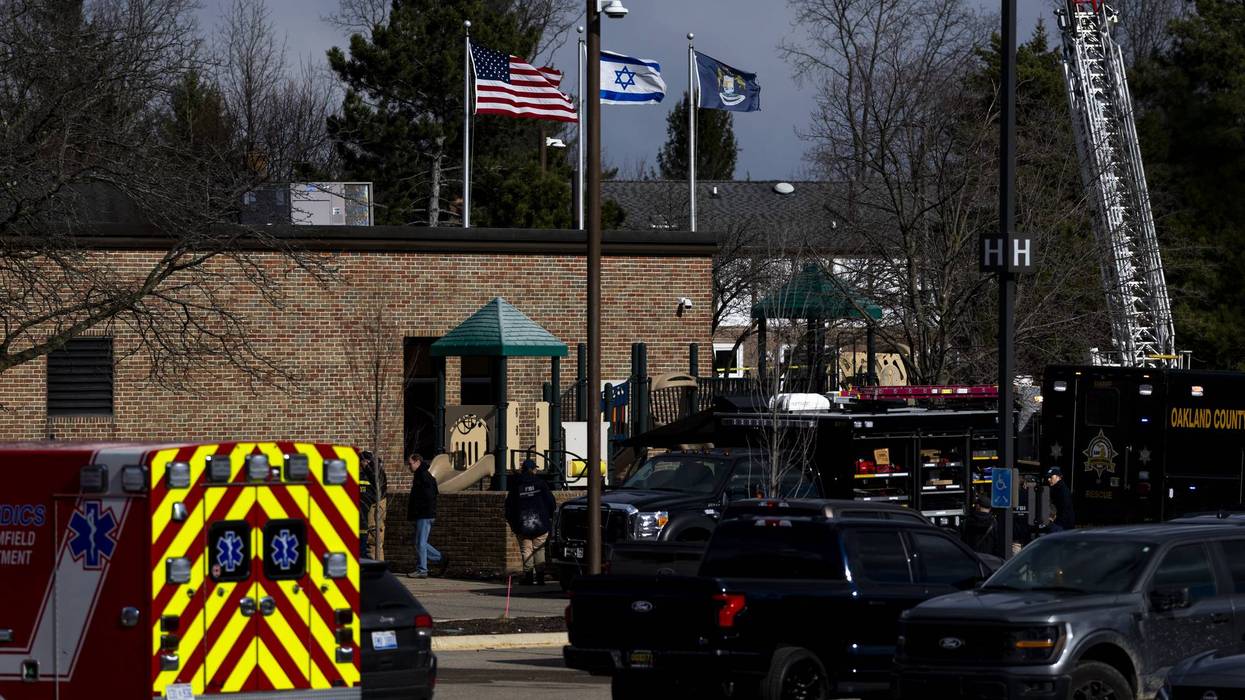
Ayman Mohamad Ghazali—a 41-year-old naturalized US citizen born in Lebanon—was killed during a shootout with security guards at the Temple Israel synagogue in West Bloomfield Township after crashing his truck into the building. Authorities said the vehicle contained mortar-type explosives and ignited upon impact. One security guard was struck by the vehicle.
No one else inside the synagogue was injured. Cassi Cohen, Temple Israel's director of strategic development, told The Associated Press that “thankfully, we have had many active shooter drills and our staff is prepared for these situations."
Jennifer Runyan, the FBI special agent in charge of the bureau's Detroit field office, described the attack as a “targeted act of violence against the Jewish community."
However, a local official in Mashgharah, a town in the Beqaa Valley of Lebanon, told the AP on condition of anonymity that Ghazali's two brothers, niece, and nephew were among five people killed by a March 5 Israeli airstrike on their home while they were eating their fast-breaking dinner during the Muslim holy month of Ramadan.
US investigative journalist Ryan Grim published photos reportedly posted by Ghazali showing his four slain relatives.
Numerous observers called the attack on Temple Israel—which flies an Israeli flag outside the building—"blowback" from Israel's renewed war on Hezbollah in Lebanon, which was launched despite a November 2024 ceasefire agreement alongside the US-Israeli war on Iran.
"The guy's family was killed last week by Israel and he was taking revenge. That’s wrong. Murder is wrong," US political commentator and author Matt Stoller, who is Jewish American, said on X. "But this isn’t some uptick of antisemitism, it’s blowback. A lot of us have been saying that Israel is bad for the Jews. It is. We have to reject that country."
Others cautioned against conflating Israel with Judaism, with Grim asserting that "it is extremely important we separate the actions of a foreign government from an American synagogue, or any synagogue."
Rights groups have noted a dramatic rise in both Islamophobia and antisemitism following the Hamas-led attack of October 7, 2023 and Israel's genocidal retaliation.
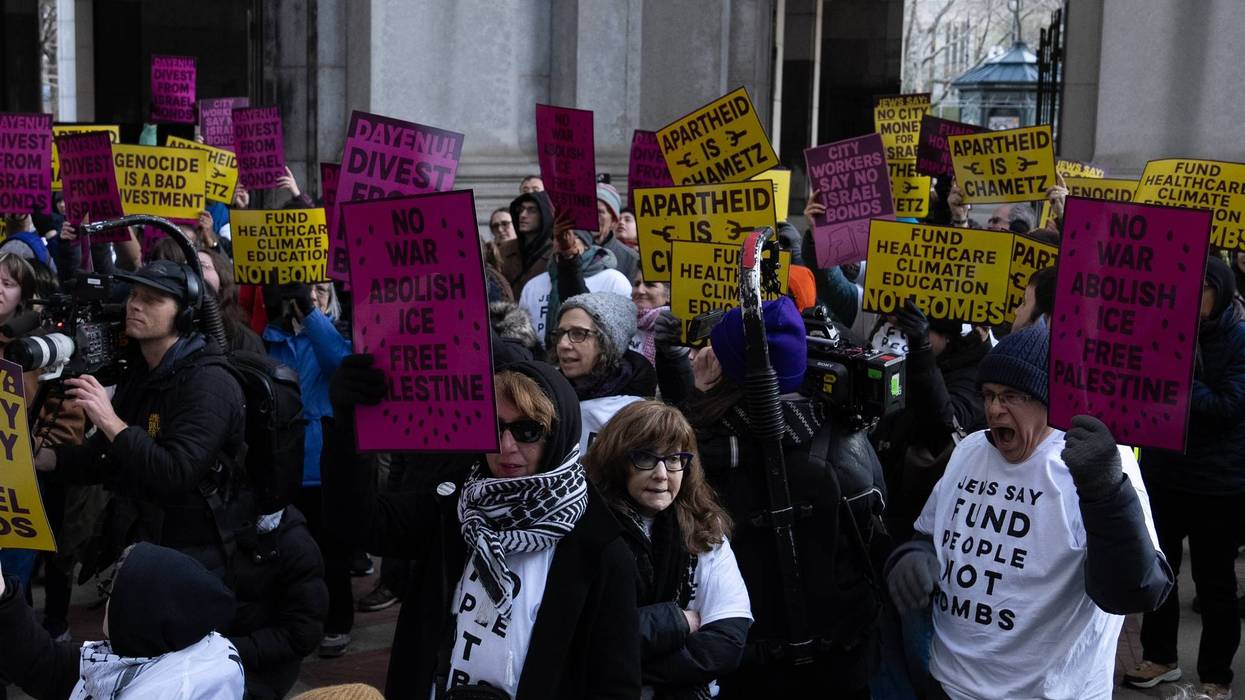
Jewish Voice for Peace (JVP)—which has led numerous protests against Israel's war on Gaza—said Friday that "Jewish communities, like all people, deserve to be safe in our houses of worship and schools."
"The person who reportedly carried out this attack was a man whose siblings, niece, and nephew were just murdered in Lebanon by Israeli bombs," JVP continued. "This is grief upon grief. War always begets trauma and further violence."
"It is clear that the Israeli government’s atrocities make all of us—including Jews—less safe," JVP added. "Israel carries out brutal wars and genocide against families and children, then falsely claims these war crimes are done in the name of Jews. This leads to more antisemitism."
"War always begets trauma and further violence."
More than 4,700 people have been killed in Lebanon by Israeli forces since October 2023, including over 1,100 women and children, according to Lebanese officials.
Israeli forces have also killed or wounded over 250,000 Palestinians in Gaza and the illegally occupied West Bank since the October 2023 attack. US and Israeli attacks on Iran have slain or injured thousands more people.
Originally coined by the CIA in the wake of its 1953 coup in Iran to describe the unintended and often deadly consequences of covert or military action, the concept of blowback gained widespread popularity after the September 11, 2001 attack on the United States, which is often regarded as a classic example of the term in action.
Directing state power against those who participate in movements for justice and equality undermines genuine efforts to confront all manifestations of bigotry and oppression while weakening democratic life.
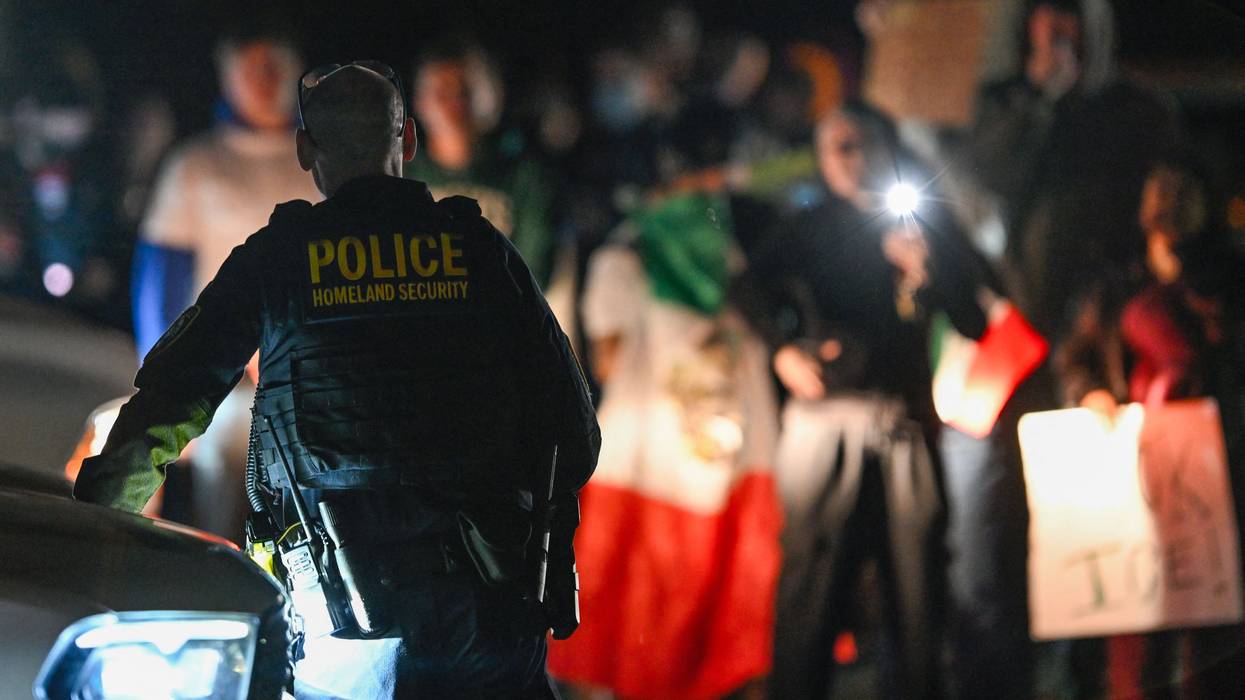
In the past few months, the Trump administration has intensified its assault on political dissent. The September 25 release of National Security Presidential Memorandum 7, titled “Countering Domestic Terrorism and Organized Political Violence,” capitalized upon the shooting death of Turning Point USA leader Charlie Kirk and marked an alarming escalation in the regime’s suppression of political dissent in the name of national security.
The NSPM-7 memorandum casts a wide net by identifying a wide swath of previously protected criticisms of American policy, capitalism, Christian nationalism, and fascism as potential threats to US security. This language reveals the government’s effort to construct a political category of terrorism so broad that it can encompass nearly any form of progressive or left-aligned civil society work.
The intensifying campaign now unfolding against progressive movements in the United States did not arise overnight. It reflects an expansion of strategies that have been enacted since some of the country’s earliest days, with historical precedents in the US government’s attacks on anti-slavery movements, Civil Rights organizations, workers’ rights movements, and anti-war activists. NSPM-7 presents itself as a decisive response to domestic extremism, but in reality, it repurposes long-standing tools of state surveillance and criminalization, and directs them toward a broader range of political actors. By framing a wide spectrum of views that challenge the administration as potential state threats, it merges national security logic with partisan hostility.
The administration’s recent designation of several European anti-fascist groups as global terrorist entities, along with its earlier attack on the Palestinian civil society groups Al-Haq, the Palestinian Centre for Human Rights (PCHR), and Al-Mezan, fits squarely into this same trajectory. It signals an effort to construct a transnational narrative in which resistance to authoritarian politics is reinterpreted as a form of organized danger to US security. This new global framing reinforces the domestic one. Together, they redefine dissent as a matter for preemptive national security intervention rather than as a form of democratic disagreement.
NSPM-7 does not establish new criminal prohibitions. It instead reorganizes existing authorities in order to expand their reach to subvert political dissent.
The approach embedded in NSPM-7 was foreshadowed in Project Esther, an October 2024 document by the Heritage Foundation that outlined the very methods now being enacted through federal authority. Presented as a plan to combat antisemitism, it has instead served as a justification for coordinated attempts to weaken civil society groups, especially those connected to Palestinian solidarity work. Jewish Voice for Peace, for example, appears prominently in Project Esther. The project treats dissenting Jewish movements as potential enemies of the state while ignoring the sources of real antisemitic violence from white supremacist organizations and Trump’s own network. In doing so, it advances an agenda that uses the language of Jewish protection to mask a campaign that targets, among many groups, Jewish progressives and anti-fascists.
NSPM-7 does not establish new criminal prohibitions. It instead reorganizes existing authorities in order to expand their reach to subvert political dissent. The most troubling aspect is the encouragement to intervene before any political act occurs. This “pre-crime” approach draws directly from earlier post-9/11counterterrorism practices that targeted Arab, Muslim, and Palestinian communities on the basis of suspicion rather than action. Those attacks produced widespread surveillance, infiltration, and community fear, and in doing so made the public less safe. The new Trump memo now positions those same strategies to be used against a much wider segment of civil society. Anyone associated with advocacy for Palestinian rights, critiques of US foreign policy, challenges to state violence, or left-aligned social movements is a potential target.
Historical parallels offer important context. Under National Socialist rule, Germany relied on security language to arrest, imprison, and murder political opponents. Italy and Spain under fascist regimes treated labor groups, social movements, and minority activists as subjects for surveillance, detention, and execution. The United States has its own history of using national security claims to silence and even execute dissenters during the Cold War. In each case, the crucial step was the transformation of political disagreement into a threat to national security.
As a scholar of modern Jewish history and Holocaust studies, I view the current moment in part through these historical precedents. The misuse of claims about protecting Jews while weaponizing antisemitic accusations against figures such as Zohran Mamdani and George Soros demonstrates that anti-Jewish hatred is not being confronted as a social prejudice but instrumentalized in support of a racist, authoritarian regime. The effect is to direct state power against those who participate in movements for justice and equality. This undermines genuine efforts to confront all manifestations of bigotry and oppression and weakens democratic life.
There is, however, another dimension to this history. Communities that endured earlier waves of repressive counterterrorism policy also developed strategies of collective defense and political resilience. What is required at this moment is recognition of the scale and coherence of the strategy being deployed. ICE raids, the false designation of peaceful Palestinian human rights groups as terrorist organizations, to attacks on transgender people—these should not be viewed in isolation. They are components of a coordinated effort to curtail the activity of civil society. The appropriate response begins with solidarity across movements, a clear understanding of the racial and political foundations of these policies, and, most of all, a refusal to allow this expansion of state power to become normalized.
The administration’s actions demand a collective defense of democratic spaces. The lessons of the past are clear: attacks on our civic freedom can be resisted, but only when communities recognize the stakes and act together. This moment requires precisely that resolve.
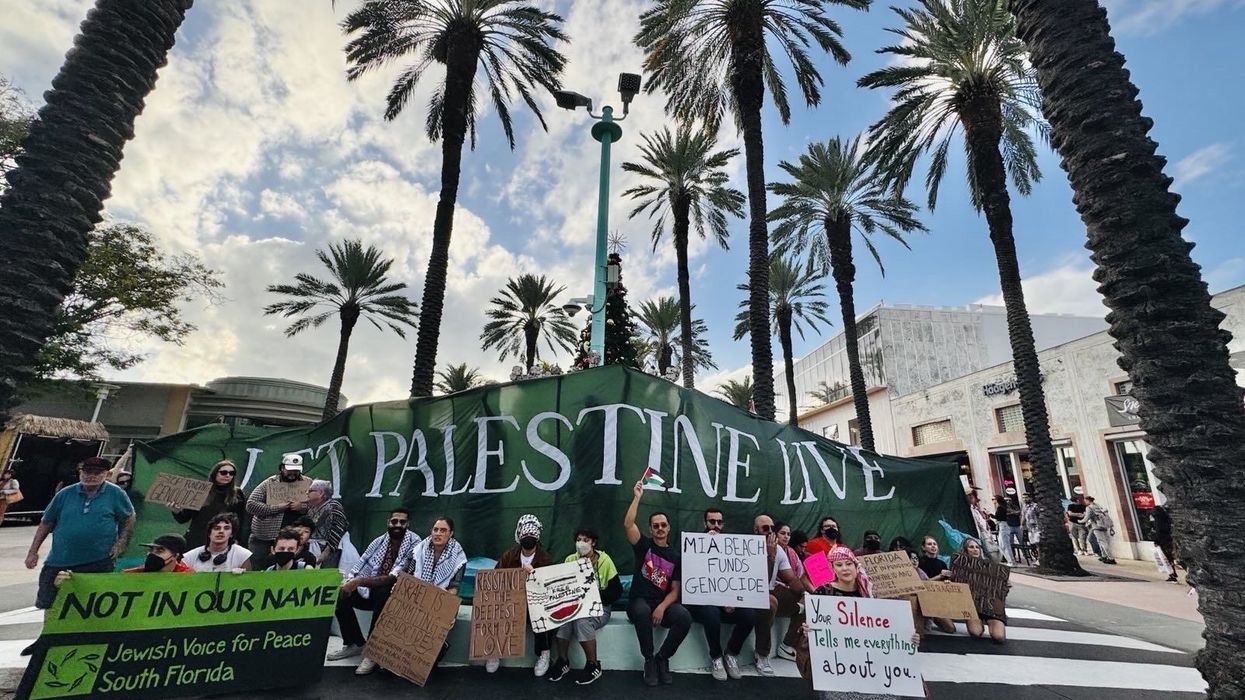
The visibility of anti-Zionist organizing throughout South Florida breaks the normalization of mainstream Jewish and other support for Israel and will continue to do so.
The actual reality of organizing for Palestinian justice in South Florida defies the region’s reputation of near unanimous support for Israel and its genocide against the Palestinian people. And the belief that all Jewish people in South Florida support Israel (it’s almost a mantra) is also not reflective of the full picture.
Joining with a coalition of groups committed to justice—Palestinian, Muslim, student, socialist, and others—Jewish organizing for Palestinian justice in South Florida takes multiple forms. Its Jewish Voice for Peace (JVP) chapter (of which this author is part) is unabashedly anti-Zionist, abolitionist, and socialist and stands firmly with Indigenous-led organizing (most recently against the Everglades Concentration Camp), queer and trans liberation, and disability justice. Part of what makes this work noteworthy is that it is happening in a state, with its reactionary governor, Ron DeSantis, at the helm, that is a step ahead of much of the country in its excessively repressive climate and policies. Though we know the rest of the country seems not to be far behind.
Community education is central to the group’s commitments, especially as more and more people are joining, rooted in the understanding that we are all learners and teachers. In ongoing workshops such as "SWANA Jews and Zionism After 1948 and in the 20th Century"; "The History and Current Day Reality of the ADL"; and "The Palestinian Nakba," participants meet outside (Covid-19 safety is a priority!) to learn together and to deepen and strengthen ongoing organizing. Jewish holidays are also observed within an anti-Zionist framework, often by the ocean, with learning including “Engineered Famine: Israel’s Starvation of Gaza–a Teach-in, Havdalah, and Solidarity Fast” and “An Anti-Zionist Shabbat Teach-in on Antisemitism from a Collective Liberation Framework.”
Most recently, one of the community’s areas of focus has been on challenging the fervent support for genocide in the rabidly pro-Zionist Miami Beach City Commission. Many across the country, and even beyond, followed the city’s fight with the local arts theatre, O Cinema, for showing the Oscar-winning documentary No Other Land, which was one chapter in an ongoing battle with the city’s mayor and City Commission in their attempts to censor criticism of Israel and its ongoing violence against the Palestinian people.
Contrary to what some may assume in South Florida’s political climate, activists have succeeded in being visible in the media and bringing these issues into the public eye.
The City of Miami Beach’s support for Israeli apartheid shows up in myriad ways: It donated an ambulance to Israel (smack in the middle of the genocide), has funneled millions of taxpayer dollars into Israel bonds, and adopted a resolution that prohibited the city from hiring contractors who refused to do business with Israel. At City Commission meetings, during the space for public comment, as residents stand up to speak against the city’s support for genocide, the mayor and commissioners consistently shut down opposition by turning off the mics and then ranting on and on in support of Israel. They accuse speakers of being antisemitic and invited the Consul General of Israel to give an invocation, whose words, in the middle of Israel’s genocide against the Palestinian people of Gaza, included, “We lift up the brave soldiers of the IDF.”
That has not deterred the community’s very visible presence and opposition at these hearings and in the streets.
But the Miami Beach commissioners and mayor didn’t just stop there. As a result of the ongoing organizing in support of Palestinian justice, the city instituted an anti-protest ordinance that denies the constitutional right to protest. After the ordinance was enacted, when activists attempted to protest at the Convention Center where large numbers of people have gathered for Art Basel and the Aspen Ideas Climate Festival, the Miami Beach Police Department barred protesters from gathering on the Convention Center sidewalk in violation of their constitutionally protected right of free speech.
In response, Jewish Voice for Peace South Florida has filed a lawsuit asking a federal court to declare the anti-protest ordinance and the actions of the Miami Beach Police Department unconstitutional as a violation of the First Amendment rights of its members.
“The First Amendment protects the right to protest in public places, including public sidewalks. It is for the protesters, not the mayor, the City Commission, nor the police, to determine where that right may be exercised, “ said Alan Levine, a member of the legal team representing Jewish Voice for Peace South Florida.
Another critical and vocal area of organizing among Jewish Voice for Peace South Florida and other local advocates is its Break the Bonds Miami campaign, devoted to challenging the county’s investments in Israel Bonds. Just recently, the campaign released a new report based on over 700 survey responses from Miami-Dade County residents, examining public opinion of the county’s $151 million investment in Israel Bonds. The findings show strong opposition to these investments and support for redirecting funds away from genocide toward much-needed local priorities.
“As a Jewish resident of Miami-Dade, I don't believe the county should be investing in a country committing a horrific genocide and starvation campaign…The $151 million Miami-Dade has invested in Israel Bonds should be redirected to empower our local community to flourish, not buy bombs and guns for Israel’s military to kill children, journalists, and doctors," said Hayley Margolis, a JVP South Florida member leader and Miami Dade County resident, at a recent press conference releasing the report.
Contrary to what some may assume in South Florida’s political climate, activists have succeeded in being visible in the media and bringing these issues into the public eye. The protests, actions, and campaign have been well-covered on TV and in print media, and numbers of opinion pieces have been published in all the local papers. The visibility of anti-Zionist organizing throughout South Florida breaks the normalization of mainstream Jewish and other support for Israel and will continue to do so. As the JVP South Florida chapter reiterates in all its messaging: “We will not be silent, and we will not be silenced.”