

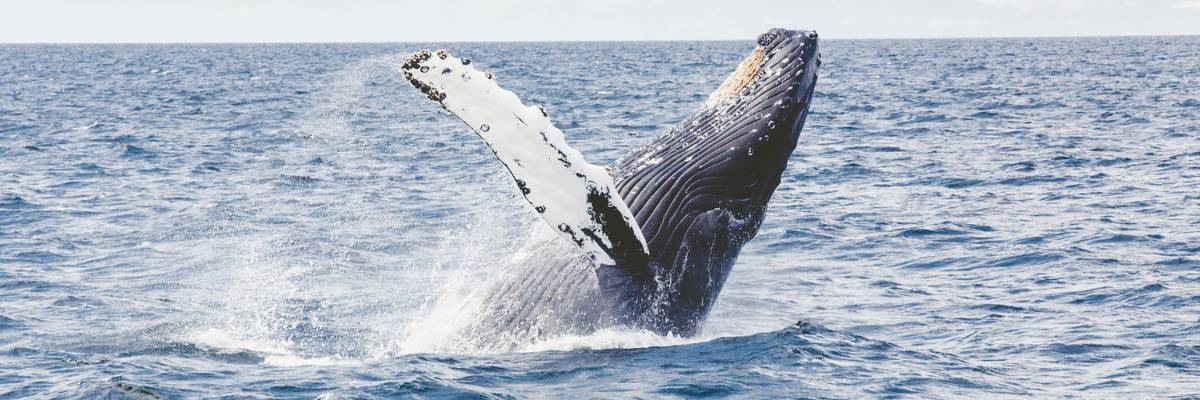
A humpback whale is seen in the ocean.
Human Activity Pushing More Than 1 in 5 Migratory Species Toward Extinction: UN
"The global community has an opportunity to translate this latest science of the pressures facing migratory species into concrete conservation action," said one U.N. official.
As world governments gathered in Uzbekistan Monday for the United Nations conference on migratory species, they centered the theme "Nature Knows No Borders"—an idea that a new landmark report said must take hold across the globe to push policymakers in all countries and regions to protect the billions of animals that travel each year to reproduce and find food.
The Convention on the Conservation of Migratory Species of Wild Animals (CMS) marked the opening of the 14th Conference of the Parties (CMS COP14) to the United Nations biodiversity treaty by releasing the first-ever State of the World's Migratory Species report, showing that nearly half of migrating species are declining in population.
The crisis is especially dire for more than 1 in 5 species that are threatened with extinction, and 70 species listed under the CMS which have become more endangered, including the steppe eagle, the Egyptian vulture, and the wild camel.
The populations of nearly all species of fish listed in the U.N. treaty, including sharks and rays, have declined by 90% since the 1970s.
The two biggest drivers of endangerment and threatened extinction are overexploitation—including incidental and intentional capture—and habitat loss, and both are directly caused by human activity.
Seven in 10 CMS-listed species are threatened by overexploitation, while 3 in 4 of the species are at greater risk of dying out due to habitat loss, as humans expand energy, transportation, and agricultural infrastructure across the globe.
The climate crisis and planetary heating, pollution, and the spread of invasive species—thousands of which are introduced by humans—are also major threats to migratory species, the report says.
"Unsustainable human activities are jeopardizing the future of migratory species—creatures who not only act as indicators of environmental change but play an integral role in maintaining the function and resilience of our planet's complex ecosystems," said Inger Andersen, undersecretary-general of the U.N. and executive director of the U.N. Environment Program (UNEP). "The global community has an opportunity to translate this latest science of the pressures facing migratory species into concrete conservation action. Given the precarious situation of many of these animals, we cannot afford to delay."
Migratory species "reinforce" the fact that nature does not observe borders put in place by humans, Andersen added in a video posted on social media, and humans must work across borders to ensure these species are protected.
According to the report, nearly 10,000 of the world's key biodiversity areas are crucial for the survival of migratory species, but more than half are not designated as areas that must be conserved—and 58% are under threat due to human activities.
Mapping and taking adequate steps to protect "the vital locations that serve as breeding, feeding, and stopover sites for migratory species" is a key priority, said the CMS in a statement.
"Migratory species rely on a variety of specific habitats at different times in their lifecycles," said Amy Fraenkel, CMS executive secretary. "When species cross national borders, their survival depends on the efforts of all countries in which they are found. This landmark report will help underpin much-needed policy actions to ensure that migratory species continue to thrive around the world.”
In addition to increasing understanding of migration paths and minimizing human infrastructure in the pathways, the report recommended that policymakers "strengthen and expand efforts to tackle illegal and unsustainable taking of migratory species"; scale up efforts to tackle climate change and light, noise, chemical, and plastic pollution; and consider expanding CMS listings to include more at-risk migratory species in need of international attention.
"There are many things that are needed to be done on addressing the drivers of environmental change, such as agriculture for habitat destruction, the sprawl of cities, we have to look at rail, road, and fences," said Fraenkel. "One of the most important things for migratory species is something we call ecosystem integrity: they need particular sites to breed, feed, and travel. If those sites cannot be accessed or don’t exist any more, then it's obviously going to be detrimental."
The report focused on 1,189 migratory species identified by the U.N. as needing protection, but found that another 399 migratory species are either threatened or near threatened with extinction.
"People might not realize that whales, lions, gorillas, giraffes, and many birds are migratory species," Fraenkel said.
At the opening ceremony of CMS COP14, Andersen called on policymakers to live up to the conference's theme "by ensuring free passage of migratory species and by ensuring that, through multilateralism, we reach a hand across every border to ensure long-term sustainability, for people and for planet."
Reversing population decline is possible, the report emphasized, pointing to coordinated local action in Cyprus that reduced illegal bird netting by 91% and "hugely successful" conservation and restoration work in Kazakhstan, "which has brought the saiga antelope back from the brink of extinction."
"I ask parties to consider how to work in harmony with other processes for mutually assured success," said Andersen, "all in the interests of sustainable economies and societies."
We are at a crossroads
This country and this world are at a monumental crossroads. In a few short weeks, US voters will have an opportunity to beat back the forces of fascism and confront the billionaires who are rigging the economy, our media system, and our democracy, making it increasingly impossible for ordinary people to get by. We’re not just talking about the election. We’re talking about what must be done once these fascist elements are vanquished from power. We need a bolder set of solutions than what either major party has so far been willing to offer and a working-class movement ready to fight like hell for it. Trump didn't emerge from nowhere. The conditions that fueled MAGA authoritarianism were created by decades of radical neoliberal economic policies and a corrupt political system dominated by corporate interests. They slashed taxes on the super-rich, promising that the benefits would trickle down. They said giveaways to the corporate titans would make life more affordable for the rest of us. It was all bullshit. And when a bitter, betrayed populace searches for someone to blame, right-wing demagogues have little trouble finding scapegoats. People know when they're being lied to, but you won't hear any of this from the corporate media. Only independent journalism—powered and funded by people who believe in building a better world—can deliver truly trustworthy daily news. Our Fall Campaign is underway, and we need your help. To power our newsroom through the rest of the year, we need to raise $125,000 by midnight on October 31. So if you share our vision, please contribute whatever you can to sustain our work. |
As world governments gathered in Uzbekistan Monday for the United Nations conference on migratory species, they centered the theme "Nature Knows No Borders"—an idea that a new landmark report said must take hold across the globe to push policymakers in all countries and regions to protect the billions of animals that travel each year to reproduce and find food.
The Convention on the Conservation of Migratory Species of Wild Animals (CMS) marked the opening of the 14th Conference of the Parties (CMS COP14) to the United Nations biodiversity treaty by releasing the first-ever State of the World's Migratory Species report, showing that nearly half of migrating species are declining in population.
The crisis is especially dire for more than 1 in 5 species that are threatened with extinction, and 70 species listed under the CMS which have become more endangered, including the steppe eagle, the Egyptian vulture, and the wild camel.
The populations of nearly all species of fish listed in the U.N. treaty, including sharks and rays, have declined by 90% since the 1970s.
The two biggest drivers of endangerment and threatened extinction are overexploitation—including incidental and intentional capture—and habitat loss, and both are directly caused by human activity.
Seven in 10 CMS-listed species are threatened by overexploitation, while 3 in 4 of the species are at greater risk of dying out due to habitat loss, as humans expand energy, transportation, and agricultural infrastructure across the globe.
The climate crisis and planetary heating, pollution, and the spread of invasive species—thousands of which are introduced by humans—are also major threats to migratory species, the report says.
"Unsustainable human activities are jeopardizing the future of migratory species—creatures who not only act as indicators of environmental change but play an integral role in maintaining the function and resilience of our planet's complex ecosystems," said Inger Andersen, undersecretary-general of the U.N. and executive director of the U.N. Environment Program (UNEP). "The global community has an opportunity to translate this latest science of the pressures facing migratory species into concrete conservation action. Given the precarious situation of many of these animals, we cannot afford to delay."
Migratory species "reinforce" the fact that nature does not observe borders put in place by humans, Andersen added in a video posted on social media, and humans must work across borders to ensure these species are protected.
According to the report, nearly 10,000 of the world's key biodiversity areas are crucial for the survival of migratory species, but more than half are not designated as areas that must be conserved—and 58% are under threat due to human activities.
Mapping and taking adequate steps to protect "the vital locations that serve as breeding, feeding, and stopover sites for migratory species" is a key priority, said the CMS in a statement.
"Migratory species rely on a variety of specific habitats at different times in their lifecycles," said Amy Fraenkel, CMS executive secretary. "When species cross national borders, their survival depends on the efforts of all countries in which they are found. This landmark report will help underpin much-needed policy actions to ensure that migratory species continue to thrive around the world.”
In addition to increasing understanding of migration paths and minimizing human infrastructure in the pathways, the report recommended that policymakers "strengthen and expand efforts to tackle illegal and unsustainable taking of migratory species"; scale up efforts to tackle climate change and light, noise, chemical, and plastic pollution; and consider expanding CMS listings to include more at-risk migratory species in need of international attention.
"There are many things that are needed to be done on addressing the drivers of environmental change, such as agriculture for habitat destruction, the sprawl of cities, we have to look at rail, road, and fences," said Fraenkel. "One of the most important things for migratory species is something we call ecosystem integrity: they need particular sites to breed, feed, and travel. If those sites cannot be accessed or don’t exist any more, then it's obviously going to be detrimental."
The report focused on 1,189 migratory species identified by the U.N. as needing protection, but found that another 399 migratory species are either threatened or near threatened with extinction.
"People might not realize that whales, lions, gorillas, giraffes, and many birds are migratory species," Fraenkel said.
At the opening ceremony of CMS COP14, Andersen called on policymakers to live up to the conference's theme "by ensuring free passage of migratory species and by ensuring that, through multilateralism, we reach a hand across every border to ensure long-term sustainability, for people and for planet."
Reversing population decline is possible, the report emphasized, pointing to coordinated local action in Cyprus that reduced illegal bird netting by 91% and "hugely successful" conservation and restoration work in Kazakhstan, "which has brought the saiga antelope back from the brink of extinction."
"I ask parties to consider how to work in harmony with other processes for mutually assured success," said Andersen, "all in the interests of sustainable economies and societies."
- 'We Must Heed the Warning': 1 in 3 Freshwater Fishes--Vital to Food and Jobs for Millions--Face Extinction ›
- Fears of Monarch Butterfly Extinction as Numbers Plummet 22% in Annual Count ›
- 'A Wake-Up Call': 21 Species Declared Extinct by US ›
- Opinion | We Must Reject Ego-Nomics to Prevent Human Extinction | Common Dreams ›
- Opinion | Turning Down the Heat, and the Noise | Common Dreams ›
As world governments gathered in Uzbekistan Monday for the United Nations conference on migratory species, they centered the theme "Nature Knows No Borders"—an idea that a new landmark report said must take hold across the globe to push policymakers in all countries and regions to protect the billions of animals that travel each year to reproduce and find food.
The Convention on the Conservation of Migratory Species of Wild Animals (CMS) marked the opening of the 14th Conference of the Parties (CMS COP14) to the United Nations biodiversity treaty by releasing the first-ever State of the World's Migratory Species report, showing that nearly half of migrating species are declining in population.
The crisis is especially dire for more than 1 in 5 species that are threatened with extinction, and 70 species listed under the CMS which have become more endangered, including the steppe eagle, the Egyptian vulture, and the wild camel.
The populations of nearly all species of fish listed in the U.N. treaty, including sharks and rays, have declined by 90% since the 1970s.
The two biggest drivers of endangerment and threatened extinction are overexploitation—including incidental and intentional capture—and habitat loss, and both are directly caused by human activity.
Seven in 10 CMS-listed species are threatened by overexploitation, while 3 in 4 of the species are at greater risk of dying out due to habitat loss, as humans expand energy, transportation, and agricultural infrastructure across the globe.
The climate crisis and planetary heating, pollution, and the spread of invasive species—thousands of which are introduced by humans—are also major threats to migratory species, the report says.
"Unsustainable human activities are jeopardizing the future of migratory species—creatures who not only act as indicators of environmental change but play an integral role in maintaining the function and resilience of our planet's complex ecosystems," said Inger Andersen, undersecretary-general of the U.N. and executive director of the U.N. Environment Program (UNEP). "The global community has an opportunity to translate this latest science of the pressures facing migratory species into concrete conservation action. Given the precarious situation of many of these animals, we cannot afford to delay."
Migratory species "reinforce" the fact that nature does not observe borders put in place by humans, Andersen added in a video posted on social media, and humans must work across borders to ensure these species are protected.
According to the report, nearly 10,000 of the world's key biodiversity areas are crucial for the survival of migratory species, but more than half are not designated as areas that must be conserved—and 58% are under threat due to human activities.
Mapping and taking adequate steps to protect "the vital locations that serve as breeding, feeding, and stopover sites for migratory species" is a key priority, said the CMS in a statement.
"Migratory species rely on a variety of specific habitats at different times in their lifecycles," said Amy Fraenkel, CMS executive secretary. "When species cross national borders, their survival depends on the efforts of all countries in which they are found. This landmark report will help underpin much-needed policy actions to ensure that migratory species continue to thrive around the world.”
In addition to increasing understanding of migration paths and minimizing human infrastructure in the pathways, the report recommended that policymakers "strengthen and expand efforts to tackle illegal and unsustainable taking of migratory species"; scale up efforts to tackle climate change and light, noise, chemical, and plastic pollution; and consider expanding CMS listings to include more at-risk migratory species in need of international attention.
"There are many things that are needed to be done on addressing the drivers of environmental change, such as agriculture for habitat destruction, the sprawl of cities, we have to look at rail, road, and fences," said Fraenkel. "One of the most important things for migratory species is something we call ecosystem integrity: they need particular sites to breed, feed, and travel. If those sites cannot be accessed or don’t exist any more, then it's obviously going to be detrimental."
The report focused on 1,189 migratory species identified by the U.N. as needing protection, but found that another 399 migratory species are either threatened or near threatened with extinction.
"People might not realize that whales, lions, gorillas, giraffes, and many birds are migratory species," Fraenkel said.
At the opening ceremony of CMS COP14, Andersen called on policymakers to live up to the conference's theme "by ensuring free passage of migratory species and by ensuring that, through multilateralism, we reach a hand across every border to ensure long-term sustainability, for people and for planet."
Reversing population decline is possible, the report emphasized, pointing to coordinated local action in Cyprus that reduced illegal bird netting by 91% and "hugely successful" conservation and restoration work in Kazakhstan, "which has brought the saiga antelope back from the brink of extinction."
"I ask parties to consider how to work in harmony with other processes for mutually assured success," said Andersen, "all in the interests of sustainable economies and societies."
- 'We Must Heed the Warning': 1 in 3 Freshwater Fishes--Vital to Food and Jobs for Millions--Face Extinction ›
- Fears of Monarch Butterfly Extinction as Numbers Plummet 22% in Annual Count ›
- 'A Wake-Up Call': 21 Species Declared Extinct by US ›
- Opinion | We Must Reject Ego-Nomics to Prevent Human Extinction | Common Dreams ›
- Opinion | Turning Down the Heat, and the Noise | Common Dreams ›