SUBSCRIBE TO OUR FREE NEWSLETTER
Daily news & progressive opinion—funded by the people, not the corporations—delivered straight to your inbox.
5
#000000
#FFFFFF
To donate by check, phone, or other method, see our More Ways to Give page.
Daily news & progressive opinion—funded by the people, not the corporations—delivered straight to your inbox.
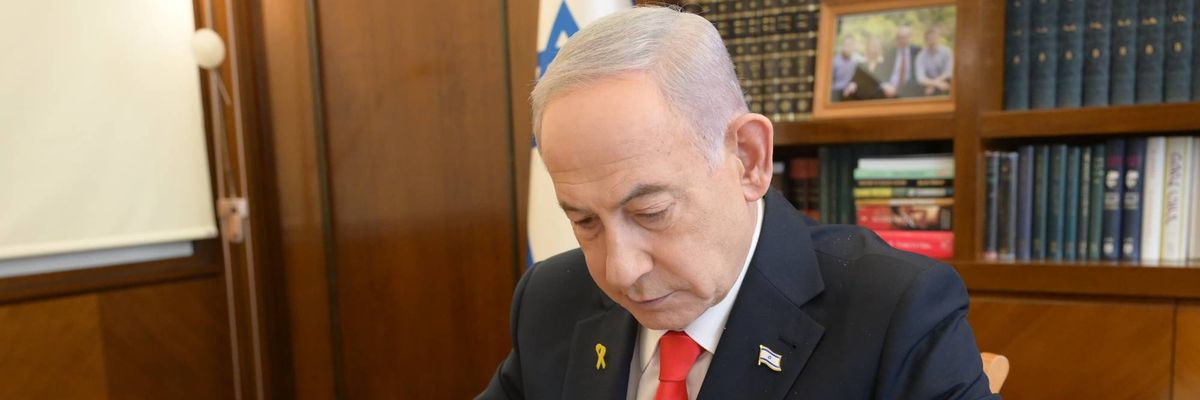
Israeli Prime Minister Benjamin Netanyahu signs an official recognition of the Republic of Somaliland as an independent state on December 26, 2025.
One foreign policy analyst said that Israel views Somaliland as a "strategic location as a launch pad for strikes on Yemen and potentially a place to forcibly 'relocate' Palestinians to."
Israel became the first nation to recognize Somaliland as a sovereign state on Friday, a move that was met with criticism from international observers who questioned its continued unwillingness to recognize a Palestinian state.
Somaliland, a breakaway region in the north of Somalia that is home to more than 6 million people, declared independence in 1991, but until now, no United Nations member states have recognized its claim.
Israeli Prime Minister Benjamin Netanyahu described his government's recognition of the territory as being “in the spirit of the Abraham Accords,” a deal brokered by US President Donald Trump for Israel to normalize relations with some of its Arab neighbors, which has itself been accused of disregarding the issue of Palestinian sovereignty.
Speaking over a video call with Abdirahman Mohamed Abdullahi, the president of Somaliland, Netanyahu said he was signing "Israel's official recognition of Somaliland and its right of self-determination," calling the friendship between the two nations "seminal and historic."
In a statement, Abdullahi said Israel's recognition "represents a milestone in Somaliland's long-standing pursuit of international legitimacy, reaffirming its historical, legal, and moral entitlement to statehood."
However, a report from the Guardian suggested that Israel's recognition of Somaliland has less to do with the self-determination of its people than with Israel's military interests. It cited a November report from a prominent Israeli think tank, which argued that Somaliland could be used as a base of military operations against Yemen's Houthis.
Somaliland, located in the horn of Africa just south of the Arabian Peninsula, already hosts an air base that the United Arab Emirates has used to conduct operations against the Yemeni militant group, which—until a "ceasefire" agreement was reached in October—launched regular attacks on Israel and its vessels in the Red Sea in what it said was an effort to pressure it to stop its genocidal military campaign in Gaza.
Egypt and Turkey condemned Israel's agreement with Somaliland, saying, "This initiative by Israel, which aligns with its expansionist policy and its efforts to do everything to prevent the recognition of a Palestinian state, constitutes overt interference in Somalia’s domestic affairs.”
Foreign ministers for the two nations joined those of Somalia and neighboring Djibouti on a call following the development, where they called for the continued unity of Somalia as an institution and condemned Israel's efforts "to displace the Palestinian people from their land."
Adil Haque, a professor at Rutgers Law School, pointed out on social media that, in August, Netanyahu met with Somaliland's leadership "offering recognition in exchange for helping Israel to illegally deport Palestinians from Gaza."
Somaliland was one of many nations reportedly approached by Israel to warehouse Palestinians exiled from the strip permanently—others included Indonesia, Uganda, South Sudan, and Libya.
Following reports at the time that Somalia was also in consideration, its president, Hassan Sheikh Mohamud, responded that "the idea of removing Palestine from their own land and putting them into another, other people’s land—I don’t see that that’s a solution at all."
A senior Israeli official who spoke on condition of anonymity with Israel's Channel 12 reportedly agreed that Netanyahu's recognition of Somaliland undermines his repeated assertions that there will never be a Palestinian state. As the Times of Israel summarized: "The official... points out that while Israel is the first country to grant recognition to Somaliland, the rest of the world considers the breakaway region an integral part of Somalia."
Tariq Kenney-Shawa, a fellow at the Palestinian Policy Network and a producer at AJ+, said: "To state the obvious, Israel wouldn’t recognize anyone unless there was something in it for them. Israel doesn’t give a shit about Somaliland apart from its strategic location as a launch pad for strikes on Yemen and potentially a place to forcibly 'relocate' Palestinians to."
Dear Common Dreams reader, It’s been nearly 30 years since I co-founded Common Dreams with my late wife, Lina Newhouser. We had the radical notion that journalism should serve the public good, not corporate profits. It was clear to us from the outset what it would take to build such a project. No paid advertisements. No corporate sponsors. No millionaire publisher telling us what to think or do. Many people said we wouldn't last a year, but we proved those doubters wrong. Together with a tremendous team of journalists and dedicated staff, we built an independent media outlet free from the constraints of profits and corporate control. Our mission has always been simple: To inform. To inspire. To ignite change for the common good. Building Common Dreams was not easy. Our survival was never guaranteed. When you take on the most powerful forces—Wall Street greed, fossil fuel industry destruction, Big Tech lobbyists, and uber-rich oligarchs who have spent billions upon billions rigging the economy and democracy in their favor—the only bulwark you have is supporters who believe in your work. But here’s the urgent message from me today. It's never been this bad out there. And it's never been this hard to keep us going. At the very moment Common Dreams is most needed, the threats we face are intensifying. We need your support now more than ever. We don't accept corporate advertising and never will. We don't have a paywall because we don't think people should be blocked from critical news based on their ability to pay. Everything we do is funded by the donations of readers like you. When everyone does the little they can afford, we are strong. But if that support retreats or dries up, so do we. Will you donate now to make sure Common Dreams not only survives but thrives? —Craig Brown, Co-founder |
Israel became the first nation to recognize Somaliland as a sovereign state on Friday, a move that was met with criticism from international observers who questioned its continued unwillingness to recognize a Palestinian state.
Somaliland, a breakaway region in the north of Somalia that is home to more than 6 million people, declared independence in 1991, but until now, no United Nations member states have recognized its claim.
Israeli Prime Minister Benjamin Netanyahu described his government's recognition of the territory as being “in the spirit of the Abraham Accords,” a deal brokered by US President Donald Trump for Israel to normalize relations with some of its Arab neighbors, which has itself been accused of disregarding the issue of Palestinian sovereignty.
Speaking over a video call with Abdirahman Mohamed Abdullahi, the president of Somaliland, Netanyahu said he was signing "Israel's official recognition of Somaliland and its right of self-determination," calling the friendship between the two nations "seminal and historic."
In a statement, Abdullahi said Israel's recognition "represents a milestone in Somaliland's long-standing pursuit of international legitimacy, reaffirming its historical, legal, and moral entitlement to statehood."
However, a report from the Guardian suggested that Israel's recognition of Somaliland has less to do with the self-determination of its people than with Israel's military interests. It cited a November report from a prominent Israeli think tank, which argued that Somaliland could be used as a base of military operations against Yemen's Houthis.
Somaliland, located in the horn of Africa just south of the Arabian Peninsula, already hosts an air base that the United Arab Emirates has used to conduct operations against the Yemeni militant group, which—until a "ceasefire" agreement was reached in October—launched regular attacks on Israel and its vessels in the Red Sea in what it said was an effort to pressure it to stop its genocidal military campaign in Gaza.
Egypt and Turkey condemned Israel's agreement with Somaliland, saying, "This initiative by Israel, which aligns with its expansionist policy and its efforts to do everything to prevent the recognition of a Palestinian state, constitutes overt interference in Somalia’s domestic affairs.”
Foreign ministers for the two nations joined those of Somalia and neighboring Djibouti on a call following the development, where they called for the continued unity of Somalia as an institution and condemned Israel's efforts "to displace the Palestinian people from their land."
Adil Haque, a professor at Rutgers Law School, pointed out on social media that, in August, Netanyahu met with Somaliland's leadership "offering recognition in exchange for helping Israel to illegally deport Palestinians from Gaza."
Somaliland was one of many nations reportedly approached by Israel to warehouse Palestinians exiled from the strip permanently—others included Indonesia, Uganda, South Sudan, and Libya.
Following reports at the time that Somalia was also in consideration, its president, Hassan Sheikh Mohamud, responded that "the idea of removing Palestine from their own land and putting them into another, other people’s land—I don’t see that that’s a solution at all."
A senior Israeli official who spoke on condition of anonymity with Israel's Channel 12 reportedly agreed that Netanyahu's recognition of Somaliland undermines his repeated assertions that there will never be a Palestinian state. As the Times of Israel summarized: "The official... points out that while Israel is the first country to grant recognition to Somaliland, the rest of the world considers the breakaway region an integral part of Somalia."
Tariq Kenney-Shawa, a fellow at the Palestinian Policy Network and a producer at AJ+, said: "To state the obvious, Israel wouldn’t recognize anyone unless there was something in it for them. Israel doesn’t give a shit about Somaliland apart from its strategic location as a launch pad for strikes on Yemen and potentially a place to forcibly 'relocate' Palestinians to."
Israel became the first nation to recognize Somaliland as a sovereign state on Friday, a move that was met with criticism from international observers who questioned its continued unwillingness to recognize a Palestinian state.
Somaliland, a breakaway region in the north of Somalia that is home to more than 6 million people, declared independence in 1991, but until now, no United Nations member states have recognized its claim.
Israeli Prime Minister Benjamin Netanyahu described his government's recognition of the territory as being “in the spirit of the Abraham Accords,” a deal brokered by US President Donald Trump for Israel to normalize relations with some of its Arab neighbors, which has itself been accused of disregarding the issue of Palestinian sovereignty.
Speaking over a video call with Abdirahman Mohamed Abdullahi, the president of Somaliland, Netanyahu said he was signing "Israel's official recognition of Somaliland and its right of self-determination," calling the friendship between the two nations "seminal and historic."
In a statement, Abdullahi said Israel's recognition "represents a milestone in Somaliland's long-standing pursuit of international legitimacy, reaffirming its historical, legal, and moral entitlement to statehood."
However, a report from the Guardian suggested that Israel's recognition of Somaliland has less to do with the self-determination of its people than with Israel's military interests. It cited a November report from a prominent Israeli think tank, which argued that Somaliland could be used as a base of military operations against Yemen's Houthis.
Somaliland, located in the horn of Africa just south of the Arabian Peninsula, already hosts an air base that the United Arab Emirates has used to conduct operations against the Yemeni militant group, which—until a "ceasefire" agreement was reached in October—launched regular attacks on Israel and its vessels in the Red Sea in what it said was an effort to pressure it to stop its genocidal military campaign in Gaza.
Egypt and Turkey condemned Israel's agreement with Somaliland, saying, "This initiative by Israel, which aligns with its expansionist policy and its efforts to do everything to prevent the recognition of a Palestinian state, constitutes overt interference in Somalia’s domestic affairs.”
Foreign ministers for the two nations joined those of Somalia and neighboring Djibouti on a call following the development, where they called for the continued unity of Somalia as an institution and condemned Israel's efforts "to displace the Palestinian people from their land."
Adil Haque, a professor at Rutgers Law School, pointed out on social media that, in August, Netanyahu met with Somaliland's leadership "offering recognition in exchange for helping Israel to illegally deport Palestinians from Gaza."
Somaliland was one of many nations reportedly approached by Israel to warehouse Palestinians exiled from the strip permanently—others included Indonesia, Uganda, South Sudan, and Libya.
Following reports at the time that Somalia was also in consideration, its president, Hassan Sheikh Mohamud, responded that "the idea of removing Palestine from their own land and putting them into another, other people’s land—I don’t see that that’s a solution at all."
A senior Israeli official who spoke on condition of anonymity with Israel's Channel 12 reportedly agreed that Netanyahu's recognition of Somaliland undermines his repeated assertions that there will never be a Palestinian state. As the Times of Israel summarized: "The official... points out that while Israel is the first country to grant recognition to Somaliland, the rest of the world considers the breakaway region an integral part of Somalia."
Tariq Kenney-Shawa, a fellow at the Palestinian Policy Network and a producer at AJ+, said: "To state the obvious, Israel wouldn’t recognize anyone unless there was something in it for them. Israel doesn’t give a shit about Somaliland apart from its strategic location as a launch pad for strikes on Yemen and potentially a place to forcibly 'relocate' Palestinians to."