SUBSCRIBE TO OUR FREE NEWSLETTER
Daily news & progressive opinion—funded by the people, not the corporations—delivered straight to your inbox.
5
#000000
#FFFFFF
To donate by check, phone, or other method, see our More Ways to Give page.
Daily news & progressive opinion—funded by the people, not the corporations—delivered straight to your inbox.
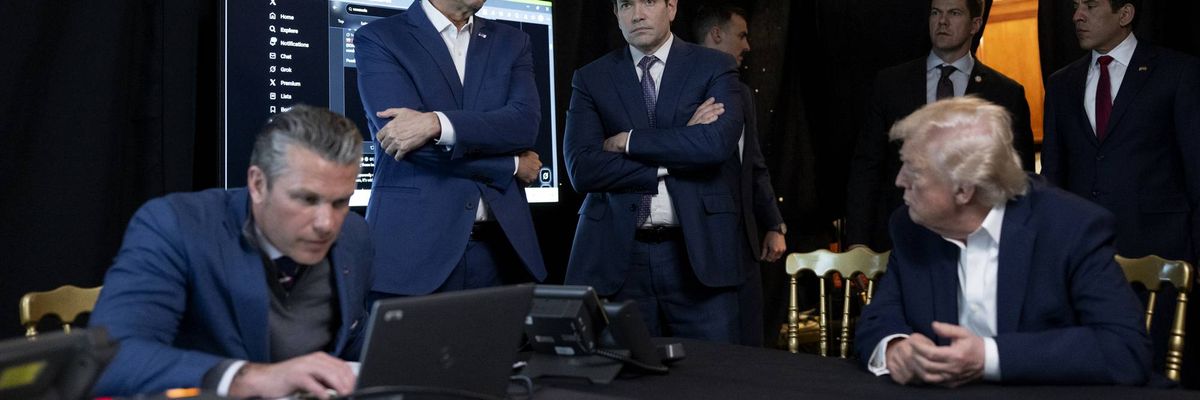
US President Donald Trump, Defense Secretary Pete Hegseth, and other top administration officials monitor the assault on Venezuela on January 3, 2026 in Palm Beach, Florida.
A mysterious gambler raked in over $400,000 in profit from a series of bets placed shortly before the Trump administration bombed Venezuela and abducted its president.
A suspiciously timed and lucrative bet on the US abduction of Venezuelan President Nicolás Maduro over the weekend has prompted speculation that the wager was placed with inside knowledge, possibly by someone within the Trump administration or its orbit.
The yet-unknown gambler placed a series of bets totaling nearly $34,000 between late December and January 3—the day of the US assault on Venezuela. All of the bets, placed on the cryptocurrency-based prediction platform Polymarket, were related to the probability of Maduro being removed from power and the US attacking Venezuela before the end of January.
The bettor, who went by username Burdensome-Mix on Polymarket, reportedly netted over $400,000 from the wagers in just 24 hours.
"Seems pretty suspicious!" wrote researcher Tyson Brody. "[US Defense Secretary] Pete Hegseth making some beer money on the side?"
NBC News reported Tuesday that the bettor "has already cashed out their Polymarket winnings in Solana, a type of cryptocurrency, through a major American exchange, with no indication they have tried to hide or launder the funds." The outlet added that "if any regulators or law enforcement went looking for the bettor, they’d likely have little difficulty locating them."
It was public knowledge that US President Donald Trump—who had said Maduro's days as the leader of Venezuela's government were "numbered"—was considering a direct attack on the South American country, and his administration had amassed a large military force in the region in recent months in preparation for such an assault.
But there was no publicly available information on the timing of any possible attack. The New York Times, which reportedly learned of the US assault and abduction operation shortly before it began, later revealed that Trump "had authorized the US military to go ahead as early as December 25, but left the precise timing to Pentagon officials and Special Operations planners to ensure that the attacking force was ready, and that conditions on the ground were optimal."
Trump gave the final go-ahead order late Friday night, according to the Times, and the attack began in the early hours of Saturday morning, Venezuela time.
Analysts have warned that the spread of prediction platforms like Polymarket—where gamblers can bet on a dizzying range of scenarios, including the timing of the second coming of Jesus Christ—could raise the likelihood of insiders trying to profit from confidential information.
It also increases the risk that people in positions of power and influence will try to push policy in a certain direction in order to cash in on their bets, said Demand Progress executive director Sean Vitka.
"And questions related to whether or not, and when, military action might be undertaken are especially vulnerable to such manipulation because the president frequently moves with discretion over the timing and (legally or not) without notice to the public or Congress," Vitka told The American Prospect.
Dear Common Dreams reader, It’s been nearly 30 years since I co-founded Common Dreams with my late wife, Lina Newhouser. We had the radical notion that journalism should serve the public good, not corporate profits. It was clear to us from the outset what it would take to build such a project. No paid advertisements. No corporate sponsors. No millionaire publisher telling us what to think or do. Many people said we wouldn't last a year, but we proved those doubters wrong. Together with a tremendous team of journalists and dedicated staff, we built an independent media outlet free from the constraints of profits and corporate control. Our mission has always been simple: To inform. To inspire. To ignite change for the common good. Building Common Dreams was not easy. Our survival was never guaranteed. When you take on the most powerful forces—Wall Street greed, fossil fuel industry destruction, Big Tech lobbyists, and uber-rich oligarchs who have spent billions upon billions rigging the economy and democracy in their favor—the only bulwark you have is supporters who believe in your work. But here’s the urgent message from me today. It's never been this bad out there. And it's never been this hard to keep us going. At the very moment Common Dreams is most needed, the threats we face are intensifying. We need your support now more than ever. We don't accept corporate advertising and never will. We don't have a paywall because we don't think people should be blocked from critical news based on their ability to pay. Everything we do is funded by the donations of readers like you. When everyone does the little they can afford, we are strong. But if that support retreats or dries up, so do we. Will you donate now to make sure Common Dreams not only survives but thrives? —Craig Brown, Co-founder |
A suspiciously timed and lucrative bet on the US abduction of Venezuelan President Nicolás Maduro over the weekend has prompted speculation that the wager was placed with inside knowledge, possibly by someone within the Trump administration or its orbit.
The yet-unknown gambler placed a series of bets totaling nearly $34,000 between late December and January 3—the day of the US assault on Venezuela. All of the bets, placed on the cryptocurrency-based prediction platform Polymarket, were related to the probability of Maduro being removed from power and the US attacking Venezuela before the end of January.
The bettor, who went by username Burdensome-Mix on Polymarket, reportedly netted over $400,000 from the wagers in just 24 hours.
"Seems pretty suspicious!" wrote researcher Tyson Brody. "[US Defense Secretary] Pete Hegseth making some beer money on the side?"
NBC News reported Tuesday that the bettor "has already cashed out their Polymarket winnings in Solana, a type of cryptocurrency, through a major American exchange, with no indication they have tried to hide or launder the funds." The outlet added that "if any regulators or law enforcement went looking for the bettor, they’d likely have little difficulty locating them."
It was public knowledge that US President Donald Trump—who had said Maduro's days as the leader of Venezuela's government were "numbered"—was considering a direct attack on the South American country, and his administration had amassed a large military force in the region in recent months in preparation for such an assault.
But there was no publicly available information on the timing of any possible attack. The New York Times, which reportedly learned of the US assault and abduction operation shortly before it began, later revealed that Trump "had authorized the US military to go ahead as early as December 25, but left the precise timing to Pentagon officials and Special Operations planners to ensure that the attacking force was ready, and that conditions on the ground were optimal."
Trump gave the final go-ahead order late Friday night, according to the Times, and the attack began in the early hours of Saturday morning, Venezuela time.
Analysts have warned that the spread of prediction platforms like Polymarket—where gamblers can bet on a dizzying range of scenarios, including the timing of the second coming of Jesus Christ—could raise the likelihood of insiders trying to profit from confidential information.
It also increases the risk that people in positions of power and influence will try to push policy in a certain direction in order to cash in on their bets, said Demand Progress executive director Sean Vitka.
"And questions related to whether or not, and when, military action might be undertaken are especially vulnerable to such manipulation because the president frequently moves with discretion over the timing and (legally or not) without notice to the public or Congress," Vitka told The American Prospect.
A suspiciously timed and lucrative bet on the US abduction of Venezuelan President Nicolás Maduro over the weekend has prompted speculation that the wager was placed with inside knowledge, possibly by someone within the Trump administration or its orbit.
The yet-unknown gambler placed a series of bets totaling nearly $34,000 between late December and January 3—the day of the US assault on Venezuela. All of the bets, placed on the cryptocurrency-based prediction platform Polymarket, were related to the probability of Maduro being removed from power and the US attacking Venezuela before the end of January.
The bettor, who went by username Burdensome-Mix on Polymarket, reportedly netted over $400,000 from the wagers in just 24 hours.
"Seems pretty suspicious!" wrote researcher Tyson Brody. "[US Defense Secretary] Pete Hegseth making some beer money on the side?"
NBC News reported Tuesday that the bettor "has already cashed out their Polymarket winnings in Solana, a type of cryptocurrency, through a major American exchange, with no indication they have tried to hide or launder the funds." The outlet added that "if any regulators or law enforcement went looking for the bettor, they’d likely have little difficulty locating them."
It was public knowledge that US President Donald Trump—who had said Maduro's days as the leader of Venezuela's government were "numbered"—was considering a direct attack on the South American country, and his administration had amassed a large military force in the region in recent months in preparation for such an assault.
But there was no publicly available information on the timing of any possible attack. The New York Times, which reportedly learned of the US assault and abduction operation shortly before it began, later revealed that Trump "had authorized the US military to go ahead as early as December 25, but left the precise timing to Pentagon officials and Special Operations planners to ensure that the attacking force was ready, and that conditions on the ground were optimal."
Trump gave the final go-ahead order late Friday night, according to the Times, and the attack began in the early hours of Saturday morning, Venezuela time.
Analysts have warned that the spread of prediction platforms like Polymarket—where gamblers can bet on a dizzying range of scenarios, including the timing of the second coming of Jesus Christ—could raise the likelihood of insiders trying to profit from confidential information.
It also increases the risk that people in positions of power and influence will try to push policy in a certain direction in order to cash in on their bets, said Demand Progress executive director Sean Vitka.
"And questions related to whether or not, and when, military action might be undertaken are especially vulnerable to such manipulation because the president frequently moves with discretion over the timing and (legally or not) without notice to the public or Congress," Vitka told The American Prospect.