SUBSCRIBE TO OUR FREE NEWSLETTER
Daily news & progressive opinion—funded by the people, not the corporations—delivered straight to your inbox.
5
#000000
#FFFFFF
To donate by check, phone, or other method, see our More Ways to Give page.
Daily news & progressive opinion—funded by the people, not the corporations—delivered straight to your inbox.
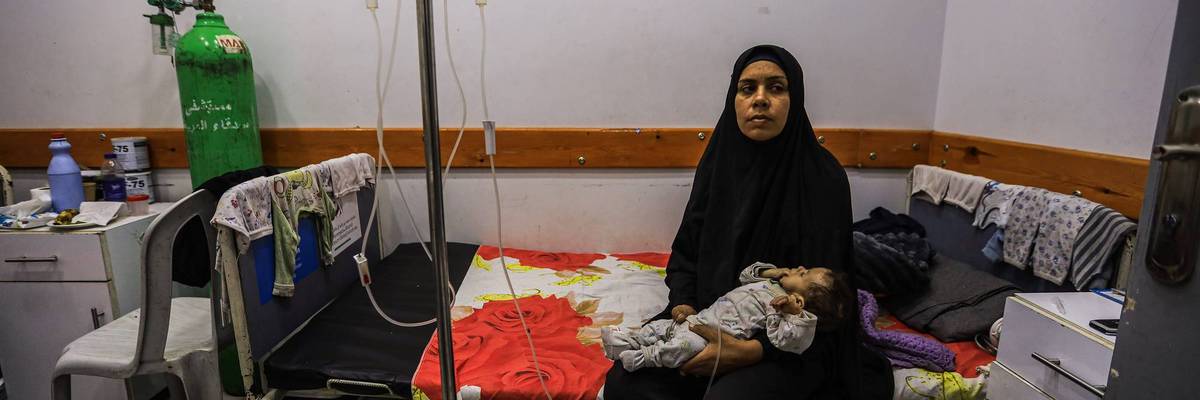
Palestinian children receive medical treatment at the Friends of Patients Hospital in Gaza City, Gaza on December 2, 2025.
Israel has not allowed the agreed-upon number of medical aid trucks into Gaza under October's ceasefire deal, and has yet to give approval to thousands of people on waiting lists to receive treatment elsewhere.
With the Israeli military having violated its "ceasefire" agreement with Hamas at least 875 times since it was finalized in October, and aid groups warning that everyone in Gaza remains at risk of starvation, the exclave's healthcare system desperately needs to treat people impacted by the ongoing humanitarian disaster—but medical experts there warn Israel's blockade has left many hospitals barely functioning.
On Tuesday, the director-general of Gaza’s Ministry of Health, Munir al-Barsh, told Al Jazeera that the healthcare system is suffering from "widespread shortages of medicines and medical supplies, particularly surgical consumables needed to perform operations."
The situation is "tragic and horrific," al-Barsh told the outlet.
After Israeli attacks on nearly all of Gaza's healthcare facilities during the war, 34 hospitals and 125 other health centers have been badly damaged. The health system has lost about 1,700 medical professionals who were killed by the Israel Defense Forces, and at least 80 doctors and other providers have been detained by Israel since 2023.
About 70% of the aid trucks that Israel has allowed into Gaza since October have carried food; the other 30% have brought in a variety of medical equipment, shelter supplies, tents, clothings, and other items. Israel is failing to allow in the agreed-upon number of medical aid trucks, Al Jazeera reported.
Earlier this month, al-Barsh told Al Jazeera that the medical supplies allowed in remain limited, with "antibiotics, IV solutions, and surgical materials" banned.
“We are facing a situation in which 54% of essential medicines are unavailable, and 40% of the drugs for surgeries and emergency care—the very medications we rely on to treat the wounded—are missing,” al-Barsh said.
Dr. Alaa Helles, director of pharmaceutical care at the Ministry of Health, also said Sunday that 52% of medications on an "essential list" were "zero stock."
Director of Pharmaceutical Care at the Palestinian Ministry of Health in Gaza, Dr. Alaa Helles, says there is a severe shortage of vital medications in Gaza. The highest it has been in two years. Israel is not allowing medicine into Gaza. pic.twitter.com/VuySKCAtkf
— Samira Mohyeddin سمیرا (@SMohyeddin) December 21, 2025
On Tuesday, al-Barsh added that three-quarters of the total supplies needed in hospitals are unavailable, while power outages and shortages of generators are making it nearly impossible for healthcare workers to help critically injured and ill people.
He said Israel must open border crossings both to allow more supplies in and to permit the transport of thousands of people who are on long waiting lists to receive treatment outside of Gaza.
Nearly 20,000 Palestinians in Gaza are on the lists, including 18,500 who have received approval from the World Health Organization but have yet to be referred by Israeli authorities for security approval. About 3,700 of those on waiting lists are in critical condition and about 4,300 are children, Al Jazeera reported.
Al-Barsh told the outlet that at least 1,156 patients have died while waiting for security clearance from Israel.
The director-general's comments came a day after the United Nations issued a similar warning about the thousands of people waiting for treatment outside of Gaza and the "destruction of health infrastructure" in the exclave.
The destruction of health infrastructure and severe shortages are exacerbating #Gaza’s health crisis. @WHO says more than 1,000 patients have died while waiting for medical evacuation from the enclave since July 2024. pic.twitter.com/8rbfhWsJeU
— UN News (@UN_News_Centre) December 22, 2025
"My daughter is ill and suffers from kidney failure," a mother named Balqees Abu Ajwa told the UN News Center. "The crossings are closed and medical supplies are scarce. The medical equipment that could help my daughter stay alive is not available. My daughter has been in this condition for 20 days. She is exhausted."
Dear Common Dreams reader, It’s been nearly 30 years since I co-founded Common Dreams with my late wife, Lina Newhouser. We had the radical notion that journalism should serve the public good, not corporate profits. It was clear to us from the outset what it would take to build such a project. No paid advertisements. No corporate sponsors. No millionaire publisher telling us what to think or do. Many people said we wouldn't last a year, but we proved those doubters wrong. Together with a tremendous team of journalists and dedicated staff, we built an independent media outlet free from the constraints of profits and corporate control. Our mission has always been simple: To inform. To inspire. To ignite change for the common good. Building Common Dreams was not easy. Our survival was never guaranteed. When you take on the most powerful forces—Wall Street greed, fossil fuel industry destruction, Big Tech lobbyists, and uber-rich oligarchs who have spent billions upon billions rigging the economy and democracy in their favor—the only bulwark you have is supporters who believe in your work. But here’s the urgent message from me today. It's never been this bad out there. And it's never been this hard to keep us going. At the very moment Common Dreams is most needed, the threats we face are intensifying. We need your support now more than ever. We don't accept corporate advertising and never will. We don't have a paywall because we don't think people should be blocked from critical news based on their ability to pay. Everything we do is funded by the donations of readers like you. When everyone does the little they can afford, we are strong. But if that support retreats or dries up, so do we. Will you donate now to make sure Common Dreams not only survives but thrives? —Craig Brown, Co-founder |
With the Israeli military having violated its "ceasefire" agreement with Hamas at least 875 times since it was finalized in October, and aid groups warning that everyone in Gaza remains at risk of starvation, the exclave's healthcare system desperately needs to treat people impacted by the ongoing humanitarian disaster—but medical experts there warn Israel's blockade has left many hospitals barely functioning.
On Tuesday, the director-general of Gaza’s Ministry of Health, Munir al-Barsh, told Al Jazeera that the healthcare system is suffering from "widespread shortages of medicines and medical supplies, particularly surgical consumables needed to perform operations."
The situation is "tragic and horrific," al-Barsh told the outlet.
After Israeli attacks on nearly all of Gaza's healthcare facilities during the war, 34 hospitals and 125 other health centers have been badly damaged. The health system has lost about 1,700 medical professionals who were killed by the Israel Defense Forces, and at least 80 doctors and other providers have been detained by Israel since 2023.
About 70% of the aid trucks that Israel has allowed into Gaza since October have carried food; the other 30% have brought in a variety of medical equipment, shelter supplies, tents, clothings, and other items. Israel is failing to allow in the agreed-upon number of medical aid trucks, Al Jazeera reported.
Earlier this month, al-Barsh told Al Jazeera that the medical supplies allowed in remain limited, with "antibiotics, IV solutions, and surgical materials" banned.
“We are facing a situation in which 54% of essential medicines are unavailable, and 40% of the drugs for surgeries and emergency care—the very medications we rely on to treat the wounded—are missing,” al-Barsh said.
Dr. Alaa Helles, director of pharmaceutical care at the Ministry of Health, also said Sunday that 52% of medications on an "essential list" were "zero stock."
Director of Pharmaceutical Care at the Palestinian Ministry of Health in Gaza, Dr. Alaa Helles, says there is a severe shortage of vital medications in Gaza. The highest it has been in two years. Israel is not allowing medicine into Gaza. pic.twitter.com/VuySKCAtkf
— Samira Mohyeddin سمیرا (@SMohyeddin) December 21, 2025
On Tuesday, al-Barsh added that three-quarters of the total supplies needed in hospitals are unavailable, while power outages and shortages of generators are making it nearly impossible for healthcare workers to help critically injured and ill people.
He said Israel must open border crossings both to allow more supplies in and to permit the transport of thousands of people who are on long waiting lists to receive treatment outside of Gaza.
Nearly 20,000 Palestinians in Gaza are on the lists, including 18,500 who have received approval from the World Health Organization but have yet to be referred by Israeli authorities for security approval. About 3,700 of those on waiting lists are in critical condition and about 4,300 are children, Al Jazeera reported.
Al-Barsh told the outlet that at least 1,156 patients have died while waiting for security clearance from Israel.
The director-general's comments came a day after the United Nations issued a similar warning about the thousands of people waiting for treatment outside of Gaza and the "destruction of health infrastructure" in the exclave.
The destruction of health infrastructure and severe shortages are exacerbating #Gaza’s health crisis. @WHO says more than 1,000 patients have died while waiting for medical evacuation from the enclave since July 2024. pic.twitter.com/8rbfhWsJeU
— UN News (@UN_News_Centre) December 22, 2025
"My daughter is ill and suffers from kidney failure," a mother named Balqees Abu Ajwa told the UN News Center. "The crossings are closed and medical supplies are scarce. The medical equipment that could help my daughter stay alive is not available. My daughter has been in this condition for 20 days. She is exhausted."
With the Israeli military having violated its "ceasefire" agreement with Hamas at least 875 times since it was finalized in October, and aid groups warning that everyone in Gaza remains at risk of starvation, the exclave's healthcare system desperately needs to treat people impacted by the ongoing humanitarian disaster—but medical experts there warn Israel's blockade has left many hospitals barely functioning.
On Tuesday, the director-general of Gaza’s Ministry of Health, Munir al-Barsh, told Al Jazeera that the healthcare system is suffering from "widespread shortages of medicines and medical supplies, particularly surgical consumables needed to perform operations."
The situation is "tragic and horrific," al-Barsh told the outlet.
After Israeli attacks on nearly all of Gaza's healthcare facilities during the war, 34 hospitals and 125 other health centers have been badly damaged. The health system has lost about 1,700 medical professionals who were killed by the Israel Defense Forces, and at least 80 doctors and other providers have been detained by Israel since 2023.
About 70% of the aid trucks that Israel has allowed into Gaza since October have carried food; the other 30% have brought in a variety of medical equipment, shelter supplies, tents, clothings, and other items. Israel is failing to allow in the agreed-upon number of medical aid trucks, Al Jazeera reported.
Earlier this month, al-Barsh told Al Jazeera that the medical supplies allowed in remain limited, with "antibiotics, IV solutions, and surgical materials" banned.
“We are facing a situation in which 54% of essential medicines are unavailable, and 40% of the drugs for surgeries and emergency care—the very medications we rely on to treat the wounded—are missing,” al-Barsh said.
Dr. Alaa Helles, director of pharmaceutical care at the Ministry of Health, also said Sunday that 52% of medications on an "essential list" were "zero stock."
Director of Pharmaceutical Care at the Palestinian Ministry of Health in Gaza, Dr. Alaa Helles, says there is a severe shortage of vital medications in Gaza. The highest it has been in two years. Israel is not allowing medicine into Gaza. pic.twitter.com/VuySKCAtkf
— Samira Mohyeddin سمیرا (@SMohyeddin) December 21, 2025
On Tuesday, al-Barsh added that three-quarters of the total supplies needed in hospitals are unavailable, while power outages and shortages of generators are making it nearly impossible for healthcare workers to help critically injured and ill people.
He said Israel must open border crossings both to allow more supplies in and to permit the transport of thousands of people who are on long waiting lists to receive treatment outside of Gaza.
Nearly 20,000 Palestinians in Gaza are on the lists, including 18,500 who have received approval from the World Health Organization but have yet to be referred by Israeli authorities for security approval. About 3,700 of those on waiting lists are in critical condition and about 4,300 are children, Al Jazeera reported.
Al-Barsh told the outlet that at least 1,156 patients have died while waiting for security clearance from Israel.
The director-general's comments came a day after the United Nations issued a similar warning about the thousands of people waiting for treatment outside of Gaza and the "destruction of health infrastructure" in the exclave.
The destruction of health infrastructure and severe shortages are exacerbating #Gaza’s health crisis. @WHO says more than 1,000 patients have died while waiting for medical evacuation from the enclave since July 2024. pic.twitter.com/8rbfhWsJeU
— UN News (@UN_News_Centre) December 22, 2025
"My daughter is ill and suffers from kidney failure," a mother named Balqees Abu Ajwa told the UN News Center. "The crossings are closed and medical supplies are scarce. The medical equipment that could help my daughter stay alive is not available. My daughter has been in this condition for 20 days. She is exhausted."