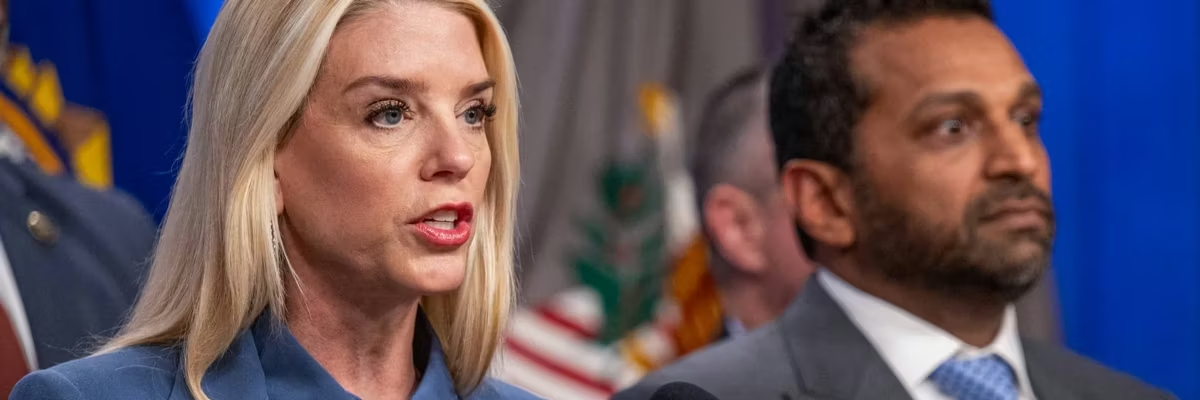
US Attorney General Pam Bondi speaks alongside FBI Director Kash Patel during a news conference at the Department of Justice in Washington, DC, on December 4, 2025.
Judge Blocks Trump Admin From Searching Data Seized During Raid on Reporter's Home
“The search and seizure of Washington Post reporter Hannah Natanson’s records is unconstitutional and illegal in its entirety," said one free press defender.
A US judge on Wednesday blocked federal prosecutors from searching data on a Washington Post reporter's electronic devices seized during what one press freedom group called an "unconstitutional and illegal" raid last week.
US Magistrate Judge William B. Porter in Alexandria, Virginia—who also authorized the January 14 raid of Post reporter Hannah Natanson's home—ruled that "the government must preserve but must not review any of the materials that law enforcement seized pursuant to search warrants the court issued."
The government has until January 28 to respond to the Post's initial legal filings against the agent's actions. Oral arguments in the case are scheduled for February 6.
Natanson—who describes her work as covering "Trump's reshaping of the government"—welcomed Wednesday's order.
"I need my devices back to do my job," she said on Bluesky.
Federal Bureau of Investigation investigators executed a warrant to search Natanson's Virginia home as part of a probe into Aurelio Perez-Lugones, a federal contractor who is accused of illegally possessing classified documents. FBI agents seized Natanson’s cellphone, her smart watch, and her personal and work laptops.
As Politico senior legal affairs reporter Kyle Cheney noted, the criminal complaint for Perez-Lugones’ case contains no allegations that he gave classified documents to any Post reporter, as implied by Attorney General Pam Bondi and FBI Director Kash Patel.
The Post said that the seized devices “contain years of information about past and current confidential sources and other unpublished newsgathering materials, including those she was using for current reporting."
“The government cannot meet its heavy burden to justify this intrusion, and it has ignored narrower, lawful alternatives,” the newspaper added.
As the Post noted Wednesday:
It is exceptionally rare for law enforcement officials to conduct searches at reporters’ homes. The law allows such searches, but federal regulations intended to protect a free press are designed to make it more difficult to use aggressive law enforcement tactics against reporters to obtain the identities of their sources...
The US has no law that explicitly makes it a crime for a journalist to obtain or publish classified information. In 2019, when WikiLeaks founder Julian Assange was indicted under the Espionage Act for disclosing classified information, First Amendment scholars warned that his case could set a precedent that could be used against journalists. That issue was never tested in court because Assange and the government reached a plea deal in 2024.
"The outrageous seizure of our reporter’s confidential newsgathering materials chills speech, cripples reporting, and inflicts irreparable harm every day the government keeps its hands on these materials,” the Post said in a statement. “We have asked the court to order the immediate return of all seized materials and prevent their use. Anything less would license future newsroom raids and normalize censorship by search warrant.”
Free press defenders cheered Porter's order.
“The search and seizure of Washington Post reporter Hannah Natanson’s records is unconstitutional and illegal in its entirety," Freedom of the Press Foundation chief of advocacy Seth Stern said in a statement. "But even the Trump administration’s policies require searches of journalists’ materials to be narrow and targeted and that authorities use filter teams and other measures to avoid searching protected records."
"That the administration wouldn’t follow its own guidelines shows that the raid on Natanson’s home wasn’t about any criminal investigation, and certainly wasn’t about national security," he added.
The search and seizure of @washingtonpost.com reporter @hannahnatanson.bsky.social's records is unconstitutional and illegal in its entirety.The judge was right to block it until a full hearing, at which time he should block it permanently.Read our statement: freedom.press/issues/judge...
[image or embed]
— Freedom of the Press Foundation (@freedom.press) January 21, 2026 at 2:30 PM
“This is the first time in US history that the government has searched a reporter’s home in a national security media leak investigation, seizing potentially a vast amount of confidential data and information," Reporters Committee for Freedom of the Press president Bruce Brown said in a statement. "The move imperils public interest reporting and will have ramifications far beyond this specific case."
Wednesday's order came two weeks after the Republican-controlled House Oversight Committee voted to subpoena Seth Harp, a journalist wrongly accused of “leaking classified intel” and “doxing” a US special forces commander involved in President Donald Trump’s invasion of Venezuela and abduction of the South American nation’s president and his wife.
We are at a crossroads
This country and this world are at a monumental crossroads. In a few short weeks, US voters will have an opportunity to beat back the forces of fascism and confront the billionaires who are rigging the economy, our media system, and our democracy, making it increasingly impossible for ordinary people to get by. We’re not just talking about the election. We’re talking about what must be done once these fascist elements are vanquished from power. We need a bolder set of solutions than what either major party has so far been willing to offer and a working-class movement ready to fight like hell for it. Trump didn't emerge from nowhere. The conditions that fueled MAGA authoritarianism were created by decades of radical neoliberal economic policies and a corrupt political system dominated by corporate interests. They slashed taxes on the super-rich, promising that the benefits would trickle down. They said giveaways to the corporate titans would make life more affordable for the rest of us. It was all bullshit. And when a bitter, betrayed populace searches for someone to blame, right-wing demagogues have little trouble finding scapegoats. People know when they're being lied to, but you won't hear any of this from the corporate media. Only independent journalism—powered and funded by people who believe in building a better world—can deliver truly trustworthy daily news. Our Fall Campaign is underway, and we need your help. To power our newsroom through the rest of the year, we need to raise $125,000 by midnight on October 31. So if you share our vision, please contribute whatever you can to sustain our work. |
A US judge on Wednesday blocked federal prosecutors from searching data on a Washington Post reporter's electronic devices seized during what one press freedom group called an "unconstitutional and illegal" raid last week.
US Magistrate Judge William B. Porter in Alexandria, Virginia—who also authorized the January 14 raid of Post reporter Hannah Natanson's home—ruled that "the government must preserve but must not review any of the materials that law enforcement seized pursuant to search warrants the court issued."
The government has until January 28 to respond to the Post's initial legal filings against the agent's actions. Oral arguments in the case are scheduled for February 6.
Natanson—who describes her work as covering "Trump's reshaping of the government"—welcomed Wednesday's order.
"I need my devices back to do my job," she said on Bluesky.
Federal Bureau of Investigation investigators executed a warrant to search Natanson's Virginia home as part of a probe into Aurelio Perez-Lugones, a federal contractor who is accused of illegally possessing classified documents. FBI agents seized Natanson’s cellphone, her smart watch, and her personal and work laptops.
As Politico senior legal affairs reporter Kyle Cheney noted, the criminal complaint for Perez-Lugones’ case contains no allegations that he gave classified documents to any Post reporter, as implied by Attorney General Pam Bondi and FBI Director Kash Patel.
The Post said that the seized devices “contain years of information about past and current confidential sources and other unpublished newsgathering materials, including those she was using for current reporting."
“The government cannot meet its heavy burden to justify this intrusion, and it has ignored narrower, lawful alternatives,” the newspaper added.
As the Post noted Wednesday:
It is exceptionally rare for law enforcement officials to conduct searches at reporters’ homes. The law allows such searches, but federal regulations intended to protect a free press are designed to make it more difficult to use aggressive law enforcement tactics against reporters to obtain the identities of their sources...
The US has no law that explicitly makes it a crime for a journalist to obtain or publish classified information. In 2019, when WikiLeaks founder Julian Assange was indicted under the Espionage Act for disclosing classified information, First Amendment scholars warned that his case could set a precedent that could be used against journalists. That issue was never tested in court because Assange and the government reached a plea deal in 2024.
"The outrageous seizure of our reporter’s confidential newsgathering materials chills speech, cripples reporting, and inflicts irreparable harm every day the government keeps its hands on these materials,” the Post said in a statement. “We have asked the court to order the immediate return of all seized materials and prevent their use. Anything less would license future newsroom raids and normalize censorship by search warrant.”
Free press defenders cheered Porter's order.
“The search and seizure of Washington Post reporter Hannah Natanson’s records is unconstitutional and illegal in its entirety," Freedom of the Press Foundation chief of advocacy Seth Stern said in a statement. "But even the Trump administration’s policies require searches of journalists’ materials to be narrow and targeted and that authorities use filter teams and other measures to avoid searching protected records."
"That the administration wouldn’t follow its own guidelines shows that the raid on Natanson’s home wasn’t about any criminal investigation, and certainly wasn’t about national security," he added.
The search and seizure of @washingtonpost.com reporter @hannahnatanson.bsky.social's records is unconstitutional and illegal in its entirety.The judge was right to block it until a full hearing, at which time he should block it permanently.Read our statement: freedom.press/issues/judge...
[image or embed]
— Freedom of the Press Foundation (@freedom.press) January 21, 2026 at 2:30 PM
“This is the first time in US history that the government has searched a reporter’s home in a national security media leak investigation, seizing potentially a vast amount of confidential data and information," Reporters Committee for Freedom of the Press president Bruce Brown said in a statement. "The move imperils public interest reporting and will have ramifications far beyond this specific case."
Wednesday's order came two weeks after the Republican-controlled House Oversight Committee voted to subpoena Seth Harp, a journalist wrongly accused of “leaking classified intel” and “doxing” a US special forces commander involved in President Donald Trump’s invasion of Venezuela and abduction of the South American nation’s president and his wife.
A US judge on Wednesday blocked federal prosecutors from searching data on a Washington Post reporter's electronic devices seized during what one press freedom group called an "unconstitutional and illegal" raid last week.
US Magistrate Judge William B. Porter in Alexandria, Virginia—who also authorized the January 14 raid of Post reporter Hannah Natanson's home—ruled that "the government must preserve but must not review any of the materials that law enforcement seized pursuant to search warrants the court issued."
The government has until January 28 to respond to the Post's initial legal filings against the agent's actions. Oral arguments in the case are scheduled for February 6.
Natanson—who describes her work as covering "Trump's reshaping of the government"—welcomed Wednesday's order.
"I need my devices back to do my job," she said on Bluesky.
Federal Bureau of Investigation investigators executed a warrant to search Natanson's Virginia home as part of a probe into Aurelio Perez-Lugones, a federal contractor who is accused of illegally possessing classified documents. FBI agents seized Natanson’s cellphone, her smart watch, and her personal and work laptops.
As Politico senior legal affairs reporter Kyle Cheney noted, the criminal complaint for Perez-Lugones’ case contains no allegations that he gave classified documents to any Post reporter, as implied by Attorney General Pam Bondi and FBI Director Kash Patel.
The Post said that the seized devices “contain years of information about past and current confidential sources and other unpublished newsgathering materials, including those she was using for current reporting."
“The government cannot meet its heavy burden to justify this intrusion, and it has ignored narrower, lawful alternatives,” the newspaper added.
As the Post noted Wednesday:
It is exceptionally rare for law enforcement officials to conduct searches at reporters’ homes. The law allows such searches, but federal regulations intended to protect a free press are designed to make it more difficult to use aggressive law enforcement tactics against reporters to obtain the identities of their sources...
The US has no law that explicitly makes it a crime for a journalist to obtain or publish classified information. In 2019, when WikiLeaks founder Julian Assange was indicted under the Espionage Act for disclosing classified information, First Amendment scholars warned that his case could set a precedent that could be used against journalists. That issue was never tested in court because Assange and the government reached a plea deal in 2024.
"The outrageous seizure of our reporter’s confidential newsgathering materials chills speech, cripples reporting, and inflicts irreparable harm every day the government keeps its hands on these materials,” the Post said in a statement. “We have asked the court to order the immediate return of all seized materials and prevent their use. Anything less would license future newsroom raids and normalize censorship by search warrant.”
Free press defenders cheered Porter's order.
“The search and seizure of Washington Post reporter Hannah Natanson’s records is unconstitutional and illegal in its entirety," Freedom of the Press Foundation chief of advocacy Seth Stern said in a statement. "But even the Trump administration’s policies require searches of journalists’ materials to be narrow and targeted and that authorities use filter teams and other measures to avoid searching protected records."
"That the administration wouldn’t follow its own guidelines shows that the raid on Natanson’s home wasn’t about any criminal investigation, and certainly wasn’t about national security," he added.
The search and seizure of @washingtonpost.com reporter @hannahnatanson.bsky.social's records is unconstitutional and illegal in its entirety.The judge was right to block it until a full hearing, at which time he should block it permanently.Read our statement: freedom.press/issues/judge...
[image or embed]
— Freedom of the Press Foundation (@freedom.press) January 21, 2026 at 2:30 PM
“This is the first time in US history that the government has searched a reporter’s home in a national security media leak investigation, seizing potentially a vast amount of confidential data and information," Reporters Committee for Freedom of the Press president Bruce Brown said in a statement. "The move imperils public interest reporting and will have ramifications far beyond this specific case."
Wednesday's order came two weeks after the Republican-controlled House Oversight Committee voted to subpoena Seth Harp, a journalist wrongly accused of “leaking classified intel” and “doxing” a US special forces commander involved in President Donald Trump’s invasion of Venezuela and abduction of the South American nation’s president and his wife.